The Beauty Trap of Looksmaxxing

On the surface, wanting to look your best doesn't sound particularly controversial. But looksmaxxing takes that idea a step further, suggesting there is an ideal version of your face waiting to be unlocked if you can simply identify what's wrong and fix it. As a facial plastic surgeon, that's where I start to have concerns.
Where the Desire to Change Actually Comes From
I see patients every day who want to change something about their appearance, and there is nothing inherently unhealthy about that. The question is where that desire comes from. Are you changing something you genuinely want to change, or have you been taught to see a perfectly normal feature as a flaw? For younger patients especially, that distinction is becoming harder to make.
I don't have to tell you that we're living in the age of the close-up. Through TikTok, Instagram, YouTube, and streaming, young people are exposed to faces constantly, often through cameras, lighting, and angles that bear little resemblance to real life. We've always had images of beautiful people to compare ourselves to, but we've never had an algorithm continuously serving us more of whatever aspect of our appearance we happen to be questioning, often enhanced by filters and AI. That constant exposure is changing what we consider normal, and ultimately, what we consider beautiful.
Why Attractiveness Isn't a Formula
Watch one video about jawlines, for example, and you can quickly find yourself in an online world where people are discussing facial ratios, chin projection, cheekbones, and symmetry as though attractiveness can be calculated. It can't.
When I evaluate a face for surgery, I'm looking at the relationship between all of the features. Proportion matters, but so do expression, movement, skin quality, and individuality. A face can be slightly asymmetrical and still be incredibly attractive. Some of the features people are now being taught to "correct" are exactly the things that give a face its character.
The Trend With No Finish Line
That's why I pay close attention when a younger patient comes in convinced that one specific feature is making them unattractive. The more time you spend online analyzing what makes a "good" jawline, nose, or cheekbone, the more likely you are to start analyzing your own face the same way. And with looksmaxxing, there is always another thing to fix. You sharpen the jawline, then the cheekbones, then the nose. There is always another perceived flaw and, ultimately, no real finish line.
I don't think the answer is to tell people they shouldn't care about their appearance, as feeling confident in how you look can be incredibly positive. But there is a meaningful difference between wanting to enhance a feature and believing your face is a problem that needs to be solved. As a facial plastic surgeon, I want to help patients look like the best version of themselves, not an algorithm's idea of what a face should be. The truth is that beauty has never been a formula, and we shouldn't let the internet convince us that it is.
Cosmetic Treatments
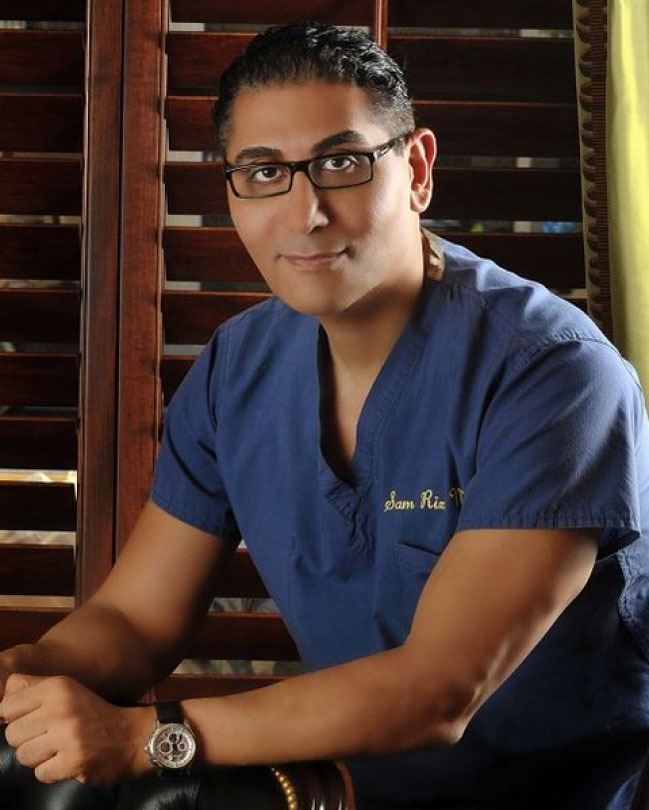
Sam RizkFacial Plastic Surgeon · Plastic Surgeon · Otolaryngologists & Facial Plastic Surgeons
Manhattan Facial Plastic Surgery
New York, NY
Articles are independently produced by the Haute Living editorial team. Featured physicians are members of the Haute MD Network — inclusion does not influence editorial coverage or rankings.