


When you’re searching for a top-tier doctor, it’s almost instinct to turn to familiar names. Yelp, the giant of local business reviews, inevitably pops up. It’s a massive library of crowd-sourced opinions, and its sheer search power means it’s often one of the first things you see when you Google a physician’s name. It has become an unavoidable part of the patient’s journey.
But this is where a critical problem emerges.
Can a platform designed to tell you where to find the best tacos and coffee shops genuinely assess the nuanced skill of a board-certified neurosurgeon? The answer is… complicated. The very design of crowd-sourcing creates a system where subjective feelings often drown out objective qualifications.
The Double-Edged Sword of Yelp Doctor Ratings
Yelp isn’t useless, but you have to understand what it’s actually measuring. It’s fantastic at capturing specific, non-clinical parts of the patient experience—things anyone can evaluate without a shred of medical knowledge.
Where Yelp Shines and Where It Fails
Yelp doctor ratings are a goldmine for information on things like:
- Office Atmosphere and Ambiance: Is the clinic clean, modern, and comfortable? Reviews will tell you.
- Front-Desk Service: You’ll learn quickly if the administrative staff is friendly and efficient or cold and disorganized.
- Wait Times and Punctuality: A long, frustrating wait is probably the #1 reason people leave a negative review.
- Bedside Manner: Patients are very good at describing a doctor’s warmth, communication style, and perceived empathy.
These things absolutely matter for a pleasant visit. No one wants to deal with a rude receptionist or wait an hour past their appointment time. But they tell you precisely nothing about a physician’s diagnostic accuracy, their surgical outcomes, or their expertise in complex conditions.
This is the central conflict of using Yelp for healthcare. It measures customer service satisfaction, not medical excellence. For patients seeking premier care in fields like executive health, longevity medicine, or highly specialized surgery, that distinction is everything.
The core issue is that Yelp’s algorithm treats a physician’s practice like any other business. It applies the same rating logic to a life-saving procedure as it does to a late pizza delivery, creating a distorted picture of what truly defines a high-quality doctor.
This guide will peel back the layers of Yelp’s system. We’ll dive into its hidden algorithm, unpack the psychological biases that drive patient reviews, and give you a clear framework for interpreting the information you find. Most importantly, we’ll show you why curated platforms that vet physicians based on actual expertise are a far more reliable path to finding the elite medical care you deserve.
How Yelp’s Rating Algorithm Actually Works
To make sense of Yelp doctor ratings, you first need to throw out the idea of simple math. A doctor’s star rating isn’t just a straightforward average of all their reviews. Instead, think of Yelp’s algorithm as a sophisticated—and often frustratingly opaque—”digital bouncer” for a VIP club.
This bouncer’s job is to decide which reviews get a prime spot on the main page (the “Recommended” ones) and which get shoved into a barely visible back room. Its decisions are driven by a complex set of rules designed to prioritize what it considers trustworthy content, but those rules can feel like a black box to patients and physicians alike.
This is exactly why a doctor with five glowing, highly detailed reviews might end up with a lower score than another doctor with ten mediocre but “trusted” ones. The algorithm’s judgment call, not the raw sentiment of every patient, is what ultimately sculpts the final star rating you see.
The Bouncer’s Checklist: What Yelp Prioritizes
Yelp’s algorithm is constantly chewing on dozens of signals to weigh the credibility of every single review. While the exact formula is a closely guarded secret, its filtering process heavily favors certain traits, effectively giving some voices a megaphone while others are barely a whisper.
Here are the key factors that get a review past the velvet rope:
- Reviewer Activity: A review from a seasoned “Yelp Elite” with hundreds of check-ins, a fleshed-out profile, and a long history carries far more weight than one from a brand-new account with no photo or friends. To the algorithm, the first-time poster just isn’t as reliable.
- Review Quality and Detail: A thoughtful, multi-paragraph review that describes specific aspects of the patient experience is valued much more than a single sentence like “Great doctor!” or “Horrible wait time.” Specificity signals authenticity to the system.
- User Engagement: When other users mark a review as “Useful,” “Funny,” or “Cool,” it gets a serious credibility boost. This social proof tells the algorithm that the community finds the review valuable, cranking up its influence on the overall score.
This system creates a feedback loop of perception and uncertainty, as this flowchart illustrates.
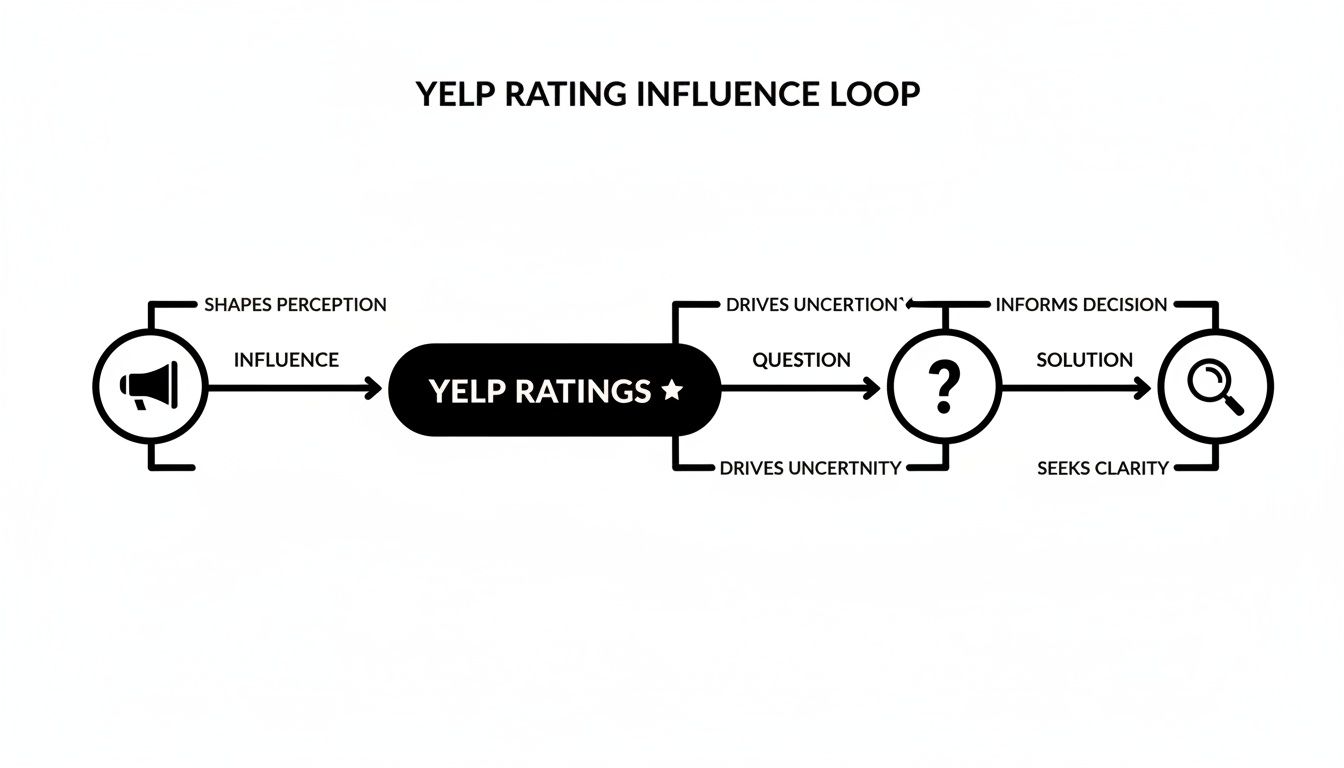
The visualization shows how this cycle of questionable ratings and perceived influence creates a loop of uncertainty for patients trying to make critical healthcare choices.
The Filter’s Impact on Medical Ratings
The implications for medical professionals are massive. A single negative review from an established Yelper can crater a doctor’s score, while a dozen positive reviews from new patients might get filtered out and hidden from sight entirely. It’s an automated system designed for restaurants and retail that simply struggles with the nuances of healthcare.
For instance, a patient might create a Yelp account for the sole purpose of posting about a single negative experience. To the algorithm, this user has zero history and low credibility, so their review often gets filtered. While this can shield doctors from baseless attacks, it also risks silencing legitimate patient feedback, creating a distorted picture of the practice.
The core takeaway is that a Yelp rating is not a pure reflection of patient satisfaction. It’s a curated score, shaped by an algorithm that prioritizes a reviewer’s history far more than the actual content of their review.
This curation is particularly problematic in healthcare. Yelp has become one of the largest hubs of physician feedback in the U.S., with over 1.2 million reviews by 2023. Yet, studies show that while 68% of these reviews focus on non-clinical issues like communication and wait times, only about 15% come from verified patients. This leaves scores wide open to bias and volatility. This reality highlights the fundamental mismatch between a crowd-sourced platform and the need for reliable, expertise-based medical evaluation. You can discover more insights about doctor ratings on WebMD.com.
The Patient’s Dilemma: Interpreting Reviews and Biases
Trying to find a top-tier doctor on Yelp can feel like searching for a Michelin-starred chef in a shopping mall food court. You’re hit with a dizzying volume of opinions, but the loudest voices are rarely the most qualified. For any discerning patient, the first step is to understand the powerful psychological currents that shape what you’re reading.
Simply put, what you see isn’t always what you get. A doctor’s star rating is often less a reflection of their medical skill and more a snapshot of raw human emotion, heavily filtered through predictable cognitive biases.

Decoding the Psychology of Patient Reviews
Two powerful forces are constantly at play in the world of online reviews: negativity bias and the intense focus on non-clinical factors. These biases create a huge gap between what a patient feels during their visit and what a doctor actually knows.
Negativity bias is hardwired into our brains; we naturally give far more weight to negative experiences than positive ones. A frustrating 45-minute wait or a curt remark from a receptionist can trigger a much stronger emotional reaction than a perfectly routine, successful appointment ever could.
This means a patient who had a single bad moment is far more motivated to log on and write a detailed, emotionally charged takedown than the 50 other patients that same day who had a perfectly fine experience and went on with their lives. The result is a skewed sample size where a few negative voices can easily drown out a silent, satisfied majority.
On top of that, most patients simply don’t have the background to judge a doctor’s clinical expertise. So, they naturally focus on what they can evaluate. This leads to reviews that are overwhelmingly centered on subjective, non-clinical elements.
- Front Desk Friendliness: Was the check-in process smooth and welcoming?
- Office Aesthetics: Is the waiting room modern and comfortable?
- Bedside Manner: Did the doctor seem empathetic and listen well?
While these things matter, they are essentially proxies for quality, not direct measures of it. A patient might leave a 1-star rating because of a billing dispute, completely overshadowing the fact that the physician provided a life-changing diagnosis.
A Practical Framework for Analyzing Yelp Reviews
To become a more critical consumer of Yelp doctor ratings, you need a system for filtering out the noise. Instead of taking star ratings at face value, use this framework to read between the lines and pull out what’s actually useful.
- Look for Patterns, Not Outliers: Ignore the single, enraged 1-star review and the glowing, perfect 5-star one. Instead, search for consistent themes across multiple reviews. If ten different people mention disorganized scheduling over a two-year period, it’s likely a real operational issue.
- Assess the Reviewer’s Credibility: Just as Yelp’s algorithm does, you should consider the source. Is the review from a brand-new account created just to post one scathing comment? Or is it from an established user who has reviewed dozens of other local businesses with thoughtful commentary?
- Differentiate Legitimate Concerns from Subjective Complaints: A review detailing how a doctor repeatedly dismissed a patient’s symptoms points to a serious clinical concern. A review complaining about the cost of parking or the style of the office art is purely subjective and has zero bearing on medical outcomes.
By focusing on recurring themes and the context of the feedback, you can start to build a more accurate picture. The goal isn’t to find a doctor with a perfect score but to understand the real strengths and weaknesses of their practice as described by multiple sources over time.
This critical approach is essential because what Yelp measures often has little to do with what defines truly elite medical care. A crowd-sourced platform just isn’t built to evaluate the credentials that matter for complex health needs.
Yelp Reviews vs. Elite Medical Criteria: A Comparison
The table below breaks down the stark difference between what a typical Yelp review focuses on and the rigorous qualifications that define a top-tier medical specialist.
| Evaluation Criteria | Focus in Yelp Reviews | Focus for Elite Specialists (Haute MD Criteria) |
|---|---|---|
| Credentials | Rarely mentioned or verified. | Board certifications, fellowship training, and academic appointments are mandatory. |
| Expertise | Based on “bedside manner” and patient feeling. | Measured by surgical outcomes, patient success rates, and contributions to medical research. |
| Technology | Focus on superficial elements like office decor or website design. | Emphasis on access to advanced diagnostic tools, innovative treatment protocols, and cutting-edge technology. |
| Peer Recognition | Not a factor in the rating. | Based on leadership roles in professional societies, peer-reviewed publications, and industry accolades. |
Ultimately, interpreting Yelp doctor ratings requires you to act more like a detective than a casual browser. You have to actively hunt for clues, weigh the evidence, and understand the inherent biases of your sources. While it can offer surface-level insights, it’s a fundamentally limited tool for anyone seeking truly exceptional medical expertise.
A Physician’s Guide to Managing Your Yelp Reputation
For an elite physician, a negative Yelp presence can feel like a direct threat to a brand you’ve spent decades building. It’s a frustrating reality. The platform’s algorithm, which rewards consumer-centric metrics over clinical excellence, often puts the most skilled practitioners at a distinct disadvantage.
But hoping bad reviews just go away isn’t a strategy. Passively waiting for things to change is a surefire way to lose control of your digital narrative. You need a proactive approach.
Managing your Yelp profile requires a sophisticated understanding of the platform’s rules and, more importantly, its limitations. This isn’t about trying to game the system. It’s about implementing a professional, ethical, and legally sound strategy to protect your reputation and attract the kind of discerning patients you want to serve.
Ethically Encouraging Patient Feedback
Let’s be clear: Yelp’s terms of service strictly forbid soliciting reviews. You can’t ask patients to write a review, offer them an incentive, or run a campaign designed to inflate your star rating. Trying to bend these rules is a mistake. Violating them can trigger public shaming alerts on your profile or get your positive reviews suppressed, causing far more damage than doing nothing at all.
So, how do you ethically encourage feedback? The trick is to shift your mindset from “asking for a review” to “gathering feedback.” You want to create an environment where your happiest patients feel naturally inspired to share their positive experiences.
Here are a few subtle, Yelp-compliant ways to do this:
- In-Office Signage: A small, professional sign at your checkout desk that simply says, “Find us on Yelp” or “Check us out on Yelp” is perfectly acceptable. It’s a gentle reminder that your practice is on the platform, without ever asking for anything.
- Email Signatures and Newsletters: Including a simple “Find us on Yelp” link in the footer of your patient communications is another low-pressure tactic. It gives patients who are already engaged with your practice an easy way to find your profile.
- Post-Appointment Surveys: Use internal feedback systems to check in on patient satisfaction. When a patient gives you glowing private feedback, that positive sentiment often translates into a public review later on, completely organically.
The goal is to simply make your Yelp presence known. That’s it. This approach honors Yelp’s policies while still paving the way for organic feedback from your best patients.
A strong digital reputation is not built on Yelp alone. It’s the product of a well-rounded strategy that includes your professional website, peer recognition, and presence on trusted, curated platforms. This diverse digital footprint provides a powerful counterbalance to the volatility of any single review site.
Crafting Professional Responses to Negative Reviews
Think of a negative review not as a complaint, but as a public relations event. How you respond says just as much about your practice’s professionalism as the original review does about one person’s experience. A calm, strategic, and thoughtful response can completely neutralize a negative comment—and might even win over prospective patients who are watching how you handle criticism.
When you respond, stick to these critical principles:
- Acknowledge, Don’t Argue: Your first move is to thank the reviewer for their feedback and acknowledge their frustration. Never, ever get into a public debate or try to tell them their experience was wrong.
- Maintain HIPAA Compliance: This is absolutely non-negotiable. Do not confirm the person was a patient or disclose any Protected Health Information (PHI). Your response must remain general and hypothetical.
- Take the Conversation Offline: The ultimate goal is to move the discussion out of the public square. Provide a direct point of contact, like an office manager’s name and phone number, and invite them to discuss their concerns privately.
Here’s an example of a professional, HIPAA-compliant response:
“Thank you for sharing your feedback. We are committed to providing an exceptional experience for everyone who walks through our doors, and we take all comments seriously. We would appreciate the opportunity to discuss your concerns directly. Please contact our practice manager, Jane Smith, at your convenience.”
This response is professional and non-confrontational. It shows you’re committed to patient satisfaction without violating any privacy laws. For a deeper dive, check out our complete guide to online reputation management for doctors, which details more advanced strategies. By controlling the narrative professionally, you reinforce your brand’s unwavering commitment to quality and care.
Beyond the Stars: Why Curated Platforms Are the Future
After navigating the wild west of Yelp doctor ratings, with its baffling algorithm and emotional biases, a serious question remains for any discerning patient: Where do you actually turn for reliable, expertise-driven recommendations? The answer isn’t about finding a better review site—it’s about abandoning the crowd-sourced model altogether for a curated, expert-vetted approach.
This is where specialized networks completely change the game. Instead of an open-for-all platform where anyone can hang a shingle, these are exclusive ecosystems built on a foundation of professional verification and proven excellence. They operate less like a massive online food court and more like a Michelin Guide for medicine.
Think of it this way. A food court lists every possible option, from fast-food chains to mystery vendors, leaving you to guess which one offers a truly exceptional meal. The Michelin Guide, on the other hand, only features restaurants that have passed a rigorous, anonymous inspection process based on objective quality, technique, and consistency. One offers volume; the other guarantees a standard of excellence.
The Power of a Rigorous Vetting Process
Curated medical platforms apply this same principle to healthcare. Instead of just letting anyone be listed and rated, they act as a filter, pre-qualifying physicians to ensure only the most accomplished professionals make the cut. For a platform like Haute MD, this isn’t a superficial background check; it’s a deep, multi-point evaluation.
This rigorous vetting process typically includes:
- Verifying Board Certifications: This is the absolute baseline, ensuring a physician has met the highest standards of training and knowledge in their specialty.
- Reviewing Clinical Outcomes: The focus shifts from subjective patient feelings about wait times to objective results, like success rates for specific procedures or long-term patient health improvements.
- Assessing Contributions to the Field: Top physicians are often leaders who publish research, teach at medical schools, or pioneer new techniques. These activities demonstrate a deep commitment to advancing medicine.
- Evaluating Peer Recognition: A doctor’s reputation among their own colleagues is a powerful, often overlooked, indicator of their true skill and professionalism.
This meticulous screening process directly fixes the core weaknesses of Yelp. It replaces subjective gripes about office decor with objective proof of medical expertise, building a network on trust and credibility from the ground up. You can explore more about what sets these high-touch medical services apart in our guide to boutique medical practices and personal care.
The fundamental value of a curated network is that the hard work of verification has already been done for you. It provides a pre-qualified pool of elite providers, saving you from the guesswork and uncertainty of interpreting crowd-sourced ratings.
Restoring Trust and Ensuring Quality
For patients seeking the best care in demanding fields like dermatology, longevity medicine, or executive health, this level of assurance is non-negotiable. These specialties require not just a competent doctor, but a true leader in their field—someone with access to the latest technology and a profound understanding of advanced treatment protocols.
Platforms like Yelp simply can’t measure these critical qualifications. Their algorithm is built to rank businesses on popularity and reviewer activity, not clinical acumen. A doctor could have pioneering surgical skills but get a poor rating because of a billing misunderstanding.
A curated network, conversely, aligns its criteria with what actually drives exceptional health outcomes. It prioritizes the qualifications that define a top-tier physician, giving patients a direct and reliable path to the best in the business. This model cuts through the noise of subjective stars and puts the focus back where it always should have been: on proven medical excellence.
How Haute MD Connects Patients with Vetted Experts
Sifting through Yelp doctor ratings can feel like a high-stakes gamble, especially when your health is on the line. But what if there was a better way? Curated networks like Haute MD offer a definitive alternative—one built on proven expertise, not just popular opinion. Instead of leaving you to decode biased reviews and confusing algorithms, Haute MD provides a direct line to the nation’s top medical professionals, every one of whom has already passed a rigorous verification process.
This completely shifts the search from a game of chance to a matter of professional assurance. The platform acts as your trusted concierge, presenting a pre-qualified roster of elite specialists. This allows you to focus on what really matters: finding the right personality and approach for your needs, confident that the baseline of medical excellence is already guaranteed.

Finding Your Specialist with Confidence
For the discerning patient, the entire experience is designed for clarity and ease. You can search for leading physicians by their specialty and location, gaining immediate access to a network organized around the key pillars of premier healthcare.
The Haute MD network is built on several core pillars, including:
- Aesthetic & Longevity Medicine: Connecting patients with innovators in advanced dermatology, hormone optimization, and preventive wellness.
- Executive Health & Concierge Care: Providing access to physicians who deliver personalized, high-touch medical management for busy professionals.
- Elite Surgical Specialists: Highlighting surgeons celebrated for their exceptional outcomes in demanding fields like orthopedics and neurosurgery.
Forget ambiguous star ratings. Each doctor’s profile features in-depth interviews and articles that let you truly understand their philosophy, their approach to patient care, and their expertise in specific advanced treatments. It’s a level of insight that a crowd-sourced review could never hope to provide. You can learn more by exploring our detailed guide on ways to find top-rated physicians near you.
The Haute MD network is powered by Haute Living, a nationally recognized luxury media brand. This established credibility gives both patients and doctors a shared seal of trust, ensuring every connection is built on a foundation of proven excellence.
The Benefits for Patients and Physicians
This curated ecosystem creates a powerful, symbiotic relationship that benefits everyone involved. Patients gain peace of mind and direct access to a level of medical talent that is incredibly difficult to find through conventional search methods. The uncertainty of interpreting Yelp doctor ratings is replaced with the confidence of choosing from a vetted list of the absolute best.
For physicians, joining the Haute MD network offers unparalleled visibility and prestige. It places them directly in front of a discerning audience actively seeking premium, outcome-driven care. This allows them to build their practice with the right patient demographic while reinforcing their status as a leader in their field. It’s a seamless, reliable, and elevated experience for finding premier medical care within a trusted, curated environment.
Frequently Asked Questions About Doctor Ratings
When you’re trying to vet a doctor online, a few key questions always seem to pop up. Here are the straight-up answers to the most common queries people have when looking at platforms like Yelp.
Can Doctors Just Delete Bad Yelp Reviews?
This is the big one, and the answer is a hard no. A physician can’t simply scrub a negative review from their Yelp profile because they didn’t like what a patient had to say. Yelp’s entire model is built on user-generated feedback, and they have policies in place to stop business owners from censoring it.
Now, there is one thing a doctor can do: flag a review that breaks Yelp’s rules. If a review contains hate speech, is completely irrelevant to the patient experience, or shows a clear conflict of interest, Yelp’s own moderators might take it down.
But the final call belongs to Yelp, not the doctor. This means a legitimate, honest, and negative review about a genuine patient experience is almost certainly going to stay put.
How Much Should I Worry About a Single 1-Star Review?
A single, scathing 1-star review should be taken with a grain of salt. While it might represent a truly terrible experience for one person, it’s just one piece of the puzzle. The key is to look for patterns, not get sidetracked by one-off rants.
A lone 1-star review often says more about the reviewer’s emotional state or a single bad day than it does about the doctor’s overall clinical skill. Before giving it significant weight, read several other reviews to see if the complaint is a recurring theme or an isolated incident.
If you see multiple reviews over several months—or even years—all pointing to the same problem, like constant billing mix-ups or a consistently dismissive attitude, then you’ve found a credible pattern. If not, it’s best to treat that outlier for what it is.
What Else Should I Look at Besides Yelp?
Yelp should be one small tool in a much larger toolkit. When it comes to choosing a specialist, especially for something serious, you need to prioritize objective qualifications over crowdsourced opinions.
Focus on the credentials that actually define a doctor’s expertise:
- Board Certifications: Is the physician board-certified in their specific field? This is non-negotiable.
- Fellowship Training: Did they pursue advanced, specialized training after their residency? This signals a deeper level of expertise.
- Hospital Affiliations: Are they connected with top-tier, reputable medical centers?
- Peer-Reviewed Publications: Have they contributed to medical research? This shows they’re at the forefront of their field.
At the end of the day, a platform that vets doctors based on these expert criteria will give you a far more reliable picture of their abilities than Yelp doctor ratings ever could.
Finding a physician you can trust shouldn’t feel like a gamble. Haute MD provides direct access to a curated network of the nation’s most respected, board-certified specialists, all vetted for their clinical excellence and patient outcomes. Explore the Haute MD Network to connect with a premier doctor today.