


Interventional pain management is a highly specialized field dedicated to diagnosing and treating pain right at its source. Using advanced, minimally invasive techniques, specialists in this area aim to provide lasting relief without relying on major surgery or a long-term dependence on oral medications. The goal is simple: help patients get their lives back.
A Precision Approach to Pain Relief
Think of your body’s nervous system as the intricate electrical grid of a city. When you experience chronic pain, it’s like a single faulty transformer—a specific nerve—is malfunctioning, sending out constant distress signals that disrupt everything.
A traditional approach might try to solve this by dimming the power across the entire city with oral pain medication. While it might lower the noise, it affects everything else, causing widespread side effects without ever fixing the actual problem. It just masks the issue.
Interventional pain management is entirely different. It’s like sending in a master electrician who pinpoints that one faulty transformer and repairs or quiets it directly. This targeted strategy is the heart of the discipline. Instead of dulling your entire system, it focuses on interrupting the pain signal at its origin.
This isn’t about a temporary fix. It’s about a definitive, restorative solution. By identifying the precise “pain generator,” your physician can deliver treatments that not only reduce your pain but restore your ability to live your life and get back to the activities you love.
Interventional vs Traditional Pain Management At a Glance
The philosophy here is what truly sets interventional pain management apart. While traditional methods often focus on managing symptoms, the interventional approach is both diagnostic and therapeutic—it’s designed to both find and fix the root cause of the pain.
This move toward targeted, minimally invasive therapies isn’t just a passing trend; it’s a direct response to the growing demand for better, more durable solutions. Patients are increasingly seeking out specialists who can deliver precision care that can reduce pain by up to 70% for certain conditions. The global market for these techniques is expanding rapidly as more people discover the power of this approach.
To make the distinction crystal clear, here’s a quick side-by-side comparison:
| Attribute | Interventional Pain Management (IPM) | Traditional Pain Management |
|---|---|---|
| Focus | Diagnosing and treating the source of pain | Managing or suppressing symptoms |
| Methods | Minimally invasive, image-guided procedures | Primarily oral medications, physical therapy |
| Goal | Lasting relief and functional restoration | Symptom control and improved coping |
| Precision | Highly targeted to specific nerves or structures | Systemic, affecting the entire body |
| Patient Role | Active participant in a targeted treatment plan | Passive recipient of symptom management |
Ultimately, this modern framework reframes your journey from one of passively managing symptoms to actively pursuing and achieving lasting, targeted relief.
The Arsenal of Interventional Pain Treatments
To really understand what interventional pain management is, you have to look at the sophisticated tools in its toolkit. This isn’t a one-size-fits-all field. It’s a collection of highly specific procedures, each designed to attack pain from a different angle. A specialist’s job is to select the right tool for the right job, ensuring the treatment perfectly matches the source of your discomfort.
Think of your interventional pain physician as a master locksmith. They don’t just jiggle the lock or try to force it open. They study the unique mechanism of your pain and then craft a specific key—the procedure—to unlock lasting relief.
This is the core philosophy of this targeted approach.
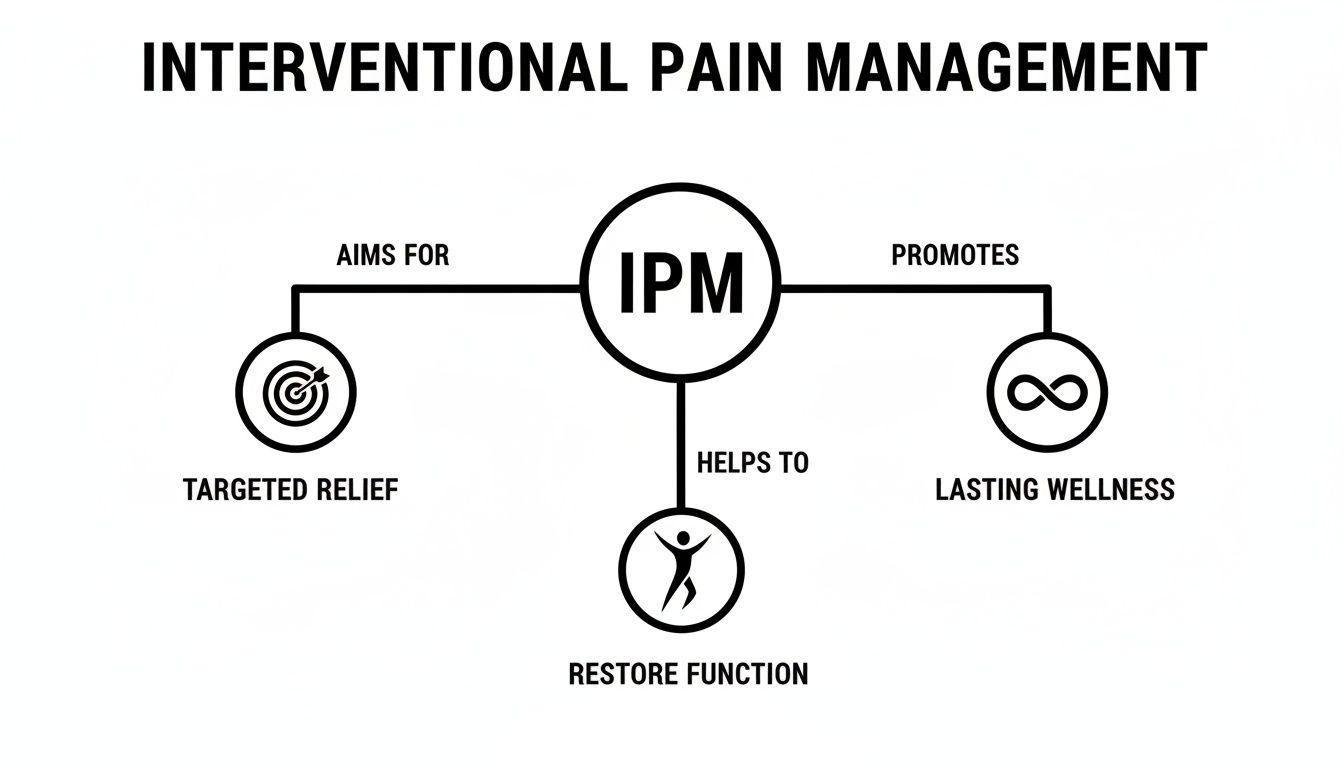
As you can see, every treatment is designed to precisely target the pain generator. The goal is to restore your ability to function and provide a sense of wellness that goes far beyond just masking symptoms.
Targeted Injections for Inflammation and Diagnosis
One of the most common categories of treatment involves injections guided with pinpoint accuracy. These aren’t just random shots in the dark. They are delivered using imaging like fluoroscopy (a type of real-time X-ray) or ultrasound to ensure the medication hits the exact spot where the problem lies.
Two main types of injections serve distinct but crucial purposes:
- Epidural Steroid Injections: If you’ve ever had radiating nerve pain from sciatica or a herniated disc, this is a go-to procedure. A powerful anti-inflammatory medication (a corticosteroid) is delivered directly into the epidural space surrounding the spinal nerves. This calms the swelling and irritation, easing the pain that travels down your arm or leg.
- Nerve Blocks: This is where a local anesthetic, sometimes paired with a steroid, is injected around a specific nerve or group of nerves. This serves two functions. First, it provides immediate therapeutic pain relief. Second, it’s a powerful diagnostic tool. If the pain vanishes after the block, it confirms we’ve found the nerve causing the problem, which is invaluable for planning long-term treatment.
These injections are often the first line of defense, providing significant relief while helping your specialist gather critical diagnostic clues. They are minimally invasive procedures, usually done in an outpatient setting, allowing you to get back to your life quickly.
Deactivating Pain Signals with Precision Heat
What about chronic pain coming from arthritic joints in the spine (facet joints) or the sacroiliac (SI) joints? For that, a more durable solution is often needed. When diagnostic nerve blocks confirm the source of the pain, your physician might recommend a procedure designed for longer-lasting results.
This is where Radiofrequency Ablation (RFA), also called a rhizotomy, comes into play.
Think of a nerve causing chronic pain as a faulty fire alarm that’s constantly blaring for no reason. RFA doesn’t just muffle the sound; it carefully deactivates the alarm’s wiring right at the source, silencing the false signal without damaging the surrounding structure.
During an RFA procedure, a specialized needle is placed alongside the problematic nerve using image guidance. A gentle radiofrequency current passes through the needle, creating a small, precise heat lesion on the nerve. This interrupts its ability to send pain signals to the brain.
The nerves do eventually grow back, but the relief from RFA can last anywhere from nine months to over two years, offering a huge window of improved function and quality of life.
Advanced Neuromodulation for Complex Pain
So what happens when the pain signals are too widespread or complex for a block or ablation to handle? For tough conditions like persistent pain after back surgery or Complex Regional Pain Syndrome (CRPS), specialists turn to a remarkable field called neuromodulation.
Neuromodulation works by altering nerve activity directly at the source. Instead of destroying the nerve, it uses technology to modify or mask the pain signals before they can even reach the brain.
Two leading neuromodulation therapies include:
- Spinal Cord Stimulation (SCS): This involves implanting a small device, much like a pacemaker, that sends mild electrical impulses to the spinal cord through thin wires called leads. These impulses essentially run interference on the pain signals, scrambling them and replacing the feeling of pain with a more pleasant tingling or, with newer systems, no sensation at all.
- Dorsal Root Ganglion (DRG) Stimulation: This is a hyper-targeted form of neuromodulation that focuses on a specific bundle of sensory nerves connected to the spinal cord. It’s incredibly effective for treating isolated, chronic pain in areas like the foot, knee, or groin that haven’t responded to anything else.
The best part? Before any device is permanently implanted, patients go through a trial period with temporary leads. This lets you and your doctor see exactly how effective the therapy will be, making sure it’s the right move for you. Neuromodulation offers real hope for many who felt they had run out of options.
Who Is a Candidate for This Approach?

Figuring out if interventional pain management is right for you goes beyond a simple diagnosis. It’s really about understanding your personal pain journey and recognizing when conventional treatments have hit a wall. This advanced field is often the perfect next step, but it’s for a specific kind of patient.
Typically, the ideal candidate is someone who feels stuck. You’ve probably done everything by the book—attended every physical therapy session, tried various medications, and followed all the initial advice—but the chronic pain just won’t quit, and it’s still running your life.
This approach is especially powerful for people who need a solution that’s more aggressive than pills but less invasive than major surgery. It fills that crucial gap between medication management and a significant operation. Many patients are also looking for a way to cut back on opioids and escape their systemic side effects.
Pinpointing the Ideal Patient Profile
While every situation is different, there are a few common threads among those who get the most out of interventional techniques. It always starts with a thorough diagnostic workup. Without a precise diagnosis that pinpoints the source of your pain, any treatment is just a shot in the dark.
An excellent candidate for an interventional procedure often has:
- A Clear Diagnostic Target: Advanced imaging and diagnostic injections have successfully identified a specific nerve, joint, or disc as the “pain generator.” This allows for a laser-focused treatment.
- Pain Unresponsive to Conservative Care: You’ve given treatments like anti-inflammatory drugs, physical therapy, or chiropractic care a fair shot—usually for at least six weeks—with little to no lasting relief.
- A Desire to Avoid or Delay Surgery: Maybe you’re looking for a less invasive alternative to a spinal fusion or joint replacement. Or perhaps you aren’t a good candidate for a major operation due to other health issues.
The core principle here is identifying the pain generator. When pain is localized and can be traced to a specific anatomical source, interventional procedures are most effective. This precision is what separates it from generalized, systemic treatments.
Common Conditions That Respond Well
Interventional specialists handle a huge range of pain disorders, but the key is that the pain has to come from a treatable source. If your discomfort stems from one of the following conditions and hasn’t improved with standard care, you could be a great candidate.
Some of the most frequently treated conditions include:
- Chronic Back and Neck Pain: This is often rooted in issues like facet joint arthritis, degenerative disc disease, or sacroiliac (SI) joint dysfunction.
- Sciatica and Radiculopathy: This is that classic radiating nerve pain—shooting from the lower back down a leg or from the neck down an arm—usually caused by a herniated disc or spinal stenosis.
- Persistent Post-Surgical Pain: Sometimes called “failed back surgery syndrome,” this is when pain lingers long after a spinal operation should have healed.
- Complex Regional Pain Syndrome (CRPS): A very challenging condition that causes severe, chronic pain, typically in an arm or a leg.
- Peripheral Neuropathy: Nerve damage that leads to persistent burning, tingling, or numbness, especially in the hands and feet.
If any of this sounds familiar, understanding what an orthopedic surgeon specializes in can give you more context on the surgical alternatives that these techniques often help people avoid. The ultimate goal is always to get you back to your life with the least invasive, most targeted method possible.
Your Patient Journey: From Evaluation to Recovery
Stepping into a new treatment path can feel uncertain. But the journey through interventional pain management isn’t a maze—it’s a structured, logical process designed entirely around you. Think of it as a well-marked trail with clear stages, from the initial consultation all the way to your full recovery.
Understanding this roadmap is key to setting realistic expectations and feeling confident in the process. The entire experience is built on precision and comfort, moving methodically from finding the source of your pain to fixing it. Let’s walk through exactly what you can expect.
The Comprehensive Evaluation: Pinpointing the Problem
Your journey doesn’t start with a procedure; it starts with a conversation. The first step is a thorough diagnostic evaluation where your specialist acts like a detective, gathering clues to pinpoint the exact source of your pain. This is, without a doubt, the most critical phase. An accurate diagnosis is the foundation for a successful outcome.
This evaluation usually involves a few key components:
- A Detailed Medical History: You’ll discuss your symptoms in depth—when the pain started, what makes it better or worse, and which treatments you’ve already tried.
- A Physical Examination: Your physician will assess your range of motion, strength, and reflexes, using specific movements to identify which structures might be involved.
- Advanced Diagnostic Imaging: While not always required, an MRI or CT scan can provide a detailed picture of your spine and joints, revealing issues like herniated discs or arthritis.
- Diagnostic Injections: Sometimes, the final confirmation comes from a diagnostic nerve block. By temporarily numbing a specific nerve, your doctor can confirm if it’s the true pain generator. If the pain vanishes, they’ve found the culprit.
The goal here is absolute clarity. A top interventional specialist will not proceed with a therapeutic treatment until they are confident they know exactly what anatomical structure is causing your pain. This “diagnosis-first” commitment is a hallmark of high-quality care.
The Procedure: A Focus on Comfort and Precision
Once the pain generator has been identified, the procedure itself is scheduled. The vast majority of interventional pain treatments are performed in a comfortable outpatient setting. This is great news—it means you arrive and go home on the same day, completely avoiding a hospital stay.
During the procedure, your comfort and safety are the top priorities. A local anesthetic is used to numb the skin and tissues at the treatment site, so you’ll feel some pressure but no sharp pain. For many procedures, a light sedation, often called “twilight sleep,” is also given to help you stay relaxed and comfortable from start to finish.
Your physician will use advanced imaging like fluoroscopy (a real-time X-ray) or ultrasound to navigate specialized needles or instruments to the precise target. This image-guided approach ensures accuracy down to the millimeter, which maximizes the treatment’s effectiveness while minimizing any risk to surrounding tissues. The procedures themselves are typically quick, often taking less than 30 minutes to complete.
Recovery and Follow-Up: Getting Back to Your Life
Because these procedures are minimally invasive, recovery is usually fast. After a brief observation period, you’ll be able to go home, although you will need someone to drive you if you received sedation. It’s normal to have some mild soreness at the injection site for a day or two, which is easily managed with an ice pack and over-the-counter pain relievers.
Most people are back to their normal activities within 24 to 48 hours. Your physician will give you specific post-procedure instructions tailored to your treatment. A follow-up appointment is usually scheduled a few weeks later to check on your progress, assess your level of pain relief, and decide on the next steps in your care plan. For those curious about the specifics, you can learn more about what minimally invasive spine surgery recovery looks like and see how these same principles apply. This final stage is all about tracking your success and ensuring you achieve the best possible long-term result.
Balancing the Upside and the Risks
Like any effective medical procedure, interventional pain management involves a straightforward trade-off. There are clear benefits and potential risks, and making an informed decision means weighing both sides honestly. The entire goal is to maximize the rewards of pain relief while minimizing any potential downsides, so you can move forward with total confidence.
The single biggest benefit—the reason people seek out this specialized care—is highly targeted and effective pain relief. Unlike oral medications that wash through your entire system, these procedures zero in on the exact source of your discomfort. This precision is what leads to profound and lasting relief, which is always the first step toward getting your life back.
When you target pain at its source, the positive effects ripple through every aspect of your life.
The Clear Advantages of a Targeted Approach
Once the pain is under control, patients often experience a cascade of improvements that go far beyond just feeling better. The downstream effects are immediate and transformative.
The key benefits almost always include:
- Less Reliance on Pills: By shutting down pain signals at the source, many people can dramatically cut back on—or even stop taking—oral pain medications, especially opioids. This lets them avoid the well-known side effects and risks that come with systemic drugs.
- Better Physical Function: When pain isn’t holding you back, you can finally engage in physical therapy, exercise, and daily activities. This is crucial for rebuilding strength and mobility, reversing the muscle loss that so often accompanies chronic pain.
- A Faster Return to Your Life: These are minimally invasive procedures, not major operations. Recovery is typically measured in hours or days, not weeks. Most patients are back to their normal routines almost immediately, sidestepping the long, painful downtime of surgery.
Understanding the Potential Risks
While interventional procedures have an excellent safety record, no treatment is completely free of risk. These complications are generally rare, but it’s essential to know they exist. A top-tier specialist will walk you through these possibilities transparently so you have a complete picture.
Potential risks can include:
- Infection at the injection site
- Bleeding or bruising
- Temporary nerve irritation or numbness
- An allergic reaction to the medication
The single most critical factor in your safety and success is the skill of your physician. A board-certified, fellowship-trained specialist executes these procedures with a level of precision that inherently minimizes these risks.
Why Elite Physician Expertise is Non-Negotiable
Choosing the right doctor is the most important decision you will make. As the demand for non-opioid pain solutions has exploded, so has the demand for these treatments. The problem is, the number of truly elite specialists hasn’t kept pace. A concerning UC Davis study even highlighted a decline in applicants for pain medicine fellowships, making the best providers a scarce and valuable resource.
This scarcity makes it critical to seek out vetted, board-certified experts who are recognized leaders in the field. When you partner with a top-tier physician, you are putting yourself in the safest possible hands. Their advanced training and deep experience are your best defense against complications, ensuring you realize the full benefits of what modern interventional pain management can offer.
How to Choose the Right Pain Management Specialist

Finding the right physician isn’t just a step in the process—it’s the single most important decision you’ll make on your journey to feeling better. The success of any procedure, from a nerve block to spinal cord stimulation, rests entirely on the specialist’s diagnostic skill, technical precision, and depth of experience.
In a field this specialized, not all doctors are created equal. Your goal is to find a true expert, someone whose training and philosophy represent the highest standards of care. This means looking beyond a general medical license to the specific qualifications that signal an elite level of expertise.
Key Credentials to Verify
When you’re vetting a potential specialist, their background tells a story. Think of it as a checklist for excellence; the more boxes a physician checks, the more confident you can be in their care.
The most critical qualification is dual board certification. A top-tier interventional pain physician should be board-certified in a primary specialty—most commonly Anesthesiology, Physical Medicine & Rehabilitation (PM&R), or Neurology. But they must also hold a subspecialty board certification in Pain Medicine.
This dual certification is non-negotiable. It proves the physician has not only mastered their foundational field but has also completed rigorous, specialized training and passed examinations dedicated solely to the complex art and science of pain management.
Beyond that, look for physicians who have completed an ACGME-accredited fellowship in pain medicine. This extra year of intensive training after residency is where they truly master the advanced, image-guided procedures that define the field.
Questions to Ask During Your Consultation
Once you’ve confirmed a doctor’s credentials on paper, the consultation is your chance to see if they’re the right fit for you. A confident, patient-focused specialist will welcome your questions and give you clear, direct answers. This conversation is as much about their philosophy as it is about their expertise.
Here are a few essential questions to get the conversation started:
- What is your diagnostic process? A great physician will always emphasize a “diagnosis first” approach. They should be focused on using a thorough evaluation to pinpoint the exact pain generator before even talking about treatment.
- How much experience do you have with the specific procedure I might need? Don’t be shy. Ask about their case volume and success rates for the treatment you’re considering.
- What are all my options, even non-interventional ones? An ethical specialist will lay out the full spectrum of choices and explain exactly why they believe a particular path is best for your situation.
- Who actually performs the procedure? You want to ensure the board-certified physician you’re meeting with is the one performing the procedure, not a less-experienced associate or trainee.
Choosing a specialist is about forming a partnership. By focusing on critical credentials like fellowship training and asking the right questions, you can find a physician with the expertise you need to get lasting relief. And as you explore your options for spine and nerve care, it can be helpful to understand what related experts do, such as learning what a neurosurgeon treats.
Frequently Asked Questions
When you’re exploring any new medical approach, it’s natural to have questions. Getting clear answers is the first step toward feeling confident and prepared to make the best decision for your health. Here are some of the most common queries we hear about interventional pain management.
Are These Procedures Painful
Patient comfort is the absolute top priority. Every procedure begins with a local anesthetic to completely numb the area being treated. For many treatments, you can also opt for light sedation to help you feel calm and totally relaxed throughout.
You might feel a bit of pressure at the injection or insertion site, but you shouldn’t feel any sharp pain at all. It’s perfectly normal to have some mild soreness afterward, almost like a bruise, for a day or two. This usually resolves on its own very quickly.
How Long Does the Pain Relief Last
This is one of the most important questions, and the answer really depends on the specific procedure and your underlying condition. The duration of relief is directly tied to what we’re trying to accomplish.
- Diagnostic Blocks: These are designed to pinpoint the source of your pain, so the relief might only last for a few hours. That’s actually a good thing—it gives us the information we need.
- Therapeutic Injections: Something like an epidural steroid injection can provide meaningful relief that lasts for several months at a time.
- Advanced Procedures: More definitive treatments like radiofrequency ablation can offer relief for a year or even longer. Implantable devices, such as spinal cord stimulators, are engineered to provide consistent, long-term pain control for many years.
Will My Insurance Cover Interventional Pain Management
In most cases, yes. Many of these well-established interventional procedures are covered by major insurance plans. Coverage is most likely when a treatment is deemed medically necessary, particularly after more conservative options like physical therapy haven’t delivered the results you need.
It’s important to remember that policies can vary, especially for newer technologies. The best practice is always to have your physician’s office run a pre-authorization to verify your specific insurance coverage. This simple step ensures you understand any potential out-of-pocket costs and can move forward without any financial surprises.
Finding a specialist who combines precision, expertise, and a patient-first philosophy is the most important step. Haute MD provides a curated network of the nation’s top, board-certified physicians, connecting you with trusted leaders in interventional pain management. Discover an elite specialist near you and start your journey toward lasting relief.