


Electrophysiology cardiology is the medical field zeroed in on the heart’s electrical system, tackling the diagnosis and treatment of irregular heart rhythms. The easiest way to think of these specialists is as master electricians for the heart. Their job is to make sure its intricate wiring functions flawlessly to keep a steady, life-sustaining beat.
These experts handle everything from a heart that beats too fast or too slow to rhythms that are chaotic and completely uncoordinated.
Demystifying Your Heart’s Electrical System
What exactly keeps your heart beating in that familiar, reliable rhythm? It’s far more than just a muscle; your heart is an incredibly sophisticated electrical organ. Picture the wiring in your home—a complex network ensuring every light and appliance switches on at precisely the right moment. The heart has its own version of this, a natural electrical grid that sends signals to make its chambers squeeze in perfect time.
Electrophysiology is the highly specialized field dedicated to diagnosing and fixing glitches in this delicate network. When those electrical signals get scrambled, blocked, or take a wrong turn, the result is a heart rhythm problem, known in medical terms as an arrhythmia.
The Role of a Cardiac Electrophysiologist
A cardiac electrophysiologist, almost always called an “EP,” is a cardiologist who has gone through years of advanced, specialized training focused exclusively on the heart’s electrical health. These are the experts who can trace the path of those tiny electrical signals to find the exact source of a problem.
- They are detectives: EPs use advanced 3D mapping technology to pinpoint the faulty circuits causing the arrhythmia.
- They are repair specialists: They perform minimally invasive procedures, often through a tiny catheter, to correct these electrical pathways.
- They manage complex conditions: EPs are on the front lines of treating a huge range of rhythm disorders, from common issues like atrial fibrillation (AFib) to life-threatening conditions that can cause sudden cardiac arrest.
This work demands an incredible level of precision. EPs are essentially performing microscopic repairs to restore the grand, rhythmic function of the entire heart.
By focusing on the electrical impulses that govern every single beat, electrophysiologists can get to the root cause of many heart conditions, often providing a permanent fix rather than just managing symptoms for a lifetime.
Before we dive deeper, here is a quick overview of what this specialty covers.
Electrophysiology Cardiology at a Glance
This table breaks down the core components of what cardiac electrophysiologists do and the conditions they treat.
| Aspect | Description |
|---|---|
| Primary Focus | The heart’s electrical conduction system |
| Specialist | Cardiac Electrophysiologist (EP) |
| Common Conditions | Atrial Fibrillation (AFib), Bradycardia (slow heart rate), Tachycardia (fast heart rate) |
| Key Procedures | Catheter Ablation, Pacemaker Implantation, Implantable Cardioverter-Defibrillator (ICD) |
| Diagnostic Tools | Electrophysiology (EP) Study, Holter Monitor, Electrocardiogram (ECG) |
| Goal of Treatment | Restore normal heart rhythm, prevent stroke, and reduce symptoms like palpitations |
In short, this field is all about ensuring the heart’s internal pacemaker and wiring work exactly as they should.
The demand for these specialists and their life-changing procedures is growing fast. In fact, the global electrophysiology market is projected to skyrocket, potentially reaching as high as $52.7 billion by 2034. This explosive growth just underscores how critical these advanced techniques have become in treating heart rhythm disorders around the world. You can explore more about these market projections and growth factors to get a better sense of where the future of cardiac care is headed.
How an EP Study Maps Your Heart’s Signals
To fix an electrical problem, you first need a detailed blueprint of the wiring. That’s exactly what an Electrophysiology (EP) study provides. Think of it as a diagnostic mission where specialists create a precise, live map of your heart’s electrical pathways to pinpoint the exact source of a rhythm issue.
This minimally invasive procedure is the cornerstone of electrophysiology. It’s the essential first step before any treatment can be planned, giving your EP the critical roadmap needed to understand what’s happening inside your heart.
The Diagnostic Process Explained
An EP study is performed in a specialized hospital setting called an electrophysiology lab, or “EP lab.” You’ll likely be asked to avoid eating or drinking for several hours beforehand and receive a light sedative to help you relax. Because of the sedation, you’ll need to arrange for a ride home.
During the study, your specialist numbs a small area—usually in the groin—and inserts thin, flexible wires called catheters into a vein. Using real-time X-ray imaging for guidance, they carefully thread these catheters up into the chambers of your heart. These catheters are tipped with tiny electrodes that act like microphones, “listening” to and recording the electrical signals as they travel through different parts of your heart muscle.
This process lets the EP watch your heart’s electrical system in action, identifying where a signal might be delayed, blocked, or firing from an abnormal area.
From Listening to Mapping
Once the catheters are in place, the true mapping begins. The electrophysiologist might send tiny, painless electrical impulses through the catheters to safely trigger your arrhythmia. This allows them to observe the abnormal rhythm in a controlled environment and confirm its precise origin. It’s like recreating the problem on purpose to find the culprit.
By analyzing this data, they create a highly detailed, three-dimensional electrical map of your heart. This incredible map often color-codes the pathways—highlighting the healthy tissue in one color and the problematic tissue causing the short circuit in another.
An EP study doesn’t just show that a problem exists; it reveals the specific cluster of cells responsible for the electrical malfunction. This level of precision is what makes subsequent treatments, like catheter ablation, so effective.
This following visual breaks down the core purpose of electrophysiology cardiology, from signaling a problem to diagnosing and fixing it.
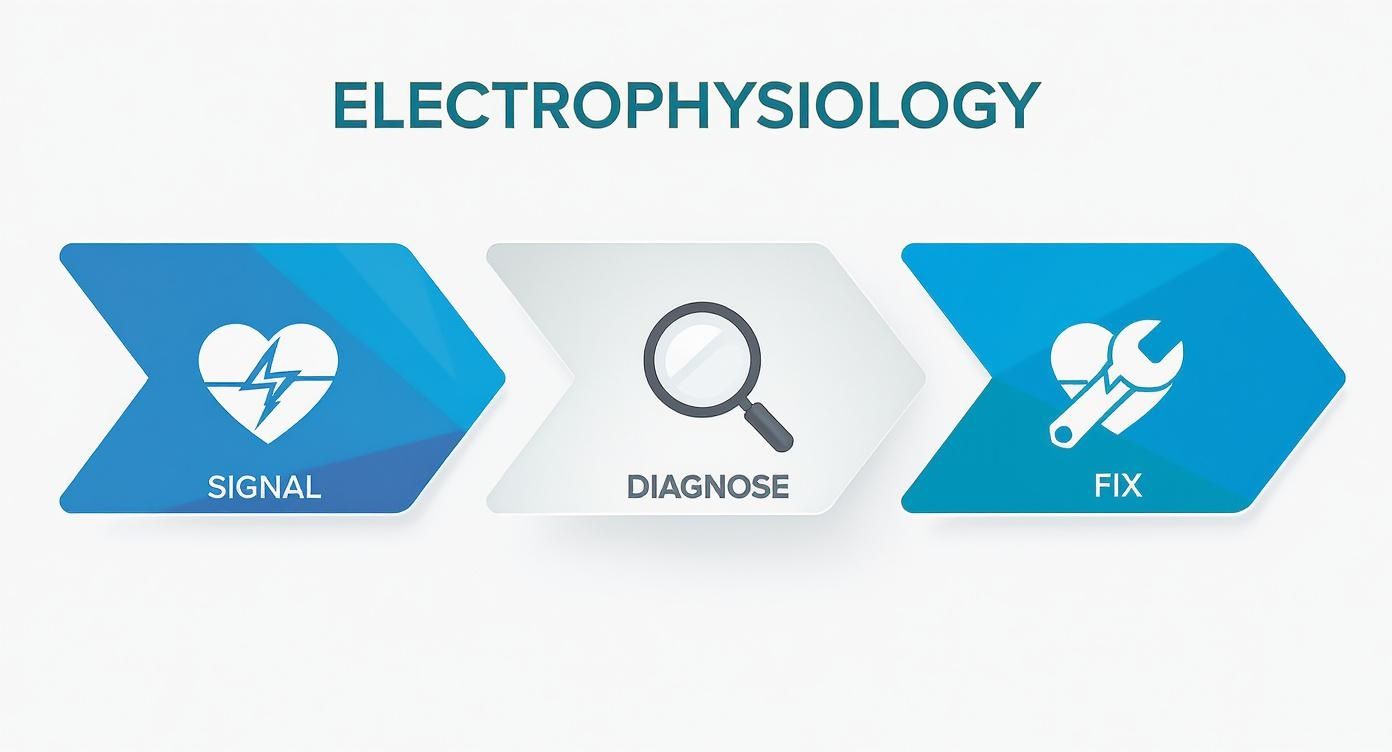
This process visualizes how an initial electrical issue is carefully diagnosed to pave the way for a targeted and effective solution.
What Happens After the Study
After the mapping is complete—a process that usually takes a few hours—the catheters are removed. You’ll rest for a bit in a recovery area for observation before heading home, typically on the same day. Most people are back to their normal routines within a day or two.
The results of the EP study are crucial. They give your doctor the clarity needed to determine the best course of action, which could include:
- Medication Adjustments: Confirming if your current medications are working or if new ones are needed to better control the rhythm.
- Device Implantation: Deciding if a pacemaker or implantable cardioverter-defibrillator (ICD) is necessary to regulate your heart’s rhythm long-term.
- Catheter Ablation: Identifying the exact tissue to target for treatment, which can often be performed during the same session as the EP study.
Ultimately, an EP study transforms an unknown issue into a clear, actionable diagnosis. It’s the critical step that bridges the gap between having a problem and knowing exactly how to fix it.
Common Heart Rhythm Conditions EPs Treat
An electrical map of the heart is only half the story. The real skill of an electrophysiologist lies in connecting that data to your real-world symptoms—translating electrical glitches into a clear diagnosis and a concrete plan for fixing your heart rhythm disorder, or arrhythmia.
These conditions can feel like anything from a minor flutter to a genuinely terrifying medical event. But they all share a common origin: a problem in the heart’s natural wiring. Understanding what’s going wrong is the first step toward getting it fixed for good.
Atrial Fibrillation: The Most Common Arrhythmia
By far the most well-known rhythm disorder is Atrial Fibrillation, or AFib. This is what happens when the heart’s two upper chambers, the atria, are bombarded with chaotic electrical signals. Instead of contracting in a strong, steady rhythm, they just quiver or “fibrillate.”
This erratic signaling creates a rapid and irregular heartbeat that people often describe as a fluttering, racing, or thumping in their chest. The real danger, however, isn’t just the strange sensation. Because the atria aren’t pumping blood efficiently, blood can pool and form clots—dramatically increasing the risk of stroke.
Atrial Fibrillation is not just a nuisance; it’s a serious medical condition. That irregular rhythm can cause profound fatigue and shortness of breath, and if left unmanaged, it leads to a five-fold increase in stroke risk.
AFib is a massive focus in electrophysiology cardiology, both because of its prevalence and its serious risks. It’s the single biggest reason people seek an EP’s help and a major driver of innovation in the field. To put it in perspective, the market for AFib treatments is projected to hit USD 8.8 billion by 2034, underscoring the urgent need for effective solutions. You can read more about the electrophysiology market trends and the move toward interventional treatments.
Tachycardia: When the Heart Races
While AFib involves a rapid heartbeat, other conditions are defined almost entirely by their speed. Tachycardia is simply the medical term for a heart rate over 100 beats per minute. A very common type that EPs treat is Supraventricular Tachycardia (SVT).
SVT is caused by something like a “short circuit” in the heart’s upper chambers, triggering episodes of a very fast but regular heartbeat. These episodes can feel like they come out of nowhere and stop just as suddenly, causing symptoms like:
- A pounding pulse you can feel in your neck
- Dizziness or a feeling of lightheadedness
- Sudden shortness of breath
- Chest discomfort or tightness
An EP can use an electrical map to find the exact location of this short circuit and, in many cases, fix it permanently using a procedure like catheter ablation.
Bradycardia: When the Heart Slows Down
On the complete opposite end of the spectrum is Bradycardia, a condition where the heart beats too slowly—usually fewer than 60 beats per minute. This can happen if the heart’s natural pacemaker (the sinoatrial node) isn’t firing correctly, or if the electrical signals get blocked on their way to the lower chambers.
A slow heart rate means the body isn’t getting enough oxygen-rich blood. This leads to symptoms like extreme fatigue, fainting spells, confusion, and dizziness. For severe bradycardia, an EP will often recommend implanting a pacemaker to make sure the heart maintains a steady, healthy rhythm.
Advanced Treatments to Restore Your Rhythm
Once an EP study gives us a detailed electrical map of your heart, the real work begins: fixing the problem. Electrophysiology cardiology isn’t just about managing symptoms; it’s about providing powerful, often permanent solutions designed to correct faulty circuits and bring your heart back into a stable, healthy rhythm.
The cornerstone of modern arrhythmia treatment is cardiac ablation. Think of it as a highly precise electrical repair job inside your heart. Using the map from the EP study as a guide, the specialist navigates a catheter to the exact cluster of cells causing the short circuit and deactivates them for good.
Fixing the Faulty Wiring: Cardiac Ablation
Cardiac ablation is a minimally invasive procedure, meaning we can fix the heart’s wiring without ever having to perform open-heart surgery. The entire goal is to create tiny, strategically placed scars on the heart tissue where the arrhythmia originates. This scar tissue is electrically inert—it can’t conduct signals, so it permanently blocks the abnormal pathway causing the trouble.
There are two primary ways we do this:
- Radiofrequency Ablation: This technique uses a specialized catheter to deliver controlled heat energy to the target cells. It’s like using a tiny, incredibly precise cauterizing tool to neutralize the problematic tissue.
- Cryoablation: This method takes the opposite approach, using extreme cold to freeze and destroy the faulty cells. A different kind of catheter delivers a refrigerant that forms a tiny ice ball at its tip, deactivating the target tissue just as effectively.
Both methods are remarkably successful, and the choice between them really comes down to the specific type of arrhythmia and its exact location in the heart. Ablation is now a global standard of care. The Asia Pacific region, for example, is seeing explosive growth, with one report from China’s Society of Cardiology showing a 25% increase in procedures in a single year. You can learn more about the global trends in electrophysiology procedures and what they mean for the future of cardiac care.
Common Electrophysiology Procedures and Their Purpose
While ablation is a go-to for many rhythm disorders, it’s just one tool in the EP toolkit. Different conditions require different solutions, from fixing “short circuits” to providing a backup for a heart that beats too slowly.
Here’s a quick look at the primary procedures and what they’re designed to accomplish:
| Procedure | Primary Goal | Commonly Used For |
|---|---|---|
| Cardiac Ablation | To permanently block faulty electrical pathways by creating targeted scar tissue. | Atrial Fibrillation (AFib), Atrial Flutter, Supraventricular Tachycardia (SVT) |
| Pacemaker Implantation | To prevent the heart from beating too slowly by sending electrical signals. | Bradycardia (slow heart rate), Heart Block |
| Implantable Cardioverter-Defibrillator (ICD) | To detect and stop life-threateningly fast heart rhythms with an electrical shock. | Ventricular Tachycardia, Ventricular Fibrillation, Prevention of Sudden Cardiac Arrest |
| Cardiac Resynchronization Therapy (CRT) | To coordinate the pumping action of the heart’s lower chambers (ventricles). | Advanced Heart Failure with uncoordinated contractions |
Each of these interventions targets a very specific electrical problem, allowing EPs to tailor the treatment directly to the patient’s underlying condition for the best possible outcome.
Implantable Devices for Long-Term Control
While ablation is perfect for fixing the source of many arrhythmias, some conditions require a different strategy. For hearts that beat too slowly (bradycardia) or have dangerously fast, life-threatening rhythms, implantable devices act as a constant, reliable safety net.
These devices are not just treatments; they are 24/7 guardians of your heart’s rhythm, monitoring every beat and stepping in only when needed to keep you safe and your heart on track.
Two of the most important devices are:
- Pacemakers: These small devices are implanted just under the skin, usually near the collarbone, with thin wires (called leads) that connect directly to the heart. A pacemaker constantly listens to the heart’s rhythm. If it senses the rate is dropping too low, it sends a tiny, painless electrical impulse to make sure it beats at a normal pace.
- Implantable Cardioverter-Defibrillators (ICDs): An ICD is a more advanced device for patients at high risk of sudden cardiac arrest from chaotic rhythms like ventricular tachycardia. Like a pacemaker, it monitors the heart, but its real job is to act like an internal emergency response system. If it detects a life-threatening arrhythmia, it can deliver a controlled electrical shock to instantly reset the heart to a normal rhythm.
These treatments can fundamentally change a person’s quality of life, not only by eliminating symptoms but also by providing invaluable peace of mind. For anyone considering these or other advanced cardiac procedures, understanding all your options is the first step. Our guide on finding the best hospital for heart surgery options can offer crucial insights as you choose the right care team for your needs.
Benefits and Risks of EP Procedures
Any time you’re considering a medical procedure, you need a clear, balanced perspective. With electrophysiology cardiology, it’s about weighing the incredible, life-changing outcomes against the potential—though often small—risks. Getting a handle on both sides of the equation is the only way to make a truly informed choice for your heart health.
The biggest win for most people after a successful EP procedure is a dramatic improvement in their quality of life. For many, this isn’t just a small change; it’s the complete disappearance of debilitating symptoms like palpitations, sudden dizziness, or that bone-deep chronic fatigue. Imagine your life without the constant fear of a racing heartbeat or feeling too exhausted to do the things you love.
Restoring Freedom and Reducing Serious Threats
Beyond just feeling better day-to-day, these procedures directly combat serious health threats. For patients with Atrial Fibrillation, a catheter ablation can slash their long-term risk of stroke, which is one of the most devastating complications of the condition. This isn’t just about physical protection; it’s about regaining invaluable peace of mind.
Another huge advantage is how minimally invasive most EP treatments are. Forget what you might picture with traditional open-heart surgery. Procedures like catheter ablation are done through a tiny incision, which usually means:
- Faster Recovery: Most people are back to their normal lives within just a few days.
- Less Pain: Any discomfort after the procedure is typically mild and easily managed.
- Reduced Scarring: The entry point is so small it leaves behind minimal physical evidence.
This modern, sophisticated approach lets specialists perform incredibly intricate work inside the heart without the long, grueling recovery that comes with major surgery.
Understanding the Potential Risks
Of course, no medical procedure is entirely without risk. It’s important to know that complications are rare, especially when you’re in the hands of a seasoned electrophysiologist, but they are possible. Potential risks might include bleeding, an infection where the catheter was inserted, or damage to a blood vessel.
More serious complications, while far less common, could involve the heart tissue itself or the formation of blood clots. Your specialist will walk you through every one of these possibilities in detail, explaining exactly how their team works to minimize these risks before, during, and after your procedure.
The key takeaway is simple: for the vast majority of patients, the proven benefits of getting the heart back into a normal rhythm far outweigh the low probability of complications.
Making proactive choices is the cornerstone of long-term wellness. For high-performing individuals who are serious about health optimization, exploring concepts like preventive cardiology for high achievers offers a powerful framework for protecting your cardiovascular system for decades to come. Ultimately, a deep, thorough conversation with your doctor is what will clarify how these benefits and risks apply to your unique situation, making sure you feel completely confident in the path you choose.
How to Find a Top Electrophysiology Specialist
Understanding your heart’s electrical system is the first step. Taking decisive action is the next.
Finding the right cardiac electrophysiologist is essential, as the success of these incredibly precise procedures often hinges on the specialist’s experience and skill. The right expert doesn’t just diagnose the problem—they provide a clear, confident path back to a steady, healthy rhythm.
Choosing a specialist from a vetted network means you’re connecting with a physician recognized for their expertise and patient outcomes. It takes the guesswork out of a critical decision and gives you confidence in your care. This is especially true when dealing with complex conditions like Atrial Fibrillation, where the right treatment can dramatically slash stroke risk and give you your quality of life back.
When your heart’s rhythm is on the line, expertise isn’t just important—it’s non-negotiable. A curated network connects you directly with leading physicians who have a proven track record of excellence in electrophysiology cardiology.
The Haute MD network offers a handpicked directory of the nation’s leading physicians, including premier EP specialists. You can use this trusted resource to explore expert profiles and take control of your heart health journey.
To get started, you can easily find a doctor in the Haute MD network and connect with a top-tier specialist in your area.
Common Questions About Electrophysiology
Even after digging into the world of electrophysiology, it’s completely normal to have a few more practical questions pop up. It’s a complex field, no doubt, but getting a handle on the key concepts can make the whole journey feel a lot less intimidating. Here are some straightforward answers to the questions we hear most often.
Is an EP Study Painful?
No, an EP study isn’t considered a painful procedure. The team uses a local anesthetic to numb the area where they insert the catheters, which just feels like a minor pinch. You might also get a light sedative to help you relax, keeping you comfortable throughout the entire study.
Most people say they only feel a bit of pressure at the insertion site. You’ll be awake enough to talk to the medical team, but you shouldn’t feel any pain from the catheters themselves.
How Long Does Recovery from an EP Procedure Take?
Recovery is usually very quick. Because most EP procedures are minimally invasive, the downtime is minimal. After a diagnostic EP study or even a catheter ablation, you’ll just need to rest in a recovery area for a few hours.
The majority of patients go home the very same day. You can expect to be back to your normal, non-strenuous activities within one to two days. Your doctor will give you specific instructions, but the general rule is to avoid any heavy lifting or intense exercise for about a week.
Will I Need a Pacemaker for Atrial Fibrillation?
Usually, no. The go-to treatments for AFib are typically medication or a catheter ablation, both of which are designed to fix the chaotic electrical signals causing the problem.
Pacemakers are mainly for conditions involving a slow heart rate, also known as bradycardia. In some complex situations, however, a patient might have both AFib and a slow underlying rhythm. In that scenario, both an ablation and a pacemaker might be necessary.
What Is the Success Rate for Catheter Ablation?
The success rate for catheter ablation is excellent, but it does depend on the specific type of arrhythmia we’re talking about.
- For simpler arrhythmias like SVT, success rates can be over 95%, often resulting in a permanent cure.
- For more complex conditions like AFib, success rates for a single procedure typically land in the 70% to 80% range. Sometimes a second procedure is needed to get the best long-term results.
Your electrophysiologist will walk you through the expected success rate for your specific condition, which is based on your heart’s unique electrical map.
Finding an expert you can trust is the single most important step you can take for your heart health. At Haute MD, we connect you with a curated network of the nation’s most respected physicians, including leading electrophysiology specialists known for their exceptional outcomes. Explore our directory to find a premier doctor dedicated to restoring your rhythm and your quality of life. Learn more at https://www.hauteliving.com/hautemd.