



Let’s get right to it. What exactly is concierge medicine? The simplest way to think about it is as a VIP membership for your healthcare. You’re stepping away from the traditional, reactive model of only seeing a doctor when you’re sick. Instead, you pay a recurring fee for direct, around-the-clock access to your physician, making your health a proactive, collaborative project.
An Overview of Concierge Medicine
At its core, concierge medicine is built on a direct relationship between you and your doctor. You pay an annual or monthly fee—often called a retainer—which completely changes the game. This fee grants you a level of access, time, and personalized attention that’s almost impossible to find in the conventional healthcare system.
The magic happens because concierge doctors intentionally shrink the size of their practice. They might care for just a few hundred patients instead of a few thousand. This isn’t just a small change; it’s a fundamental shift that allows them to dedicate real, meaningful time to every single person.
What does that look like in practice? It means longer, unhurried appointments where you can actually discuss all your concerns. It means getting in to see your doctor the same day or the next. And it means you can call, text, or email your physician directly, even after hours, and get a response. It’s a return to the old-fashioned, relationship-driven medicine we’ve lost, just powered by a modern membership model.
The whole point is to move beyond the rushed, 15-minute check-up. It’s about building a continuous, collaborative partnership with your doctor that’s focused on keeping you healthy for the long run.
Key Pillars of the Concierge Model
This model stands on a few core ideas that really set it apart from standard care. Understanding them makes it crystal clear what your membership fee is actually buying: a totally different kind of healthcare experience.
This infographic gives you a quick visual breakdown of how it all works.
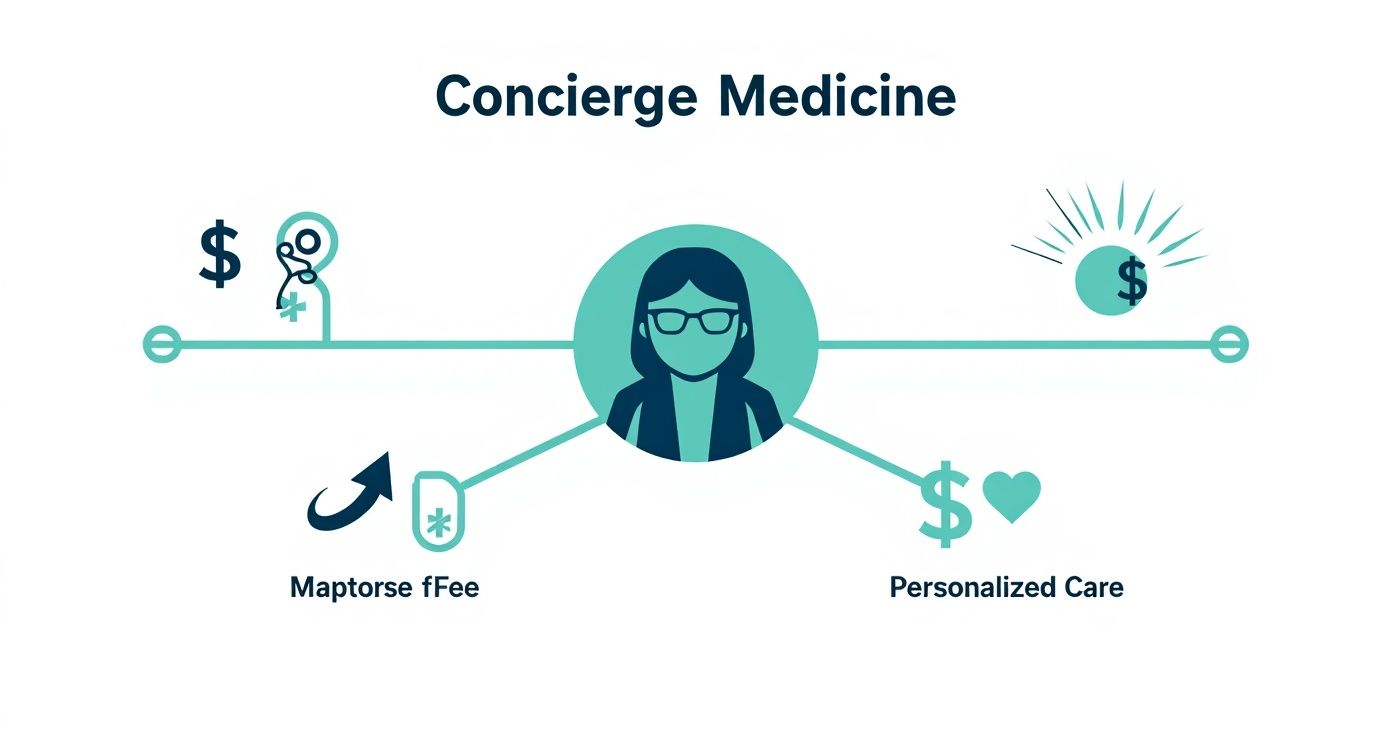
As you can see, that membership fee is the key. It unlocks everything else—the enhanced access, the deeper relationship, and the highly personalized care. You’re not just paying for sick visits; you’re investing in your doctor’s time and availability. This ensures your healthcare journey is built around your specific needs and schedule, not dictated by the pressures of insurance billing or an overflowing waiting room.
Concierge Care vs Traditional Care at a Glance
To really understand the difference, it helps to see the two models side-by-side. The contrast in everything from appointment length to how you communicate with your doctor is stark. This table lays out the fundamental distinctions.
| Feature | Concierge Medicine | Traditional Healthcare |
|---|---|---|
| Patient Panel Size | Small (typically 100-600 patients) | Large (often 2,000-3,000+ patients) |
| Appointment Wait Times | Minimal to none, same-day or next-day appointments | Weeks or even months for a routine visit |
| Appointment Length | Extended (30-90 minutes is common) | Short (average is 15-20 minutes) |
| Doctor Access | Direct access via cell, text, and email, often 24/7 | Call office, speak to staff, wait for a callback |
| Care Focus | Proactive, preventive, and wellness-oriented | Reactive, focused on treating existing sickness |
| Cost Structure | Annual or monthly membership fee + insurance for labs/specialists | Co-pays, deductibles, and co-insurance per visit |
| Care Coordination | Physician actively manages specialist referrals and follow-ups | Often left to the patient to navigate referrals |
Seeing it laid out like this makes the value proposition clear. Concierge care is an investment in time, access, and a proactive partnership with your physician, fundamentally reshaping the healthcare experience from the ground up.
How the Concierge Healthcare Model Works

So, we know what concierge medicine is in theory. But how does it actually play out in real life? The entire system hinges on a membership-based structure, where you pay a retainer fee directly to your doctor’s practice. This single change is what unlocks a completely different world of healthcare.
This fee—usually paid monthly, quarterly, or annually—rewrites the rules of the doctor-patient relationship. Instead of each visit being a rushed, one-off transaction, your health becomes an ongoing partnership. That retainer covers a level of access and service that the traditional, insurance-driven model simply can’t deliver.
The Retainer Fee and What It Unlocks
Think of the retainer as a subscription for elite, personalized medical care. It secures your spot in a deliberately small patient group, which is the secret sauce of the whole model. By limiting their practice to a few hundred patients instead of a few thousand, doctors finally have the time to provide the kind of attentive care that’s impossible in a volume-based system.
This membership fee typically includes a core set of game-changing services designed for proactive care and unmatched convenience:
- 24/7 Direct Physician Access: Forget answering services. You get your doctor’s personal cell number or a direct line for urgent needs, day or night. It’s a direct connection when you need it most.
- Extended, Unhurried Appointments: Visits often last 30-60 minutes or even longer. This allows for real conversations about your health, lifestyle, and preventive strategies—not just a quick look at your chief complaint.
- Same-Day or Next-Day Scheduling: When you’re sick, you get seen. Immediately. No more waiting weeks for an appointment or resorting to an urgent care clinic for a simple issue.
- Comprehensive Wellness Planning: With time on their side, your doctor can build a personalized health roadmap that focuses on keeping you well, not just treating you when you’re sick.
It’s crucial to understand that the retainer fee is buying back your doctor’s time and direct access—the two most valuable and scarce resources in modern healthcare. It’s a direct investment in a partnership for your well-being.
The Role of Health Insurance
One of the biggest misconceptions about concierge medicine is that the membership fee replaces health insurance. That’s not how it works. You absolutely still need a traditional health insurance plan.
Your insurance is the safety net for anything that happens outside of the direct primary care services your concierge doctor provides.
For example, your insurance plan is what you’ll use for:
- Visits to specialists like cardiologists or dermatologists
- Hospital stays and surgical procedures
- Major diagnostic imaging, such as MRIs and CT scans
- Prescription medications
Your concierge fee and your insurance plan are a team. The fee secures you an attentive, dedicated healthcare quarterback, while your insurance provides the heavy-duty coverage for more complex and expensive medical needs.
It’s also worth noting that many practices still bill your insurance for routine visits, just like a traditional office would, though the specific model can vary. For a deeper dive into the nuances, this piece on direct primary care vs concierge medicine explained does a great job of clarifying the distinctions.
The Real Benefits of Personalized Medical Care
So, beyond the membership fees and smaller patient lists, why are people actually making the switch to concierge medicine? The answer gets to the heart of what’s broken in the traditional system. The benefits aren’t just about convenience; they fundamentally rebuild the doctor-patient relationship from the ground up.
Imagine waking up with a worrying symptom and getting a same-day or next-day appointment without a fight. Picture walking into your doctor’s office and not even having a chance to open a magazine in the waiting room. This kind of immediate access is a cornerstone of the concierge model, wiping out the frustratingly long waits that have become the norm.
That promptness carries right into the exam room. Instead of a hurried 15-minute visit where you feel like you’re on a stopwatch, you get a full 30 to 60 minutes with your doctor. This allows for real conversation, thorough examinations, and the simple but powerful feeling of being truly heard.
A Partnership Focused on Prevention
One of the biggest shifts is moving from reactive “sick care” to proactive wellness. With the luxury of time, your concierge doctor becomes a true health partner. They can focus on preventive strategies, detailed wellness plans, and lifestyle changes designed to keep you healthy for the long haul—not just patch you up when something goes wrong.
This deeper relationship builds a powerful foundation of trust, which is absolutely critical for managing chronic conditions or complex health issues. When your doctor knows your full story, not just a 10-minute snapshot, they can provide far more effective oversight and catch problems before they escalate. For many, the top benefits of concierge medicine all circle back to this highly personal and forward-thinking approach.
In essence, your physician transforms from a reactive problem-solver into a proactive healthcare advocate. They coordinate with specialists, ensure your care is seamless across different providers, and serve as your personal guide through the complexities of the medical system.
This isn’t just a niche trend; it’s a reflection of a major market shift. With chronic diseases on the rise globally and an aging population, the demand for continuous, individualized care is exploding. The concierge medicine market, currently valued at around USD 20.3 billion, is projected to soar past USD 35.7 billion by 2030.
This growth isn’t just about luxury. It’s driven by patients who are tired of the administrative hurdles and unpredictable nature of traditional healthcare and are actively seeking something better.
Understanding the Costs of Concierge Medicine

Alright, let’s talk about the investment. The first question most people ask about concierge medicine is, “What does it actually cost?” The financial model is different from what you’re used to—it’s a shift from paying for care only when you’re sick to investing in your health proactively.
At the heart of it is the membership fee, often called a retainer. This is an annual cost you pay directly to the physician’s practice, and it’s what buys you into this high-touch model of care.
The price tag can vary quite a bit, generally falling somewhere between $2,000 to $5,000 per year. Of course, in major cities or with physicians who are leaders in their field, those fees can climb north of $10,000 annually.
Breaking Down the Membership Fee
So, what drives that number? It really comes down to a few key things: the doctor’s specific expertise, the practice’s location, and exactly what services are bundled into your membership. Think of it like a subscription with different tiers—the more comprehensive the services, like in-depth diagnostic screenings or integrated wellness coaching, the higher the fee.
It’s absolutely critical to understand that this fee is for access and service, not for all your medical care.
Your membership fee is an out-of-pocket expense that secures your spot in a small practice and covers things like 24/7 physician access, long appointments, and personalized care planning. It does not replace your health insurance. You still need insurance for everything else—hospital stays, specialist visits, surgeries, and prescriptions.
Many people find that using a tax-advantaged account makes the cost more manageable. A Health Savings Account (HSA) or a Flexible Spending Account (FSA) can often be used to pay for the membership fee, though it’s always smart to double-check with your specific plan administrator first.
What Does the Price Really Get You?
To really gauge the value, you have to look past the price tag. What you’re buying is your doctor’s time and undivided attention—the two most precious (and scarcest) commodities in the modern healthcare system. This investment flips the script, allowing your doctor to focus on keeping you healthy and optimizing your well-being, not just reacting to problems as they arise.
To give you a clearer picture, here’s a sample breakdown of what you might expect at different price points.
Example Concierge Membership Tiers
This table illustrates how concierge medicine pricing often works, showing typical annual costs and the services you might get at each level.
| Tier Level | Typical Annual Cost Range | Common Included Services |
|---|---|---|
| Standard | $2,000 – $3,500 | 24/7 direct doctor access, same-day appointments, extended visits, basic care coordination. |
| Premium | $3,500 – $6,000 | All standard services plus advanced annual physicals, basic health coaching, and some in-office tests. |
| Executive | $6,000 – $10,000+ | All premium services plus extensive diagnostic screenings, personalized wellness plans, and direct specialist coordination. |
Ultimately, the right tier depends on your specific health goals and how much value you place on that direct, proactive partnership with your physician.
Is Concierge Medicine the Right Choice for You?

This personalized healthcare model offers incredible benefits, but it isn’t a universal fit. The real question is whether it fits your life. Making that call means taking a hard look at your health needs, your lifestyle, and where you place your financial priorities.
So, who really stands to gain the most from this kind of investment in proactive, high-touch care?
Certain people find the value proposition impossible to ignore. If you’re a busy professional, the power to schedule same-day appointments and skip the waiting room isn’t just a perk—it’s a critical tool for keeping your life on track. Likewise, individuals managing one or more chronic conditions find that direct, anytime access to their physician is invaluable for staying ahead of complications.
And then there are those who simply want a real, lasting partnership with their doctor. If you’re looking for a physician who knows your full story and acts more like a wellness coach than a distant practitioner, this model was designed for you.
Who Is an Ideal Candidate?
To help you figure it out, see if you recognize yourself in any of these common profiles who thrive in a concierge setting:
- Busy Executives and Professionals who simply can’t afford to lose hours in a waiting room and need immediate, flexible access to medical advice.
- Individuals with Chronic Conditions like diabetes or heart disease, who benefit tremendously from the close monitoring and coordinated care that prevents small issues from becoming big ones.
- Proactive Health Enthusiasts who want to move beyond basic check-ups and dive deep into advanced screenings, genetic insights, and in-depth wellness planning.
- Families Seeking Convenience who want a single, trusted physician to manage the health of multiple family members with streamlined, hassle-free communication.
Ultimately, the value comes from engagement. This model is most effective for patients who will actively use the extended time and direct access to have meaningful conversations and partner with their doctor on their health journey.
On the other hand, if you’re young, in perfect health, and rarely need a doctor for more than an annual physical, the membership fee might feel like an unnecessary expense. The key is to align what you pay with the level of service and access you genuinely need.
If you’re weighing your options, learning more about finding a concierge doctor near me can give you the local insights needed to make a confident decision.
A Glimpse into the Future of Primary Care
Concierge medicine isn’t just some fringe trend; it’s a powerful and rapidly growing shift in how people are approaching their health. This movement is being pulled forward by two massive forces: patients who are utterly fed up with the conventional system and doctors who are burning out at an alarming rate.
People are tired of waiting weeks for an appointment only to be rushed through a 10-minute visit where they feel like just another number. At the same time, doctors are desperately searching for a way to practice medicine that lets them build real relationships with their patients instead of just churning through them.
This model is a direct answer to that widespread frustration, offering a real alternative that’s catching on. What once seemed like a luxury service for the ultra-rich is now becoming a solid, expanding part of primary care. The market’s explosive growth is proof that this isn’t just a fad—it’s a sustainable model with serious momentum.
The Numbers Don’t Lie
The data paints a very clear picture. The global concierge medicine market was valued at around USD 21.8 billion and is on track to nearly double, hitting an estimated USD 42.3 billion by 2032.
That reflects a powerful compound annual growth rate (CAGR) of about 9.9%. It’s a clear signal of sustained, high-level demand for a more personal and proactive approach to healthcare. You can dive deeper into these projections and see the raw data in this full analysis of concierge medicine trends.
A huge part of this growth story is the rise of group-owned practices. These larger, more organized groups are making the concierge model far more efficient and scalable than ever before.
By pooling their resources and centralizing all the administrative headaches, group practices can dramatically lower the overhead for each individual doctor. That efficiency often means more affordable membership fees for patients, opening the door for more people to access this level of care.
In fact, group-owned models now command a dominant market share of over 64%, showing just how critical scalability has become. This structure is helping more and more physicians make the leap from the high-volume, insurance-driven world of traditional medicine.
And while North America has long been the stronghold for concierge care, its rapid expansion into regions like Asia Pacific proves this is a global phenomenon. It’s a sign that patients all over the world are demanding a higher standard of care, and the market is scrambling to keep up.
Common Questions About Concierge Medicine
Even when the model makes sense on paper, you’re bound to have some practical questions. Figuring out if this is the right move for you means understanding how it fits into your real life—your health, your finances, and your family’s needs. Let’s tackle the most common questions people ask.
Do I Still Need Health Insurance with a Concierge Doctor?
Yes, absolutely. This is one of the most important things to get straight. Your concierge membership fee is for the enhanced, direct access you get with your primary care doctor. Your traditional health insurance is still your safety net for everything else.
Think of it like this: your membership is for elite, personalized primary care, while your insurance plan is what protects you from major, high-cost medical events. You’ll still rely on insurance for things like:
- Seeing specialists like a cardiologist or an orthopedist.
- Emergency room visits and hospitalizations.
- Major surgeries and medical procedures.
- Advanced imaging like MRIs and CT scans.
How Are Specialist Referrals Handled?
This is where the concierge model really shines. Instead of just getting a name and a phone number scribbled on a piece of paper, your concierge doctor becomes your personal healthcare quarterback. They don’t just refer you; they actively manage the process.
Your doctor will often pick up the phone and call the specialist themselves to discuss your case, ensuring a seamless and informed handoff. They help you find the absolute best expert for your specific needs and coordinate directly with their office. They are your advocate, making sure every provider on your team is on the same page with your treatment plan.
This coordinated approach saves you the immense frustration of navigating the healthcare maze alone. Your doctor is the central hub, ensuring nothing gets lost in translation between different medical offices.
Is This Type of Care Only for the Wealthy?
It may have started that way, but the answer today is a firm “no.” Concierge medicine has become far more accessible, with many practices offering different membership levels to fit various budgets. For many people, the monthly fee is comparable to a high-end gym membership or a family’s cell phone plan.
If you’re managing a chronic condition, the predictable fee can actually be a smart financial move. When you add up the high out-of-pocket costs, endless co-pays, and urgent care visits common in the traditional system, an investment in proactive health management that prevents bigger, more expensive problems down the road starts to look very appealing.
Ready to connect with a top-tier physician who prioritizes your health and time? Haute MD is a curated network of the nation’s leading doctors, including premier concierge and executive health specialists. Discover a higher standard of care and find a vetted expert near you. Explore our network.