



Aesthetic dermatology isn’t about vanity—it’s a sophisticated medical field where science meets artistry to elevate your skin’s health and appearance. This specialty focuses on tackling concerns like aging, sun damage, and scarring with precise, evidence-based, and minimally invasive treatments designed for maximum impact with minimal downtime.
The Art And Science Of Skin Wellness
Think of aesthetic dermatology less as a collection of quick fixes and more as a proactive strategy for lifelong skin wellness. It’s built on the simple truth that looking good is deeply connected to being healthy. While traditional dermatology is focused on diagnosing and treating skin diseases, this specialized field refines and restores, helping you achieve a natural, refreshed look that truly reflects your inner vitality.
This isn’t about chasing fleeting trends or creating an artificial, “done” look. Quite the opposite. Elite practitioners use their deep understanding of skin biology, facial anatomy, and advanced medical technology to make subtle yet meaningful improvements. The real goal is to work with your unique features, not against them.
Core Philosophy and Goals
At its core, aesthetic dermatology is guided by a few key principles. A board-certified expert’s mission is to deliver results that are both beautiful and medically sound, prioritizing your safety and health above all else.
The primary objectives are straightforward:
- Restoring Youthful Contours: Strategically addressing the volume loss and skin laxity that naturally occur with age.
- Improving Skin Quality: Enhancing texture, tone, and clarity by treating common issues like fine lines, unwanted pigmentation, and acne scars.
- Preventing Future Damage: Using targeted treatments and advising on skincare that shields the skin from environmental stressors, effectively slowing down the aging process.
- Boosting Confidence: The psychological impact can’t be overstated. When you feel good about your skin, it often translates into greater self-assurance in every aspect of your life.
This proactive and personalized approach has fueled incredible growth in the field. The U.S. aesthetic medicine market, valued at USD 38.19 billion just a few years ago, has already swelled to USD 49.28 billion. Projections show it could surge to USD 167.13 billion, highlighting a clear demand for expert-led aesthetic care among discerning patients. You can explore more about these market trends and their drivers at Novaone Advisor.
Aesthetic dermatology is a partnership between patient and physician. It involves creating a long-term strategy to not only correct existing concerns but to gracefully manage the skin’s health for years to come.
Ultimately, understanding what aesthetic dermatology truly is means seeing it for what it is: a sophisticated medical discipline. It demands an artistic eye, a steady hand, and years of rigorous medical training to master. By focusing on evidence-based procedures, a qualified dermatologist helps you invest in the long-term health and beauty of your skin, ensuring every treatment is safe and delivers refined, elegant outcomes.
The Core Treatments Shaping Modern Aesthetics
To really get a feel for aesthetic dermatology, you have to look past the philosophy and into the actual toolkit. The entire field is built on a foundation of incredibly effective, scientifically proven procedures. But these aren’t just a random menu of services. They fall into distinct families, each designed to address specific aspects of skin health and aging with surgical-like precision.
Think of an artist’s studio. A painter doesn’t just have one brush; they have a whole collection for broad strokes, fine lines, and everything in between. An aesthetic dermatologist’s toolkit is no different. We can group these foundational treatments into four main categories, each with its own unique purpose and mechanism.
The diagram below maps out the three pillars of this approach—enhancing, restoring, and protecting the skin.
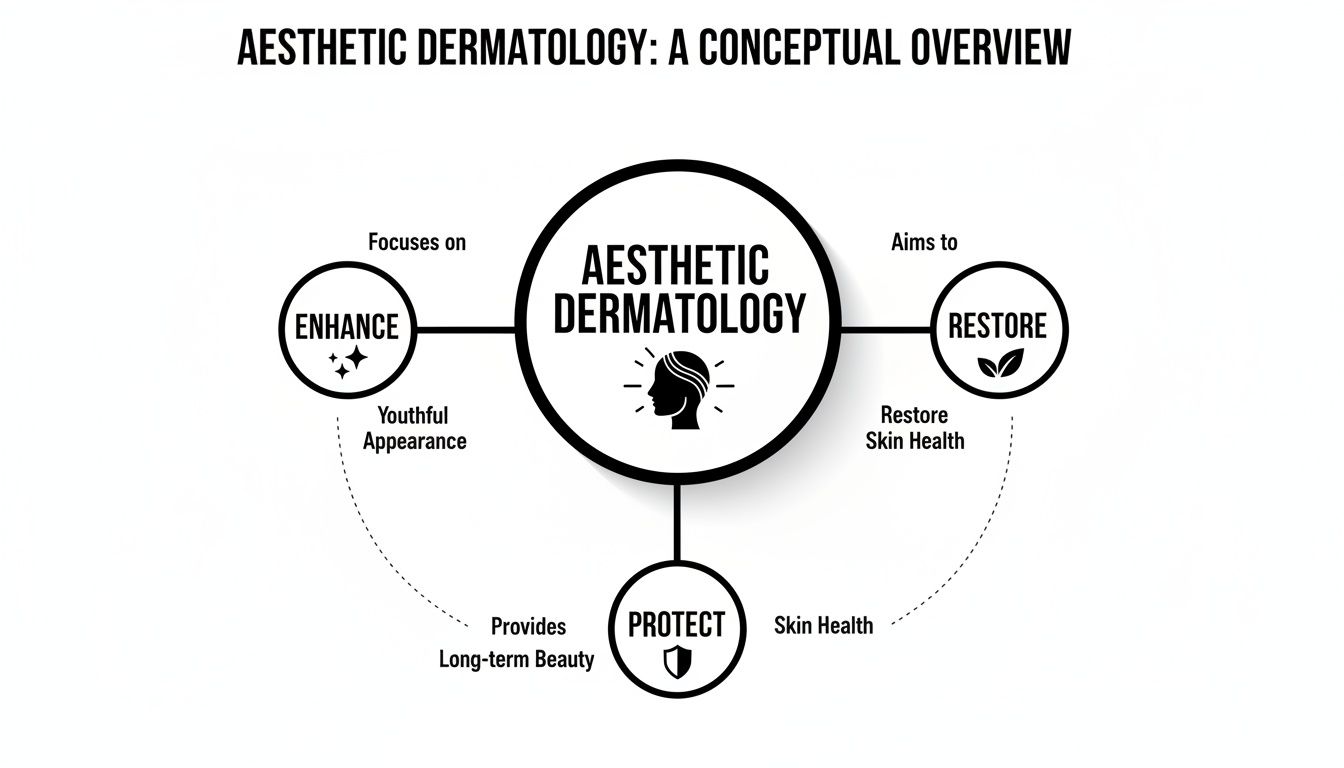
This visual shows how these core treatments are part of a unified strategy. The goal isn’t just a quick cosmetic fix but a long-term plan for comprehensive skin wellness.
Neurotoxins: The Muscle Relaxers
Neurotoxins are easily the most famous players in aesthetic dermatology, known by brand names like Botox®, Dysport®, and Xeomin®. Their function is brilliantly simple yet profoundly effective. They work by temporarily relaxing the tiny facial muscles that cause dynamic wrinkles—those lines that show up from years of smiling, frowning, or squinting.
Picture a piece of paper you keep folding in the same spot. Eventually, that crease becomes permanent. Neurotoxins essentially stop the muscle from making that “fold,” which allows the skin on top to smooth itself out. This makes them the go-to solution for treating:
- Crow’s feet around the eyes
- Frown lines between the eyebrows (the dreaded “11s”)
- Horizontal forehead lines
The goal isn’t to create a “frozen” look. It’s about softening expressions to appear more rested and refreshed. A skilled, board-certified dermatologist uses meticulous doses to get natural-looking results, ensuring you still look exactly like yourself—just a smoother version.
Dermal Fillers: The Volume Restorers
If neurotoxins relax, then dermal fillers rebuild. As we get older, our faces naturally lose the subcutaneous fat and collagen that give them youthful volume. This is why cheeks can start to look hollow, lines deepen around the mouth, and lips begin to thin.
Dermal fillers, which are mostly made from hyaluronic acid (a sugar molecule your body produces naturally), are designed to fix this. They are smooth, injectable gels that literally “fill” in these areas of lost volume, restoring youthful contours and structure from within.
Think of your facial structure like a beautiful piece of fabric draped over a supportive frame. With time, that frame starts to shrink. Fillers help rebuild that underlying support, allowing the fabric of your skin to hang smoothly and naturally again.
Their applications are incredibly versatile:
- Restoring cheek volume for a subtle, natural lift.
- Smoothing nasolabial folds (the “smile lines” running from nose to mouth).
- Defining the jawline and chin to improve facial harmony.
- Enhancing lip volume and shape with precision.
The artistry here is everything. The objective is to strategically replace what’s been lost, not to add unnatural bulk.
Energy-Based Devices: The Skin Tighteners
This category is where some of the most advanced technology in dermatology lives. These devices use light, heat, and sound energy to kickstart rejuvenation deep within the skin. The basic principle is the same across all of them: deliver controlled energy into the skin’s deeper layers to trigger the body’s own healing response—specifically, the production of new collagen and elastin.
- Laser Therapy: Lasers use focused beams of light to zero in on specific problems. Some lasers target pigment to erase sunspots and broken capillaries. Others create microscopic channels in the dermis to force collagen remodeling, which dramatically improves skin texture and tightness.
- Radiofrequency (RF): RF devices use radio waves to gently heat the deep layers of the skin. This controlled thermal energy makes existing collagen fibers contract immediately and, more importantly, stimulates new collagen growth over time. The result is progressively firmer, tighter skin.
- Ultrasound Technology: This approach uses focused ultrasound to reach the deepest foundational layer of the skin—the same layer a surgeon would address in a facelift. It triggers a powerful regenerative response for significant, non-surgical lifting and tightening.
Skin Resurfacing: The Texture Refiners
Finally, skin resurfacing techniques are all about perfecting the canvas itself. These treatments work by removing the outermost, damaged layers of skin to reveal the healthier, more radiant skin hiding underneath. They are phenomenal for tackling superficial issues like fine lines, acne scars, uneven tone, and rough texture.
Popular methods include:
- Chemical Peels: A specially formulated chemical solution is applied to the skin, causing it to exfoliate and eventually peel away. This process clears out dead cells and kickstarts new cell growth for a smoother, brighter complexion.
- Microneedling: This procedure uses ultra-fine needles to create thousands of invisible micro-injuries in the skin. This controlled trauma activates the body’s natural wound-healing process, stimulating a surge of new collagen and elastin. It is sometimes paired with other regenerative treatments; for instance, you can learn more about how platelet-rich plasma therapy for hair loss uses similar principles.
- Laser Resurfacing: This is a more intensive version of the lasers used for tightening. Ablative lasers actually vaporize the outer layers of damaged skin, leading to a dramatic improvement in texture and tone once the skin has healed.
Together, these four pillars give a board-certified dermatologist a powerful and versatile set of tools to design a personalized plan that addresses your unique concerns—ensuring safe, effective, and beautiful results.
Understanding The Difference Between Medical And Cosmetic Dermatology
While both live under the vast umbrella of dermatology, the medical and aesthetic sides of the field have fundamentally different missions. It’s helpful to think of it this way: medical dermatology is the essential first responder, while aesthetic dermatology is the master architect. One is focused on detecting immediate threats and managing disease; the other is dedicated to long-term structural integrity and refined design.
Medical dermatology is all about diagnosing, treating, and preventing diseases of the skin, hair, and nails. Its primary concern is pathology. A medical dermatologist is the expert you see for urgent health issues—skin cancer screenings, suspicious moles, acute rashes, psoriasis, eczema, severe acne, or infections. Their job is to resolve medical conditions that compromise your health.
Aesthetic dermatology, in contrast, zeroes in on improving the appearance and quality of the skin. Its goal is enhancement, restoration, and the artful management of the aging process. While built upon that same rigorous medical foundation, its application is elective and centered on achieving a specific visual outcome, whether that’s smoother texture, restored volume, or a more even complexion.
Defining The Core Mission
The most important distinction comes down to their primary objectives. A medical dermatologist’s goal is to cure or manage a disease. Success is measured by clinical outcomes, like clearing a psoriasis plaque or completely removing a cancerous lesion. The fundamental question they answer is, “Is your skin healthy?”
An aesthetic dermatologist’s objective is to improve the skin’s appearance in a way that looks natural and feels authentic to you. Their work answers the question, “Do you feel confident and happy with your skin’s appearance?” Here, success is measured by patient satisfaction and achieving a subtle, refreshed look that enhances your natural features.
Medical dermatology saves lives and resolves disease, while aesthetic dermatology improves quality of life and restores confidence. One is a necessity; the other is a choice.
This distinction also dictates the entire approach. Medical treatments follow established protocols designed to fight disease, often involving prescription medications or surgical excisions. Aesthetic treatments, however, are highly personalized, blending science with artistry to create a completely customized plan for rejuvenation.
A Look At Insurance And Accessibility
Another practical difference patients immediately notice is the role of insurance. Because medical dermatology addresses diagnosed health conditions, its services are typically covered by health insurance plans. Procedures like removing a mole for suspected melanoma or treating a bacterial skin infection are considered medically necessary.
Aesthetic dermatology, on the other hand, involves elective procedures performed purely to improve appearance. Since these treatments aren’t deemed medically necessary, they are almost never covered by insurance. This means treatments like Botox, dermal fillers, or laser skin resurfacing are paid for out-of-pocket.
- Medical Dermatology: Focuses on treating diseases such as skin cancer, eczema, psoriasis, and infections. These treatments are generally covered by insurance.
- Aesthetic Dermatology: Concentrates on elective procedures like injectables, laser treatments, and chemical peels to address signs of aging. These are self-funded.
This financial distinction highlights a growing global trend: viewing appearance as a key component of overall wellness. The aesthetic medicine market is valued at billions and is projected to grow steadily, reflecting a worldwide audience that values investing in their appearance for both professional and personal fulfillment.
Why A Medical Foundation Is Non-Negotiable
While their goals differ, the best aesthetic outcomes are always built on a deep understanding of medical dermatology. A board-certified dermatologist’s extensive training in skin pathology, anatomy, and physiology is precisely what makes aesthetic procedures safe. They can spot underlying conditions that might mimic cosmetic issues and recognize contraindications that would make a procedure unsafe for a particular patient.
This medical expertise ensures that your pursuit of aesthetic improvement never comes at the expense of your health. It’s the reason why choosing a provider with an unimpeachable medical background is so critical, a topic we explore further when discussing why elite dermatologists outperform med spas.
Ultimately, the two fields are partners. Healthy skin is the perfect canvas for beautiful aesthetic work.
Your Patient Journey From Consultation To Results
Deciding to explore aesthetic dermatology is a big step, and knowing what to expect can make all the difference. This isn’t just a quick transaction; it’s a genuine partnership between you and your physician. Think of it as a clear roadmap designed to get you from your first conversation to your final results, making sure you feel confident and fully informed every step of the way.

The whole process is built to be methodical and safe, centered entirely around what you want to achieve. It unfolds in three distinct phases, each one essential for creating the refined, natural-looking outcomes you’re looking for.
The Initial Consultation: Your Strategic Blueprint
Honestly, the first step is the most important one. Your initial consultation with a board-certified dermatologist is a deep-dive session where we build the foundation for your entire plan. This is way more than a simple meet-and-greet; it’s a comprehensive medical and aesthetic assessment.
During this meeting, we’ll talk through your specific concerns, your ultimate goals, and your medical history. Your physician will perform a thorough skin analysis, looking at everything from skin elasticity and texture to volume loss and pigmentation. It’s the perfect time to ask every question you have and build a real rapport with your doctor.
The outcome is a fully personalized treatment plan. This blueprint will lay out:
- Recommended Procedures: The specific treatments that will get you to your goals.
- Treatment Timeline: A clear schedule of how many sessions you’ll need and how often.
- Expected Outcomes: A realistic look at the results you can anticipate.
- Transparent Costs: A complete, no-surprises breakdown of all fees.
This initial meeting ensures we’re perfectly aligned. It’s a dialogue that establishes trust and sets clear, achievable expectations for the path ahead.
The Procedure Experience: Precision and Comfort
Once your plan is set, we move on to the treatment phase. Whether you’re coming in for injectables, a laser session, or something else, our absolute focus is on your safety and comfort. Top-tier clinics are designed to be serene and professional, helping you feel completely at ease.
Before anything begins, your dermatologist will walk you through the steps one more time, making sure you’re ready. We use comfort measures like topical numbing creams or advanced cooling devices for laser treatments as standard practice. These steps are all about minimizing any potential discomfort and making the experience as pleasant as possible.
The procedure itself can vary in length. A neurotoxin session might take just 15-20 minutes, while a more intensive laser resurfacing treatment could last over an hour. Your physician will manage every detail with meticulous care, using their deep knowledge of facial anatomy and medical science to deliver the treatment with absolute precision.
A successful procedure isn’t just about technical skill—it’s about how the patient feels. The goal is for you to feel cared for, safe, and confident in the hands of an expert from start to finish.
Recovery and Unveiling Your Results
The final phase is all about aftercare and recovery. Your dermatologist will give you detailed post-treatment instructions designed to ensure a smooth healing process and optimize your results. Following this guidance is crucial for getting the best possible outcome.
Recovery times change depending on the treatment’s intensity. For injectables, downtime is usually minimal—maybe some minor swelling or bruising that fades in a few days. For more intensive procedures like deep chemical peels or ablative laser resurfacing, the recovery will be longer and involve specific skincare routines to help your skin heal beautifully.
Patience is key here. The results of many aesthetic treatments don’t just pop up overnight; they appear gradually. While you might see the effects of dermal fillers right away, other treatments, like collagen-stimulating radiofrequency, reveal their magic over several weeks or even months. This progressive improvement is what creates such natural and lasting results. Your journey culminates not in a sudden change, but in a subtle, beautiful enhancement that restores and refreshes your appearance.
Why A Board Certified Specialist Is Non Negotiable
When you’re considering aesthetic dermatology, the single most important decision you’ll make has nothing to do with a specific laser or filler. It’s about who you trust to perform the procedure. The qualifications of your provider aren’t just a minor detail—they are the absolute foundation of your safety, your results, and your long-term health.
Putting it bluntly: choosing a board-certified dermatologist is the only way to guarantee you’re in the hands of a true medical expert.
This distinction has never been more critical. The medical aesthetics market in the U.S. has exploded into a multi-billion dollar industry, largely driven by minimally invasive treatments. With over 80% of patients aged 35-55 seeking anti-aging solutions, the demand is booming. But as the number of providers skyrockets, it’s up to you to separate genuine medical expertise from clever marketing. You can explore more data on this market growth at Grand View Research.
The Rigor Behind Board Certification
The title “board-certified dermatologist” isn’t just fancy wording. It represents a grueling journey of medical education and specialized training that is worlds apart from the qualifications you might find at a typical medspa. It’s an official credential from the American Board of Dermatology, signaling the highest possible level of expertise in the field.
Here’s what that journey actually looks like:
- Four years of medical school to earn an M.D. or D.O. degree.
- A demanding one-year internship, typically in internal medicine or surgery.
- An intensive three-year residency focused exclusively on dermatology, covering thousands of conditions affecting the skin, hair, and nails.
- Passing a punishing two-day board certification exam that tests comprehensive medical and surgical knowledge.
This is the kind of deep training that builds an unmatched understanding of skin anatomy, physiology, and pathology. It’s this medical foundation that allows a specialist to not only perform a procedure safely but also to anticipate potential complications and know exactly how to manage them if they arise.
A board-certified dermatologist doesn’t just see the surface; they understand the intricate biological systems beneath it. This knowledge is what separates a routine procedure from a masterful, medically sound outcome.
Your Checklist for Vetting Any Provider
When you choose a provider, you aren’t just booking a one-off treatment. You’re hiring a medical expert to be a long-term partner in your skin’s health. You need to arm yourself with the right questions to make sure you’re choosing expertise over convenience or a tempting price tag. A great place to start is by understanding what makes a board-certified cosmetic dermatologist the undisputed expert.
Before committing to any provider, use this practical checklist during your research and consultation.
A well-qualified provider should make it easy for you to verify their credentials and experience. The answers to these questions will reveal whether you’re dealing with a true specialist or just a skilled marketer.
| Provider Qualification Checklist | | :— | :— | :— | | Credential/Quality | Why It Matters | How to Verify | | Board Certification | Is the provider certified by the American Board of Dermatology? This is the non-negotiable gold standard. | Check the American Board of Dermatology or American Academy of Dermatology websites. It should also be displayed in their office. | | Aesthetic Specialization | Does the practice focus heavily on aesthetic dermatology, or is it just an add-on service? A specialist will have more experience. | Review their website’s list of services and “About Us” page. Look for a practice where cosmetic procedures are a core offering. | | Patient Portfolio | Can they show you a portfolio of their work with patients who have similar concerns and skin types as you? | Ask to see before-and-after photos during your consultation. Look for natural, consistent results that match your goals. | | Technology and Techniques | Do they invest in proven, state-of-the-art technology and stay current with the latest, safest techniques? | Ask what devices they use for specific treatments (e.g., laser resurfacing) and why they chose them. A top provider will explain their rationale. |
Making this choice is an investment in yourself. By insisting on a board-certified specialist, you ensure your aesthetic journey is guided by uncompromising medical expertise, artistic vision, and a profound commitment to your safety.
Your Questions About Aesthetic Dermatology Answered
Even after diving into the procedures and the importance of choosing a board-certified expert, it’s completely normal to have a few more practical questions pop up. Deciding to invest in your skin is a big step, and feeling fully informed is the only way to move forward with real confidence.
Let’s tackle some of the most common questions people have as they get ready to start their aesthetic dermatology journey. We’ve got clear, direct answers to help you sort through the final details and feel genuinely prepared for that first consultation.
How Much Do Aesthetic Dermatology Treatments Typically Cost?
This is almost always the first question, and the honest answer is: it varies—a lot. The price of any procedure hinges on a few key factors, including the specific treatment you choose, your geographic location, and, most importantly, the expertise and reputation of your provider. You aren’t just buying a service; you’re investing in a medical procedure performed by a highly trained specialist.
To give you a clearer idea, here’s how pricing often breaks down for common treatments:
- Neurotoxins (like Botox): Usually priced per unit. The total cost depends on how many units are needed to treat your target areas, whether that’s the forehead, crow’s feet, or between the brows.
- Dermal Fillers: Typically priced per syringe. The number of syringes you’ll need is determined by the treatment area and the amount of volume required to achieve a subtle, natural-looking result.
- Laser and Energy-Based Devices: These treatments can range from a few hundred to several thousand dollars per session. The final cost depends on the specific technology used and the size of the area being treated.
It’s critical to remember that these procedures are considered elective and are almost never covered by health insurance. During your consultation, a reputable, board-certified dermatologist will give you a transparent, detailed cost breakdown for your personalized treatment plan, so there are absolutely no surprises.
Think of the cost as an investment in expertise and safety. While lower prices at a medspa might seem tempting, you are paying a premium for a board-certified dermatologist’s years of medical training, artistic eye, and ability to manage any potential complications.
Are Aesthetic Dermatology Procedures Painful?
Patient comfort is a huge priority in any high-quality dermatology practice. The thought of needles or lasers can be intimidating, but modern aesthetic medicine has made incredible strides in making treatments as comfortable as possible. The level of discomfort really depends on the specific procedure.
For most minimally invasive treatments, the sensation is very manageable.
- Injectables (Neurotoxins and Fillers): These procedures involve ultra-fine needles. Most patients describe the feeling as a quick, slight pinch. To make sure you’re comfortable, a topical numbing cream is almost always applied to the area before the injections begin.
- Laser Treatments and Microneedling: For treatments that work more intensively on the skin’s surface, providers use a variety of comfort measures. This can include powerful topical anesthetics, integrated cooling devices that blow cold air on the skin during the procedure, and other advanced techniques.
Always be open with your dermatologist about your pain tolerance and any anxieties you have. They can walk you through the specific comfort protocols for your chosen treatment and make adjustments to ensure your experience is positive and as stress-free as possible.
How Long Do The Results Of Aesthetic Treatments Last?
The durability of your results is just as varied as the treatments themselves. Aesthetic dermatology isn’t about a permanent, one-and-done fix; it’s about managing your skin’s health and appearance over time with a smart, long-term strategy. How long any given procedure lasts is influenced by the product used, your body’s own metabolism, and your lifestyle.
Here’s a general timeline for some of the core treatments:
| Treatment Category | Typical Duration of Results | Important Considerations |
|---|---|---|
| Neurotoxins | 3 to 4 months | Regular treatments are needed to maintain the muscle-relaxing effect and prevent dynamic wrinkles from returning. |
| Hyaluronic Acid Fillers | 6 to 18+ months | Longevity depends on the type of filler used and where it’s placed. Thicker fillers in areas with less movement (like the cheeks) last longer. |
| Laser Resurfacing | Several years | While the results are long-lasting, the natural aging process continues. Sun protection is absolutely essential to preserve the outcome. |
| Skin Tightening (RF) | 1 to 2 years | Results appear gradually as your body produces new collagen. Maintenance sessions are often recommended to sustain skin firmness. |
The best way to ensure lasting results is to work with your dermatologist to create a comprehensive, long-term care plan. This plan will likely include a schedule for maintenance treatments combined with a medical-grade skincare regimen to protect your investment and keep your skin looking its best for years to come.
Finding the right specialist is the most critical step in your aesthetic journey. At Haute MD, we connect discerning patients with the nation’s leading board-certified physicians who are vetted for their expertise, safety, and commitment to exceptional, natural-looking results. Explore our network to find a trusted provider near you.