



A vascular surgery specialist is a highly trained physician dedicated to diagnosing, treating, and managing the intricate network of blood vessels—the arteries and veins—that supply your entire body. They are the definitive experts for the circulatory system, with the specific exception of the vessels inside the heart and brain.
What Does a Vascular Surgery Specialist Actually Do
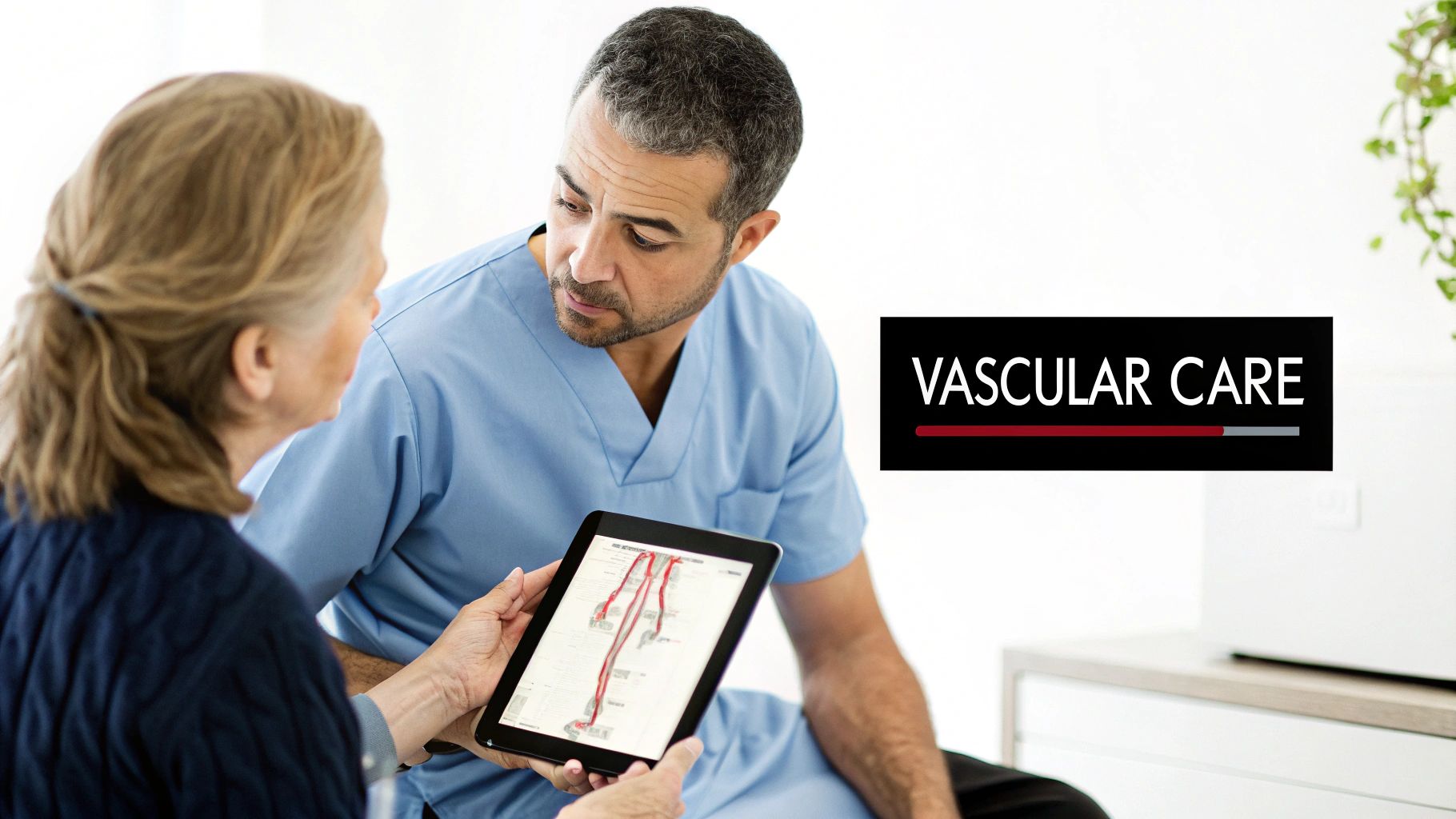
Think of your body’s vascular system as a massive, complex highway network. Arteries are the major freeways carrying oxygen-rich blood away from the heart, and veins are the routes bringing it all back. A vascular surgery specialist is the master engineer of this entire system, stepping in to ensure traffic flows smoothly and efficiently to every last part of your body.
Their role, however, extends far beyond the operating room. While the title includes “surgery,” a huge portion of their work involves non-surgical management and prevention. They are comprehensive managers of circulatory health, often becoming long-term partners with their patients on their wellness journey.
A Spectrum of Care Beyond Surgery
It’s a common misconception that a referral to a vascular surgeon automatically means a major operation is on the horizon. Not at all. In reality, their approach is carefully tailored and nearly always begins with the least invasive options possible. They are uniquely qualified to offer the full range of treatments precisely because their training covers every potential solution.
This complete toolkit allows a vascular surgery specialist to recommend the best course of action without being biased toward one particular treatment. Their primary goal is to resolve the underlying issue, not just to perform a procedure.
A top-tier vascular surgery specialist functions as both a diagnostician and a clinician, leveraging their expertise to create a personalized health roadmap. They decide whether the best route involves medication, a lifestyle adjustment, a minimally invasive procedure, or traditional open surgery.
Conditions Under Their Expertise
The scope of a vascular surgeon’s practice is remarkably broad. They address issues that can dramatically affect your quality of life and long-term health, managing everything from common cosmetic concerns to life-threatening emergencies.
Their expertise includes:
- Medical Management: Prescribing medications to manage high blood pressure, high cholesterol, or prevent dangerous blood clots.
- Lifestyle Counseling: Providing expert guidance on diet, exercise, and smoking cessation to improve vascular health and halt disease progression.
- Minimally Invasive Procedures: Using advanced endovascular techniques with catheters and stents to open blocked arteries or repair aneurysms through tiny incisions.
- Complex Open Surgery: Performing traditional surgical procedures like bypasses or aneurysm repairs when it’s necessary for the best long-term outcome.
Ultimately, a vascular surgery specialist provides a complete continuum of care. From the initial diagnosis of a silent condition like an aortic aneurysm to managing varicose veins with simple office-based procedures, they are the central authority on maintaining the health of your body’s critical supply lines.
What a Vascular Expert Actually Treats
A vascular surgery specialist is the master of the body’s entire network of arteries and veins—everything outside of the heart and brain. While the list of conditions they treat is extensive, most fall into three core categories: issues with arteries carrying blood away from the heart, problems with veins bringing it back, and critical structural failures in the body’s largest blood vessels.
Think of your circulatory system as a complex highway network. Arteries are the high-speed freeways delivering fuel (oxygenated blood), while veins are the service roads returning traffic. A vascular expert is like a master civil engineer and emergency response chief, capable of clearing blockages, reinforcing weak points, and rerouting traffic to prevent catastrophic failures.
Arterial Blockages and Narrowing
Arterial conditions are usually about blockages. Over time, a buildup of plaque (atherosclerosis) can narrow these critical freeways, creating a traffic jam that starves downstream tissues of the oxygen they desperately need.
- Peripheral Artery Disease (PAD): This is one of the most common issues a vascular surgeon sees. It’s essentially plaque buildup in the arteries of the legs and feet. The classic early sign is cramping in the calves when you walk or exercise, a symptom known as claudication, that disappears when you rest. If you ignore it, PAD can progress to constant pain, sores that won’t heal, and in the worst cases, limb loss. It’s a serious condition affecting an estimated 8.5 million Americans over 40.
- Carotid Artery Disease: This is the same plaque-buildup problem, but it happens in the carotid arteries—the two main pipelines supplying blood to your brain. It’s notoriously silent, often showing no symptoms at all until a stroke or a “mini-stroke” (transient ischemic attack) occurs. A vascular specialist has the tools to find this hidden threat and intervene before it causes a devastating neurological event.
Venous Disorders and Blood Clots
Venous problems are different. They’re less about blockages and more about flow and pressure. Your veins have a tough job, working against gravity to get blood back to the heart. They rely on a series of one-way valves to prevent backflow. When these valves fail, blood pools, pressure builds, and clots can form.
Your veins are like a plumbing system with one-way valves. When those valves get weak or damaged, you get backflow and pressure buildup. A vascular specialist is an expert in fixing these valves or dealing with the consequences of their failure.
Here are the most common venous conditions:
- Varicose and Spider Veins: Many people dismiss these as a cosmetic problem, but significant varicose veins are often a sign of a deeper issue called chronic venous insufficiency. They can cause aching, swelling, and a feeling of heaviness in the legs. Left unchecked, this can lead to skin damage and hard-to-heal venous ulcers.
- Deep Vein Thrombosis (DVT): This is a medical emergency. It happens when a blood clot forms in one of the deep veins, usually in the leg. You might notice sudden swelling, pain, and redness. The real danger is that a piece of that clot can break free, travel to the lungs, and cause a pulmonary embolism—a life-threatening event.
Major Vessel and Aneurysmal Disease
This category deals with the body’s “main pipelines,” particularly the aorta. These aren’t just blockages; they’re structural integrity failures that can have immediate and fatal consequences.
The classic example is an Abdominal Aortic Aneurysm (AAA). This is when a weak spot develops in the wall of the aorta—the body’s largest artery—as it runs through your abdomen. It begins to bulge outward, like a weak spot on a tire.
Most of the time, AAAs grow slowly and silently, without any symptoms. This is what makes them so dangerous. If the aneurysm gets too big, it can rupture, leading to massive internal bleeding that is almost always fatal. Vascular surgeons are trained to find these ticking time bombs, monitor them, and perform proactive repairs—either with traditional open surgery or newer, minimally invasive endovascular techniques—long before a rupture can happen. This is why screening for at-risk individuals, especially smokers and those with a family history, is so critical.
Understanding Modern Vascular Procedures
If you’re exploring vascular treatment, you’ve stepped into a remarkable field where surgical precision and incredible technology meet. Not that long ago, fixing a blocked artery or a dangerous aneurysm meant one thing: major open surgery. Today, a top-tier vascular surgery specialist can often resolve these life-threatening issues with techniques that would have felt like science fiction just a generation ago.
The fundamental difference is the approach. Traditional open surgery involves making a significant incision to get direct, hands-on access to repair a damaged blood vessel. This method is incredibly effective and remains the best choice for certain complex situations. The trade-off, however, is a longer hospital stay, a more demanding recovery, and a higher risk of complications like infection. It’s a powerful and proven tool, but it’s no longer the only tool.
The Rise of Endovascular Techniques
The modern alternative is a family of procedures known as endovascular surgery. The prefix “endo” means “within,” which perfectly captures the method. Instead of a large incision, the surgeon makes a tiny entry point—often no bigger than the tip of a pen—usually in the groin or wrist.
Through this small puncture, they guide a suite of sophisticated tools—thin, flexible tubes called catheters, fine wires, balloons, and stents—directly through the body’s natural highway of arteries and veins. Using real-time X-ray imaging as a live roadmap, they navigate right to the problem without disturbing the surrounding tissues. Think of it like a plumber clearing a blockage from outside by sending a tool down the pipe instead of tearing open a wall.
The essence of endovascular treatment is precision and subtlety. By working from within the blood vessel, a vascular surgery specialist can perform intricate repairs with minimal disruption to the body, leading to faster healing and a dramatically improved patient experience.
This infographic breaks down the main categories of conditions these modern procedures are designed to fix.
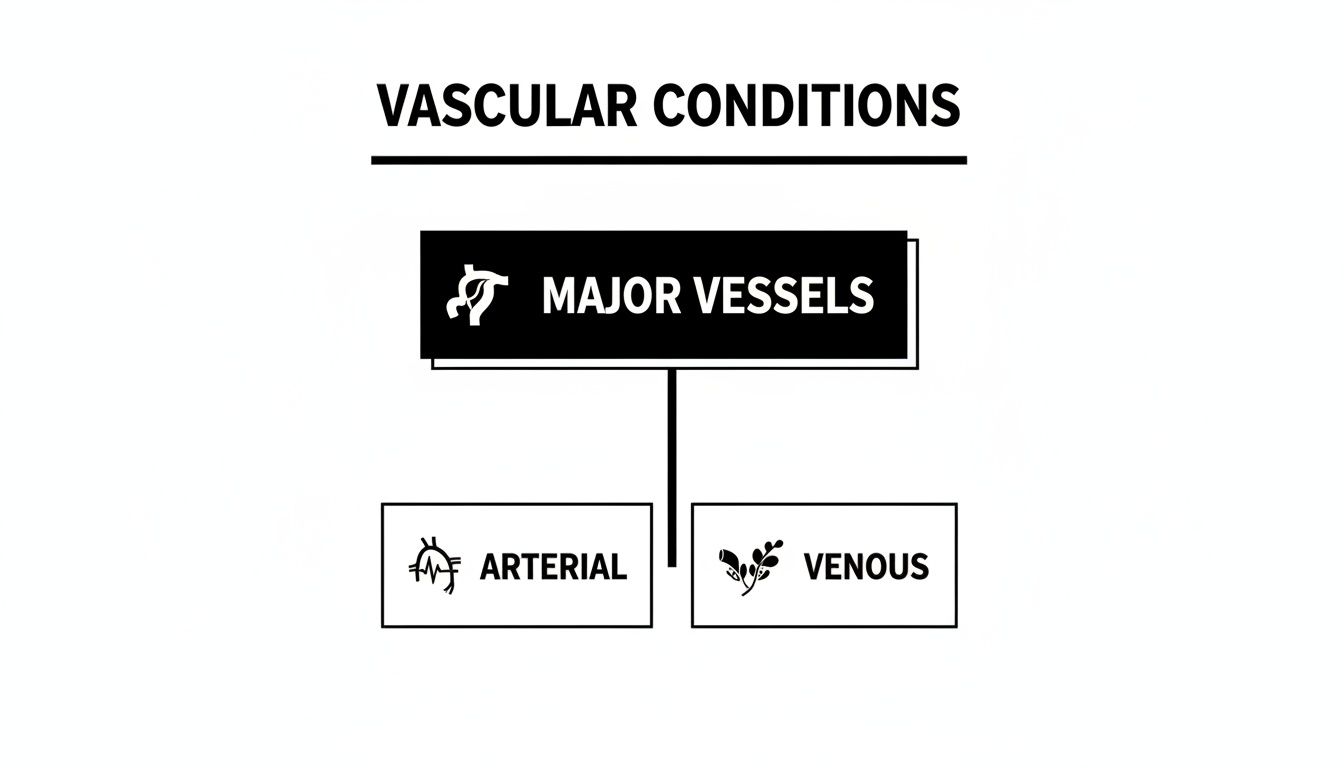
This visual helps clarify that whether the problem lies in a major vessel like the aorta or in the smaller arterial or venous pathways, a specialist has a specific set of tools for the job.
Personalizing Your Treatment Plan
What’s most critical in modern vascular care is that there’s no “one-size-fits-all” solution. An elite vascular surgeon doesn’t automatically favor one technique. Instead, they carefully assess your unique anatomy, the severity of your condition, your overall health, and your lifestyle goals to map out the absolute best approach for you.
For instance, a younger, healthier patient with a complex aortic aneurysm might be a perfect candidate for a durable open surgical repair. On the other hand, an older patient with multiple health challenges and a similar aneurysm would likely benefit more from a less taxing endovascular repair, known as an Endovascular Aneurysm Repair (EVAR). In an EVAR, a stent graft is deployed from inside the aorta to reline and strengthen the weak area, effectively sealing off the aneurysm to prevent a rupture.
Another common example is treating Peripheral Artery Disease (PAD) in the legs. For a short, simple blockage, a specialist might perform an angioplasty and stenting. Here, a tiny balloon is inflated inside the artery to compress the plaque, and a small metal mesh tube (a stent) is usually placed to prop the vessel open. This straightforward intervention can restore blood flow and eliminate debilitating leg pain in a procedure that might take less than an hour.
To make the differences clear, here’s a straightforward comparison of the two main approaches a vascular surgery specialist might discuss with you.
Comparing Open Surgery and Endovascular Procedures
| Feature | Open Vascular Surgery | Endovascular Procedures |
|---|---|---|
| Incision Size | Large, direct incision over the target vessel | Tiny puncture, typically in the groin or wrist |
| Hospital Stay | Several days to a week or more | Often same-day discharge or a short overnight stay |
| Recovery Time | Weeks to months, with significant restrictions | Days to a few weeks, with a quicker return to normal activity |
| Anesthesia | General anesthesia is almost always required | Can often be done with local anesthesia and sedation |
| Blood Loss | More significant potential for blood loss | Minimal blood loss |
| Scarring | A noticeable linear scar | A very small, often nearly invisible puncture site |
| Ideal Candidate | Patients with complex anatomy or extensive disease; younger patients needing maximum durability | Patients who are older, have other medical conditions, or have suitable anatomy |
Ultimately, having a vascular surgeon with deep expertise in both open and endovascular techniques is paramount. Their comprehensive training means they can give you an unbiased recommendation tailored specifically to you, ensuring the safest and most effective path back to health. This dual proficiency is the true hallmark of a top-tier expert.
Choosing the Right Specialist for Your Needs
When you’re facing a problem with your circulation, the medical world can feel like a maze of overlapping specialties. You’ll likely hear terms like interventional cardiologist, interventional radiologist, and vascular surgeon thrown around, and it’s easy to get confused. While all of these experts work on blood vessels, their training, philosophy, and the tools they bring to the table are fundamentally different.
Making the right choice from the start is critical because the specialist you see often dictates the treatment you’re offered. An interventional cardiologist’s world revolves around the heart’s arteries. An interventional radiologist is a master of using imaging to guide minimally invasive procedures throughout the body. Both are brilliant at what they do, but their expertise is, by design, highly focused.
The Comprehensive Skill Set of a Vascular Surgeon
A board-certified vascular surgery specialist offers something unique: a complete, unbiased perspective on your circulatory health.
Think of it this way: you need to renovate a historic home. You could hire a great plumber for the pipes and a skilled electrician for the wiring. But a master builder is the only one who understands the entire structure—from the foundation to the roof. They know when to repair a pipe, when to rewire a circuit, and when the project demands rebuilding a load-bearing wall. They can do it all, so they recommend what the house actually needs, not just what their specific trade offers.
That master builder is the vascular surgeon. Their demanding training is the only one that covers every single approach to treating vascular disease:
- Medical Management: They’re trained to manage conditions with medication and lifestyle adjustments, often making procedures unnecessary.
- Endovascular Procedures: They are experts in the same catheter-based, minimally invasive techniques used by other interventional specialists.
- Open Surgery: Crucially, they are the only specialists trained to perform complex open vascular operations—an essential option when a minimally invasive fix won’t last or the anatomy is too challenging.
Why This Complete Training Matters for You
This comprehensive training means you get a truly patient-first recommendation. Because a vascular surgeon is an expert in every possible treatment—from medication to a minimally invasive stent to a complex surgical bypass—they aren’t limited to a single playbook. They can objectively assess your specific condition and architect the absolute best solution, free from any bias toward the one tool they know best.
The true value of a vascular surgery specialist lies in their versatility. They are not just technicians skilled in one type of procedure; they are strategic physicians who can architect the ideal, personalized treatment plan from a complete range of options.
This versatility is invaluable. Say you have a blockage in your leg. If it’s best treated with a stent, they can perform that procedure with expertise. But if the blockage is too long or located in a high-stress area where a stent is likely to fail, they have the surgical skill to perform a bypass, giving you the best chance at a durable, long-term result.
Other specialists who lack surgical training are limited to offering only an endovascular approach, even when it might not be the most effective choice for you. Ultimately, connecting with a provider who possesses this complete skill set is a critical first step. Our guide on how to find the best doctors near you offers key insights for identifying these top-tier experts. Consulting a true vascular surgery specialist ensures you are seeing the one expert who can design and execute any solution your condition demands.
How to Identify a Top-Tier Vascular Specialist
When you’re dealing with your body’s circulatory system, choosing the right specialist isn’t just another decision—it’s one of the most critical health choices you can make. For patients who demand the highest level of expertise, finding a truly elite vascular surgeon requires looking far beyond a quick online search. It means knowing the definitive markers that separate a competent physician from a true leader in the field.
These markers go beyond just years of experience. They point to a verifiable, career-long commitment to the specialty, a dedication to continuous learning, and a proven track record of excellent patient outcomes. Finding this level of expert means you aren’t just hiring a doctor for a single procedure; you’re partnering with a master of vascular health who commands the full spectrum of advanced care.
The Unquestionable Gold Standard: Board Certification
The single most critical credential to look for is Board Certification in Vascular Surgery. This isn’t just a minor detail—it’s the absolute gold standard and the very first filter you should apply. To earn this, a surgeon must complete an intensive, accredited residency or fellowship program focused exclusively on vascular disease.
After that grueling training comes a series of rigorous written and oral examinations testing the full scope of their medical, endovascular, and open surgical knowledge. Certification by the American Board of Surgery is the clearest signal that a physician has met the highest standards of the profession and is committed to the lifelong learning required to maintain that elite status.
Beyond this essential benchmark, other qualifications can indicate a surgeon is operating at the pinnacle of their field.
- Fellowship Training: This signifies an extra one to two years of hyper-specialized training after a general surgery residency. It’s dedicated solely to mastering complex vascular procedures and is a clear mark of deep specialization.
- Academic Appointments: A specialist holding a position at a university or teaching hospital is often at the forefront of medical advancements and is trusted to train the next generation of surgeons.
- A History of Research: Involvement in clinical trials or publishing in peer-reviewed journals shows a commitment to advancing the entire field. It also means they can provide patients with access to the latest evidence-based treatments.
For discerning patients, the search is not merely for a qualified doctor but for a trusted authority. An expert with these credentials has demonstrated a career-long dedication to excellence, innovation, and the highest standards of patient care.
Assessing a Specialist’s Focus and Reputation
A specialist’s specific area of focus can also reveal their depth of expertise. While any board-certified vascular surgeon is highly skilled, some develop a particular mastery in certain areas, like complex aortic aneurysm repair, limb salvage for peripheral artery disease, or carotid artery surgery for stroke prevention. If your condition is particularly challenging, finding a surgeon with a deep focus in that exact area provides an invaluable layer of confidence.
Furthermore, reputation among peers is a powerful, often overlooked, indicator of quality. The best specialists are the ones other physicians turn to for consultations on their most difficult cases. They are active leaders in national surgical societies, a standing earned only through years of consistent, high-quality results. If you are looking for vetted experts, exploring a curated network can be a highly effective starting point. You can discover some of the best vascular surgeons who meet these elite criteria through dedicated professional directories.
The growing importance of this specialty is reflected in its rapid market expansion. The emergency general surgery services segment alone was valued at USD 3.32 billion in 2024. This growth is largely driven by an aging population, as patients over 65 now account for 61% of all vascular surgeries worldwide, highlighting the critical role these specialists play in senior healthcare. You can explore more detailed insights on this market’s growth and trends at MarketGrowthReports.com.
Your Questions About Vascular Health, Answered
Stepping into the world of vascular health can feel a bit overwhelming. You’re likely wondering about the practicalities—what to expect from your first appointment, what kinds of tests are involved, and what the path to recovery looks like. Getting clear answers demystifies the process, empowering you to move forward with confidence. Here are the answers to some of the most common questions we hear.
Do I Need a Referral to See a Specialist?
This really comes down to your insurance plan. If you have a PPO, you can often book directly with a specialist. HMO plans, on the other hand, almost always require a referral from your primary care physician first.
Honestly, regardless of your insurance, starting with your primary care doctor is a smart move. They can do an initial workup to confirm that a vascular surgery specialist is truly the right expert for your symptoms. This little bit of groundwork can make the whole process smoother.
What Happens During the Initial Consultation?
Think of your first appointment as a deep dive. Your specialist will want to understand the full picture, so expect a detailed conversation about your personal and family medical history, your lifestyle, and, of course, the specific symptoms that brought you in.
This is followed by a thorough physical exam. The specialist will pay close attention to the pulses in your limbs, check your blood pressure in different areas, and look for any visible clues like swelling or changes in skin color. This initial meeting is all about connecting the dots to build the foundation for your care plan and decide what, if any, diagnostic tests are needed next.
What Are Non-Invasive Vascular Lab Tests?
Before even thinking about a procedure, your specialist will likely send you to a vascular lab. These tests are completely painless and use ultrasound technology—the same kind of sound waves used for imaging during pregnancy—to create a live map of your blood vessels and measure how well blood is flowing through them.
These scans are the gold standard for diagnosing issues like Peripheral Artery Disease (PAD), blockages in the carotid arteries, and deep vein thrombosis (DVT), all without a single needle or any radiation.
You can think of a vascular ultrasound as a sophisticated traffic report for your circulatory system. It shows the specialist exactly where the slowdowns or complete blockages are, how bad they are, and the impact they’re having on circulation throughout your body.
What Is Recovery Like for Common Procedures?
Recovery time really depends on the type of procedure you have. For modern, minimally invasive endovascular treatments—like an angioplasty or placing a stent—the recovery is incredibly quick. Many people head home the very same day and are back to their usual routines within just a few days.
On the other hand, a major open surgery like a leg bypass is a bigger undertaking. That requires a hospital stay of several days, followed by a few weeks of taking it easy at home before you can get back to normal. It’s also a reminder that your overall heart health is crucial; learning about what is preventive cardiology can offer powerful strategies for protecting your entire circulatory system for the long haul.
Finding a specialist who aligns with your standards is paramount. The Haute MD network is a curated resource designed to connect discerning patients with the nation’s most respected, board-certified physicians, ensuring you receive premier, outcome-driven care. Explore our network to find a vetted expert near you at https://www.hauteliving.com/hautemd.