


Picking the right testosterone replacement therapy (TRT) isn’t just a medical decision—it’s a lifestyle choice. How you choose to restore your testosterone levels will directly impact your daily routine, convenience, and the consistency of your results. Your main options are injections, gels, patches, pellets, and oral formulations, and each one comes with a completely different set of trade-offs.
Getting a handle on these differences is the first real step toward having a productive conversation with your doctor.
Comparing Your TRT Options
Deciding on a TRT plan is about more than just fixing a number on a lab report. It’s about finding a method that fits so seamlessly into your life you barely have to think about it. Thankfully, as awareness of low T (hypogonadism) has grown, we’ve seen huge strides in treatment options, giving men more control than ever before. This is part of a larger, smarter trend in men’s health that prioritizes personalized care.
The global TRT market, valued at around USD 2.07 billion in 2024, is expected to hit USD 2.97 billion by 2032. That growth is no surprise when you realize that low testosterone affects an estimated 2–6% of men between 40 and 79. The need for effective, practical solutions is massive. For a deeper dive, you can read more about the testosterone replacement therapy market on databridgemarketresearch.com.
Key Factors To Consider
When you’re weighing your options, it’s not just about which method works best on paper. It’s about what works best for you.
Think through these key points:
- Dosing Frequency: Are you the kind of person who’s okay with a quick daily application? Or would you rather do a weekly injection and be done with it? Maybe a long-term implant you only think about a few times a year is more your speed.
- Hormone Stability: Some methods deliver very steady, stable hormone levels day in and day out. Others create noticeable peaks and valleys that can impact your mood and energy.
- Administration Method: Do you want something you can do yourself in two minutes at home? Or are you comfortable with a minor in-office procedure every few months?
- Lifestyle Impact: Be realistic about your life. Consider your travel schedule, daily activities, and whether there’s a risk of transferring medication to a partner or child.
The best TRT option is intensely personal. A protocol that’s perfect for one guy might be a total non-starter for another. This is why a real, collaborative decision with your doctor is non-negotiable.
Ultimately, TRT isn’t just about normalizing your testosterone. It’s a cornerstone of a much bigger wellness strategy. To get a better sense of the bigger picture, it’s worth understanding how hormone optimization and metabolic medicine improve healthspan.
Here’s a quick rundown of the most common TRT delivery methods, which we’ll break down in much more detail.
| TRT Option | Best For | Key Consideration |
|---|---|---|
| Injections | Cost-effectiveness and infrequent dosing | Creates hormonal peaks and troughs |
| Gels/Patches | Stable daily hormone levels and convenience | Risk of skin irritation and transference |
| Pellets | Long-term convenience (3-6 months) | Requires a minor in-office procedure |
| Oral/Nasal | Non-invasive, needle-free application | Often requires multiple daily doses |
Comparing TRT Delivery Methods Side By Side
Choosing the right testosterone replacement therapy isn’t about finding the “best” one-size-fits-all solution. It’s about finding the best fit for your life, your body, and your personal preferences. The world of testosterone replacement therapy options is surprisingly diverse, ranging from daily applications to long-term implants. Making a confident decision with your doctor comes down to understanding the real-world trade-offs of each method.
Every delivery system works differently, creating its own unique pattern of hormone absorption and stability. This directly impacts how you feel day-to-day and what’s required of you to manage your treatment. Let’s move past a simple pros-and-cons list and get into a practical, side-by-side analysis of how these therapies actually perform.
The infographic below gives you a sense of the scale of TRT, highlighting just how many men are seeking treatment and how the field is growing.
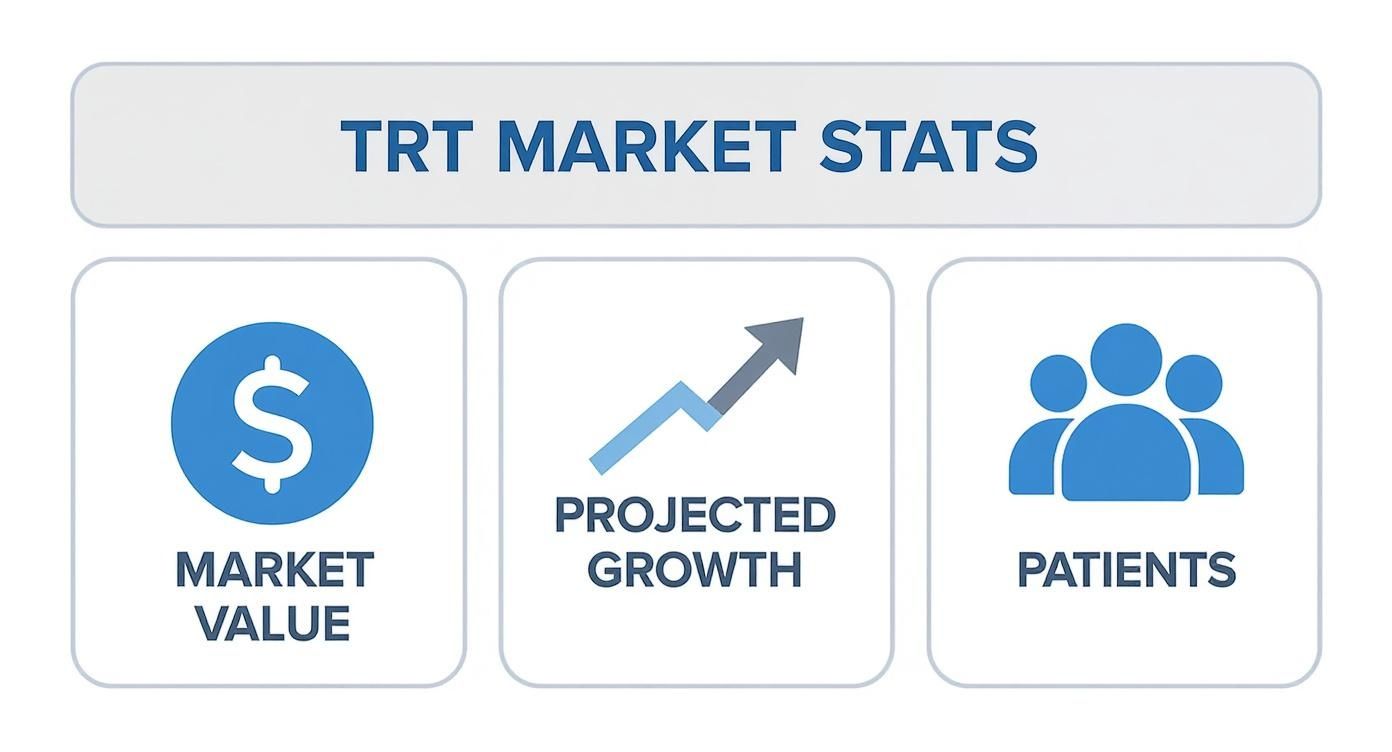
This growth isn’t just a market trend; it shows that low testosterone is increasingly recognized as a treatable condition, driving innovation and providing men with better options than ever before.
The Core Comparison Criteria
To really weigh these options, we need a consistent way to measure them. I find it boils down to four critical factors that will shape your experience and success with TRT:
- Dosing Frequency: How often do you have to think about your treatment? This spans from multiple times a day to just a few times a year.
- Hormone Stability: Does the method keep your testosterone levels smooth and steady, or does it create hormonal “peaks and troughs” that can mess with your mood and energy?
- Administration & Convenience: Is this something you do yourself at home, or do you need to go to a clinic? How much does it interrupt your daily routine?
- Cost & Accessibility: What’s the likely out-of-pocket cost each month, and how easy is it to get?
With this framework, we can build a clear picture of where each therapy shines and where it might not be the right fit for your specific needs.
Injections: A Cost-Effective Mainstay
Testosterone injections are the workhorse of TRT. They’re often the first method men consider, mainly because of their long track record, proven effectiveness, and relatively low cost. For good reason, they represent the biggest chunk of the market.
The primary drawback, however, is the hormonal rollercoaster they can create. After a shot, your T levels spike, then steadily fall until the next dose. While many guys get used to this cycle, some find the “trough” period right before the next injection brings back symptoms like fatigue and irritability.
- Dosing: Usually self-administered once every 7 to 14 days. Some protocols use smaller, more frequent shots (like twice a week) to smooth out the peaks and valleys.
- Stability: This is the big one. Injections are known for creating significant peaks and troughs, making them the least stable day-to-day option.
- Convenience: There’s a learning curve to self-injection (either into the muscle or just under the skin), but for most men, it quickly becomes a simple routine.
- Cost: This is where injections win, hands down. It’s generally the most affordable TRT option, often running between $30 to $100 per month.
Key Differentiator: Injections deliver the best bang for your buck, combining high efficacy with low cost. The trade-off is the cyclical hormone levels, which requires you to be in tune with your body and manage your schedule carefully.
Topical Gels and Patches: For Daily Stability
For men who hate needles and want to prioritize smooth, stable hormone levels, topical options are an excellent alternative. Gels and patches are applied once a day, delivering a steady stream of testosterone through the skin. This approach does a much better job of mimicking the body’s natural daily rhythm compared to injections.
That stability often translates to more even energy and mood. But this convenience comes with its own set of rules.
The biggest issue with gels is the risk of transference—accidentally exposing a partner, child, or pet to testosterone through skin-to-skin contact. This demands careful hygiene, like washing your hands thoroughly after application and making sure the area is covered by clothing. Patches get around this risk but can cause some pretty significant skin irritation for some users.
- Dosing: Applied once daily, typically in the morning.
- Stability: Provides very stable and consistent daily hormone levels.
- Convenience: It’s non-invasive and easy to do at home, but you have to be diligent every single day and take precautions against transference.
- Cost: Moderately priced, you can expect to pay anywhere from $200 to $500 per month, depending on the brand and your insurance.
Pellets: The Long-Term Solution
Think of testosterone pellets as the “set-it-and-forget-it” approach to TRT. In a minor in-office procedure, these tiny, rice-sized pellets are implanted under your skin, where they slowly release testosterone over 3 to 6 months.
This method is perfect for the busy guy who wants to eliminate a daily or weekly medical task from his to-do list. Your hormone levels stay remarkably stable for months on end, wiping out any issues with remembering doses. The main things to consider are the need for a clinical procedure for insertion and a higher upfront cost.
There’s also a small risk of infection at the insertion site or something called “pellet extrusion,” where your body pushes the pellet out. With a skilled doctor, however, these issues are rare.
- Dosing: Just one simple procedure every 3-6 months.
- Stability: Offers excellent, long-term stability with minimal day-to-day fluctuations.
- Convenience: After the quick procedure, the convenience is off the charts. There’s nothing you need to do daily or weekly.
- Cost: The upfront cost is higher, often $600 to $1,200 per procedure. But when you average it out over time, it can be quite competitive with other methods.
Oral and Nasal Options: Modern Alternatives
Newer forms of TRT have solved many of the problems that plagued older options. Today’s oral capsules and nasal gels are needle-free alternatives that are finding their place for specific situations.
Oral Capsules (e.g., Jatenzo): Forget the old-school methyltestosterone pills that were notoriously hard on the liver. Modern capsules are designed to be absorbed through the lymphatic system, which means they bypass the liver and dramatically reduce the risk of toxicity. They offer the ease of a pill but usually need to be taken twice a day with a fatty meal to work correctly.
Nasal Gels (e.g., Natesto): This is a unique one. You apply a gel inside each nostril two or three times per day. It absorbs quickly and has a very low risk of transference. The big hurdle is the frequent dosing schedule—it can be tough for anyone to stick to that consistently.
TRT isn’t a single treatment; it’s a whole spectrum of options, each with its own market share. In 2024, injectables still dominated, making up over half of the global market revenue. For instance, testosterone cypionate—a common injectable—brought in around USD 636 million in sales in 2024 alone. You can find more details on the TRT market breakdown at gminsights.com.
To help you see how these all stack up, here’s a quick summary table that puts the key differences side-by-side.
TRT Options At a Glance
This table gives you a quick, scannable overview of the core features for each TRT method, making it easy to compare them directly.
| TRT Method | Dosing Frequency | Hormone Stability | Administration | Typical Monthly Cost |
|---|---|---|---|---|
| Injections | Weekly or Bi-weekly | Low (Peaks & Troughs) | Self-Administered | $30 – $100 |
| Gels/Patches | Daily | High (Very Stable) | Self-Administered | $200 – $500 |
| Pellets | Every 3-6 Months | Highest (Consistent) | In-Office Procedure | $200 – $400 (Avg) |
| Oral | Twice Daily | Moderate to High | Self-Administered | $250 – $450 |
| Nasal | 2-3 Times Daily | Moderate (Short Bursts) | Self-Administered | $200 – $400 |
Hopefully, this gives you a clearer picture of the landscape. The best choice always comes down to a conversation with your doctor about what works best for your body, budget, and lifestyle.
Understanding Testosterone Injections

Of all the ways to get testosterone back to optimal levels, injections are the old guard—the most established, widely used, and battle-tested method out there. For many men starting TRT, injectables like testosterone cypionate and enanthate are the first stop, and for good reason. They are remarkably effective and, frankly, the most affordable option on the table.
This approach delivers testosterone directly into your body, which guarantees 100% bioavailability. Nothing gets lost in translation through the skin or digestive tract; you get every milligram. The idea of self-injecting can feel a bit intimidating at first, but almost every patient quickly finds it becomes a simple, two-minute routine. The real trade-off isn’t the needle—it’s managing the delivery cycle.
Administration and Dosing Schedules
Getting comfortable with self-administration is the first hurdle. Your doctor will walk you through the proper technique, but it usually comes down to two main options for where you inject:
- Intramuscular (IM): This is the classic method, using a longer needle to inject deep into large muscles like the glutes or thigh. It’s ideal for holding a larger volume of testosterone suspended in oil.
- Subcutaneous (SubQ): A more modern approach that many men prefer. It involves using a much smaller, thinner needle (like an insulin needle) to inject into the fatty tissue around the stomach or on the thigh. It’s often less painful and easier to manage.
The dosing schedule is where the real art of TRT comes into play. A very common protocol might be a single injection every 7 to 14 days. However, to sidestep the hormonal roller coaster, many clinicians now favor smaller, more frequent injections—think twice a week. This strategy creates a much more stable level of testosterone, smoothing out the peaks and troughs that can come with less frequent dosing.
Living with Hormonal Peaks and Troughs
The defining experience of injectable testosterone is its impact on your hormonal rhythm. Right after an injection, your testosterone levels climb sharply, hitting a peak within a day or two. Then, as the week goes on, those levels slowly drift downward, hitting a low point, or “trough,” right before your next dose is due.
This up-and-down cycle is the most significant practical reality for anyone on injectable TRT.
For many men, that “peak” feels fantastic—a surge of energy, a sharp mind, and a strong libido. But the “trough” can feel like a return of the old symptoms: fatigue, brain fog, or irritability.
Learning to manage this rhythm is everything. Plenty of guys adapt just fine and barely notice the fluctuations. Others are more sensitive to the shifts. If the lows become a problem, your doctor can easily adjust the dose or, more commonly, increase the injection frequency to keep your levels in a steadier, more optimal range.
Despite this, the unbeatable cost and proven effectiveness of injections mean that for countless men, managing the cycle is a small price to pay. It remains the bedrock of testosterone therapy for one simple reason: it works reliably and affordably.
A Closer Look at Topical Gels and Patches

For a lot of guys, the idea of weekly injections—with the hormonal ups and downs that can come with them—is a non-starter. This is where transdermal testosterone replacement therapy options, like gels and patches, really shine. They’re designed to mimic your body’s natural daily testosterone rhythm, delivering a steady, consistent dose right through the skin.
This daily application helps keep your energy levels and mood on a much more even keel. While the concept is simple—just apply it once a day—getting it right requires a bit of discipline to ensure it’s both safe and effective.
The Daily Routine and Key Considerations
The commitment is straightforward. You typically rub a gel onto your shoulders, upper arms, or stomach in the morning, usually after a shower. Patches work similarly; you apply one a day to a clean, dry patch of skin on your back, abdomen, or thighs, rotating the spot to avoid irritation.
But this convenience comes with two big asterisks: the risk of skin irritation and the very real danger of transference to others.
- Skin Irritation: The adhesive on patches can be a problem for some men, leading to redness, itching, or rashes. Gels are generally better tolerated, but skin sensitivity can still be an issue.
- Transference Risk: This is the most critical downside of gels. You can accidentally expose your partner, kids, or even pets to testosterone through skin-to-skin contact. Managing this risk is non-negotiable. It means washing your hands thoroughly after you apply it and making sure the area is completely dry and covered by clothing.
Topical TRT’s biggest advantage is its ability to deliver stable, physiological hormone levels every single day. The patient’s biggest responsibility is managing the real-world risks of skin irritation and accidental transference.
How Lifestyle Impacts Absorption
What you do during the day can absolutely affect how well topical testosterone works. Heavy sweating from a workout or jumping in a pool too soon after application can literally wash the medication off your skin before it has a chance to be fully absorbed.
This is why you have to let the gel dry completely—we’re talking at least a couple of hours—before you do anything that could interfere. It takes a little planning, but building it into a consistent morning routine is key.
A Growing Field of Transdermal Innovation
The transdermal delivery model just keeps getting better, which shows how reliable and popular it is. While TRT is most commonly associated with men, recent developments are pointing toward a future where it’s used more in female hormone therapy. In fact, in 2025, the UK approved AndroFeme 1, the first testosterone cream dosed specifically for women. That’s a huge milestone.
This kind of innovation highlights how far transdermal systems have come. You can dig into more of these TRT statistics and developments on pparx.org.
Ultimately, gels and patches are an excellent choice for men who want the needle-free convenience and hormonal stability. They’re best for guys who can stick to a daily routine and are meticulous about the safety precautions. For those men, the benefit of avoiding hormonal peaks and valleys easily outweighs the daily management.
Pellets, Oral, And Nasal TRT: Specialized Solutions
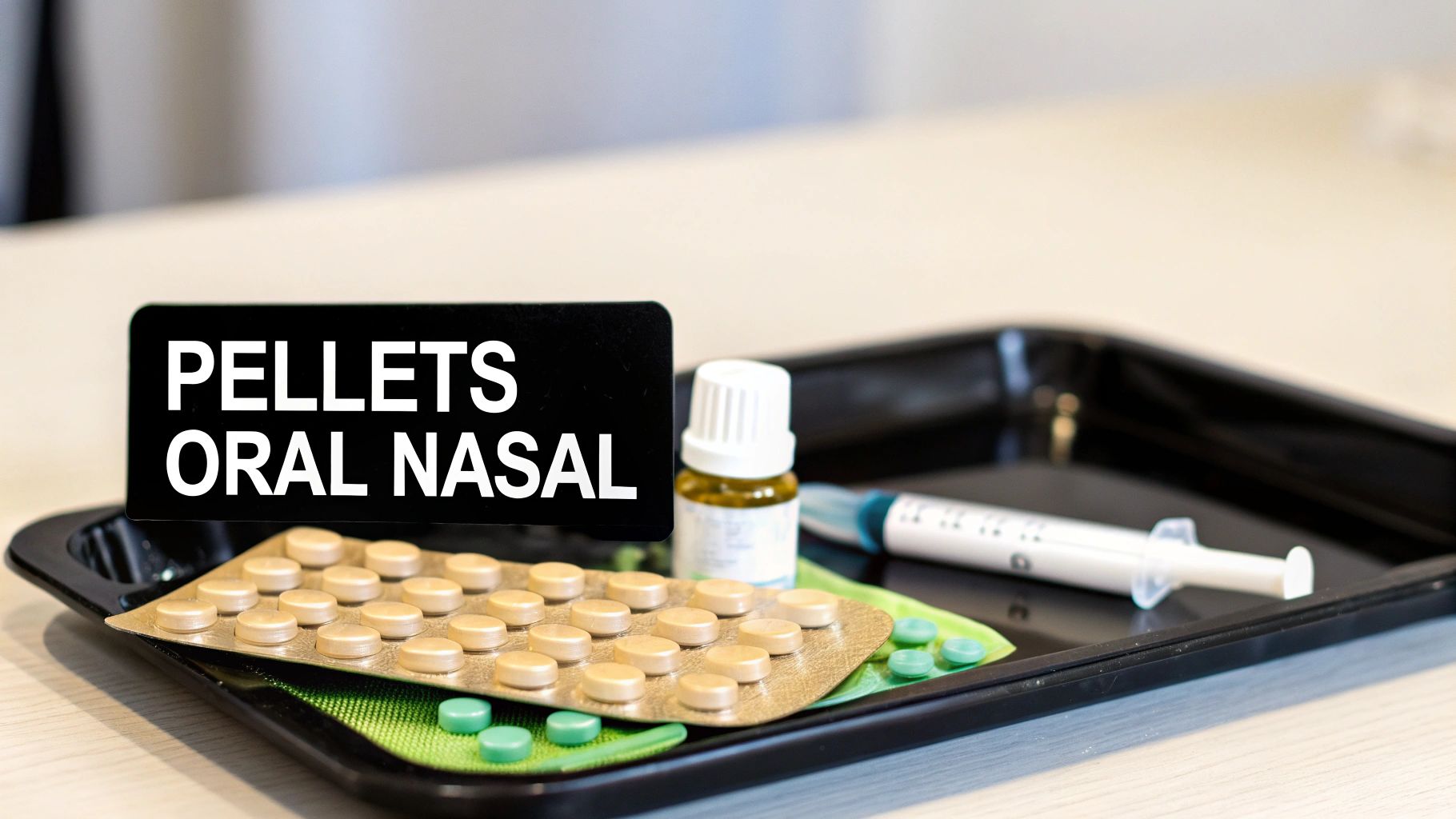
While injections and gels get most of the attention, the world of TRT offers other powerful options designed for very specific needs and lifestyles. These less common but highly effective methods—pellets, oral capsules, and nasal gels—solve unique problems for men who find daily creams or weekly shots a poor fit.
Each of these delivery systems answers a specific “what if.” What if you could get treated and not think about it again for months? That’s pellets. What if you want a needle-free option without the skin-to-skin transfer risk of gels? That’s where modern oral and nasal formulations come in.
Testosterone Pellets: The “Set It and Forget It” Method
For the man who wants his therapy to be completely out of sight and out of mind, testosterone pellets are a true game-changer. It’s a simple concept: during a minor in-office procedure, several tiny, rice-sized pellets are implanted just under the skin, usually in the hip area.
Once in place, they get to work, consistently releasing testosterone over three to six months. This delivery system produces some of the most stable hormone levels you can get, completely flattening the peaks and valleys that can come with injections. The trade-off is the procedure itself. While complications like infection or the pellet working its way out are rare with a skilled doctor, they’re still a possibility.
The undeniable appeal of pellets is the freedom. After a 15-minute procedure, you can go months without a single thought about your TRT schedule. This makes it a perfect match for frequent travelers, busy executives, or anyone who just wants to get on with their life.
Pellets are often made with bioidentical hormones, which are molecularly identical to the hormones your body produces naturally. To learn more about this approach, you can read this complete bioidentical hormone replacement therapy guide.
The New Generation of Oral and Nasal TRT
For years, doctors warned against oral testosterone because early versions were notoriously hard on the liver. But modern medicine has completely rewritten that story, engineering safe and effective formulations that offer a needle-free alternative.
- Oral Capsules: Today’s advanced oral testosterone (like Jatenzo) is designed to cleverly bypass the liver. Instead of being processed there, it’s absorbed through the body’s lymphatic system, which dramatically cuts the risk of liver strain. The catch? It has to be taken twice a day with a fatty meal to ensure it’s absorbed properly.
- Nasal Gels: A truly unique option, nasal gels (like Natesto) are applied directly inside the nostril. The testosterone is absorbed almost instantly through the nasal lining. This gives you a rapid testosterone boost with practically zero risk of transferring the medication to a partner or child. The main hurdle is the demanding schedule, often requiring you to apply it two or three times every single day.
These newer options show just how far hormone therapy has come, offering tailored solutions for nearly every preference. Ultimately, the right choice comes down to an honest conversation with your physician about your lifestyle, your body, and what you want to achieve long-term.
Finding The Right TRT Option For Your Lifestyle
Choosing the right testosterone replacement therapy goes far beyond clinical data. It’s about the practical, real-world fit. The best method is always the one that slots seamlessly into your daily life, aligning with your schedule, comfort level, and personal goals.
Think of it less like picking a medication and more like matching the therapy to your personal archetype. Are you constantly traveling for work with little time for a daily routine? A low-maintenance approach like pellets or even a weekly injection is probably your best bet.
On the other hand, if the very thought of needles is a deal-breaker, your search immediately narrows. You should be looking at daily, non-invasive options like gels or patches.
Matching Method To Motivation
Get honest about what you prioritize. Is it perfectly stable hormone levels day in and day out? Or is sheer convenience the most important factor? Your answer will point you directly to the right category of TRT.
- For Maximum Convenience: The “set-it-and-forget-it” nature of testosterone pellets is tough to beat. One simple, in-office procedure can have you covered for 3-6 months. It completely eliminates any daily or weekly tasks from your to-do list.
- For Stable, Needle-Free Daily Dosing: If you want consistency without injections, topical gels deliver steady hormone levels. This demands a consistent daily routine and, crucially, careful attention to prevent transferring the medication to family members.
- For Cost-Effective Control: Injections remain a highly effective, low-cost gold standard. They put you in direct control of your dosing, though you’ll need to learn how to manage the potential for hormonal peaks and troughs.
The right TRT plan feels less like a medical chore and more like a natural extension of your lifestyle. The goal is to find a sustainable rhythm that delivers results without adding unnecessary complexity to your life.
This personalized strategy is a cornerstone of modern hormone optimization and longevity medicine, which tailors treatments to the individual, not the masses. The single most effective step you can take is to discuss these lifestyle factors with your physician to make a confident, sustainable choice.
Answering Key Questions on TRT
As you start exploring the different routes for testosterone therapy, a few critical questions always come up. Getting clear, practical answers is the only way to feel confident working with your doctor to choose a path. Let’s break down the most common concerns patients have when they’re weighing their options.
We’ll cover hormone stability, safety profiles, and how fast you can expect to feel a difference. This is the essential information you need before moving forward.
Which TRT Method Keeps Hormone Levels Most Stable?
For many men, the number one goal of TRT is achieving stable, consistent hormone levels to smooth out the ups and downs in mood and energy. The methods that really nail this are the ones that deliver a continuous, slow release of testosterone, which does a better job of mimicking the body’s natural rhythm.
Typically, daily applications like topical gels and patches, or long-term solutions like implantable pellets, are the winners here. They are engineered to sidestep the significant “peaks and valleys” that often come with less frequent dosing, like weekly or bi-weekly injections.
By keeping testosterone in a steady state, these options often create a more predictable and even experience, dialing down the hormonal swings that can mess with how you feel day-to-day.
This stability is a huge draw and a major reason why guys who are sensitive to hormonal shifts often lean towards these choices.
Is One TRT Option Safer Than The Others?
When prescribed and managed by a skilled physician, all FDA-approved TRT methods are considered safe. But—and this is a big but—their risk profiles aren’t identical. Each one comes with its own unique set of safety considerations, and the right fit for you depends entirely on your personal health and lifestyle.
Let’s look at a few key distinctions:
- Topical Gels: The main risk here is transference. It’s possible to accidentally transfer the medication to a partner or child through skin-on-skin contact if you’re not careful.
- Pellets: This involves a minor in-office procedure, which brings a very small risk of infection or “extrusion,” where the pellet works its way out of the implantation site.
- Oral Formulations: While modern oral options are designed to be much safer for the liver, older versions carried a known risk of liver toxicity, which is why they fell out of favor.
Your doctor will run a thorough evaluation to recommend the therapy that aligns best with your individual health profile, building a treatment plan that is both safe and effective.
How Quickly Will I Actually Feel The Effects of TRT?
Every guy is different, but most men start noticing the initial benefits surprisingly quickly. The first shifts are usually in mood, mental clarity, and energy levels, with many reporting a noticeable positive change within the first 2 to 4 weeks of starting therapy.
Libido often perks up on a similar timeline. However, the more significant physical changes—the ones you can see—take a bit longer to show up. You can expect to see an increase in muscle mass and a reduction in body fat develop over 3 to 6 months of consistent treatment. This timeline holds true for pretty much all of the different testosterone replacement therapy options.
At Haute MD, we connect you with the nation’s leading physicians who specialize in hormone optimization and longevity. Find a rigorously vetted expert to guide your treatment journey and help you make the best choice for your health and lifestyle. Explore our network of top-tier doctors at https://www.hauteliving.com/hautemd.