



When the very foundation of your pelvic support system weakens, it can feel like your body has let you down. Pelvic reconstructive surgery is a highly specialized field dedicated to rebuilding that foundation—the intricate network of muscles and tissues that hold your pelvic organs in place. For women dealing with issues like organ prolapse or incontinence after events like childbirth or simply due to aging, this surgery is about much more than a physical repair. It’s about restoring function and giving you back your quality of life.
Restoring Your Body’s Foundational Support

It helps to think of your pelvic floor as a strong, flexible hammock. This web of muscles and ligaments stretches from your pubic bone back to your tailbone, cradling your bladder, uterus, and rectum. When it’s strong and fully intact, everything stays exactly where it should be, and your body functions as it’s designed to.
But major life events—especially pregnancy and childbirth—can stretch, strain, or even tear this critical support system. Other things like a chronic cough, years of heavy lifting, genetics, or just the natural aging process can also weaken it over time. As that hammock begins to sag, the organs it’s holding can start to slip downwards, a condition we call pelvic organ prolapse (POP).
The Goal of Surgical Intervention
The real purpose of pelvic reconstructive surgery isn’t just to fix the anatomy you see on a diagram. It’s about getting rid of the disruptive and uncomfortable symptoms that prolapse causes. The goal is to rebuild that core support structure so you can move through your day with confidence and comfort.
This specialized surgery is designed to:
- Lift and secure prolapsed organs, putting them back in their natural position.
- Repair weakened or torn tissues, often using your body’s own tissue for a more natural and durable fix.
- Reinforce the entire pelvic floor to restore long-term stability and prevent future problems.
- Correct related issues that often go hand-in-hand with prolapse, like urinary or bowel incontinence.
It’s about so much more than a simple anatomical correction. This is about restoring your confidence to laugh hard, go for a run, or lift your kids without the fear of leakage or that constant, nagging feeling of pelvic pressure.
A Modern and Personalized Approach
Thankfully, pelvic reconstruction has evolved far beyond the highly invasive operations of the past. Today’s specialists rely on minimally invasive techniques—including vaginal, laparoscopic, and robotic-assisted surgery—which mean smaller incisions, less postoperative pain, and a much faster return to your normal life.
These advanced methods give surgeons incredible precision to perform complex repairs. The entire process is centered on creating a personalized surgical plan that’s tailored to your specific anatomy, your symptoms, and what you want to get back to doing. For many women, for instance, finding a procedure that preserves the uterus is a top priority, and modern techniques make that possible.
Ultimately, the choice to have pelvic reconstructive surgery is a deeply personal one, made in partnership with a highly trained specialist. By understanding the fundamental goal—to rebuild your body’s essential support system—you’re in a much better position to explore your options and take that first step toward reclaiming your well-being. This guide will walk you through everything you need to know.
When Does Surgery Become the Right Path Forward?
The conversation about pelvic reconstructive surgery often starts quietly. It might begin with a nagging feeling of heaviness in your pelvis that gets worse throughout the day. Or maybe it’s the frustration of an unexpected leak during a laugh or a workout. These aren’t just minor annoyances; they’re signals from your body that your pelvic support system is struggling.
When conservative approaches like physical therapy haven’t brought the relief you need, or when symptoms start dictating your daily life, surgery becomes the logical next conversation. The decision is deeply personal, driven by how much your symptoms are impacting your quality of life. A specialist is the one who can help you connect the dots and determine if a surgical solution makes sense for you.
Decoding Pelvic Organ Prolapse
One of the most common reasons women end up in my office is Pelvic Organ Prolapse, or POP. This happens when the hammock of muscles and ligaments holding your pelvic organs in place weakens, allowing one or more of them to “drop” or descend. The result can be an uncomfortable bulge in the vagina or a persistent, dragging pressure.
We grade prolapse to understand its severity, which is key to guiding treatment. Think of it as a staging system for how far an organ has shifted from its proper home.
- Cystocele: This is when the bladder falls backward, bulging into the vagina. It often causes that frustrating feeling of not being able to empty your bladder completely.
- Rectocele: Here, the rectum bulges forward into the vagina, which can make bowel movements difficult and incomplete.
- Uterine Prolapse: The uterus itself descends into the vaginal canal. In more advanced cases, it can even become visible outside the body.
The need for effective solutions is undeniable. The global market for POP treatments is on track to hit USD 1.06 billion by 2030, which tells you just how many women are seeking real, lasting relief. In North America, surgery is often the definitive standard of care for moderate-to-severe cases—typically what we classify as POP-Q stage III and higher. You can explore more on the global trends in POP treatment here.
Addressing Incontinence and Regaining Control
Beyond prolapse, a weakened pelvic floor is the culprit behind incontinence—an issue that can be both embarrassing and profoundly limiting. When other methods have failed, pelvic reconstructive surgery can be a game-changer for restoring control and confidence.
Two main types of incontinence frequently lead patients to consider a surgical option:
- Stress Urinary Incontinence (SUI): This is the involuntary leak of urine that happens during moments of physical exertion—a cough, a sneeze, a jump, or a laugh. It occurs because the muscular support for the urethra is too weak to keep it sealed under pressure.
- Fecal Incontinence: In a similar way, damage to the muscles and nerves around the rectum can lead to an inability to control bowel movements or gas. This condition can be especially isolating and distressing.
For so many women, the decision to have surgery isn’t just about fixing a medical problem. It’s about reclaiming freedom—the freedom to enjoy a spin class, laugh without holding back, or lift a grandchild without a moment’s hesitation.
When a Previous Surgery Creates a New Problem
Another critical reason to seek out a top-tier specialist is to fix complications from a prior pelvic surgery, especially those that involved synthetic mesh. While mesh was once a go-to material, we now know it can cause significant long-term issues for some patients, including chronic pain, infection, or mesh erosion—where the implant literally wears through surrounding tissues.
In these cases, a highly skilled pelvic reconstructive surgeon must perform a revision surgery. This is incredibly delicate and complex work. The goal is to remove the problematic mesh and meticulously repair the underlying anatomy, often using the patient’s own native tissue to rebuild support. This level of specialized expertise is absolutely essential to resolve the pain and restore proper pelvic function for good. If you’re having symptoms after a previous procedure, a consultation is a crucial next step.
Understanding Your Surgical Options
When you’re facing pelvic reconstructive surgery, the array of choices can feel overwhelming at first. But it’s helpful to think of your surgeon like a master architect designing a custom support structure just for you. They have different techniques and materials in their toolkit, and their job is to choose the perfect combination to build the strongest, most functional, and most comfortable repair for your specific anatomy.
There’s no one-size-fits-all answer here. Your surgeon’s recommendation will be carefully considered, based on your overall health, the exact type and severity of your condition, and what you hope to achieve with the surgery. It’s a collaborative conversation, all aimed at finding the right path forward for you.
The diagram below shows the main conditions that pelvic reconstructive surgery is designed to correct. All of them stem from a weakness in the pelvic floor’s support system.
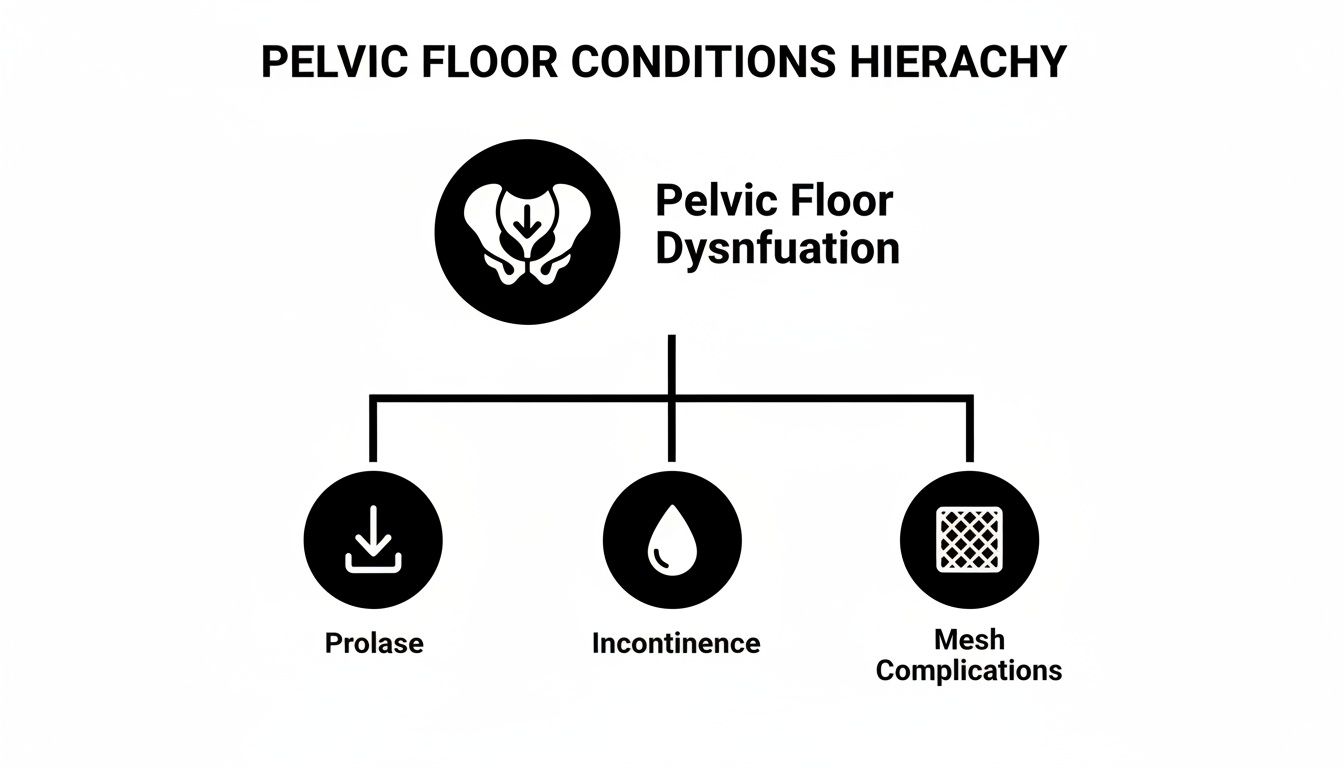
As you can see, prolapse, incontinence, and even complications from older surgeries are distinct problems that share a common root cause: a compromised pelvic floor.
Comparing Surgical Approaches
Modern pelvic surgery has come a long way, with a heavy emphasis on precision and minimizing downtime. Surgeons generally have four main ways to perform these repairs, each with unique benefits.
The table below breaks down the four main surgical approaches, giving you a clearer picture of how they differ in terms of incisions, advantages, and when they’re typically used.
Comparing Surgical Approaches for Pelvic Reconstruction
| Surgical Approach | Incision Type | Key Advantages | Best Suited For |
|---|---|---|---|
| Vaginal | No external incisions; all work done through the vaginal canal | Least invasive, no visible scarring, typically faster recovery | Many common types of prolapse repair where external access isn’t needed |
| Abdominal (Open) | Single larger incision on the lower abdomen (like a C-section) | Provides wide, direct access for the surgeon | Highly complex or extensive repairs, or revisions of prior surgeries |
| Laparoscopic | A few tiny “keyhole” incisions in the abdomen | Minimally invasive, reduced pain and scarring, faster recovery than open | A wide range of prolapse repairs, offering a balance of access and recovery |
| Robotic-Assisted | Several small keyhole incisions, similar to laparoscopic | Unmatched precision, 3D high-def vision, enhanced dexterity for surgeon | The most delicate and complex reconstructions, especially in tight spaces |
Ultimately, the best approach depends entirely on your specific diagnosis and your surgeon’s expertise. A great surgeon is proficient in multiple techniques and can recommend the one that offers you the highest chance of a successful, long-lasting outcome.
Choosing the Right Repair Materials
Just as critical as how the surgery is performed is what is used to rebuild your support structures. This decision is fundamental to the long-term strength and durability of the repair.
Native Tissue Repair This is often the go-to approach. The surgeon uses your body’s own healthy, strong ligaments and connective tissues to reconstruct the pelvic floor. Think of it as restoring the original architecture. Your tissues are carefully repositioned and sutured to bring everything back into its proper place. The major advantage is that no foreign materials are introduced into your body.
Biologic Grafts Sometimes, your own tissue might be too thin or weakened to provide a durable fix on its own. In these situations, a surgeon might use a biologic graft. This is a specially processed and sterilized piece of tissue from a donor source that acts as a scaffold. It encourages your own cells to grow into it over time, creating a new, reinforced layer of support.
Synthetic Mesh Synthetic mesh is a medical-grade material used to bridge a gap or reinforce a weak area, similar to using a patch to repair a tear in strong fabric. While it can provide very robust support, its use has become highly specialized due to concerns about potential complications. Today, it’s typically reserved for very specific procedures, like an abdominal sacrocolpexy, where it has a proven track record of excellent long-term success.
A huge part of your consultation will be this exact discussion about materials. Your surgeon should be able to clearly explain why they are recommending one option over another for your body, carefully balancing the need for a durable repair with the goal of the safest possible outcome.
Walking into that conversation prepared will empower you to make a confident choice. For a great starting point, check out these insightful questions to ask before surgery. Remember, your surgeon is your partner in this. Their job is to make sure you feel you understand every single aspect of the plan before moving forward.
Finding the Right Surgeon for You
Choosing the surgeon who will perform your pelvic reconstructive surgery is arguably the most important decision you’ll make in this entire process. This isn’t just about finding a doctor; it’s about finding a specialist with the precise, advanced training needed to navigate the complex anatomy of the pelvic floor. The right surgeon dramatically influences your outcome, ensuring a repair that is both effective and built to last.
Think of it this way: if you needed a sophisticated heart procedure, you wouldn’t go to a general practitioner. You’d seek out a cardiologist who has dedicated years to mastering that one area. The same principle applies here. While your general OB-GYN is a trusted expert in routine care, pelvic reconstruction demands a much higher level of specialized training.
The Urogynecologist Difference
The absolute gold standard in this field is a Urogynecologist, also known as a Female Pelvic Medicine and Reconstructive Surgery (FPMRS) specialist. This isn’t just a title; it’s a credential that represents years of additional, rigorous training after completing a standard OB-GYN residency.
An FPMRS specialist has completed a fellowship focused specifically on:
- Diagnosing and treating complex pelvic floor disorders, from every type of prolapse to severe incontinence.
- Mastering multiple surgical techniques, including vaginal, laparoscopic, and robotic-assisted approaches.
- Managing surgical complications and performing delicate revision surgeries, like removing problematic mesh.
This advanced training means they can create a truly personalized treatment plan. They don’t have a “one-size-fits-all” approach because they are skilled in a wide spectrum of solutions, from non-surgical options to the most advanced reconstructions.
This expertise is critical. The number of women needing surgery for pelvic organ prolapse is expected to grow by nearly 47% by 2050. And about one-third may need a second surgery due to recurrence. Finding an expert who can get it right the first time is paramount. You can explore the full study on the growing need for specialized pelvic surgery here.
Key Questions for Your Consultation
Once you’ve found a board-certified Urogynecologist, your consultation is your chance to make sure they’re the right fit. This is a partnership, and you should feel completely confident in their skills and their approach.
A great surgeon welcomes your questions. They understand that an informed patient is an empowered patient, and they will take the time to ensure you feel comfortable and clear about every step of the process.
Walk into that meeting with a list of questions ready to go. Here are some of the essentials to ask:
- Are you board-certified in Female Pelvic Medicine and Reconstructive Surgery (FPMRS)?
- How many procedures like the one you’re recommending for me do you perform each year?
- What is your success rate with this specific surgery?
- Do you offer a full range of treatment options, including non-surgical alternatives?
- What is your philosophy on using native tissue versus mesh or grafts for repairs?
Their answers will give you a clear sense of their experience and whether their surgical philosophy aligns with your personal goals. Don’t skip this step. Our guide on how to find the best doctor for your needs offers more valuable tips for this crucial process.
What to Expect During Recovery and Beyond

The surgery itself is just one part of your journey back to comfort and confidence. A truly successful outcome from pelvic reconstructive surgery hinges on what happens after you leave the operating room. Understanding the recovery timeline and your role in it is the key to achieving the best possible long-term results.
Your recovery is a gradual, deliberate process, not a race. It’s designed to give your body the time it needs to heal the deep, internal repairs. While every woman’s experience is unique, the timeline is structured and predictable, setting clear expectations from the moment you wake up to your full return to an active life.
The Initial Phase: Your Hospital Stay
Thanks to modern, minimally invasive techniques, your hospital stay will likely be brief. Many procedures are even performed on an outpatient basis, meaning you can go home the same day. For more complex reconstructions, a stay of 24 to 48 hours is typical.
During this time, the entire focus is on a smooth transition:
- Pain Management: Your comfort is the top priority. Your medical team will manage any post-surgical discomfort with medication to keep it at a very tolerable level.
- Monitoring: Nurses will keep a close eye on your vital signs and make sure your bladder is functioning properly after the procedure.
- Early Mobility: You’ll be encouraged to get up and walk as soon as possible. Gentle movement is fantastic for preventing blood clots and kick-starting the healing process.
Before you’re discharged, your surgical team will arm you with detailed instructions for at-home care. This covers everything from managing pain and caring for incisions to knowing exactly what signs warrant a call to the doctor’s office.
The First Six Weeks at Home
These first few weeks post-surgery are the most critical for healing. Your body is working overtime to repair tissues and secure the reconstruction. Your main job is simple but vital: rest and avoid any activity that puts strain on your pelvic floor.
Your surgeon will provide a strict list of restrictions. These aren’t just suggestions; they are non-negotiable for ensuring a durable, lasting repair.
Following your surgeon’s post-operative instructions isn’t just a recommendation—it is the single most important factor within your control for achieving a successful, lasting surgical outcome.
Common restrictions during this initial six-week period include:
- No Heavy Lifting: Avoid lifting anything heavier than a gallon of milk (about 8-10 pounds). Seriously.
- No Strenuous Activity: This means no running, high-impact exercise, or intense workouts of any kind.
- No Sexual Intercourse: The tissues need uninterrupted time to heal completely.
- Avoid Straining: Take steps to prevent constipation, as straining during bowel movements puts direct pressure on the surgical site.
Gentle walking, however, is highly encouraged. It boosts circulation and aids healing without stressing the repair. Most women find they can gradually increase the length and frequency of their walks as the weeks go by.
Beyond Six Weeks: The Role of Physical Therapy
Around the six-week mark, you’ll get the green light from your surgeon to begin the next crucial phase of your recovery: pelvic floor physical therapy. This isn’t an optional add-on; it’s a fundamental part of locking in the success of your surgery for the long term. A specialized physical therapist will design a program just for you.
The goals of post-surgical physical therapy are to:
- Re-educate Pelvic Floor Muscles: You’ll learn how to correctly contract and—just as importantly—relax your pelvic muscles to support the surgical repair.
- Strengthen Core Support: Building strength in your deep abdominal and back muscles creates a “natural corset” that reduces pressure on the pelvic floor.
- Ensure a Safe Return to Activity: Your therapist will be your guide, showing you how to safely reintroduce exercise and daily activities without compromising your results.
Think of this guided rehabilitation as your insurance policy for the future. By strengthening your body’s own support system, you actively protect the surgical repair and dramatically lower the risk of future prolapse or incontinence. It’s the final step that bridges the gap between a successful surgery and a lifetime of renewed confidence.
Exploring Alternatives to Surgery
Deciding on pelvic reconstructive surgery is a huge step, but it’s critical to know that it’s rarely the first or only road to take. Any top-tier specialist will tell you the same thing: we always explore conservative, non-surgical treatments first. For many women, especially those with mild to moderate symptoms, these alternatives can bring substantial relief and may even delay—or entirely eliminate—the need for an operation.
The real goal is to find the least invasive path that gets you back to feeling comfortable and living your life fully. This patient-first philosophy ensures your treatment plan is built around your body’s needs and your personal comfort level.
Rebuilding Strength with Physical Therapy
One of the most powerful non-surgical tools in our arsenal is Pelvic Floor Muscle Training (PFMT), guided by a physical therapist who specializes in this area. Think of this as personal training for your body’s deep core support system. This therapy is a world away from just being told to “do more Kegels.”
A trained therapist works with you to:
- Isolate and Strengthen: They teach you how to correctly find and fire up the precise muscles that support your bladder, uterus, and rectum. Many people engage the wrong muscles, but a specialist can get you on track.
- Improve Coordination: It’s not just about strength, but about timing. The therapy re-educates your muscles to work in perfect harmony, providing dynamic support exactly when you need it—like when you cough, laugh, or lift something heavy.
- Address Specific Weakness: You’ll get a customized exercise plan designed to rebuild the foundational strength of your entire pelvic floor, not just one part of it.
For many, PFMT is the first line of defense, and for good reason. It puts you in the driver’s seat of your own recovery, using your body’s natural ability to heal and restore function.
Mechanical Support with Pessaries
Another fantastic non-surgical option is a pessary. This is a small, flexible device, usually made of soft, medical-grade silicone, that is inserted into the vagina to provide internal support for the pelvic organs. The best analogy is a custom orthotic for your pelvic floor—it physically lifts and holds prolapsed organs in a more natural, comfortable position.
Pessaries come in all sorts of shapes and sizes. Your doctor will fit you for one to make sure it’s both comfortable and effective. They are an ideal choice for women who want to avoid surgery, aren’t good candidates for an operation, or need to manage symptoms while planning for a procedure down the line.
Simple lifestyle adjustments can also make a world of difference by reducing strain on the pelvic floor, like managing your weight and tweaking your diet to prevent constipation. When you combine these strategies, you create a robust, non-surgical approach to feeling better. And as medicine continues to advance, it’s worth knowing how regenerative medicine is creating new non-surgical possibilities across many different fields of health.
Frequently Asked Questions About Pelvic Surgery
Thinking about pelvic reconstructive surgery naturally brings a lot of questions to the surface. Getting clear, straightforward answers is the best way to feel confident and prepared for what lies ahead. Here, we’ll tackle some of the most common concerns patients have about the procedure, recovery, and what life looks like afterward.
How Long Does a Surgical Repair Last?
The goal of any modern pelvic repair is to provide a durable, long-lasting solution. While success rates are generally high, the longevity of the results really depends on a few key factors: the strength of your own tissues, the specific surgical technique used, and, just as importantly, how closely you follow your post-operative guidelines.
While many repairs are designed to last a lifetime, some traditional native tissue procedures can have recurrence rates of up to 30%. Your surgeon will be able to discuss the expected durability of your specific procedure and may recommend certain techniques or materials to give you the best possible long-term support.
When Can I Get Back to My Normal Life?
Patience is key here. A careful, phased approach to recovery is absolutely essential for protecting your surgical repair and ensuring a successful outcome.
- Exercise: Most surgeons will advise you to avoid all strenuous exercise and heavy lifting for at least 6 to 12 weeks. This downtime is critical for allowing the deep internal tissues to heal fully without being put under strain. Gentle walking, however, is encouraged almost right away to promote good circulation.
- Sexual Activity: Similar to exercise, you’ll need to abstain from sexual intercourse for a minimum of six weeks, and often a bit longer, depending on your exact procedure. Your surgeon will give you a clear, personalized timeline during your post-op appointments.
Will This Surgery Affect My Bladder or Bowel Function?
For the vast majority of patients, the entire point of pelvic reconstructive surgery is to improve bladder and bowel function, not harm it. The surgery works by restoring the natural anatomical support to the bladder and rectum, which directly addresses the root causes of issues like incontinence and incomplete emptying.
It’s normal to have some temporary swelling that can cause minor changes in function during the initial healing phase. But once that subsides, most patients experience a significant and lasting improvement in their symptoms. A thorough pre-operative evaluation, which often includes urodynamic testing, helps your surgeon map out a plan that maximizes functional improvement and minimizes any potential risks.
What Are the Most Important Risks to Understand?
All surgeries come with general risks, like infection or bleeding. But with pelvic reconstructive surgery, it’s important to talk about the risks specific to this delicate anatomical area. These can include injury to nearby organs like the bladder or rectum, or potential complications related to the use of surgical mesh, if that’s part of your plan.
The single most effective way to minimize these risks is to choose a board-certified, high-volume Urogynecologist. Their specialized training and deep experience are directly linked to lower complication rates and better outcomes for patients. A top specialist will have a completely open and honest conversation about all potential risks and explain the precise safety measures they take to ensure a successful surgery.
Finding a physician with the right expertise is the most important step in your healthcare journey. Haute MD provides a curated network of the nation’s leading specialists, connecting you with board-certified experts who are leaders in their fields. Discover trusted, top-tier doctors dedicated to delivering exceptional outcomes.