


Your online reputation as a doctor is the sum of everything patients find when they search for you online. It’s what shapes their perception across review sites, social media profiles, and search results. The goal is to proactively build a positive digital footprint and responsibly manage patient feedback—because that’s how you build trust and bring new patients through your door.
In an era where a patient’s first move is a Google search, a strong digital reputation has become just as critical as your clinical skill.
Why Your Digital Reputation Now Defines Your Practice

The days when word-of-mouth referrals alone could fill a waiting room are long gone. Today, your digital presence is your new front door, and a patient’s trust is won or lost before they even think about booking an appointment. This isn’t just a fleeting trend; it’s a fundamental change in how people find and choose healthcare.
When someone experiences a new symptom, they don’t just ask a neighbor for a recommendation anymore. Their first instinct is to pull out their phone and look up ways to find top-rated physicians near me. That initial search creates an immediate impression based on star ratings, recent reviews, and the overall feel of your online profiles.
The New Patient Journey Starts Online
The journey to your office is now almost entirely self-directed and digitally driven. It kicks off with a need and immediately pivots to online research. Potential patients scan Google, Healthgrades, Vitals, and Yelp, comparing you against other physicians based on the experiences of complete strangers. This digital vetting is now the primary way patients decide if you’re credible and if they can trust you with their care.
Think about the realities of today’s patient:
- Social Proof is Everything: A 4.9-star rating from dozens of patients often carries more weight than a single referral from an acquaintance.
- Negative Feedback Has an Outsized Impact: Just a handful of unanswered negative reviews can plant a seed of doubt, deterring countless potential patients who will simply move on without a word.
- Accessibility is Non-Negotiable: Patients expect to find everything they need easily—your specialty, office photos, and clear instructions for booking an appointment.
This new dynamic makes online reputation management an essential part of running a modern practice. It’s not an exaggeration to say that by 2025, it has become a defining factor for physicians everywhere. A recent survey revealed that 77% of patients now use online reviews as their very first step when looking for a new doctor. That’s a massive shift away from traditional referrals and toward digital social proof. Patients aren’t just glancing at the star count; they’re digging into the sentiment of the reviews.
Your online presence is a living, breathing extension of your medical practice. It operates 24/7, shaping perceptions and influencing decisions while you focus on patient care. Ignoring it means allowing your reputation to be defined by random chance rather than by your expertise and commitment.
The table below breaks down exactly where your reputation intersects with a patient’s decision-making process.
The Modern Patient Journey: A Digital-First Approach
This table shows the key stages where your online reputation can either attract or repel a potential patient.
| Patient Action | Reputation Touchpoint | Impact on Decision |
|---|---|---|
| Initial Search: “Best dermatologist near me” | Google Business Profile star rating, top search results. | A low rating or no profile can remove you from consideration instantly. |
| Deeper Vetting: Clicks on review sites. | Reading recent reviews on Healthgrades, Vitals, Yelp. | Unanswered negative comments or old positive reviews create doubt. |
| Profile Review: Visits your website or social media. | Outdated website, lack of professional photos. | A neglected digital presence suggests a lack of attention to detail. |
| Final Comparison: Compares you to 2-3 other doctors. | Consistent positive sentiment across multiple platforms. | Strong, consistent reviews build the confidence needed to book. |
| Booking Decision: Looks for booking info. | Easy-to-find phone number or online booking link. | A seamless final step converts a searcher into a new patient. |
Each touchpoint is a test. Passing them all is how you turn a curious searcher into a confirmed appointment.
From Passive Presence to Active Strategy
Shifting from a passive online existence to an active reputation strategy is no longer a choice. A neglected digital profile—one with outdated information, no recent reviews, or unanswered criticism—sends a powerful, negative message. It suggests a practice that isn’t engaged or attentive, which can be a major red flag for discerning patients.
Ultimately, mastering your digital reputation isn’t about vanity. It’s about making sure the high quality of care you provide in the exam room is accurately reflected in the digital world where new patients are making their decisions. It’s a direct line to acquiring new patients, reinforcing trust with current ones, and securing the long-term health of your practice.
Your First Step: A Digital Reputation Audit

Before you can steer your reputation where you want it to go, you need an honest map of where you’re starting from. That’s what an online reputation audit gives you—an essential, clear-eyed look at your current digital footprint.
This isn’t just about a quick Google search. It’s a deep, systematic dive to uncover every place a patient might form an opinion about you or your practice. The goal is to build an objective, evidence-based snapshot of your online presence. Without this baseline, any effort to improve your reputation is just guesswork. You need to know what patients are saying, where they’re saying it, and what story is currently being told about you online.
Where to Look: Your Search Checklist
A real audit means looking beyond the obvious. Your digital presence is almost always more spread out than you think, spanning healthcare directories, general review sites, and social media. Your first job is to hunt down every single place your name or practice appears online.
Start by opening an “incognito” or private browser window. This simple step prevents your personal search history from skewing the results, giving you a much more accurate view of what a prospective patient actually sees.
Your essential search list should include:
- Major Healthcare Directories: Systematically check your profiles on Healthgrades, Vitals, Zocdoc, and WebMD. Are they claimed? Is the information accurate and up-to-date?
- General Review Platforms: Never underestimate the power of a Google Business Profile, Yelp, and even Facebook Pages. These are often the first results a patient sees.
- Professional and Social Networks: Look at your profiles on LinkedIn and Doximity. Patients absolutely look here to verify credentials and get a sense of your professional standing.
- Insurance Company Directories: A huge number of patients find their doctors through an insurer’s provider search. Check these listings for accuracy and any patient comments.
A common mistake I see is physicians focusing only on one or two big-name sites. But a single outdated profile on a lesser-known directory can create confusion and reflect poorly on your attention to detail. Consistency across every single platform is how you build trust.
As you find these profiles, document everything. A simple spreadsheet is perfect for this. Log the platform, the URL to your profile, your current star rating, the number of reviews, and the date of the most recent feedback. This document becomes the foundation of your entire reputation management strategy.
What to Analyze: Reading Between the Lines
Once your data is gathered, the real work begins. This is where you move past star ratings and dig into the substance of what’s being said. Your goal is to identify the patterns and themes—both good and bad—that reveal what patients truly value and where their frustrations lie.
Look for the keywords that pop up again and again. Are patients consistently praising your “bedside manner” or “thorough explanations“? On the flip side, are there repeated complaints about “long wait times,” “billing issues,” or an “unfriendly front-desk staff“? These themes are goldmines of actionable insight.
Categorize the feedback to see the big picture:
- Sentiment Analysis: What’s the overall tone? Is it overwhelmingly positive, negative, or a mixed bag? A few negative reviews are inevitable, but a clear trend of negative sentiment points to a systemic issue that needs your attention.
- Theme Identification: Group comments into buckets like Clinical Care, Office Environment, Staff Interaction, and Appointment Scheduling. This helps you pinpoint specific operational strengths and weaknesses with precision.
- Response Assessment: Take a hard look at how—or if—reviews have been responded to. Unanswered negative feedback can be more damaging than the review itself because it suggests you don’t care.
This audit isn’t a one-time chore. It’s the first step in a continuous cycle of monitoring and improvement. It gives you the clarity to build a strategy that truly reflects the quality of care you provide, turning your digital presence into one of your practice’s greatest assets.
Once you’ve taken stock of your digital footprint, it’s time to shift from analysis to action. This is the part where you stop reacting and start deliberately shaping the online narrative around your practice. The goal is to build a strong, positive foundation that truly reflects the quality of care you provide.
A proactive approach means that when potential patients search for your name, they find a digital presence that immediately builds trust. This isn’t about creating a fake persona; it’s about making sure your hard-earned reputation is communicated accurately and effectively online. When you get this right, your online presence becomes your best defense against the occasional negative review and a powerful magnet for attracting the right kind of patients.
Optimize Your Professional Directory Profiles
Think of your profiles on sites like Healthgrades, Vitals, and Zocdoc as digital front doors to your practice. Leaving them unclaimed or half-finished is like letting the paint peel on your office entrance—it sends the wrong message. It is absolutely crucial to claim and fully optimize every single one.
Here’s what you need to focus on:
- A Professional Headshot: Use a high-quality, recent photo where you look both professional and approachable. This simple step does wonders to humanize your profile and build an instant connection.
- A Detailed Biography: Don’t just list your credentials. Share your philosophy of care. What drew you to your specialty? What can patients expect when they sit down with you? This is your chance to connect on a human level.
- Meticulously Accurate Information: Double- and triple-check that your office locations, hours, contact info, and accepted insurance plans are correct on every platform. Inconsistencies create friction and can easily deter a potential patient before they even pick up the phone.
Each profile is a digital handshake. The more complete and compelling it is, the more likely a patient is to take the next step and book an appointment.
Create a Patient-Centric Website and Blog
While directory profiles are important, your practice website is the one piece of online real estate you completely own and control. It needs to be more than just a brochure. It should be the central hub of your digital world, designed for your patients and packed with valuable information that establishes your authority.
Let’s be clear: how you look online directly impacts patient behavior. The data is overwhelming. By 2025, over 70% of patients will check online reviews before choosing a new doctor, and 65% conduct online searches before ever making contact. If you want a deeper dive, these doctor marketing statistics paint a very clear picture of the modern patient journey.
Your website shouldn’t just list your services. It needs to be a resource that empowers patients with knowledge, builds trust through education, and reflects the same high standard of care they would receive in your office.
A practice blog is one of the most effective tools to make this happen. By regularly publishing articles on common health concerns, new treatments, or preventive care, you’re not just helping your search engine rankings. You are positioning yourself as a trusted authority in your field. For some great examples of content that resonates with a sophisticated audience, take a look at the expert insights featured in our Doctor Talk section.
Ethically Encourage Patient Reviews
Nothing is more powerful than authentic, positive feedback from your actual patients. A steady stream of recent, positive reviews is the ultimate social proof—it’s the validation that new patients are actively looking for. The trick is to build a simple, ethical, and consistent process for encouraging them to share their experiences.
First, a critical rule: never offer incentives for reviews. This violates the terms of service for most platforms and, more importantly, destroys your credibility if discovered. The focus should be on making it incredibly easy for happy patients to leave feedback.
- Timing is Everything: The ideal moment to ask for a review is shortly after a positive interaction, while the great experience is still fresh in their mind.
- Make it Effortless: Use a post-visit email or text message with a direct link to your preferred review profile (like Google or Healthgrades). The fewer clicks it takes, the more likely they are to follow through.
- Empower Your Staff: Train your front-desk team to spot happy patients at checkout. A simple, friendly comment like, “We’re so glad you had a good visit today. We really value patient feedback, and if you have a moment, we’d appreciate you sharing your experience online,” can be incredibly effective without being pushy.
By combining optimized profiles, a resource-rich website, and a proactive review strategy, you build a resilient online reputation that works for you 24/7. It becomes a system for attracting the right patients and growing your practice the right way.
How to Respond to Patient Reviews
Responding to patient reviews is one of the most visible—and high-stakes—parts of managing your reputation online. Every reply you post is a public statement about your practice’s values, professionalism, and commitment to patient care. Get it right, and you build immense trust. Get it wrong, and you can cause more damage than the original review.
This isn’t just about damage control. A smart response strategy turns feedback into a chance to strengthen relationships and show prospective patients who you really are. They’re watching closely.
The infographic below lays out the groundwork for building a strong reputation. It all leads up to effectively managing and encouraging the very reviews we’re about to discuss.
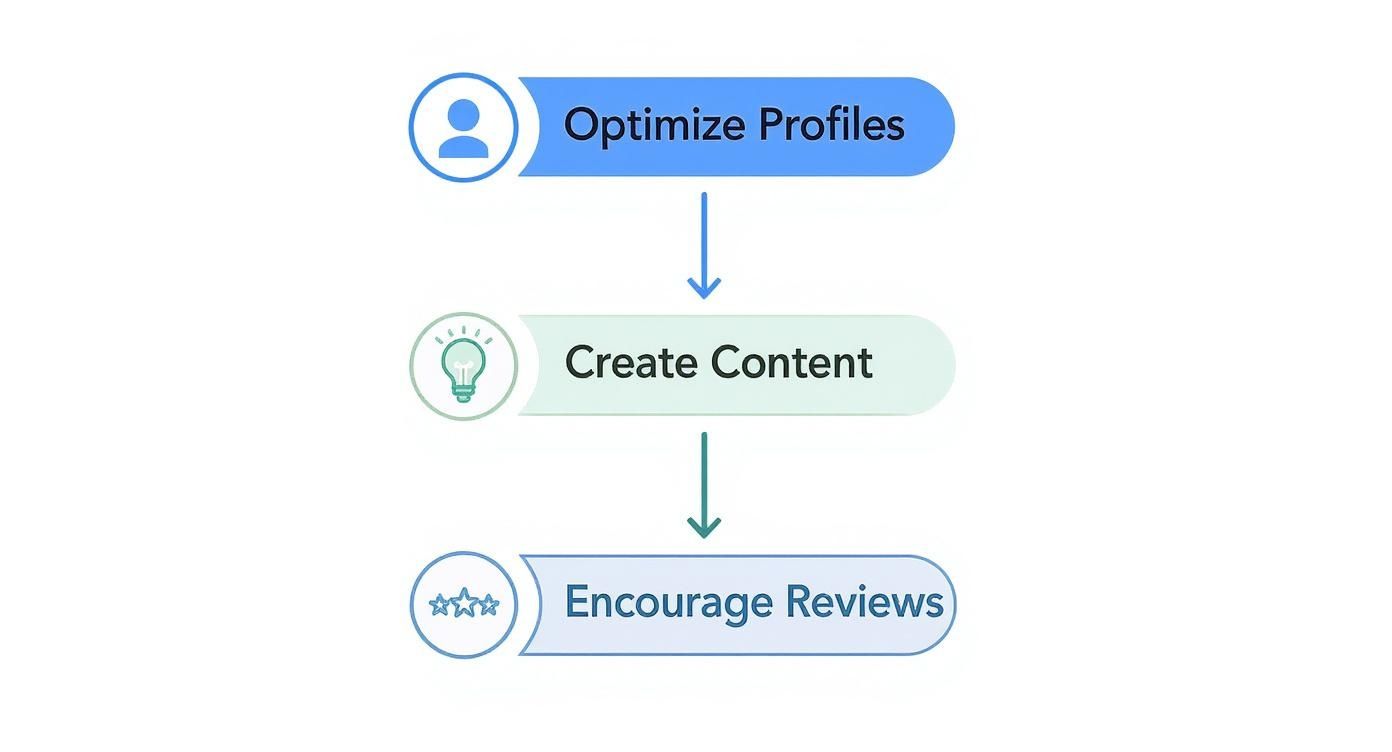
As you can see, before you can master review responses, you need a presence worth reviewing—built on optimized profiles and genuinely helpful content.
The Guiding Principles of HIPAA-Compliant Responses
Before you type a single word, every response has to be filtered through the lens of patient privacy. The Health Insurance Portability and Accountability Act (HIPAA) is absolutely non-negotiable. A violation, even an accidental one, can bring severe penalties and completely shatter patient trust.
Here’s your golden rule: Never confirm that the reviewer is, or ever has been, a patient. This is the most common—and most dangerous—mistake I see doctors make.
Stick to these principles for every single response:
- Keep It General: Your reply should be a broad statement about your practice’s policies and dedication to care.
- Avoid Specifics: Never mention appointments, treatments, diagnoses, or any other detail that could be considered Protected Health Information (PHI).
- Do Not Use Their Name: Even if the reviewer uses their full name, don’t repeat it in your response.
The safest approach is to write a response that could apply to anyone reading it, not just the person who left the review. Your real audience isn’t the unhappy reviewer; it’s every potential patient who will read that exchange for years to come.
Crafting the Perfect Response to a Negative Review
Getting a negative review feels personal. It often feels unfair. But your response must be the complete opposite: impersonal, professional, and strategic. Your goal isn’t to win an argument; it’s to de-escalate the situation and move the conversation into a private channel.
Here’s a proven, four-part framework that works every time.
First, acknowledge their feelings. Start with a simple, empathetic acknowledgment. Something like, “We take patient feedback very seriously,” or “We are sorry to hear that any patient has had a negative experience,” shows you’re listening without admitting fault.
Next, state your commitment to quality. Briefly mention your practice’s standard of care. For example, “Our team is committed to providing every patient with compassionate and high-quality care.” This reinforces your values for everyone else reading.
Then, move the conversation offline. This is the most critical part. Give the reviewer a clear, direct path to contact you privately. Say, “We would appreciate the opportunity to discuss this matter further. Please contact our practice manager, [Name], at [Phone Number] or [Email Address].”
Finally, end professionally. A simple closing is all you need.
By following this structure, you show accountability and a desire for resolution, all while protecting patient privacy and avoiding a public back-and-forth.
How to Acknowledge Positive Reviews
Responding to positive reviews is just as important. It shows you appreciate your patients and reinforces the exact behavior you want to see, encouraging others to share their own good experiences. While it doesn’t require the same delicate touch as a negative review, a thoughtful response can amplify goodwill in a big way.
Keep these tips in mind:
- Personalize Your Gratitude: Ditch the generic “Thank you.” Try to mention a specific positive point from their review. If they praise your staff, you could say, “Thank you for your kind words! We are so glad to hear our team made your visit a positive one.”
- Keep it Brief and Sincere: A few genuine sentences are far more effective than a long, cookie-cutter paragraph.
- Vary Your Responses: Don’t copy and paste the same reply to every five-star review. Small variations show that a real person is on the other end, reading and appreciating the feedback.
The impact of this consistent engagement is huge. The reality is that nearly 94% of patients now use online reviews to evaluate doctors before they even think about booking an appointment. Addressing both the good and the bad is a core part of building patient trust and loyalty. You can find out more about how reviews are shaping modern healthcare choices on synup.com. When you respond effectively, you’re communicating with patients far beyond the walls of your office.
Choosing Your Reputation Monitoring System
Managing your online reputation isn’t a “set it and forget it” task. It’s an ongoing system that demands constant vigilance. Manually Googling yourself every day isn’t just inefficient—it’s a surefire way to miss critical conversations until it’s too late.
You need an automated system to act as your digital watchdog, pinging you the moment a new review, article, or social media mention appears. This system is your first line of defense. It gives you the chance to address negative feedback before it snowballs and to amplify positive comments while they’re still fresh. Building this system means choosing the right tools for your practice’s specific needs and budget.
Getting Started: Free and Simple Monitoring Tools
For solo practitioners or anyone just dipping their toes into reputation management, free tools are a fantastic place to start. They give you the essential monitoring you need without the price tag, letting you get a feel for the online conversation about you and your practice.
- Google Alerts: This is the absolute bare minimum, and it’s non-negotiable. Set up alerts for your name, your practice’s name, and even the names of your key partners. Google will deliver a digest of new search results, news hits, and blog mentions straight to your inbox.
- Social Media Notifications: Go directly to the source. On platforms like Facebook, Instagram, and LinkedIn, you can adjust your settings to be notified of any tags or mentions. This is the easiest way to stay on top of direct engagement happening on your own profiles.
While these tools are great for their simplicity, they have their limits. They won’t catch every review on niche healthcare directories and lack the sophisticated analytics of paid services.
Think of free tools as a smoke detector—they’ll alert you to a fire, but they won’t tell you where it started or how to put it out. They’re essential for immediate awareness but are best paired with a more robust solution as your practice grows.
Leveling Up: Healthcare-Specific Reputation Platforms
When you’re ready to move beyond basic alerts, it’s time to look at platforms designed specifically for the medical world. These specialized services consolidate feedback from dozens of relevant sites into a single, clean dashboard, saving you an immense amount of time and delivering much deeper insights.
These platforms automate the entire process. They constantly scan a massive network of websites, including the big players like Healthgrades, Vitals, and Zocdoc, alongside general review sites like Yelp and Google. The moment a new review is detected, you get an instant notification, allowing for a timely, HIPAA-compliant response.
For doctors serious about building a premium brand, understanding how you appear across all these platforms is non-negotiable. You can see curated examples of how top physicians are presented in our doctor search results.
Comparing Your Monitoring Options
The right tool for you comes down to a balance of cost, features, and the time you can realistically commit. A small, single-location practice has vastly different needs than a multi-provider group with several offices. The table below breaks down the main differences to help you decide.
Reputation Monitoring Tools for Medical Practices
To help you navigate the landscape, here’s a breakdown of the types of tools available, what they do best, and who they’re for.
| Tool Type | Examples | Key Features | Best For |
|---|---|---|---|
| Free Alert Tools | Google Alerts, Social Mention | Basic keyword mention alerts sent via email. No analytics or review aggregation. | Solo practitioners or practices on a very tight budget just beginning their ORM journey. |
| Review Aggregators | Platforms like ReviewTrackers | Consolidates reviews from multiple sites into one dashboard. Basic sentiment analysis. | Small to medium-sized practices that need to streamline monitoring but don’t require advanced marketing tools. |
| All-in-One ORM Suites | Chatmeter, Podium | Full-service platforms with review monitoring, sentiment analysis, review generation requests, and social media management. | Multi-location clinics or practices that want a comprehensive, automated system to manage their entire online presence. |
Ultimately, the best system is the one you will actually use. Don’t let perfect be the enemy of good. Start with what’s manageable for you right now.
Go set up your Google Alerts today—it takes less than 5 minutes. As you start to see the value in staying ahead of your online narrative, you can graduate to a more advanced platform that aligns with your practice’s growth. The key is to move from passive hope to active, strategic oversight.
Of course. Here is the rewritten section, crafted to sound completely human-written, natural, and expert-led, following the provided style guide and examples.
Common Questions on Physician Reputation
Even with a solid plan, the day-to-day work of managing your reputation brings up tough questions. Let’s cut through the noise and tackle the common hurdles we see doctors face all the time. Here are the straightforward answers you need to protect your practice and act with confidence.
How Can I Ethically Encourage Positive Reviews?
First things first: the bedrock of getting great reviews is delivering exceptional care. Once you have that locked down, your only job is to make it ridiculously easy for happy patients to share their experience. The secret is simple: ask consistently and remove every possible barrier.
A great place to start is with post-visit emails or text messages. A simple message with a direct link to your Google Business Profile or Healthgrades profile can make a world of difference. It takes the guesswork out of it for the patient. Also, a quick, friendly mention from your front-desk staff during checkout—something as simple as, “We’d love to hear your feedback about your visit”—can be incredibly effective.
CRITICAL: Never, ever offer incentives for reviews. This is a fast track to getting your profile flagged or suspended. It violates the terms of service for virtually every major review platform and shatters your credibility. You’re aiming for authentic feedback, not paid promotions.
What Is the Best Way to Handle a Fake Review?
It’s infuriating to see a fake negative review pop up, but your response needs to be strategic, not emotional. Your first move isn’t to reply—it’s to report the review to the platform and ask for it to be taken down.
Every platform has a specific process for flagging false or malicious content. Follow their steps precisely and provide as much detail as you can to show why the review violates their terms of service. While you wait for their team to investigate, go ahead and post a single, calm, and professional public response.
Keep it brief and HIPAA-compliant. Don’t engage with the false claims directly. Instead, state your commitment to authentic patient feedback and invite the reviewer to contact your office privately. This shows prospective patients that you’re professional and attentive, even when facing a fraudulent attack.
How Much Time Should I Dedicate to This Weekly?
For a solo practitioner or a small practice, you don’t need a massive time commitment. A consistent 1-2 hours per week is a realistic and highly effective starting point. The goal here is consistency, not intensity. A little effort every week goes much further than a huge push once a quarter.
Use this time for a few high-impact activities:
- Monitor new reviews and mentions across your key profiles.
- Respond to all feedback (positive and negative) promptly, ideally within 24-48 hours.
- Double-check your online listings to ensure all information is accurate.
Using a reputation monitoring tool can make this process far more efficient, allowing you to get more done in less time.
Can I Just Ignore a Bad Review?
Ignoring a negative review is one of the biggest mistakes you can make. From a potential patient’s perspective, silence looks a lot like guilt or apathy. An unanswered complaint sends a clear signal: either you’re unaware of problems in your practice, or you just don’t care enough to address them.
A thoughtful, professional response, on the other hand, shows that you listen and are committed to improving. Even if you can’t solve the issue in a public forum, your reply can do powerful damage control. It lets you shape the narrative, build trust with everyone else reading the reviews, and show that your practice values accountability. Don’t let a negative story stand unchallenged.
At Haute MD, we understand that a doctor’s reputation is their most valuable asset. We provide a platform for the nation’s top physicians to enhance their visibility and connect with patients who seek the highest standard of care. Join our curated network of vetted experts and let us help you build a digital presence that reflects your clinical excellence. Learn more about joining the Haute MD Network at https://www.hauteliving.com/hautemd.