


Let’s be honest—most weight loss advice is a shot in the dark. It fails because it ignores the single most important factor: your unique metabolism.
Think of your body as a high-performance engine. Some engines are built for raw power, burning fuel at an incredible rate. Others are engineered for quiet efficiency. Following a generic diet plan is like pouring the wrong grade of fuel into that engine and just hoping for the best.
Metabolic testing is the owner’s manual for your specific engine. It gives you the hard data to understand exactly how your body operates, finally moving you beyond the vague “calories in, calories out” mantra that works for almost no one.
The Power of a Personalized Baseline
The real game-changer in metabolic testing for weight loss is discovering your Resting Metabolic Rate (RMR). This isn’t some wild guess from an online calculator; it’s the precise measurement of the calories your body burns just to stay alive—powering your brain, circulating your blood, and keeping you breathing.
Knowing this number is the critical first step in building a weight loss plan that actually works with your body, not against it. It ends the frustrating cycle of guesswork.
This highly personalized approach is becoming more mainstream as people demand better health data. The global metabolic testing market was valued at USD 547.32 million and is on track to hit USD 1,060.82 million by 2033, largely because more people are looking for smarter ways to manage lifestyle-related conditions like obesity.
Your RMR is the starting point for everything. Without it, any calorie target is just a guess. Knowing your number allows you to create a sustainable calorie deficit that promotes fat loss without triggering extreme hunger or metabolic slowdown.
Moving Beyond Generic Advice
Once you have your RMR, you can finally build a strategy that’s truly yours. This single piece of data allows you or a professional to determine:
- Accurate Calorie Targets: You can set a realistic daily goal for weight loss based on your actual metabolic rate, not a generic, one-size-fits-all formula.
- Smarter Nutrition Choices: Understanding how many calories your body truly needs helps you make better decisions about balancing proteins, fats, and carbs.
- Effective Exercise Plans: Your RMR is a key component of your Total Daily Energy Expenditure (TDEE), showing you exactly how physical activity impacts your overall calorie burn.
By starting with precise data, you empower yourself to make informed decisions. To take the next step, our guide on how to improve metabolic health with practical, actionable tips can help you build on this foundation. This scientific approach puts an end to the frustrating cycle of trial and error for good.
How Metabolic Tests Measure Your Calorie Burn
So, how does a machine actually peek inside your body’s engine room to see how it’s burning fuel? The gold standard for measuring your metabolism for weight loss is a method called Indirect Calorimetry (IC). It sounds intimidating, but the science behind it is surprisingly straightforward.
Think of your body like a small, controlled campfire. To keep the fire going, it has to pull in oxygen. As it burns wood (your calories), it releases smoke—which is mostly carbon dioxide. If you could precisely measure how much oxygen the fire uses and how much carbon dioxide it produces, you could calculate exactly how much wood it’s burning.
Indirect Calorimetry works on the exact same principle. The test is simple: you just breathe normally into a specialized device, either through a mouthpiece or a clear hood resting over your head, for about 15 to 20 minutes. The machine isn’t just measuring how much you breathe; it’s analyzing the composition of every single breath.
The Science of Gas Exchange
The real magic happens when the device analyzes the gasses you inhale versus the gasses you exhale. Every cell in your body uses oxygen to convert food—calories from fat, carbs, and protein—into usable cellular energy. This process, called cellular respiration, creates carbon dioxide as a byproduct.
The IC device measures two critical data points with incredible precision:
- Oxygen Consumption (VO2): This is the amount of oxygen your body pulls from the air to fuel all its background processes.
- Carbon Dioxide Production (VCO2): This is the amount of CO2 your body creates as metabolic waste and pushes out when you exhale.
By plugging these two values into a scientific formula, clinicians can determine your energy expenditure with pinpoint accuracy. The test essentially reveals the exact speed of your internal “campfire” while you’re at rest, giving you your Resting Metabolic Rate (RMR).
From Breath to Actionable Data
This process replaces guesswork with hard data, paving the way for a truly personalized plan. The guesswork is gone, replaced by clarity.
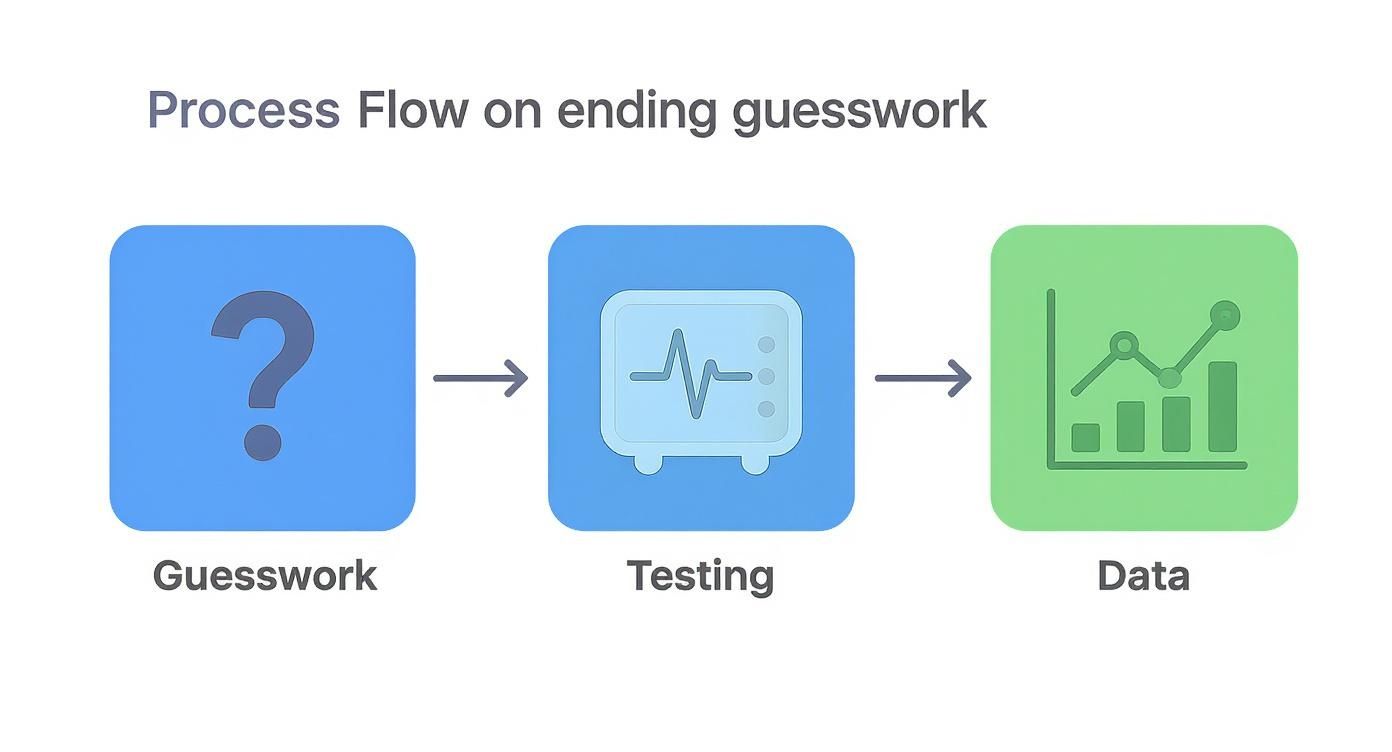
This simple flow highlights the core benefit: metabolic testing turns a vague wellness goal into a data-driven strategy.
But it gets even better. Beyond just your RMR, the ratio of the carbon dioxide you produce to the oxygen you consume gives us another vital piece of the puzzle—the Respiratory Exchange Ratio (RER). This number tells you what type of fuel your body prefers to burn at rest.
- An RER value closer to 0.7 means your body is primarily burning fat for energy.
- An RER value closer to 1.0 suggests your body is relying more on carbohydrates.
This insight is incredibly powerful for designing a nutrition plan that works with your body, not against it. If you’re a natural “sugar burner,” a plan focused on managing carbohydrate timing and intake might be the key. If you’re already a “fat burner,” you have a metabolic advantage that can be fine-tuned for even better results.
Comparing Different Metabolic Testing Methods
While clinical Indirect Calorimetry is the most precise method, the market is full of at-home gadgets and fitness trackers claiming to measure your metabolism. It’s crucial to understand what you’re actually getting from each.
Here’s a quick breakdown of the most common methods, highlighting their accuracy and best use cases for someone serious about weight loss.
| Testing Method | How It Works | Accuracy Level | Best For |
|---|---|---|---|
| Indirect Calorimetry (Clinical) | Measures the exchange of oxygen and carbon dioxide in a controlled, resting state. | Gold Standard (Highest accuracy) | Getting a precise RMR and RER baseline for a medical-grade weight loss or performance plan. |
| Wearable Fitness Trackers | Uses algorithms with heart rate, movement, and personal data (age, weight) to estimate calorie burn. | Low to Moderate (Can be off by 20-40%) | Tracking daily activity levels and general trends, but not for setting precise caloric targets. |
| At-Home Breath Devices | Typically measure acetone or CO2 levels in breath to estimate fat-burning states (ketosis) or RER. | Variable (Less accurate than IC) | Gaining general insights into your fuel source preference on a day-to-day basis. |
The key takeaway is this: while consumer devices offer convenience, they provide estimates, not direct measurements. For a foundational number that will guide your entire weight loss strategy, the precision of a clinical-grade Indirect Calorimetry test is unmatched. It’s the difference between guessing and knowing.
Translating Your Test Results Into Real Insights

Getting back a metabolic report packed with numbers and acronyms can feel like trying to decipher a foreign language. But buried in that data is the exact blueprint for a smarter, more effective weight loss strategy.
Let’s cut through the noise and focus on the two metrics that really matter. Think of this as your personal translator, turning abstract data points into a clear, actionable understanding of how your body actually works.
Decoding Your Resting Metabolic Rate (RMR)
The first, and most important, number on your report is your Resting Metabolic Rate (RMR). This isn’t an estimate; it’s the precise number of calories your body burns over 24 hours while doing absolutely nothing. It’s the energy cost for running essential operations—breathing, circulating blood, repairing cells. It’s your body’s baseline.
Your RMR is the cornerstone of any legitimate nutrition plan because it replaces guesswork with a hard, scientific fact. Those online calculators? They’re often off by hundreds of calories, which is exactly what leads to frustrating plateaus. Your measured RMR is your unique metabolic signature.
So, is your metabolism “fast” or “slow”? The report will compare your measured RMR to a predicted value based on your age, sex, height, and weight. Here’s how it breaks down:
- Measured RMR > Predicted RMR: Your engine runs hotter than average for someone your size. You have a metabolic advantage.
- Measured RMR < Predicted RMR: Your metabolism is slower than predicted. This doesn’t mean weight loss is impossible; it just means your calorie targets have to be far more precise.
- Measured RMR = Predicted RMR: Your metabolism is right where it’s expected to be for your demographic.
Understanding this comparison is a powerful moment. It often explains why past weight loss attempts failed and gives you the exact data needed to set a calorie goal that will finally work.
Your RMR is not just a number—it’s the definitive baseline for your body’s energy needs. Using this measured value instead of a generic estimate is the difference between following a random map and using a precise GPS for your weight loss journey.
Understanding Your Fuel Preference with RER
The second key metric is the Respiratory Exchange Ratio (RER). If RMR tells you the speed of your metabolic engine, RER tells you what kind of fuel that engine prefers to burn at rest: carbs or fats. It’s calculated by comparing the carbon dioxide you exhale to the oxygen you inhale.
Think of your body as a sophisticated hybrid car. It can switch between its gas engine (burning carbs) and its electric battery (burning fats), depending on what’s most efficient at the moment. Your RER score reveals its default setting.
- RER closer to 0.70: Your body is a proficient fat burner at rest. This shows good metabolic flexibility, meaning your body easily taps into its fat stores for energy.
- RER closer to 1.00: Your body is running primarily on carbohydrates. This suggests a reliance on readily available sugars and might mean your body struggles to access its fat stores.
- RER between 0.80 and 0.90: You have a mixed metabolism, burning a combination of both fats and carbs for fuel.
This single number provides incredible insight. Someone with a high RER might see huge success with a nutrition plan that carefully manages carbohydrate intake, encouraging their body to finally flip the switch to fat-burning mode.
On the other hand, a person with a low RER already has a fat-burning advantage that can be optimized even further. By understanding these two core metrics—your RMR and RER—you transform a confusing page of numbers into a clear, personalized roadmap for your health.
Building Your Personalized Weight Loss Plan

Your metabolic test results are far more than just interesting data points—they are the architectural blueprint for your weight loss strategy. This is where the science gets real. We take your numbers and build a practical, day-to-day plan that works with your body, not against it. Forget the generic advice; it’s time to design a plan based on your unique metabolic signature.
The cornerstone of this plan is your Resting Metabolic Rate (RMR). This number tells us exactly how many calories your body burns just to stay alive. But unless you plan on lying in bed all day, that’s only part of the story.
Calculating Your Total Daily Energy Expenditure
To build a plan that actually works, we need to understand your Total Daily Energy Expenditure (TDEE). Think of your RMR as your base salary in calories. Your TDEE is your total income after you add in bonuses for all the work you do—walking to meetings, hitting the gym, running errands, and even digesting food.
To find your TDEE, we multiply your scientifically measured RMR by an activity factor. This factor accounts for everything from a sedentary desk job to a physically demanding career.
Let’s use a real-world example. Meet Sarah, whose metabolic testing for weight loss revealed her RMR is 1,550 calories per day. Sarah works an office job but makes a point to exercise moderately three times a week.
Here’s how we dial in her TDEE:
- Identify the Activity Level: Sarah’s lifestyle fits squarely in the “Lightly Active” category.
- Apply the Multiplier: We multiply her RMR by the corresponding factor for that activity level.
- Calculate TDEE: 1,550 (RMR) x 1.375 (Activity Factor) = 2,131 calories per day.
That number—2,131—is Sarah’s metabolic break-even point. It’s the total number of calories she needs to eat daily just to maintain her current weight.
Your TDEE is the most accurate estimate of your daily calorie burn. It combines your scientifically measured RMR with your lifestyle, providing a realistic target for creating a sustainable calorie deficit for weight loss.
Creating a Smart and Sustainable Calorie Deficit
With Sarah’s TDEE locked in at 2,131 calories, we can now create a sensible calorie deficit that encourages fat loss without triggering metabolic panic. A common and highly effective approach is to subtract 300 to 500 calories from the TDEE. This is the sweet spot—large enough to drive results but small enough to prevent brutal hunger, muscle loss, and a metabolic slowdown.
- Moderate Deficit (300 calories): 2,131 – 300 = 1,831 calories per day
- Larger Deficit (500 calories): 2,131 – 500 = 1,631 calories per day
For Sarah, a daily target of around 1,700 calories creates a sustainable deficit of over 400 calories. This data-driven strategy is worlds away from randomly picking a number like 1,200 calories—a target that would be far too low for her metabolism and likely lead to failure. This is the precision that metabolic testing for weight loss provides.
Aligning Your Plate with Your RER Results
Calories are just one piece of the puzzle. Your Respiratory Exchange Ratio (RER) gives us powerful clues about your macronutrient balance—the mix of proteins, fats, and carbohydrates your body prefers. Your RER tells us what your body likes to burn for fuel when you’re at rest.
Let’s say Sarah’s RER came back at 0.95, indicating her body heavily relies on carbohydrates for energy at rest. A savvy practitioner would use this insight to design a nutrition plan that:
- Manages Carbohydrate Timing: Focusing her carb intake around workouts to fuel activity and recovery, when her body needs them most.
- Increases Protein and Healthy Fats: Shifting her macro ratios to encourage her body to become more efficient at burning fat for fuel.
- Prioritizes Fiber: Including high-fiber foods to boost satiety and keep blood sugar levels stable.
This level of detail helps align your eating habits with your unique physiology. Of course, metabolism is also deeply connected to hormones. To understand this better, you can explore how hormone optimization and metabolic medicine are transforming healthspan, adding another layer of insight. By combining RMR, TDEE, and RER data, you finally have a comprehensive, effective roadmap to achieve your weight loss goals.
How to Choose a Reputable Testing Provider
Not all metabolic tests are created equal, and frankly, the value of your results is only as good as the provider you choose. Investing in metabolic testing for weight loss is a significant step, so it’s critical to find a clinic that delivers both precision data and practical, real-world guidance.
Think of it like this: you wouldn’t trust a cheap, off-brand camera to capture a once-in-a-lifetime photo. In the same way, the accuracy of your metabolic data depends entirely on the quality of the equipment and the expertise of the person operating it. A top-tier provider uses medical-grade, validated Indirect Calorimetry machines—not consumer gadgets.
Verifying Equipment and Professional Credentials
Your first move is to confirm the clinic uses gold-standard technology. Don’t be shy—ask them directly what type of machine they use for RMR testing. Look for names known for clinical accuracy. This is non-negotiable, because a precise RMR measurement is the foundation of your entire plan. An inaccurate reading can send you down the wrong path from day one.
Just as important is who interprets your results. Raw data is just a bunch of numbers without an expert to translate it. The person walking you through your report needs to be a qualified professional who can turn those complex figures into an actionable plan.
Look for providers with staff who hold credentials like:
- Registered Dietitian (RD): Experts in nutrition science who can build a powerful meal plan around your specific metabolic needs.
- Exercise Physiologist: Specialists in how the body responds to physical activity, making them perfect for designing a smart workout strategy.
- Board-Certified Physician: A doctor, especially one specializing in metabolic health or weight management, provides comprehensive medical oversight. Our guide to finding top-rated physicians near you can offer more insight here.
Asking the Right Questions Before You Commit
Before you book anything, come prepared with a list of questions to vet potential providers. Their answers will tell you everything you need to know about the quality of their service. A confident, transparent provider will welcome your diligence.
A great metabolic testing service doesn’t just give you a number; it gives you a roadmap. The real value is in the post-test consultation and the support that helps you turn data into sustainable lifestyle changes.
Be sure to ask things like:
- Who will explain my results to me? Make sure it’s one of the qualified professionals listed above, not just an assistant.
- What does the consultation actually include? It should be a deep dive into your RMR, RER, and exactly how to apply this information to your life.
- What kind of support do you offer afterward? Look for follow-up appointments, customized meal plans, or personalized exercise recommendations.
This kind of technology is becoming more accessible worldwide. Asia Pacific, for example, is now the fastest-growing region for metabolic testing adoption, thanks to rising healthcare investments and a greater focus on preventive health in countries like China and Japan. Choosing a top-tier provider ensures you get the most reliable data possible for your health journey.
Common Questions About Metabolic Testing
Even with a clear understanding of the benefits, it’s only natural to have a few questions before investing in your health. Let’s tackle some of the most common queries about metabolic testing for weight loss, giving you straightforward answers so you can make a confident, well-informed decision.
Think of this technology as a powerful tool—and feeling certain about how it works is the first step toward using it effectively. Our goal here is to demystify the process and clear up any lingering doubts you might have.
Is Metabolic Testing Actually Accurate?
Yes. When performed correctly, clinical Indirect Calorimetry is the gold standard for measuring your Resting Metabolic Rate (RMR). It gives you a direct measurement of your unique metabolism, which is a world away from the online calculators that just spit out population-based averages.
Those calculators can easily be off by hundreds of calories, a margin of error big enough to completely derail a weight loss plan. For maximum accuracy, it’s critical to follow the pre-test instructions from the clinic, which usually involve fasting and avoiding strenuous exercise. These protocols ensure the test captures your true resting state.
How Much Does a Metabolic Test Usually Cost?
The cost for a single RMR test can vary by provider and location, but you can generally expect it to fall somewhere in the $100 to $300 range. While it’s an upfront investment, the precision it provides can save you a ton of time, money, and frustration by eliminating months of guesswork.
Many top-tier wellness centers also offer packages that bundle the test with a comprehensive consultation. This helps you build a personalized nutrition and exercise plan directly from your results, making the investment even more valuable.
How Often Should I Get Retested?
For most people just starting out, one initial test is all you need to establish a powerful and accurate baseline. But your metabolism isn’t set in stone; it can and will change as your body composition shifts.
Your metabolism adapts as your body changes. Retesting after major milestones ensures your plan stays perfectly aligned with your current physiological needs, helping you break through plateaus and maintain momentum.
It’s a smart move to consider a re-test after hitting a major milestone, like losing more than 10% of your body weight or finishing a new, intensive strength training program. Otherwise, an annual or semi-annual check-in can help you make precise adjustments to your plan.
Can I Use My Test Results to Increase My Metabolism?
Absolutely. Your test results are the blueprint for a targeted plan to fire up your metabolic engine. The data, particularly your RMR and RER, reveals exactly where you stand and what needs to be optimized.
The single most effective way to boost your RMR is by increasing your lean muscle mass through consistent strength training. Muscle is far more metabolically active than fat, so building more of it naturally increases the number of calories your body burns at rest. A qualified professional can take your data and design a plan aimed at making your metabolism more powerful over time.
Ready to stop guessing and start building a plan based on your unique biology? Haute MD connects you with a curated network of the nation’s top physicians specializing in metabolic health and longevity. Find a rigorously vetted expert who can provide the precision and guidance you deserve.
Explore our network of elite doctors and begin your personalized health journey at https://www.hauteliving.com/hautemd.