


Think of an MD in Internal Medicine as the master diagnostician of adult health. These physicians, known as internists, are the ultimate problem-solvers for the complex medical landscape we all navigate from young adulthood through our senior years. They’re the medical detectives you want on your case, whether you’re seeking peak wellness or managing a rare, chronic illness.
Unpacking the Role of an MD in Internal Medicine
At its core, internal medicine is dedicated to the comprehensive, long-term care of adults. Unlike specialists who focus on a single organ system—like a cardiologist for the heart or a pulmonologist for the lungs—an internist is trained to see the entire, interconnected picture. They connect the dots between seemingly unrelated symptoms and conditions, acting as the quarterback for a patient’s entire healthcare journey.
Imagine a brilliant detective piecing together a complex case. They gather clues (your symptoms), analyze the evidence (medical history and lab tests), and consult with other experts (specialists) to uncover the root cause of the problem. That’s precisely what an internist does—they assemble your unique health puzzle to arrive at an accurate diagnosis and build a powerful, effective treatment strategy.
The Doctor’s Doctor
There’s a reason internists are often called the “doctor’s doctor.” Their deep diagnostic skill makes them the go-to resource for other physicians who need help solving challenging medical mysteries.
They truly shine when managing patients with multiple, overlapping health issues. Think of someone dealing with diabetes, high blood pressure, and kidney disease all at once—an internist is specifically trained to manage these competing conditions cohesively, ensuring one treatment doesn’t inadvertently worsen another problem. This broad-yet-deep expertise is the foundation of modern adult healthcare.
This central role has created a significant demand for their expertise. The Health Resources and Services Administration forecasted that by 2025, the demand for primary care physicians, a field heavily populated by internists, would reach 263,100 full-time equivalents, creating a deficit of over 23,600 doctors. This highlights a growing need for qualified internists across the country. You can explore more about these healthcare workforce projections and their implications.
A Snapshot of Responsibilities
To really grasp their extensive scope, it helps to see their primary functions in action. From proactive preventive screenings to managing life-threatening illnesses in a hospital, an internist’s duties cover the full spectrum of adult medicine. It’s this versatility that makes them so indispensable.
The table below breaks down the core duties an internist performs, showcasing the sheer breadth of their practice and why they are so vital to keeping adults healthy and thriving.
The Core Responsibilities of an MD in Internal Medicine
This table outlines the primary functions of an internist, showcasing their specialized role in adult medicine.
| Area of Focus | Description | Common Examples |
|---|---|---|
| Diagnostic Medicine | Serving as the lead diagnostician to identify the cause of symptoms, especially in complex or unusual cases. | Investigating unexplained weight loss, persistent fatigue, or multi-symptom presentations. |
| Chronic Disease Management | Providing long-term, ongoing care for patients with chronic conditions to improve quality of life and prevent complications. | Managing diabetes, heart disease, hypertension, and autoimmune disorders. |
| Preventive Care | Focusing on proactive health strategies, including screenings, risk assessments, and lifestyle counseling to prevent future illness. | Administering vaccinations, ordering cancer screenings, and advising on diet and exercise. |
| Acute Care | Treating patients for sudden illnesses or severe symptoms, often in a hospital or urgent care setting. | Managing infections like pneumonia, treating acute injuries, and stabilizing critical conditions. |
| Care Coordination | Acting as the central coordinator who manages a patient’s care across different specialists and healthcare settings. | Communicating with cardiologists, oncologists, and surgeons to ensure a cohesive treatment plan. |
Ultimately, an internist acts as your long-term health partner, building a deep understanding of your medical history and goals to provide truly personalized and effective care.
The Rigorous Journey to Becoming an Internist
Becoming a board-certified internist is a marathon, not a sprint. It’s a demanding path that requires more than a decade of intense dedication, intellectual horsepower, and a deep commitment to the complexities of adult patient care. The journey to earning an MD in internal medicine is one of the most extensive in the medical field, shaping doctors into the expert diagnosticians patients depend on.
This multi-stage process unfolds over more than a decade, starting long before a physician ever steps into a clinic. Each phase is designed to build upon the last, layering foundational scientific knowledge with practical, hands-on clinical experience. It’s a carefully structured progression that ensures every internist is prepared for the intricate challenges of adult health.
The Educational Foundation
The pathway kicks off with a four-year undergraduate degree, typically packed with hard sciences like biology, chemistry, and physics. This pre-medical education is crucial for acing the Medical College Admission Test (MCAT) and getting into a competitive medical school.
From there, it’s four more years of intensive medical school. Students split their time between mastering the fundamentals of human anatomy, physiology, and pharmacology in the classroom and rotating through various medical specialties—surgery, pediatrics, and, of course, internal medicine. This exposure is where many discover their passion for the diagnostic challenges that define internal medicine.
The Crucible of Residency
The most formative stage in becoming an internist is the three-year internal medicine residency. This is where theoretical knowledge gets forged into practical expertise. After graduating from medical school with their MD, these new doctors enter a supervised training program, working directly with patients in both hospital and outpatient settings.
Residency is a period of intense, immersive learning. It’s not for the faint of heart. Doctors work long hours, make critical decisions under immense pressure, and learn to manage a massive spectrum of adult health conditions, from common illnesses to rare, life-threatening diseases. Under the guidance of experienced physicians, they hone the diagnostic skills that become their calling card. This is what truly makes an internist.
The demand for these skilled diagnosticians is clear. The 2025 Main Residency Match saw a remarkable 10,984 internal medicine positions filled at a 96.8% rate, underscoring its role as a top choice for new doctors. The data also shows a diversifying physician pipeline, with international graduates and DO seniors playing a key part in meeting patient care needs. You can explore more insights from the National Resident Matching Program’s latest report.
Achieving Board Certification
The final step is achieving board certification from the American Board of Internal Medicine (ABIM). While not technically required to practice, it’s universally recognized as the gold standard of professional excellence. To become certified, an internist must pass a grueling exam that tests their clinical judgment, diagnostic skills, and medical knowledge.
This long journey equips internists with a unique skill set, moving from simple diagnosis to complex treatment and, ultimately, sophisticated long-term management.
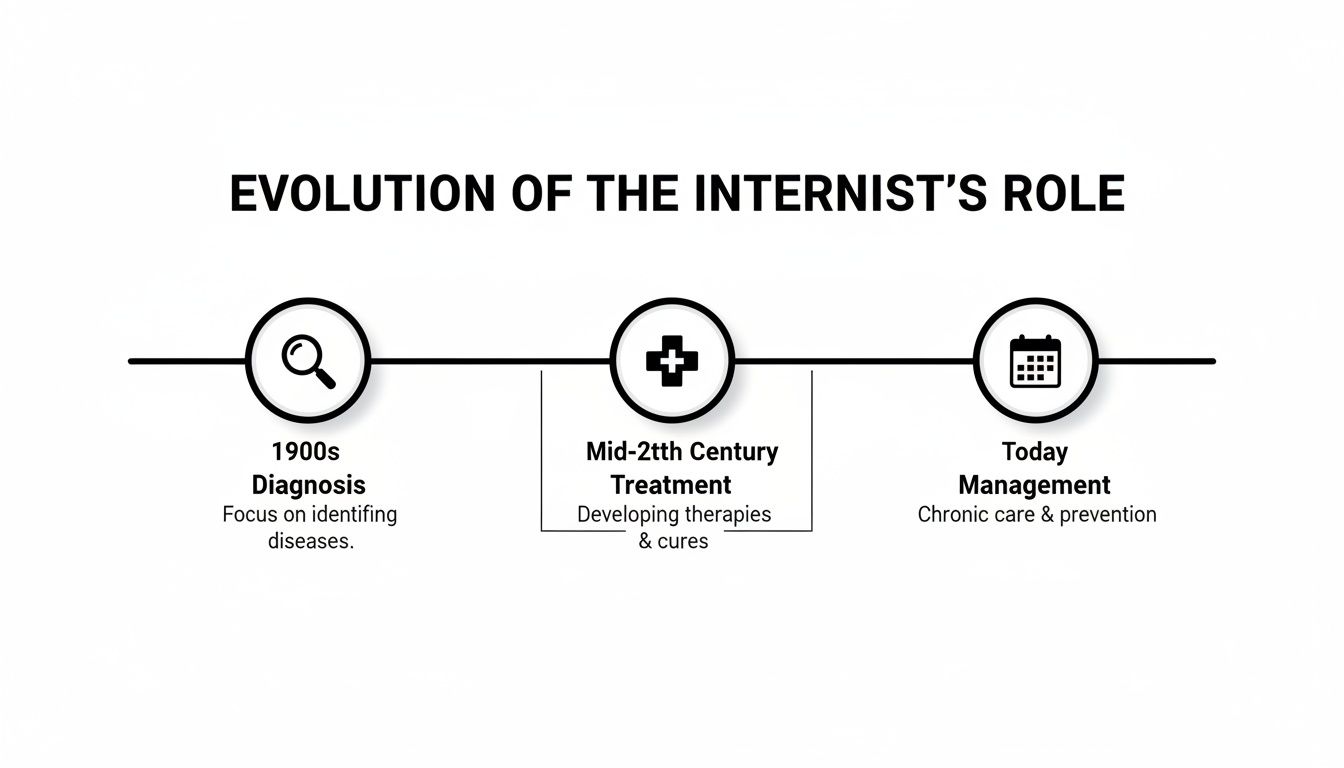
As the infographic shows, the role has evolved into a holistic approach focused on continuity of care. But board certification isn’t a one-and-done achievement. It signifies a lifelong commitment to continuous learning, forcing internists to stay on top of the latest medical advancements and ensuring their patients always receive the highest quality of care possible.
Internal Medicine vs Family Medicine Explained
While you might hear the terms used interchangeably, an MD in internal medicine and a family medicine doctor follow very different training paths and focus on distinct patient populations. Getting this distinction right is the first step in choosing the right primary care partner for your long-term health.
The main difference boils down to one simple question: who are they trained to treat?
Internists, or internal medicine physicians, are specialists exclusively for adults. Their training is laser-focused on the unique and often complex medical issues that arise from young adulthood through the senior years. In contrast, family medicine doctors are trained to provide care for the entire family unit, from newborns to grandparents.
A Tale of Two Specialties
Think of it this way: a family doctor is like a versatile Swiss Army knife, perfectly equipped to handle a wide range of health needs for everyone in the family. They’re skilled in pediatrics, obstetrics, and adult medicine, making them a fantastic single point of care for a household.
An internist, however, is more like a high-precision, specialized instrument. Their entire medical residency is dedicated to diagnosing, managing, and preventing the vast spectrum of diseases that affect adults. This focused training gives them profound expertise in managing complicated, chronic conditions like heart disease, diabetes, and autoimmune disorders that typically show up in adulthood.
This deep specialization is a key reason why internists are often called upon to unravel complex adult cases. Their in-depth training prepares them to handle multiple, interacting health issues at once, making their role indispensable in adult primary care. For a deeper look into this topic, you can read our guide on the difference between internal medicine and primary care explained to understand the nuances further.
This fundamental training difference naturally shapes where and how they practice. Family doctors often work in outpatient clinics designed to welcome patients of all ages, while internists are found in both outpatient clinics and hospital settings, where they manage acutely ill adult patients.
Comparing Internal Medicine and Family Medicine
So, how do you choose? It really comes down to your personal and family health needs. If you’re an adult with complex health concerns or simply want a physician whose expertise is solely concentrated on adult medicine, an internist is probably your ideal choice. If you’re looking for a single trusted physician to care for your entire family, including your children, then a family doctor is the perfect fit.
This side-by-side comparison helps clarify the key attributes of each specialty.
Comparing Internal Medicine and Family Medicine
| Attribute | Internal Medicine MD | Family Medicine MD |
|---|---|---|
| Patient Population | Exclusively adults (typically 18 and older) | All ages (infants, children, adults, seniors) |
| Training Focus | Three-year residency focused on adult diseases, including complex chronic conditions and hospital care. | Three-year residency covering pediatrics, obstetrics, adult medicine, and geriatrics. |
| Scope of Practice | Deep focus on diagnosing and managing complex adult illnesses, preventive care, and chronic disease. | Broad scope including well-child visits, vaccinations, minor procedures, and general adult health. |
| Common Practice Setting | Outpatient clinics and inpatient hospital care. | Primarily outpatient clinics and community health centers. |
Ultimately, both are exceptional choices for primary care. The best physician for you is the one whose training aligns with your specific stage of life and health requirements, ensuring you receive the most relevant and expert care possible.
The Comprehensive Scope of an Internist’s Care
An internist’s role goes so much deeper than the simple annual physical. Think of them as the central figure in your long-term health journey, with an expertise built on three core pillars that define modern internal medicine. They are, at once, expert diagnosticians, champions of preventive health, and masterful coordinators of care.

This multi-faceted approach ensures your care isn’t just reactive but proactive, comprehensive, and cohesive. Once you understand these three pillars, it becomes crystal clear why an MD in internal medicine is so vital for navigating the complexities of adult health.
The Expert Diagnostician
At their heart, internists are medical detectives. They truly excel at diagnosing complex, often interconnected conditions that only affect adults. While a specialist might focus on a single organ, an internist is trained to see the bigger picture—how different systems like the cardiovascular, endocrine, and renal systems all interact and influence one another.
This skill is absolutely critical for patients managing multiple chronic illnesses. Take, for instance, an individual with diabetes, high blood pressure, and early-stage kidney disease. They need a physician who can craft a treatment plan that addresses all three conditions at once without causing harmful side effects. The internist is uniquely equipped for this delicate balancing act, tweaking medications and lifestyle advice to create one unified health strategy.
When symptoms are vague or just plain confusing, they are the expert you turn to. Their extensive training allows them to connect seemingly unrelated clues to get to the root cause of whatever is going on.
The Champion of Preventive Health
A huge part of an internist’s job is stopping disease before it ever gets a foothold. They act as your primary advocate for long-term wellness, zeroing in on proactive strategies rather than just treating sickness as it comes up.
This isn’t a one-size-fits-all approach; it’s deeply personalized and built on a solid foundation of:
- Comprehensive Risk Analysis: Internists dig into your family history, genetics, lifestyle, and environment to pinpoint your specific health risks.
- Targeted Screenings: Based on that unique risk profile, they recommend and interpret screenings for conditions like cancer, heart disease, and osteoporosis.
- Lifestyle Guidance: They provide evidence-based, practical advice on nutrition, exercise, stress management, and sleep to optimize your health and head off risks at the pass.
By focusing on prevention, an internist helps you build a strong foundation for lifelong health, aiming to preserve your vitality for decades. This forward-thinking mindset is a true cornerstone of high-quality internal medicine.
The Coordinator of Care
In today’s fragmented healthcare landscape, having a single leader for your medical team is more important than ever. The internist serves as the “quarterback” of your health, coordinating every aspect of your care and making sure every provider is on the same page.
When you need to see a specialist—like a cardiologist for a heart issue or an oncologist for a cancer diagnosis—your internist doesn’t just hand you a referral slip and send you on your way. They collaborate directly with that specialist.
An internist acts as your chief advocate, translating complex medical information and ensuring that your overall treatment plan is integrated and effective. They manage communication between different specialists, review all test results, and make sure that one specialist’s treatment doesn’t interfere with another’s.
This coordination is critical for your safety and for getting the best possible outcomes. Without this central oversight, patients can easily face conflicting medical advice, redundant testing, and even dangerous medication interactions. An internist provides the continuity and leadership needed to navigate these challenges effectively.
The demand for this kind of comprehensive care is only growing amidst rising physician shortages. Projections show a potential shortfall of 87,150 primary care physicians by 2037, making the coordinated expertise of an internist more valuable than ever. You can review the latest workforce trends and their impact on physician recruitment to see the data for yourself.
The Rise of Concierge and Executive Internal Medicine
For discerning individuals who see their health as their most valuable asset, a new standard of care is emerging. Concierge and executive internal medicine marks a deliberate move away from the traditional, high-volume healthcare machine. It replaces rushed appointments and impersonal interactions with a deeply personalized, proactive, and remarkably accessible medical partnership.
This is a complete redesign of the patient-doctor relationship. The conventional model often forces physicians to see dozens of patients a day, leaving just a few minutes for each visit. In stark contrast, a concierge MD in internal medicine intentionally keeps their patient list small. This allows for the kind of unhurried, in-depth care that’s essential for building a genuine health alliance.
This structure is a perfect fit for busy executives, entrepreneurs, and anyone who demands a data-driven, preventative strategy for their long-term health and vitality. It’s a fundamental shift from reactive sick-care to proactive, high-performance healthcare.
Defining the Premium Tier of Care
The benefits of concierge internal medicine are both tangible and immediate. This elevated tier of service is built on a foundation of direct access and radical personalization, completely changing how you engage with your physician and your own health. It’s not just about convenience; it’s about achieving superior outcomes.
Key features of this model almost always include:
- Unhurried, Extended Appointments: Consultations can last an hour or more, giving you the time to actually discuss complex health concerns, review diagnostic data in detail, and build a wellness plan together.
- Direct 24/7 Physician Access: Forget call centers and administrative hurdles. Patients often have their doctor’s direct cell phone number or a private email for urgent needs that arise outside of office hours.
- Deeply Personalized Wellness Plans: These programs go far beyond standard advice. They integrate advanced diagnostics with a sharp focus on longevity, metabolic optimization, and peak physical and cognitive performance.
- Same-Day or Next-Day Scheduling: The smaller patient panel means you can see your physician right when an issue arises, avoiding long, anxious waits for an appointment.
The entire model is built around a membership or retainer fee, which covers the enhanced access and personalized services that fall outside of what insurance typically pays for. This investment is what allows physicians to dedicate more time and resources to every single patient, fostering a relationship built on trust and continuity.
The core idea is to shift the focus from volume to value. By stepping outside the constraints of the traditional insurance-based system, concierge doctors can provide a level of service and attention that is simply not possible in a standard practice. This is the new benchmark for patient-centered care.
Connecting Personalized Medicine to Superior Outcomes
The advantages of concierge care stretch far beyond simple convenience. This highly attentive model empowers physicians to practice a more advanced, forward-thinking style of medicine. With more time for each patient, an internist can dive deeper into complex health data and focus on the science of longevity and true disease prevention.
This approach often brings in cutting-edge concepts that are nearly impossible to implement in a fast-paced traditional clinic. For example, a concierge internist can dedicate hours to analyzing your unique biomarkers to craft a plan for metabolic optimization, helping you master blood sugar, elevate energy levels, and slash your risk of chronic disease.
They can also leverage precision diagnostics, using genetic testing and advanced imaging to build a startlingly accurate picture of your future health risks. This allows for truly proactive interventions designed to stop problems before they even start. For a deeper dive into this model, our guide on what concierge medicine is and how it works offers a comprehensive overview.
Ultimately, concierge and executive internal medicine transforms the patient-doctor dynamic. It’s no longer about a quick fix for today’s problem, but a long-term collaboration focused on maximizing your healthspan and helping you achieve your personal wellness goals with unparalleled support.
How to Find the Right Internal Medicine Physician
Choosing your internist is one of the most important health decisions you’ll ever make. This isn’t just about finding a doctor; it’s about selecting a trusted partner and chief advocate who will guide your wellness strategy for years to come. The search for the right MD in internal medicine should be a deliberate, thoughtful process—one focused on finding an expert whose philosophy aligns perfectly with your long-term goals.

Your search should start with the non-negotiables. Board certification from the American Board of Internal Medicine (ABIM) is the baseline, confirming that a physician has met rigorous standards of excellence. But from there, your evaluation needs to get personal, shifting to the nuances that define a truly great fit.
Key Criteria for Your Selection
A strong physician-patient relationship is built on far more than just credentials. It demands an alignment in communication style, care philosophy, and overall approach. As you consider your options, look for these critical factors:
- Communication Style: Does the doctor truly listen? Can they explain complex medical topics in a way that’s clear and empowering? A real partner in your health makes sure you feel heard and understood in every single conversation.
- Practice Philosophy: Is their approach proactive and preventive, or do they simply react to problems as they arise? You want an internist who is deeply invested in your long-term wellness, not just in treating illness.
- Patient Reviews and Reputation: While online ratings offer a quick snapshot, dig deeper. Look for detailed testimonials that speak to a doctor’s diagnostic skill, bedside manner, and the outcomes they achieve for their patients.
The goal is to move beyond a simple checklist and find a physician who feels like a true collaborator. This relationship is foundational to achieving your best health, demanding a blend of proven expertise and genuine personal connection.
Simplifying Your Search with Curated Networks
Trying to navigate this process on your own can feel overwhelming. This is where curated platforms and networks like Haute MD become so valuable. Instead of you sifting through endless online directories and reviews, these services have already done the heavy lifting.
By pre-screening physicians based on their board certifications, patient outcomes, and commitment to innovative, patient-first care, these networks give you a highly vetted shortlist of elite practitioners. This completely changes the dynamic of your search, letting you focus your energy on what matters most: finding the right personality and practice style for your needs.
For more practical advice, take a look at our detailed guide on ways to find top-rated physicians near me. Securing the right fit—whether in a traditional or concierge setting—gives you the confidence that a dedicated expert is managing your health for the long run.
Common Questions About MD Internal Medicine
Navigating the healthcare world can feel like learning a new language. As you consider partnering with an internist, it’s completely normal to have questions about how it all works. We’ve put together some straightforward answers to the things people ask most often.
Think of this as your practical guide to feeling confident and prepared as you take control of your long-term health.
Do I Need a Referral to See an Internist?
For the most part, no. If you’re choosing an internist to be your primary care physician (PCP), you can typically just select one from your insurance network and book an appointment. It’s usually that simple.
The main exception comes into play when that internist is also a subspecialist, like a cardiologist or an endocrinologist. If you want to see them for their specialized expertise (not just as your PCP), your insurance plan will almost certainly require a referral from your primary doctor first. This is one area where concierge and direct primary care models often cut through the red tape, allowing for much more direct access.
MD vs. DO: What Is the Real Difference?
This is a classic question, and the answer is simpler than you might think. Both MDs (Medical Doctors) and DOs (Doctors of Osteopathic Medicine) are fully licensed physicians. They complete nearly identical internal medicine residencies, prescribe the same medications, and order the same tests.
The only real distinction is in their initial medical school training. DOs receive extra hands-on training in the musculoskeletal system, a practice called osteopathic manipulative treatment (OMT). In the day-to-day reality of an internal medicine clinic, however, their approaches to diagnosing and managing complex adult diseases are virtually indistinguishable. Both are excellent choices.
Ultimately, a patient’s experience with an MD or a DO internist will be fundamentally the same. The choice comes down to personal preference, not a difference in the quality or depth of care you’ll receive. Both are masters of applying evidence-based science to adult medicine.
How Can I Prepare for My First Appointment?
A little bit of prep work before your first visit can make a world of difference. It helps your new internist get a comprehensive picture of your health right from the very beginning, making your time together far more productive.
Before you go, try to pull together a few key things:
- Gather Your Medical History: Make a simple list of past major illnesses, surgeries, and any significant health issues that run in your family (like heart disease or cancer).
- List All Medications: Don’t forget anything. Write down every single prescription, over-the-counter pill, supplement, and vitamin you take, including the dosages.
- Prepare Your Questions: Jot down any health concerns or questions you have. It’s smart to put your most important ones right at the top so you don’t forget them.
Bringing this information allows your physician to establish an accurate health baseline, ensuring your consultation is as effective and personalized as possible.
Can an Internist Also Be a Specialist?
Absolutely. This is a common path for many of the best physicians. After finishing a demanding three-year residency in internal medicine, many doctors choose to dive even deeper with a fellowship. This is an extra 1-3 years of highly specialized training that makes them an expert in one specific area.
You’ll find that many of the top specialists in fields like cardiology (heart), gastroenterology (digestive system), pulmonology (lungs), and oncology (cancer) started as an MD in internal medicine. They carry that broad, foundational knowledge of the entire adult body with them while also offering world-class expertise in their chosen field.
Finding the right physician is the single most important decision you’ll make for your health. At Haute MD, we’ve made that process seamless. We connect you with a curated network of the nation’s most respected, board-certified physicians, including top-tier internists and executive health experts. Explore our network to find a trusted partner for your long-term wellness.