



So, you’re ready to learn how to reverse metabolic syndrome? That’s the right mindset. The path forward isn’t about a single magic bullet but a strategic combination of smarter eating, consistent movement, and a few key lifestyle shifts. Think of it as a series of interconnected upgrades that work together to restore your body’s natural balance.
Your Action Plan for Reversing Metabolic Syndrome
Metabolic syndrome isn’t one single disease. It’s a cluster of conditions—high blood pressure, elevated blood sugar, excess belly fat, and out-of-whack cholesterol levels—that collectively skyrocket your risk for heart disease, stroke, and type 2 diabetes.
The great news? It’s highly reversible with deliberate, focused action. This guide provides a clear roadmap, moving past generic advice to give you specific, real-world tactics that create lasting change.
This screenshot from Wikipedia breaks down the five core criteria doctors use for a diagnosis.

If you meet three or more of these benchmarks, you’ll likely get a diagnosis. It really highlights how interconnected these health markers are.
Core Pillars of Your Reversal Plan
Tackling this requires a multi-pronged strategy. Focusing on just one area won’t cut it. Real success comes from integrating improvements across a few key domains of your life. I’ve found the most effective approach is built on these four pillars:
- Strategic Nutrition: Ditching processed foods for whole, nutrient-dense options is non-negotiable for managing blood sugar and taming inflammation.
- Consistent Movement: Blending aerobic exercise with resistance training is the one-two punch for improving insulin sensitivity and fortifying your cardiovascular system.
- Lifestyle Optimization: Prioritizing quality sleep and actively managing stress are crucial for balancing the hormones that control your metabolism.
- Medical Partnership: Working closely with a healthcare professional to monitor your progress with real data and adjust your plan is the key to accountability and success.
A proactive partnership with your healthcare team is critical. They provide the essential testing, interpret your lab results, and help you build a plan that’s not only effective but also safe for your unique health profile.
To get started on the right foot, it’s incredibly helpful to work with a qualified professional. You can find a doctor specializing in metabolic health who can guide your journey and provide personalized medical advice.
Below, we’ll dive deeper into each of these pillars.
Here’s a quick overview of what to expect as you start implementing these changes. This table summarizes the core strategies and offers a realistic look at how quickly you can start seeing tangible results.
Core Strategies for Metabolic Health At a Glance
| Strategy | Key Benefit | Implementation Timeframe |
|---|---|---|
| Dietary Overhaul | Improved blood sugar & cholesterol levels | Noticeable changes in 2-4 weeks |
| Regular Exercise | Enhanced insulin sensitivity & weight loss | Tangible benefits in 4-6 weeks |
| Lifestyle Adjustments | Reduced stress hormones & better sleep | Immediate to 2 weeks |
| Medical Monitoring | Data-driven adjustments & accountability | Ongoing, with quarterly checks |
As you can see, you don’t have to wait months to start feeling and seeing the difference. Consistent effort across these areas builds powerful momentum, leading to significant health improvements much faster than most people realize.
The Metabolic Syndrome Challenge: What You’re Really Up Against
Before we dive into a plan for reversing metabolic syndrome, you need to understand what you’re really facing. This isn’t one single disease; it’s a cluster of interconnected risk factors. When these conditions show up together, they dramatically crank up your risk for the big three: heart disease, stroke, and type 2 diabetes.
Think of it as your body’s metabolic engine sending out smoke signals. These warnings aren’t always loud or obvious, which is exactly why so many people don’t realize there’s a problem until it’s become serious. A diagnosis usually comes when you have three or more of the following five conditions.
The Five Core Risk Factors
Getting a handle on these markers is your first real step toward taking back control. Each one is a piece of a much larger puzzle, and the key to restoring your health is tackling them as a group.
- High Blood Pressure (Hypertension): A consistent reading of 130/85 mmHg or higher is a major red flag. This puts constant, damaging strain on your heart and arteries.
- High Blood Sugar (Hyperglycemia): When your fasting blood glucose hits 100 mg/dL or more, it’s a clear sign your body is struggling to manage insulin effectively.
- Excess Belly Fat: This is about more than just your weight on the scale; it’s about dangerous visceral fat around your organs. A waist circumference over 35 inches for women or 40 inches for men is a critical indicator of metabolic risk.
- High Triglycerides: Having levels of this blood fat at 150 mg/dL or higher is another crucial piece of the puzzle.
- Low “Good” HDL Cholesterol: When HDL drops below 40 mg/dL for men or below 50 mg/dL for women, it means you’re losing the very cholesterol that helps clear plaque out of your arteries.
This isn’t just an abstract checklist; these numbers represent real, measurable aspects of your internal health. High-achievers often get laser-focused on external performance metrics, but understanding these internal ones is what truly matters for longevity. Proactive health management is a cornerstone of our approach to preventive cardiology for high achievers.
A Widespread and Growing Problem
The challenge of metabolic syndrome has exploded over the past few decades. It’s gone from a relatively rare issue to a full-blown public health concern. Worse, it’s no longer just an adult problem—its rising prevalence among kids and teens is a chilling preview of future health trends.
The statistics tell a stark story. What was once considered a condition of aging is now hitting younger and younger populations, signaling a critical need for proactive, aggressive lifestyle changes.
Data from the National Institutes of Health reveals that metabolic syndrome now affects about 3% of children and 5% of adolescents. The trend among adults is just as alarming, with prevalence in the U.S. jumping from 25.3% in the early 2000s to a staggering 34.2% by 2012.
This rapid escalation shows just how quickly our modern environment can impact our health. Understanding these stakes is the first step in fueling your motivation for the lasting changes we’re about to cover.
Building Your Metabolic Reset Diet
The single most powerful tool you have to reverse metabolic syndrome is the food on your plate. Forget about those complicated, punishing fad diets that are impossible to stick with for more than a few weeks. Our goal here is completely different: to build a sustainable, satisfying way of eating that calms inflammation, gets your blood sugar under control, and restores your body’s metabolic health from the ground up.
This isn’t about deprivation. It’s about making strategic upgrades. We’re moving past generic advice like “eat healthier” and getting into the practical, proven approaches that actually move the needle. This means learning how to build a plate that properly balances lean proteins, fiber-rich carbohydrates, and healthy fats at every single meal.
The exploding rate of metabolic syndrome is a flashing red light, signaling that something is deeply wrong with our modern food environment. The condition is far more common than many realize.
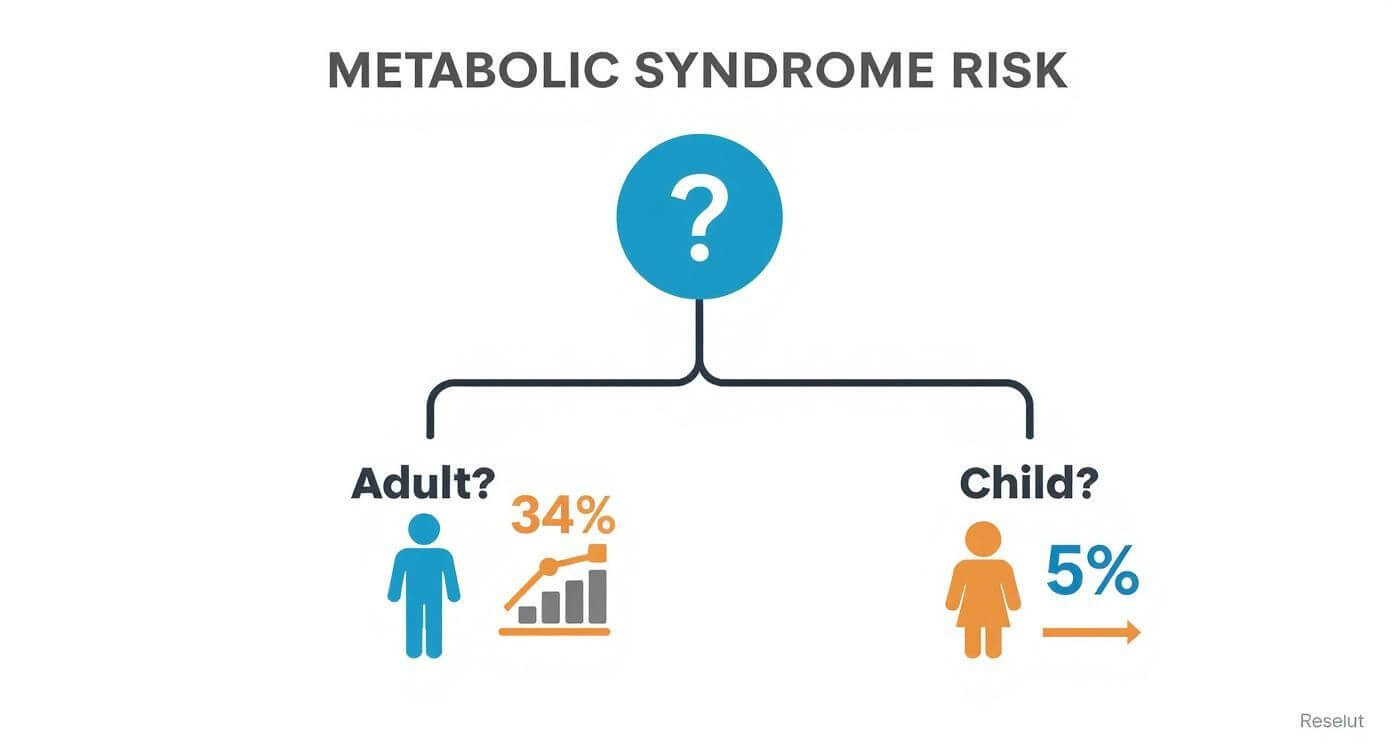
While 34% of adults are affected, a shocking 5% of children now have the condition, which underscores just how urgent it is to get back to healthier eating patterns.
Choosing Your Nutritional Strategy
There are several evidence-based eating patterns that have shown incredible success in reversing the key markers of metabolic syndrome. The truth is, the best one for you is the one you can actually stick with long-term. Let’s look at a few of the top contenders.
- The Mediterranean Diet: This isn’t really a “diet” so much as a lifestyle. It’s built around whole foods like fruits, vegetables, nuts, seeds, legumes, whole grains, fish, and lots of good olive oil. It’s naturally low in processed junk and high in anti-inflammatory omega-3 fatty acids.
- The DASH Diet: The Dietary Approaches to Stop Hypertension (DASH) plan was originally designed to lower blood pressure, and it excels at that. It focuses on reducing sodium while boosting potassium, calcium, and magnesium through fruits, vegetables, and low-fat dairy.
- A Low-Glycemic Diet: This strategy directly targets insulin resistance, which is the absolute core of metabolic syndrome. It prioritizes carbohydrates that don’t cause massive spikes in blood sugar—think steel-cut oats instead of instant oatmeal, or quinoa instead of white rice.
The global shift toward highly processed, Western-style diets has had a direct and measurable impact on our health. For instance, as developing nations adopted these eating habits, metabolic syndrome prevalence shot up from 23.8% between 2000–2005 to 27.0% by 2010–2015. You can read the full research on these dietary shifts to see the clear link between what we eat and our metabolic risk.
When it comes to picking a diet, it can be tough to sort through the noise. Here’s a quick comparison of the most effective approaches for metabolic health.
Comparing Diets for Metabolic Health
| Diet Type | Primary Focus | Evidence Strength | Typical Results |
|---|---|---|---|
| Mediterranean | Whole foods, healthy fats, anti-inflammatory | Very Strong | Improved lipids, blood pressure, insulin sensitivity |
| DASH Diet | Lowering sodium, increasing minerals | Strong | Significant reduction in blood pressure, improved lipids |
| Low-Glycemic | Blood sugar control, minimizing insulin spikes | Strong | Improved insulin sensitivity, weight loss, better A1c |
| Low-Carb / Keto | Drastically reducing carbs to lower insulin | Moderate to Strong | Rapid weight loss, dramatic A1c reduction, improved triglycerides |
Ultimately, the best diet is the one that fits your lifestyle and preferences. The principles behind them—cutting processed foods, increasing fiber, and balancing macronutrients—are more important than the specific label you put on it.
Building a Better Plate Every Time
No matter which specific plan you lean toward, the core principles of plate composition are the same. Simply visualizing your meal can make a huge difference.
Your plate should be a vibrant mix of colors and textures. Aim to fill half your plate with non-starchy vegetables, a quarter with lean protein, and the final quarter with high-fiber, complex carbohydrates.
This simple framework is your secret weapon. It guarantees you get the fiber to slow down sugar absorption, the protein to keep you full and maintain muscle, and the slow-burning carbs you need for sustained energy. The USDA’s MyPlate model is a great visual for this exact concept.
Practical Tips for Your Next Grocery Run
Making these changes begins at the supermarket. Learning to read nutrition labels is a non-negotiable skill that will pay massive dividends for your health.
- Scrutinize the Sugar Content. Always look for “added sugars” on the label. A great rule of thumb is to avoid any product where sugar is listed in the first three ingredients.
- Prioritize Fiber. This is your best friend for managing blood sugar and feeling full. Aim for products with at least 3-5 grams of fiber per serving. More is better.
- Choose Healthy Fats. Look for monounsaturated and polyunsaturated fats from sources like avocados, nuts, seeds, and olive oil. If you see “partially hydrogenated oil” in the ingredients, put it back on the shelf—that’s code for artificial trans fat.
Building your metabolic reset diet is an incredibly empowering first step. You are taking back control, meal by meal, of the primary inputs that determine your metabolic health.
Integrating Movement That Makes A Difference

Your diet lays the foundation for better metabolic health. Movement is what actually activates those benefits. Regular exercise sharpens insulin response and gives your cardiovascular system a serious boost.
You don’t need an intense gym routine to see results. In fact, showing up consistently beats one-off marathons every time. Committing to 15-20 minutes of purposeful movement each day can lower blood pressure, shrink your waistline, and improve insulin sensitivity.
Finding Your Ideal Mix Of Aerobic And Strength Training
Think of aerobic and strength work as a one-two punch against metabolic syndrome.
- Aerobic Exercise (Cardio): Any sustained activity that raises your heart rate—brisk walking, cycling, swimming, even an elliptical session. Cardio strengthens your heart, brings down blood pressure, and burns through excess blood sugar.
- Resistance Training (Strength): Using weights, bands, or body weight to challenge muscles. Building lean muscle turns your body into a glucose magnet, dramatically improving insulin sensitivity.
I once coached a busy executive who swapped his morning news scroll for a 20-minute brisk walk. A month later, we introduced two 30-minute strength sessions each week—squats, rows, planks. Three months in, his fasting glucose had dropped by 15 points.
Weaving More Activity Into Your Busy Day
Dedicated workouts matter, but everyday movement adds up too. “Non-exercise activity thermogenesis” (NEAT) covers all the extra steps and stretches you do outside a structured routine. Over time, NEAT makes a huge difference.
Your body wasn’t built for an eight-hour sit—small, frequent movements keep your metabolism awake and efficient.
Try these easy tweaks:
- Take Walking Calls: Skip the conference room; wander your office or neighborhood during phone meetings.
- Use the Stairs: Whenever you’re going up or down three floors or less, ditch the elevator.
- Set a Movement Timer: Let your watch or phone nudge you to stand, stretch, and walk every hour.
These tiny habits interrupt long sitting stints, a hidden driver of insulin resistance even for regular gym-goers.
A Sample Weekly Schedule For Beginners
If you’re not sure where to begin, this outline hits 150 minutes of moderate activity each week—just enough to spark real change without overwhelming your calendar.
| Day | Activity | Duration | Focus |
|---|---|---|---|
| Monday | Brisk Walking | 30 minutes | Steady-pace cardio |
| Tuesday | Bodyweight Strength | 20 minutes | Squats, push-ups, planks |
| Wednesday | Active Recovery | 30 minutes | Gentle walk or stretching |
| Thursday | Brisk Walking | 30 minutes | Steady-pace cardio |
| Friday | Bodyweight Strength | 20 minutes | Lunges, rows with bands |
| Saturday | Longer Activity | 45-60 mins | Hike, bike ride, or swim |
| Sunday | Rest | N/A | Full rest and recovery |
This plan delivers 150 minutes of moderate-intensity activity, matching the minimum guidelines for significant health gains. It’s practical, flexible, and builds the consistency you need to turn the tide on metabolic syndrome.
Mastering Lifestyle Habits for Long-Term Success
While a strategic diet and consistent movement are the engines driving your metabolic recovery, don’t forget about the steering wheel: your daily habits. Specifically, how you handle stress and sleep.
Ignoring them is like trying to drive a high-performance car with a shaky alignment. You’ll work incredibly hard but never quite get where you want to go. Lasting success in reversing metabolic syndrome absolutely depends on mastering these foundational pillars.
Chronic stress isn’t just a mental burden—it’s a physical, metabolic disruptor. When you’re constantly under pressure, your body pumps out the stress hormone cortisol. This hormonal cascade directly raises your blood sugar and encourages your body to store visceral fat right around your abdomen, actively worsening two of the key markers of metabolic syndrome.
Even with a perfect diet, unmanaged stress can completely sabotage your progress. It triggers cravings for the exact high-sugar, high-fat foods you’re trying to avoid and drains the willpower you need to make good choices. Addressing stress isn’t a luxury; it’s a non-negotiable part of the plan.
Taming the Stress Response
You can’t eliminate stress from your life, but you can fundamentally change how your body reacts to it. The goal is to build a toolkit of simple practices that activate your body’s relaxation response, directly counteracting the damaging effects of cortisol. This isn’t about grand gestures, but small, consistent actions woven right into your daily routine.
Here are a few practical techniques you can start with today:
- Mindful Breathing: When you feel that wave of overwhelm coming on, stop. Take five minutes for deep, diaphragmatic breathing. Inhale slowly through your nose for a count of four, hold for four, and then exhale slowly through your mouth for a count of six. This simple act can physically lower your heart rate and signal your entire nervous system to calm down.
- Strategic Disconnection: Designate specific times—like the first hour of your morning or during meals—as “no-screen zones.” Cutting off the constant firehose of digital stressors gives your mind a much-needed chance to reset.
- Nature Exposure: Think of this as a prescription for stress reduction. Just a 15-20 minute walk in a park or any green space can significantly lower cortisol levels. No special equipment required.
These practices create a crucial buffer between life’s demands and your physiological response, giving your metabolism the breathing room it needs to heal.
Prioritizing Restorative Sleep
Sleep is when your body does its most critical maintenance work. It’s when your hormones are regulated, your cells are repaired, and your brain processes the day’s events. When sleep is poor, this entire system is thrown into chaos, with a direct and immediate impact on your metabolic health.
Think of sleep as your nightly metabolic reset button. Consistently getting less than 7-8 hours of quality sleep can impair insulin sensitivity, crank up your hunger hormones, and make it nearly impossible to manage blood sugar effectively.
In fact, just one night of poor sleep can make your cells more resistant to insulin the next day—an effect startlingly similar to what’s seen in pre-diabetes. Over time, this chronic sleep debt becomes a powerful driver of metabolic dysfunction. Improving your sleep isn’t just about feeling more rested; it’s about giving your body the fundamental tools it needs to reverse this condition.
Crafting Your Ideal Sleep Environment
You can dramatically improve the quality and quantity of your rest by optimizing your “sleep hygiene.” This is all about creating a sanctuary that is dedicated to one thing: restorative sleep.
- Establish a Consistent Schedule: Go to bed and wake up at the same time every single day. Yes, even on weekends. This reinforces your body’s natural sleep-wake cycle, known as its circadian rhythm.
- Create a Cool, Dark, and Quiet Room: Use blackout curtains, a white noise machine, or earplugs to eliminate disruptions. The ideal temperature for sleep is generally between 60-67°F (15-19°C).
- Implement a “Wind-Down” Routine: For the final hour before bed, get off your screens. The blue light suppresses melatonin production, the hormone that tells your body it’s time to sleep. Instead, read a physical book, take a warm bath, or listen to calming music.
These lifestyle adjustments are not optional add-ons; they are indispensable actions. They work in concert with your diet and exercise plan to create a holistic environment where your body can finally heal and thrive, securing your long-term success against metabolic syndrome.
Working with Your Doctor and Tracking Progress
While the lifestyle changes you make are the engine driving your success, a strong partnership with your doctor is the navigation system. Trying to reverse metabolic syndrome without professional guidance is like flying blind. You need objective data to see what’s working, what isn’t, and where to make strategic adjustments.
This collaboration turns guesswork into a precise, data-driven plan. Your doctor can order the right lab tests, interpret them in the context of your overall health, and make sure your approach is both safe and effective. It’s the expert oversight you need for lasting success.
Knowing Your Numbers: The Key Metrics to Track
To get a real handle on metabolic syndrome, you have to get comfortable with your key biomarkers. These numbers are the tangible proof of your progress. Don’t let them intimidate you; think of them as your personal health dashboard, guiding every decision you make.
Your doctor will be keeping a close eye on these:
- Hemoglobin A1c (HbA1c): This isn’t just a one-time blood sugar reading; it’s the story of your average blood sugar over the last three months. A fasting glucose test is a snapshot; HbA1c is the whole movie. The goal is to get this below 5.7%.
- Lipid Panel: This is a comprehensive look at the fats in your blood. The two numbers that matter most here are triglycerides (aim for below 150 mg/dL) and your HDL or “good” cholesterol. For HDL, you want to be above 40 mg/dL for men and 50 mg/dL for women.
- Blood Pressure: Hypertension often has no symptoms, which is why regular monitoring is non-negotiable. Your target is to consistently stay below 130/85 mmHg.
- Waist Circumference: This simple measurement is a surprisingly powerful indicator of visceral fat—the dangerous stuff packed around your internal organs. Aim for under 40 inches for men and 35 inches for women.
When you see these numbers start to move in the right direction, it’s one of the most powerful motivators you can have. It proves your hard work is paying off.
When Is Medication a Necessary Tool?
Let’s be clear: lifestyle changes are always the first and most important line of defense. But there are times when medication becomes an intelligent addition to your plan. Think of it as a bridge to help you reach your goals faster and more safely while you build lasting habits.
Your doctor might bring up medication if:
- Your blood pressure remains dangerously high despite your best efforts with diet and exercise.
- Your cholesterol and triglyceride levels just aren’t budging enough with lifestyle changes alone.
- Your blood sugar or HbA1c levels put you at immediate, high risk for developing type 2 diabetes.
Medication is not a substitute for lifestyle changes, but a powerful ally. It can help control critical risk factors while you continue to build the foundational habits that will sustain your health for a lifetime.
Commonly prescribed medications might include metformin to improve your body’s sensitivity to insulin or statins to get a handle on cholesterol. The decision is always a personal one, made after a thorough discussion with your doctor about the pros and cons for your specific situation. This is also where more advanced approaches, like hormone optimization and metabolic medicine, can play a critical role by providing a much more complete picture of your underlying health.
Show up to that conversation prepared. Ask about the specific goal of the medication, what side effects to watch for, and how it fits into your long-term plan. This isn’t about passively following orders; it’s about being an active, informed partner in your own health journey.
Common Questions About Reversing Metabolic Syndrome
When you decide to take on metabolic syndrome, a lot of questions pop up. It’s completely normal. Getting clear answers to these common concerns can make all the difference in keeping you motivated and on track. Let’s tackle some of the biggest ones I hear all the time.
How Quickly Can I Expect to See Results?
This is always the first question, and for good reason. You want to know your hard work is paying off. The good news is that you can start feeling and seeing changes much faster than you might think, often within a few weeks.
For example, after just two to four weeks of cutting out processed sugars and cleaning up your diet, you’ll likely see a noticeable drop in your fasting blood sugar. And that consistent exercise, even something as simple as a brisk walk for 30 minutes a day, can start nudging your blood pressure down in as little as a month.
The key is to focus on progress, not perfection. The first signs you’re winning are often subtle—more energy, sleeping better, clothes fitting a bit looser. Those are your cues that big changes in your lab work are just around the corner.
Is Metabolic Syndrome Reversible for Everyone?
For the vast majority of people, the answer is a resounding yes. Metabolic syndrome is fundamentally a condition driven by lifestyle. That’s actually great news because it means it’s highly responsive to changes you make in your diet, activity, sleep, and stress.
Sure, some people have genetic predispositions that might make them more susceptible. But genetics are not destiny. Think of your genes as the blueprint for a house; your lifestyle choices are the construction crew that decides what actually gets built. With the right strategies, you can effectively tell that crew to build a healthier structure, overriding many of those genetic risks.
When Should I Consider Medication?
Lifestyle changes are always—always—the first and most important line of defense. But medication can be an incredibly useful tool, especially when certain numbers put you at immediate risk.
Your doctor might bring up medication if, despite your best efforts:
- Your blood pressure stays stubbornly high (think above 140/90 mmHg).
- Your HbA1c levels are creeping dangerously close to a type 2 diabetes diagnosis.
- Your cholesterol and triglyceride numbers are so out of whack that they pose a serious short-term risk for a heart attack or stroke.
It’s crucial to see medication not as a failure, but as a strategic support system. It can act as a bridge, stabilizing your key metrics and buying you the time you need for your new, healthier habits to take full effect.
Can I Still Eat Foods I Enjoy?
Absolutely. In fact, you must. The goal here is a sustainable lifestyle, not a miserable, short-term diet. The biggest trap I see people fall into is the “all-or-nothing” mindset, which almost always leads to burnout.
The 80/20 rule is a fantastic framework. If you build 80% of your meals around whole, nutrient-dense foods, you have room for a planned indulgence with the other 20%. The key words there are “planned” and “intentional.” This isn’t about a spontaneous slip-up; it’s about consciously enjoying a treat without guilt, knowing it fits into your larger plan. This approach is what turns a diet into a lasting way of life.
Navigating your health journey requires access to trusted, top-tier medical experts. Haute MD connects you with a curated network of the nation’s leading physicians specializing in metabolic health, preventive cardiology, and longevity medicine. Find a specialist who can provide the personalized guidance and advanced care you deserve.