



Finding the right doctor isn’t about stumbling upon a name in a directory. It’s a deliberate process that starts with you. Before you ever begin researching specialists, you need a crystal-clear picture of your own health goals and what you value in a medical partner.
Defining What You Need in a Doctor

The single most important step in this entire journey happens before you open a single web browser. It’s an internal audit. Finding a phenomenal physician isn’t just about their credentials; it’s about finding a genuine partner who aligns with your long-term health vision.
First, you have to identify the type of care you need right now. Are you looking for a long-term relationship with a primary care physician to quarterback your overall wellness? Or do you have a specific, complex issue—like a heart condition or a spinal injury—that requires a specialist’s focused expertise?
Getting this right is fundamental. You can learn more about the difference between internal medicine and primary care to figure out which type of general physician is the best fit for your foundation of care.
Pinpointing Your Medical Specialty
The first filter in your search is purely logistical: what kind of medical expertise do you need? If you’re managing a chronic condition like diabetes, an endocrinologist is non-negotiable. For nagging joint pain, an orthopedist is your target.
But think beyond just the immediate problem. Consider the full scope of care required.
For instance, a patient managing a multi-faceted autoimmune disease will need a rheumatologist who is known for collaborating well with other specialists. In contrast, an athlete needing a one-time ACL repair should prioritize a surgeon’s specific track record with that exact procedure.
Jot down a quick list of your medical must-haves:
- Condition-Specific Expertise: Does this doctor have deep, proven experience with your particular diagnosis?
- Procedural Skills: If surgery is on the table, what is their volume and success rate for that specific operation?
- Access to Technology: Does their affiliated hospital have the advanced imaging or surgical equipment you might need?
Defining Your Personal Fit and Communication Style
Medical expertise is the ticket to the game, but the human element is what makes a doctor your doctor. How a physician communicates can make or break your comfort, confidence, and even your commitment to a treatment plan.
Are you someone who wants a direct, data-driven approach? You might click with a doctor who presents statistics and clear-cut options. Or maybe you need a more empathetic, collaborative partner—someone who carves out time to explore your concerns and makes decisions with you, not for you.
This personal connection is not a “nice-to-have.” It’s everything.
Recent data reveals a startling decline in patient trust. The percentage of Americans trusting healthcare providers plummeted from 71.5% in 2020 to just 40.1% in 2024. The single biggest factor driving that trust is “emotional care”—the simple feeling that a provider is personally invested in a patient’s well-being.
Think about your past experiences with doctors. What made you feel truly heard and respected? What left you feeling rushed, dismissed, or confused? Use those reflections to build a profile of the person you want in your corner.
Creating Your Ideal Doctor Profile
Now, let’s combine the medical and personal criteria into a simple, actionable profile. This becomes your North Star, keeping your search focused and preventing you from getting distracted by impressive but irrelevant credentials.
To help you get specific, think through the criteria in the table below. It’s a quick exercise to organize your priorities and turn vague feelings into a concrete checklist.
Key Criteria for Your Doctor Profile
| Criteria | Why It Matters | Example Question to Ask Yourself |
|---|---|---|
| Communication Style | Defines the doctor-patient dynamic. | Do I prefer a direct, data-driven communicator or a more collaborative, empathetic partner? |
| Practice Philosophy | Determines their approach to care. | Am I looking for a doctor focused on preventive wellness or one who is an expert in acute problem-solving? |
| Punctuality & Access | Impacts your time and stress levels. | How important are on-time appointments and the ability to reach the office staff easily? |
| Practice Size | Shapes the patient experience. | Would I thrive in a large, integrated health system or a smaller, more intimate private practice? |
| Tech Integration | Affects convenience and communication. | Is having a modern patient portal for results and messaging a priority for me? |
By taking the time to build this profile, you’re not just passively accepting a provider. You are actively selecting a professional who is perfectly suited to guide your unique health journey.
Vetting Credentials and Professional History

You’ve got your shortlist of potential doctors. Now, the real investigation starts. This is where you move beyond online reviews and word-of-mouth to confirm the foundational qualifications that separate a good doctor from a great one.
Think of it as essential due diligence for your health. This isn’t about being overly critical; it’s about being smart and ensuring the physician you’re considering has a clean record and has committed to the highest standards of their specialty. Skipping this part means you could miss publicly available information that is critical to your decision.
Confirming Board Certification: The Gold Standard
First, and most importantly, you must verify board certification. This is non-negotiable.
While every practicing doctor needs a medical license, board certification is a voluntary, far more demanding process. It proves a physician has gone well beyond the basic requirements to demonstrate true mastery in their field.
A board-certified doctor has:
- Finished an accredited, multi-year residency program.
- Passed a rigorous exam given by a member board of the American Board of Medical Specialties (ABMS) or a similar group.
- Committed to continuous learning and re-certification, keeping them sharp and up-to-date.
Research has consistently linked board-certified physicians with better patient outcomes and fewer medical errors. You can easily check a doctor’s status on the ABMS’s official Certification Matters website. It’s a free, powerful tool that tells you not just if a doctor is certified, but in which specific areas, ensuring their expertise is a perfect match for your needs.
Checking State Medical Board Records
Next, you need to dig into the doctor’s record with their state medical board. Every state has a licensing board that keeps a public database on every physician licensed to practice there. This is where you find the unvarnished truth.
A quick search on your state’s medical board website can reveal:
- License Status: Is their license active, expired, or has it been suspended?
- Disciplinary Actions: Has the board ever disciplined the doctor for misconduct, negligence, or other violations?
- Malpractice Claims: Many state boards also list malpractice judgments or settlements.
This search is the fastest way to uncover red flags. A single malpractice claim isn’t automatically a dealbreaker—especially for surgeons in high-risk fields—but a pattern of claims or any disciplinary action is a serious warning sign that demands a closer look.
Pro Tip: Don’t just check the state where the doctor practices now. If you know they’ve worked in other states, it’s worth checking those medical board records, too. You want the full picture of their professional conduct.
Investigating Hospital Affiliations
Finally, look at the doctor’s hospital affiliations. Where a doctor has privileges to admit and treat patients says a lot about their reputation in the medical community.
Top hospitals have extremely strict credentialing processes. An affiliation with a nationally ranked academic medical center isn’t just a line on a resume; it’s a strong vote of confidence from other elite professionals. A neurosurgeon affiliated with a leading neurological institute, for instance, has access to better technology and a more skilled support team, which can directly impact your care.
When you look at their hospital affiliations, ask yourself:
- Is this hospital known for excellence in the specific care I need?
- Does it have modern facilities and high patient safety scores?
- Is the location practical for me if I need a procedure or hospital stay?
By combining these three checks—board certification, state board records, and hospital affiliations—you create a comprehensive, factual foundation for your choice. This methodical approach ensures you’re choosing a provider who is not only a good fit personally but also a highly qualified professional with an impeccable record.
Decoding Patient Reviews and Satisfaction Scores
Once you’ve confirmed a doctor has the right credentials, it’s time to dig into what their actual patients think. Online reviews and satisfaction scores offer a raw, on-the-ground perspective that you’ll never find on a medical board website.
But be warned: you have to approach these reviews with a strategy. A single five-star rave or a furious one-star rant rarely paints the full picture. The real insight comes from spotting consistent patterns across multiple platforms like Healthgrades, Vitals, and even Google.
Reading Between the Lines of Online Reviews
When you start digging into reviews, your first move should be to ignore the extreme outliers. Instead, zero in on the substance of the feedback and look for themes that keep popping up.
What are multiple patients saying, both good and bad? You might uncover a brilliant surgeon who gets endless praise for their technical skill but is also consistently described as having a rushed, dismissive bedside manner. That’s not necessarily a dealbreaker, but it’s critical information.
Spotting these trends gives you a far more reliable picture of the practice. Pay close attention to comments about:
- Communication Style: Do patients feel heard? Does the doctor take the time to explain complex issues in a way they can understand?
- Office Staff and Logistics: Are there constant complaints about billing nightmares, rude front-desk staff, or chaotic scheduling?
- Access and Follow-Up: How hard is it to get an appointment? Do calls about test results go unanswered for days?
These details give you the context to decide if a practice’s operational style actually works for you. For top-tier doctors, managing this digital conversation is a huge priority. You can learn more about how they do it in our guide to online reputation management for doctors.
Understanding Formal Patient Satisfaction Data
Beyond individual anecdotes, it’s smart to look at more structured data. Patient satisfaction is a serious metric in healthcare, and large-scale surveys reveal trends that individual reviews might miss.
For example, national surveys from 2019 to 2021 consistently showed that clear communication with doctors and nurses was one of the biggest drivers of overall patient satisfaction. The data revealed that while things like hospital amenities are nice, the quality of the dialogue between clinician and patient is what truly matters.
Another incredibly useful tool is the HCAHPS (Hospital Consumer Assessment of Healthcare Providers and Systems) score. This is a standardized, national survey that asks patients about their experiences during a recent hospital stay.
HCAHPS scores are public and provide objective data on crucial aspects of care, including doctor communication, staff responsiveness, and the cleanliness of the hospital. If your doctor is affiliated with a particular hospital, these scores offer a reliable window into the quality of the facility where you might be treated.
Putting It All Together for a Complete Picture
The goal is to blend the anecdotal evidence from reviews with the objective data from formal surveys. One person’s bad experience with a receptionist might be a fluke. But if twenty different reviews mention the exact same issue, you’ve found a credible pattern.
Here’s a practical way to synthesize what you’ve learned:
- Identify Top Themes: Jot down the 3-4 most common points—good or bad—that you see across all review sites.
- Cross-Reference with HCAHPS: Check if the hospital’s HCAHPS scores back up what the reviews are saying. For instance, if reviews consistently praise a doctor’s communication, the hospital’s scores in that category should be strong.
- Align with Your Priorities: Now, weigh these findings against what matters most to you. If you can’t stand waiting, a doctor with amazing surgical reviews but constant complaints about 90-minute wait times is probably not the right fit.
This methodical approach lets you see past the emotional, one-off comments and use patient feedback as the powerful tool it’s meant to be. You’ll build a nuanced, 360-degree view of a doctor and their practice, setting yourself up to make a final decision with complete confidence.
Evaluating the Doctor and Practice in Person

After all the online research, the real test happens in the exam room. Your first appointment is far more than a medical check-up; it’s a two-way interview where you assess the doctor, the staff, and the practice’s overall culture. This is your chance to see if the real-world experience matches the impressive profile you found online.
The feeling you get during this visit is a powerful predictor of your future doctor-patient relationship. So, pay attention to everything—from the clinical conversation to the subtle cues that tell you how the practice really operates.
Beyond Your Medical History: The Questions to Ask
Your conversation needs to go deeper than just reciting your medical chart. This is your moment to truly understand a doctor’s philosophy of care and how they function day-to-day. A great physician will welcome your questions, seeing them as a sign of an engaged and proactive patient.
Come prepared with a few questions to gauge your compatibility. For example:
- “How do you typically communicate test results?” Do they call personally for significant findings, or will you be chasing information through a patient portal?
- “What’s the best way to reach you or your team if I have a question between appointments?” This clarifies their process for ongoing communication and support before you actually need it.
- “How do you partner with patients on treatment decisions?” Their answer reveals whether their approach is truly collaborative or more of a top-down directive.
These questions shift the focus from what they do to how they do it. The answers will give you a much clearer picture of what being their patient would actually feel like.
Observing the Office Environment and Staff
The doctor is only one part of the healthcare equation. A disorganized or discourteous office staff can create constant friction, turning simple tasks like scheduling or getting a prescription refill into a major headache. From the moment you walk in, be an observer.
Notice the details. Is the waiting room clean and calm, or is it chaotic? Does the front desk staff seem professional and focused, or are they overwhelmed and frazzled? A practice that runs smoothly behind the scenes is often a sign of a well-managed operation that values the patient experience.
Key Takeaway: An efficient, respectful office environment isn’t a luxury; it’s a direct reflection of the practice’s commitment to quality. Constant chaos, long waits, and rude staff are significant red flags that you shouldn’t ignore.
Here’s a quick guide to potential warning signs you might encounter and what they could mean for your care.
Red Flags to Watch For in a New Doctor’s Practice
| Red Flag | What It Might Indicate | Your Next Step |
|---|---|---|
| Excessively long wait times (over 45 mins) | Systemic scheduling issues; disrespect for patient’s time. | Ask staff if this is typical. If it happens twice, reconsider the practice. |
| Dismissive or rushed interactions | Physician burnout; a focus on patient volume over quality care. | Directly ask the doctor if they have enough time to address your concerns. |
| Disorganized or rude front desk staff | Poor management; high staff turnover; a culture that doesn’t prioritize patients. | Consider this a major warning. This friction will affect every interaction. |
| Difficulty getting in touch with the office | Inadequate staffing or inefficient communication systems. | Test their responsiveness with a follow-up question. If it’s a struggle, move on. |
| Outdated or clunky technology | Lack of investment in modern tools; potential for communication breakdowns. | Ask about their patient portal and communication tools. If they don’t exist, weigh the inconvenience. |
| High-pressure sales for in-office supplements | A focus on revenue generation over evidence-based medicine. | Be wary. Ask for peer-reviewed data supporting their recommendations. |
These flags aren’t just minor annoyances; they are often symptoms of deeper issues within the practice that can directly impact the quality of your care. Trust your gut—if something feels off, it probably is.
Assessing the Role of Technology in the Practice
In modern healthcare, technology is the backbone of an efficient patient experience. A practice that invests in user-friendly tools shows a commitment to clear communication and your convenience. Ask if they use a patient portal for viewing results, scheduling appointments, or messaging the care team.
This is more than just a nice-to-have feature. The digital tools a practice uses, especially its electronic health record (EHR) system, can directly impact care quality. A global survey found a direct link between a clinician’s satisfaction with their EHR and better patient outcomes, safety, and overall satisfaction. When doctors are fighting with clunky software, they have less time and mental energy for you. You can explore the full findings on EHR satisfaction and its impact on care.
Choosing a doctor affiliated with a system that prioritizes functional technology means a smoother, more transparent healthcare journey. It translates to less time spent on administrative hurdles and more time focused on what matters: your health.
Navigating Insurance and Financial Realities
You’ve found a doctor who seems to check all the boxes—great credentials, rave reviews, a philosophy of care that resonates with you. It’s a huge win, but the search isn’t over. Now comes the final, critical filter: making sure their care is financially sustainable.
Ignoring the practical realities of insurance and cost is a recipe for disaster. It leads to surprise bills and a level of stress that can undermine even the best doctor-patient relationship.
Before you even think about booking a consultation, you need to get fluent in the language of your health plan. The two most important terms you’ll ever learn are in-network and out-of-network. An in-network provider has a contract with your insurance company, which means they’ve agreed to provide services at a pre-negotiated, discounted rate.
An out-of-network provider, on the other hand, has no such agreement. While your plan might cover some of their bill, your share of the cost—your deductible, copay, and coinsurance—will be dramatically higher. This single distinction is the biggest factor determining what you’ll actually pay out of pocket.
Verifying a Doctor’s Network Status
Here’s a rule you should never, ever break: always verify a doctor’s network status directly with your insurance company. Do not just trust the doctor’s website or what their office staff tells you over the phone.
Why? Doctor directories on insurance websites are notoriously out of date. And a well-meaning receptionist might mistakenly believe they accept your specific plan when they only accept a different one from the same insurer (e.g., they take the PPO but not the HMO). A quick call is the only surefire way to get the correct information and dodge a costly bullet.
When you call your insurer, use this simple script:
- State Your Goal Clearly: “I need to confirm if Dr. Jane Smith is an in-network provider with my specific plan.”
- Provide All the Details: Give the representative the doctor’s full name, office address, and, if you have it, their National Provider Identifier (NPI) number.
- Get Confirmation: Before you hang up, ask for a reference number for the call. This creates an official record of the information you were given, which can be invaluable if a claim is later denied.
This five-minute phone call can literally save you thousands of dollars. It’s a non-negotiable step.
Exploring Alternative Payment Models
The traditional insurance-based system isn’t your only option. A growing number of physicians and patients are moving toward models that prioritize direct access and personalized care, often on a cash-pay basis.
Two of the most common are Direct Primary Care (DPC) and concierge medicine. DPC practices usually charge a flat monthly fee that covers most primary care services—from routine check-ups to basic lab work—without involving insurance at all.
Concierge medicine is built on a similar membership fee but often bills insurance for visits as well. This model is known for its premium, white-glove service, including things like 24/7 access to your physician, extended appointment times, and intensive coordination of your specialist care. For a deeper dive, you can explore our guide on what concierge medicine is and how it works.
Is a Cash-Pay Model Right for You? These models offer a level of access and a doctor-patient relationship that’s nearly impossible to find in the traditional system. Just remember, the membership fee is an out-of-pocket expense, and you’ll still need a separate insurance plan to cover specialist visits, hospitalizations, and major procedures.
Ultimately, understanding the financial side of your healthcare is empowering. By confirming network status and weighing all the payment models available, you can confidently choose a doctor whose excellent care won’t come with an unsustainable price tag. Financial clarity is the final piece of the puzzle.
Making Your Final Decision with Confidence
You’ve done the hard work. You’ve vetted credentials, sifted through patient reviews, and had that all-important initial consultation. Now comes the final step: pulling every piece of information together to make a choice you feel genuinely good about.
This isn’t just about ticking boxes, though the research is critical. It’s about weighing all the factors to find a true partner for your health. The goal is to land on a decision that feels right on every level, setting the stage for a trusting, effective relationship for years to come.
Synthesizing the Data and Your Gut Feeling
Your decision should be a thoughtful blend of hard facts and personal comfort. Start by laying out the objective data you’ve gathered for your top one or two candidates. A simple side-by-side comparison can work wonders here.
Look at their credentials one last time: board certification, hospital affiliations, any disciplinary history. Then, revisit your notes from patient reviews. What were the consistent themes—good or bad—about their communication style, office efficiency, or staff interactions?
Now, layer in your personal experience. How did you actually feel during the visit? A doctor can look perfect on paper, but if you felt rushed, dismissed, or simply unheard, that gut feeling is valuable data. Trust is the absolute cornerstone of a successful doctor-patient relationship, and it almost always starts with that initial human connection.
Of course, practicalities matter. A simple visual can help you map out key logistical factors, like whether a potential doctor is in your insurance network.
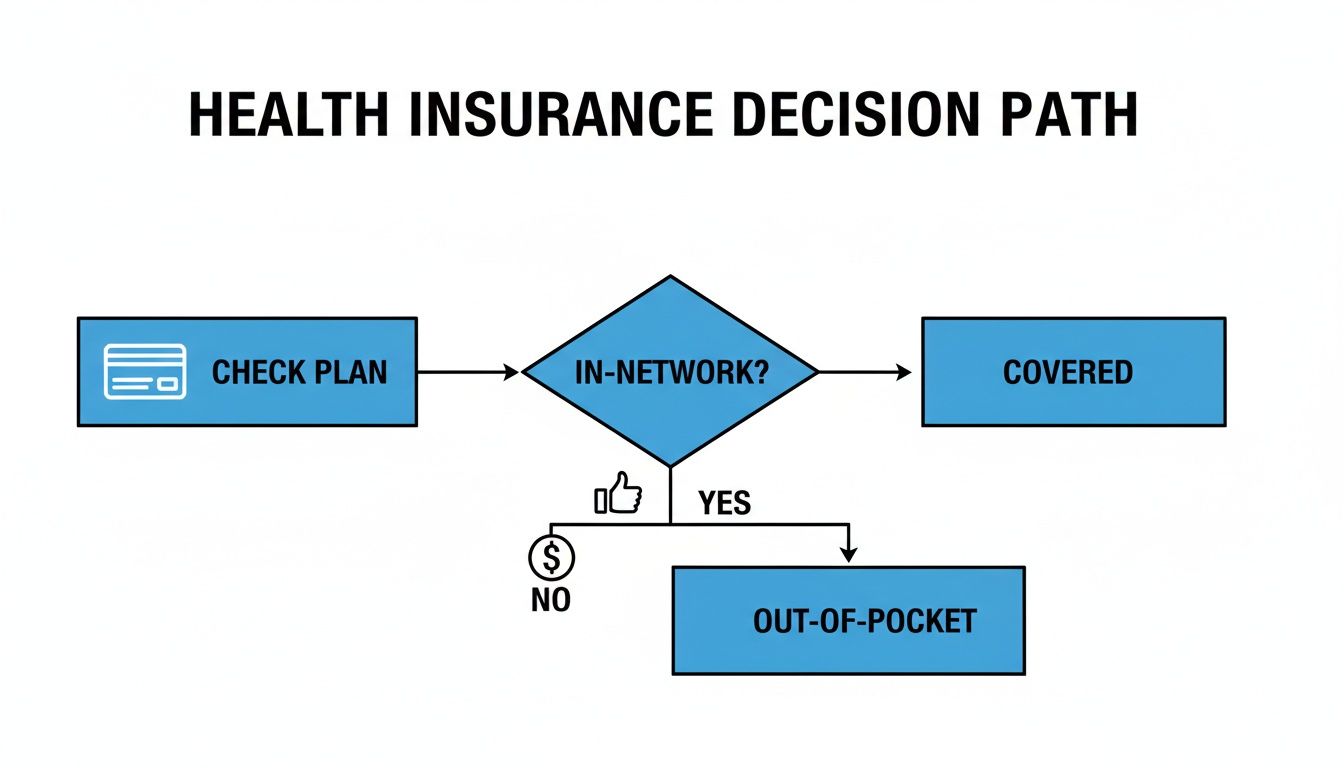
As this decision tree shows, verifying your insurance plan is a critical first move. It dictates whether your care will be covered at a lower cost or if you’ll be facing significant out-of-pocket expenses.
Your Final Decision-Making Checklist
To bring it all home, run your top candidates through one final filter. This isn’t about scoring them numerically but taking a moment for a thoughtful review of what matters most to you.
- Professional Qualifications: Is the doctor board-certified in the right specialty? Are their hospital affiliations considered top-tier for the care you need?
- Practice Operations: Does the office run like a well-oiled machine? Is the staff professional and respectful? Are the wait times reasonable for your lifestyle?
- Communication and Philosophy: Does the doctor’s communication style click with yours? Do you get the sense they will be a collaborative partner in your healthcare decisions?
- Personal Comfort: Did you feel respected? Were you comfortable asking questions, even the “silly” ones? Did you walk out of the appointment feeling confident and heard?
- Logistical Fit: Is the location convenient? Do their office hours align with your schedule? And crucially, is the doctor in your insurance network?
If you find yourself stuck between two excellent physicians, ask yourself this: Who made you feel more empowered? Who left you feeling more in control of your health journey? The answer to that question often points you to the right choice.
Key Insight: The “best” doctor is a completely subjective title. The right physician for a friend or family member might not be the right one for you. Your final choice should be deeply personal, aligning with your specific medical needs and how you prefer to communicate.
Once you’ve made up your mind, let the doctor’s office know when you schedule your next appointment. Articulating your decision to move forward with them can be a powerful first step in building that new partnership. You’ve done the research, gathered the facts, and listened to your intuition. You can now move ahead with the assurance that you’ve made an informed, proactive decision for your health.
Finding a physician who meets the highest standards of care shouldn’t be left to chance. At Haute MD, we’ve created a curated network of the nation’s most respected, rigorously vetted specialists. Our platform connects discerning patients with elite doctors known for their expertise, innovation, and commitment to exceptional outcomes. To find a top-tier physician in your area, explore our exclusive network at https://www.hauteliving.com/hautemd.