



So, you’re ready to find a dermatologist. Smart move. But “finding a dermatologist” isn’t the goal—finding the right one is. It all begins with building a solid shortlist of candidates.
Starting Your Search for the Right Dermatologist
Before you even think about fancy lasers or specific procedures, your first filter should be for board certification. This is non-negotiable. It’s the baseline guarantee that a doctor has completed years of rigorous, specialized training and passed comprehensive exams. Don’t even consider someone without it.
Once you’ve made board certification your mandatory entry ticket, you can start building your initial list. Here’s where to look:
- Tap into Your Doctor’s Network: Your primary care physician is your most trusted ally. They have a professional network and know which specialists consistently deliver great results for their patients. Ask them for a direct referral.
- Check Your Insurance Provider: This is a purely practical step, but it’s a critical one. Hopping on your insurer’s website to find an in-network doctor will save you from surprise bills and endless administrative headaches down the road.
- Ask People You Trust: Friends and family who’ve had positive experiences can be an incredible resource. They’ll give you the unvarnished truth about everything from a doctor’s bedside manner to the office wait times.
This early legwork is about creating a vetted pool of qualified, accessible options. It’s the same fundamental process you’d use for finding any top-tier doctor, and it sets you up to confidently move on to the more detailed evaluation phase.
To help you decode what you’re looking for, here’s a quick rundown of the credentials that matter most.
Dermatologist Credentials at a Glance
This table breaks down the essential qualifications you should look for and explains why they’re so important for your care.
| Credential | What It Means | Why It Matters |
|---|---|---|
| MD or DO | The doctor has graduated from an accredited medical school (Doctor of Medicine or Doctor of Osteopathic Medicine). | This is the foundational degree for any physician, ensuring they have a comprehensive medical education. |
| Board-Certified | They’ve passed rigorous exams administered by the American Board of Dermatology or a similar governing body. | This is the gold standard. It confirms their expertise specifically in dermatology and a commitment to ongoing education. |
| FAAD | “Fellow of the American Academy of Dermatology.” This isn’t a certification but signifies membership in the largest professional dermatology group. | It shows the doctor is engaged with the latest research, best practices, and ethical standards in their field. |
| Fellowship Training | Additional, intensive training in a sub-specialty like Mohs surgery, cosmetic dermatology, or pediatric dermatology. | If you need specialized care, a fellowship-trained dermatologist has next-level expertise in that specific area. |
Think of these credentials as your checklist. Once a potential dermatologist ticks these boxes, you know you’re looking at a highly qualified professional, and you can move on to evaluating their practice and approach.
How to Verify Credentials and Specializations
Once you have a shortlist, it’s time to get granular. Board certification is the non-negotiable starting point, but what truly matters is a dermatologist’s specific area of expertise. They aren’t all interchangeable; some are masters of medical dermatology, treating conditions like severe eczema or psoriasis, while others focus on cosmetic enhancements or pediatric care.
Your goal is to align your needs with their proven track record. If you’re battling persistent adult acne, a doctor known primarily for injectables and laser treatments might not be the ideal fit. Think of it like hiring any other expert—you want the one who lives and breathes your specific problem.
The American Academy of Dermatology’s ‘Find a Dermatologist’ tool is a great resource for confirming credentials and any advanced fellowship training.
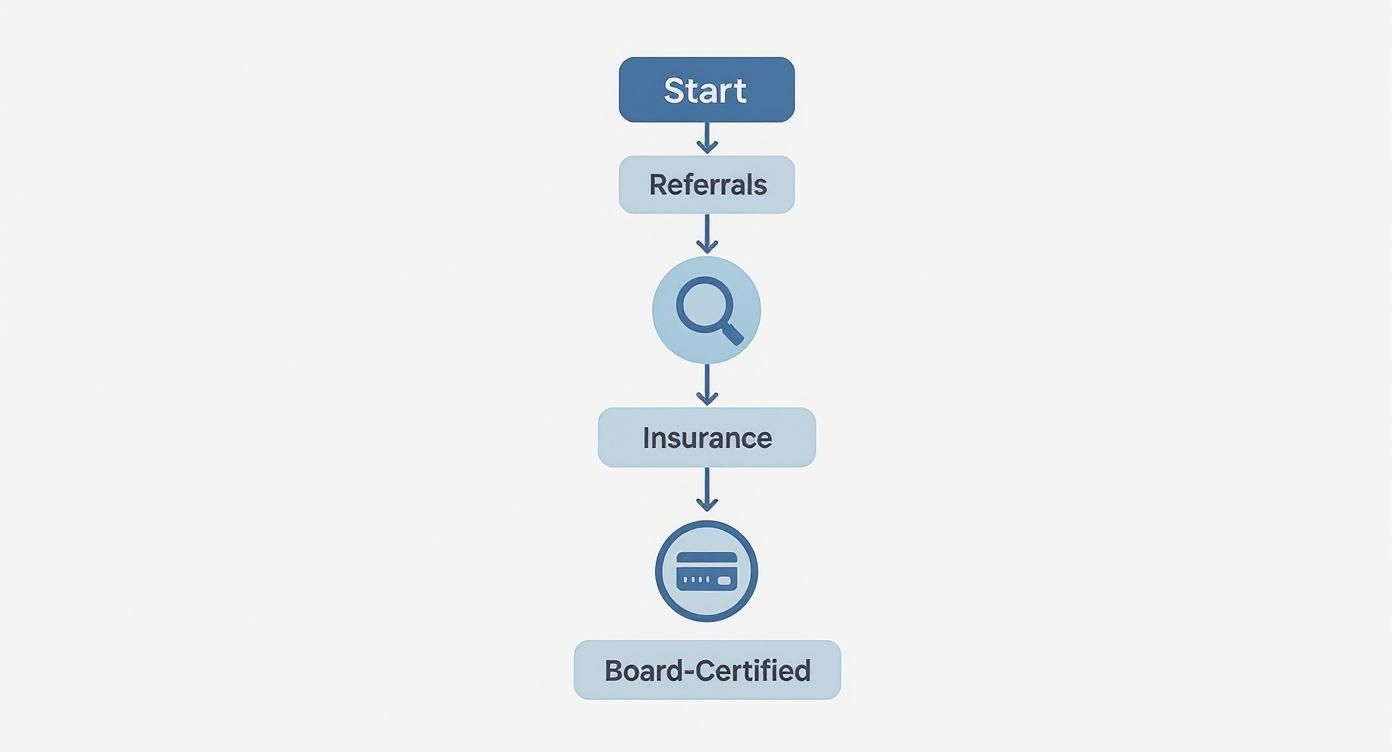
As the graphic illustrates, after getting referrals and confirming insurance, verifying board certification is a critical next step. From there, you can explore curated networks of top-tier dermatology specialists to pinpoint the right expert for your unique skin concerns.
Reading Between the Lines of Patient Reviews

Anyone can glance at a star rating, but that number tells you almost nothing. The real gold is buried in the comments. When you’re vetting an elite dermatologist, your goal is to hunt for patterns on platforms like Google, Healthgrades, or Vitals.
One disgruntled comment about a long wait time? That’s just noise. Ignore it.
Ten different reviews that all mention how the doctor took the time to listen, never seemed rushed, and explained every option in detail? That’s a powerful signal. That’s the pattern you’re looking for.
This isn’t just a gut feeling; it’s backed by data. One major study found that a dermatologist’s perceived friendliness and caring nature were the single biggest drivers of patient satisfaction. In fact, a staggering 92% of patients gave top marks based on their doctor’s compassionate approach.
Forget the star rating. The real value comes from spotting consistent themes about the doctor’s communication style, the staff’s professionalism, and the clinic’s overall vibe. You’re gauging the entire patient experience, not just the medical outcome.
This is the exact same process top doctors use to manage their own reputations. By reading reviews like an insider, you get a much clearer picture of what it’s actually like to be a patient there, which is a key part of effective online reputation management for doctors.
A great dermatologist’s skill is only one piece of the puzzle. The clinic itself—its technology, its services, its entire philosophy of care—is just as critical for getting the results you want. The right tools are non-negotiable.
Before you even think about booking a consultation, do a quick deep-dive into the clinic’s offerings. This isn’t just about ticking boxes; it’s about making sure their capabilities align perfectly with your goals, whether that’s managing a chronic skin condition or exploring a cosmetic treatment. Your first stop should always be the “Services” or “Treatments” page on their website.
Let’s get specific. If you’re bothered by old acne scars, you should be looking for clinics that offer advanced options like fractional CO2 lasers, radiofrequency microneedling, or other sophisticated resurfacing technologies. A clinic that only offers chemical peels isn’t going to cut it.
Similarly, if you have a family history of melanoma and need a meticulous skin cancer screening, does the clinic offer full-body digital mole mapping? This technology creates a comprehensive baseline of your skin, making it far easier to track subtle changes over time. It’s a world away from a quick visual glance.
This simple pre-screening step saves you from wasting time and money on a consultation at a clinic that isn’t even equipped to handle your chief concern.
It’s no surprise that a huge number of dermatology visits are for skin cancer screenings (20.2%) and managing chronic conditions (16.5%). Knowing this, you can see why verifying a clinic’s specialized services is so important. For more on what brings people to the dermatologist, you can read about European dermatology patient trends.
Making Your First Consultation Count

Think of your first appointment as the final interview. It’s less about getting a quick diagnosis and more about determining if this doctor’s entire approach—their philosophy, communication style, and bedside manner—is the right fit for you.
You need to go in prepared. This isn’t the time to be a passive patient.
Instead of just describing your symptoms, come armed with questions that peel back the curtain on how they practice medicine. Ask things like, “What’s your typical approach for a condition like mine?” or “How do you prefer to track progress and adjust treatments over time?” Their answers will tell you everything.
Pay close attention not just to what they say, but how they say it. Do they listen? Do you feel heard and respected, or rushed and dismissed?
This initial interaction is everything. Research consistently shows that a positive, communicative encounter is directly linked to better patient satisfaction and outcomes—far more than any other factor. One revealing U.S. study found that patients rated positive interactions nearly four times higher than negative ones when judging their overall care quality. You can read the full research on patient-doctor communication for yourself.
The takeaway is simple: If the connection feels off from the start, it probably is. Trust your gut and find someone who makes you feel like a partner in your own healthcare.
Got Questions About Finding a Dermatologist? We’ve Got Answers.
When you’re looking for the right dermatologist, a few key questions always come up. Here’s a straightforward breakdown of the essentials.
What Is the Difference Between a Dermatologist and an Esthetician?
This is probably the most critical distinction to understand. A dermatologist is a medical doctor (MD) who has gone through medical school and a specialized residency. They are trained to diagnose and treat over 3,000 conditions affecting your skin, hair, and nails.
An esthetician, on the other hand, is a licensed skincare professional who focuses on cosmetic treatments. Think facials, light chemical peels, waxing, and helping you build a solid daily routine. They are experts in the surface-level health and appearance of your skin.
The bottom line: If you have any medical concern—acne, eczema, psoriasis, a suspicious mole, or hair loss—you need a board-certified dermatologist. Estheticians provide fantastic complementary services, but they cannot diagnose conditions or prescribe medication.