



Choosing the right physician isn’t just about finding someone qualified; it’s about finding the right partner for your health journey. It boils down to a clear, three-part process: define what you need, verify their expertise, and ensure the personal fit is right.
Viewing it this way transforms the search from a chore into a strategic investment in your long-term well-being.
Beyond a Basic Search: Finding Your Ideal Physician

This is one of the most critical decisions you’ll make for your health, yet it’s shocking how many people simply pick a name off their insurance provider’s list. For those who demand excellence in every other part of their lives, from financial advice to personal training, their medical care shouldn’t be an exception.
This guide moves beyond generic advice. We’re talking about a framework for finding a true partner in your health—someone whose clinical philosophy, communication style, and access to modern treatments align perfectly with your goals. Think of it less like a quick search and more like selecting a trusted advisor who understands you on a deeper level.
Setting a Higher Standard for Your Healthcare
The first step is simply acknowledging that not all physicians are created equal, particularly when your needs are complex or specialized. As of 2022, there were 989,320 active physicians in the United States. That’s an overwhelming number.
So, how do you filter for excellence? The non-negotiable starting point is board certification. This isn’t just a line on a resume; it’s proof that a doctor has met rigorous standards far beyond basic medical licensing. The data is clear: studies show that patients of board-certified doctors often have significantly better outcomes, including 19% lower mortality rates for certain procedures. For anyone seeking elite care in areas like executive health or longevity medicine, this credential is the absolute baseline.
The right physician acts as more than a service provider; they become a strategic ally. Your goal should be to find someone whose expertise and approach align perfectly with your vision for a healthy, high-performance life.
Defining What Excellence Looks Like—For You
Before you even look at a single CV, you have to get clear on what you’re actually looking for. A fantastic physician for a colleague might be a terrible fit for you. Take a moment to define your personal priorities. Our guide on finding the best doctor can help you drill down on this.
Start by considering these key areas:
- Clinical Focus: Are you after a top-tier primary care physician focused on proactive, preventive health? Or do you need a specialist in a niche field like hormone optimization, metabolic health, or sports medicine? Be specific.
- Care Philosophy: Do you prefer a doctor who is strictly data-driven and follows conservative, evidence-based protocols? Or are you looking for an innovator who is open to integrating cutting-edge treatments and thinking outside the box?
- Communication Style: What works best for you? Do you want a direct, to-the-point communicator who gets right to the facts? Or do you thrive with a physician who spends more time on detailed explanations and collaborative, back-and-forth decision-making?
Answering these questions first gives you a powerful lens through which to evaluate every potential physician. It ensures your final choice is built on a solid foundation of shared goals and mutual understanding, moving you past the basics to find a genuine medical partner.
Defining Your Needs and Verifying Expertise
Before you even think about looking at a physician’s profile, the first and most critical step is an internal one. The entire process of choosing the right doctor hinges on a brutally honest assessment of your own health needs and what you truly expect from this relationship. Without this personal roadmap, even the most celebrated physician can be a terrible fit.
Are you looking for a primary care doctor who specializes in comprehensive executive health? Or do you need a true sub-specialist for something complex, like metabolic dysfunction or advanced hormone optimization? Getting specific is everything. You can start by understanding the difference between internal medicine and primary care to narrow your focus.
Nailing this down from the start makes the whole selection process more targeted and efficient. It saves you an enormous amount of time and ensures the doctor you choose is perfectly aligned with your long-term health ambitions.
Articulating Your Clinical and Personal Needs
Think beyond just the medical specialty. You need to consider the style of care that works for you. Do you want a proactive physician who’s always thinking five steps ahead, anticipating future health risks and focusing on prevention? Or are you more comfortable with a doctor who reacts to issues as they come up?
Make a list of your non-negotiables. This is your personal filter.
- Clinical Approach: Are you drawn to an early adopter of new technologies and advanced treatments, or do you prefer someone who relies on more traditional, time-tested protocols?
- Logistical Must-Haves: Is telehealth an absolute necessity for your schedule? How critical is direct access to your doctor via text or email for urgent questions?
- Personal Preferences: Do you connect better with a warm, collaborative doctor, or do you prefer a more direct, data-driven communicator?
Once you have this framework, you can shift your focus to the hard part: rigorously vetting a candidate’s expertise.
Decoding Credentials Beyond the Basics
Verifying a doctor’s expertise goes much, much deeper than just confirming they have a medical license. The global physician workforce is enormous and incredibly varied, which makes this step absolutely essential. By 2021, the number of doctors across OECD member countries had swelled to 4.3 million. In the U.S. alone, nearly a quarter of all active physicians are international medical graduates, and in some states, that number climbs past 36%.
This isn’t a judgment; it’s a reality check. The variability in training, background, and experience is massive, and these factors directly impact patient outcomes. For instance, some research suggests a physician’s age can correlate with their diagnostic speed—it’s one reason platforms like Haute MD focus on specialists who are at the absolute peak of their fields. You can discover more insights about global physician trends on OECD.org.
True expertise isn’t just about a degree; it’s a reflection of continuous learning, specialized training, and a demonstrated commitment to excellence in a specific field.
Don’t just glance at credentials—learn to interpret what they really mean for the quality of care you’ll receive. A doctor’s background tells a story about their focus, dedication, and proficiency.
Understanding Physician Credentials
This table breaks down key credentials to look for when vetting a physician and explains what each one signifies about their level of expertise.
| Credential | What It Means | Why It Matters for You |
|---|---|---|
| Board Certification | The physician has passed rigorous exams in a specific specialty, demonstrating expertise beyond basic licensing. | This is the gold standard. It ensures your doctor has mastered the knowledge and skills required for high-quality specialty care. |
| Fellowship Training | An additional 1-3 years of highly specialized training in a sub-specialty after completing a medical residency. | Essential for complex conditions. A fellowship in longevity medicine or neurosurgery signifies deep, focused expertise. |
| Hospital Affiliations | The physician has privileges to admit and treat patients at specific hospitals, typically top-tier medical centers. | Affiliation with a leading academic or research hospital often indicates a doctor is respected by their peers and up-to-date. |
| Academic Appointments | The doctor holds a teaching position at a medical school, such as a professor or clinical instructor. | This often signals that the physician is a thought leader in their field and is actively involved in training the next generation. |
Doing this level of due diligence on your own can be exhaustive. A curated network like Haute MD streamlines the entire process because every single physician listed has already been put through a thorough vetting process based on these exact criteria. This lets you spend less time verifying basic qualifications and more time finding the perfect personal and philosophical match for your health.
Assessing Clinical Philosophy and Communication Style

A physician can have flawless credentials and an impeccable reputation, but if their fundamental approach to medicine doesn’t resonate with you, the relationship is destined to fail. This is where the selection process becomes deeply personal.
Choosing a doctor who acts as a true partner requires looking beyond the CV. You have to assess the critical ‘soft skills’—the communication style and clinical philosophy that shape every single interaction. These aren’t trivial details; they are the absolute foundation of trust. Without a strong personal and philosophical alignment, achieving your long-term health goals becomes exponentially harder.
Gauging Bedside Manner and Communication
The initial consultation is your first real test. This is your opportunity to observe how the physician interacts with you when your health is the topic of conversation. Pay close attention not just to what they say, but how they say it.
A great doctor should make you feel like the most important person in the room. You’re looking for someone who can translate complex medical information into clear, understandable terms without being condescending. The goal is to find a physician who empowers you with knowledge, not one who dictates orders from on high.
Here are specific communication traits to watch for during that first meeting:
- Active Listening: Do they let you finish your thoughts without interrupting? A physician who constantly cuts you off may be more focused on their agenda than on understanding your unique situation.
- Clarity and Empathy: Can they explain a diagnosis or treatment plan in a way that makes sense to you? Do they show empathy for your concerns, or do they dismiss them?
- Pacing and Presence: Do you feel heard, or do you feel rushed? Top-tier physicians, particularly in concierge settings, should dedicate ample time to each patient, ensuring all questions are answered thoroughly.
This initial feeling is a powerful indicator of how the long-term relationship will function, especially when you need to make important health decisions together.
The best doctor for you is not just a brilliant diagnostician but also a skilled communicator. They should make you feel seen, heard, and respected as an active participant in your own healthcare.
Aligning on Treatment Philosophies
Beyond communication, you need to ensure your doctor’s core approach to medicine aligns with your own. It’s not uncommon for two highly qualified doctors to have wildly different philosophies on treatment, prevention, and patient care. This is a crucial element in knowing how to choose a doctor who fits your lifestyle.
For instance, one physician might favor an aggressive, intervention-heavy approach using the latest pharmaceuticals. Another might prefer a more conservative path, starting with lifestyle modifications and less invasive options first. Neither is inherently wrong, but one will be a much better fit for you.
To uncover this, you need to ask direct, insightful questions. This isn’t about challenging their expertise; it’s about understanding their mindset. Curated platforms like Haute MD can give you a head start by providing profiles of leading doctors, often including interviews that shed light on their care philosophy, saving you valuable time.
Key Questions to Ask a Potential Doctor
Come to your initial meeting prepared with a list of questions designed to reveal their clinical style. This shows you are an engaged, proactive patient and gives you the specific information you need to make a confident decision.
Consider asking some variation of the following:
- On Patient Collaboration: “How do you see the patient’s role in the decision-making process? How do you work with patients who have done their own research?”
- On Treatment Approach: “Can you describe your general philosophy on using medication versus lifestyle changes? When do you typically recommend a more aggressive treatment path?”
- On New and Complementary Therapies: “What is your perspective on integrating complementary or alternative therapies alongside conventional medicine? How do you stay current with new medical advancements?”
- On Preventive Care: “What does proactive and preventive health look like in your practice? What kind of advanced diagnostics or screenings do you typically recommend for someone with my health profile?”
Their answers will provide a clear window into their clinical mind. This conversation is the final, essential layer of due diligence. After verifying their credentials and expertise, confirming this personal and philosophical fit ensures you are not just choosing a qualified doctor, but the right doctor for you.
Don’t Overlook the Operations: Practice Logistics and Patient Access
You can find the most brilliant physician on the planet, but their genius is useless if the practice is a disaster to deal with. The day-to-day experience of getting care—the logistics—isn’t just about convenience. It’s a direct reflection of the doctor’s standards and a critical part of your overall outcome.
For a busy professional, time is your most guarded asset. A practice that doesn’t respect it is an immediate deal-breaker. When you’re vetting a potential doctor, you have to look past the diplomas on the wall and see how the office actually runs. A well-oiled machine that values your time and communicates clearly is a sign of excellence. This is especially true in concierge and executive health, where seamless, high-touch service is precisely what you’re paying for.
Can You Actually Get In and Get a Hold of Them?
The first test is often the simplest: getting on the calendar. If a new patient consultation is three months out, what happens when you have an urgent issue? A long wait time for routine appointments is a major red flag about the practice’s capacity to serve its patients properly.
Then there’s communication. In a world of instant access, an office still stuck in a maze of phone trees and unreturned voicemails is hopelessly out of date.
- Appointment Wait Times: When you call, ask what the typical wait is for an appointment. More importantly, ask how long patients usually wait in the office.
- Urgent & After-Hours Needs: What’s the protocol for urgent issues that pop up after 5 PM or on a weekend? Is the doctor, or a trusted colleague, directly reachable?
- Digital Access: Do they have a modern, secure patient portal for messages, lab results, and prescription refills? This isn’t a luxury anymore; it’s a basic requirement for any efficient practice.
Your time is non-negotiable. A practice that consistently runs an hour behind or makes you jump through hoops to communicate is sending a clear message: they don’t respect their patients. Excellence in medicine has to include the entire experience.
The Real Cost of a Bad Location
Location is more than a simple convenience—it’s a major factor in whether you’ll stick with your care plan. Data shows that geographic access is a huge driver in doctor choice, especially for patients who expect top-tier service without a cross-country flight.
The distribution of elite physicians is far from even. Doctor density can vary from less than 2.5 per 1,000 people in some developed countries to over 5 in others. In the US, the best specialists are often clustered in a few major cities. This creates a real challenge for people in states like California or New York who might live hours away from the top-tier surgical specialist they need.
Choosing a local provider through a curated platform like Haute MD’s city/state search can dramatically lower this barrier. And it’s not just about saving time—studies show that patients who have to travel long distances for certain elective surgeries can face up to 15% higher complication rates. You can dig into the full OECD report on geographic doctor distribution for more details.
The Front Lines: Evaluating Staff and Environment
The office staff are the gatekeepers. Their professionalism, empathy, and efficiency are often a direct mirror of the physician’s own philosophy. A courteous, organized team makes every single interaction, from scheduling to billing, feel effortless.
Pay close attention to your first few interactions. Do they sound welcoming and on top of things, or are they rushed and dismissive? That first impression tells you almost everything you need to know. A chaotic or rude staff will inevitably create friction and stress, undermining the quality of care you’re there to receive.
Your Quick Logistics Checklist
As you make your initial calls or go for a visit, run through this mental checklist to see how the practice stacks up:
- Office Vibe: Does the clinic feel calm, clean, and professional, or chaotic and dated?
- Staff Interaction: Was the person you spoke with polite, sharp, and genuinely helpful?
- Scheduling: Do they understand the demands of a professional’s schedule and offer some flexibility?
- Telehealth Options: Can you do a virtual follow-up for simple issues, or is every visit in-person?
- Billing Clarity: Is the staff upfront and transparent about costs, what insurance covers, and their payment process?
At the end of the day, a practice’s logistics reveal how much it truly centers its operations around the patient. A world-class doctor knows that exceptional medical care and exceptional service are two sides of the same coin. By scrutinizing these practical details, you ensure your final choice is not only clinically brilliant but operationally sound.
4. Evaluate the Medical Practice Model
A doctor’s clinical skill is one thing; the structure of their practice is another. How a practice operates and its underlying financial model will ultimately define your access to that skill. This is a critical piece of the puzzle, as it dictates everything from how you schedule appointments to the depth of your relationship with the physician.
The decision usually boils down to the trade-offs between a traditional, insurance-based practice and the more personalized world of concierge or direct-pay medicine. Neither is inherently better—the right choice hinges on what you value most.
Traditional vs. Concierge: A Tale of Two Models
Most medical practices you encounter are built on a volume-based model. They rely on insurance reimbursements, which means they need to see a high number of patients every day just to keep the lights on. The inevitable result is shorter appointments, longer wait times, and a system that’s primarily designed for reactive care—fixing problems as they arise.
Concierge medicine and its cousin, direct primary care (DPC), flip that model on its head. These practices run on membership fees, allowing them to dramatically limit the number of patients they see. With a smaller patient panel, physicians can offer what has become a true luxury: time. This means longer, unhurushed appointments and direct lines of communication. If you want to dive deeper, you can explore the nuances between direct primary care vs concierge medicine in our guide.
This structure is built for a proactive, high-touch partnership focused on your long-term wellness and performance. The flowchart below can help you visualize how different needs might steer you toward one model over the other.
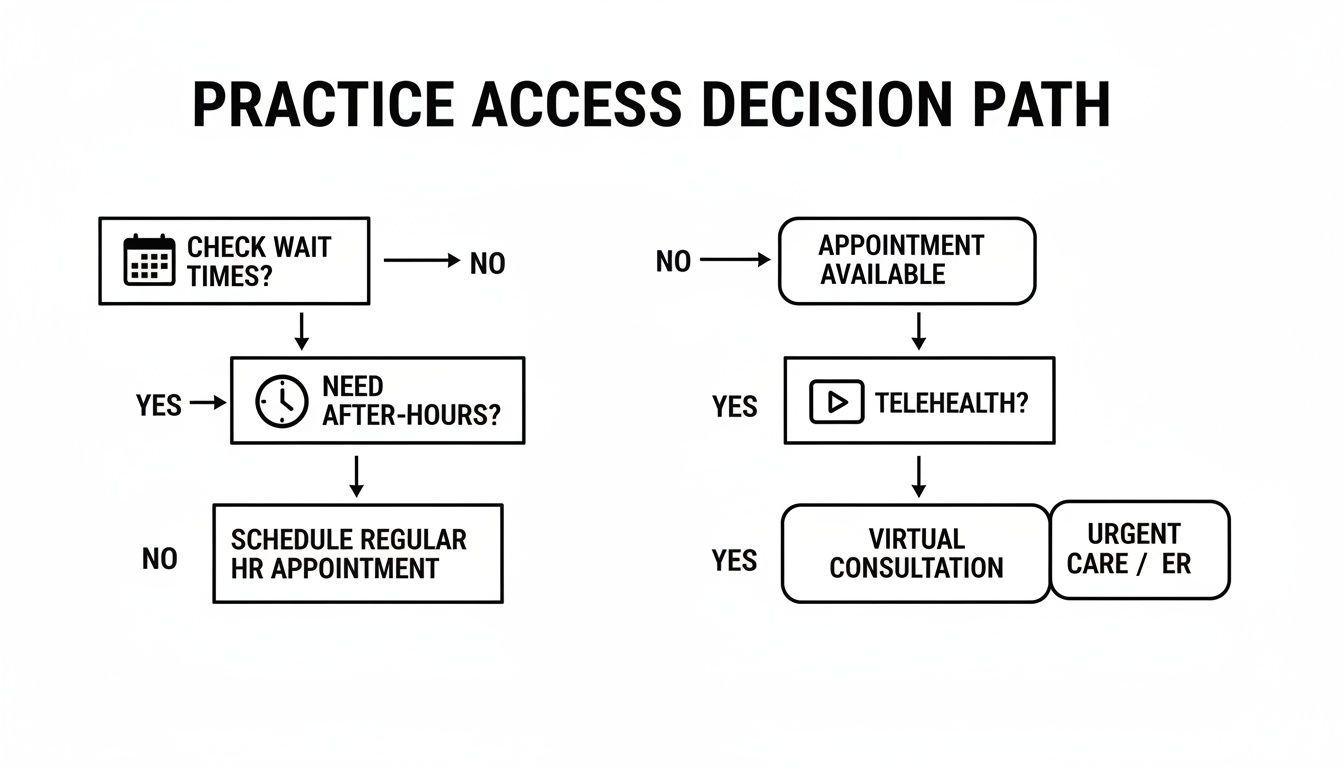
As you can see, factors like after-hours needs, appointment availability, and the desire for virtual care often point directly toward a membership-based model that prioritizes access.
To help clarify the differences, let’s break down the key features of each model.
Comparing Medical Practice Models
| Feature | Traditional Insurance Model | Concierge and Executive Health |
|---|---|---|
| Patient Panel Size | 2,000 – 3,000+ patients | 100 – 600 patients |
| Appointment Length | Typically 10 – 15 minutes | 30 – 60+ minutes |
| Physician Access | Through staff/portals; limited after-hours contact | 24/7 direct access via cell, text, or email |
| Wait Times | Weeks or months for routine visits; long office waits | Same-day or next-day appointments; minimal to no office wait |
| Care Focus | Reactive; addresses acute issues | Proactive; focuses on prevention, wellness, and optimization |
| Care Coordination | Limited; patient often manages specialist referrals | Comprehensive; physician actively manages specialist care |
| Cost Structure | Co-pays, deductibles, co-insurance | Annual or monthly membership fee ($2,000 – $25,000+) |
This table highlights the fundamental trade-off: The traditional model is built for broad access at a lower direct cost, while the concierge model is designed for deep, personalized relationships at a premium price.
What a Concierge Membership Really Gets You
Joining a concierge practice is less about buying a service and more about investing in a healthcare partnership. It’s built for busy professionals and anyone who simply demands a higher standard of care.
While every practice is different, you can generally expect a suite of premium benefits:
- Same-Day or Next-Day Appointments: Urgent issues are handled immediately, without the agonizing wait.
- 24/7 Direct Physician Access: You get your doctor’s cell number. No more navigating phone trees or waiting for a call back from a nurse.
- Extended, Unrushed Visits: Appointments often last 30 to 60 minutes, sometimes longer. This is where real conversations happen and complex issues get the attention they deserve.
- Proactive Wellness Planning: The focus shifts from treating sickness to building robust health through advanced diagnostics, personalized health plans, and longevity strategies.
- Seamless Care Coordination: Your physician acts as your healthcare quarterback, managing referrals to top specialists and ensuring your entire care team is on the same page.
The cost for this level of service can range from a few thousand to tens of thousands of dollars a year, a price that reflects the exclusivity and depth of the relationship.
Navigating Out-of-Network Specialists
It’s a common scenario: the absolute best specialist for your unique condition isn’t in your insurance network. While it adds a layer of administration, this should never be a barrier to getting world-class care.
Choosing an out-of-network provider is a strategic decision to prioritize expertise over network convenience. It empowers you to select the absolute best physician for the job, not just the best one your insurance plan has contracted with.
If you go this route, you’ll typically pay for the services upfront. The specialist’s office will then provide you with a detailed receipt, often called a “superbill,” which you submit to your insurance company for reimbursement. How much you get back depends entirely on your plan’s out-of-network benefits.
Before you book anything, call your insurance provider. Get a clear understanding of your out-of-network coverage, including any deductibles you need to meet and the exact reimbursement rates. It’s a manageable trade-off when the goal is to access the very best medical talent available.
Making the Final Decision and Building a Partnership
You’ve done the heavy lifting. The research is compiled, the consultations are complete, and you’ve weighed everything from board certifications to bedside manner. Now comes the final, crucial step.
All the data points are essential, but the ultimate decision often boils down to a well-informed sense of trust. The credentials and outcomes data confirmed the physician’s technical competence. The logistical review confirmed the practice fits your life.
Now, you have to answer one last, deeply personal question: Do you trust this person to be your health advocate? Your gut feeling, developed after a thoughtful consultation, is a powerful and valid piece of data. This entire process is designed to ensure you aren’t just selecting a provider—you’re initiating a true healthcare partnership.
Trust Your Gut, But Get a Second Opinion
Even with a leading candidate in mind, seeking a second opinion for a major diagnosis or a significant new treatment plan is simply smart due diligence. This isn’t a sign of distrust. On the contrary, it’s the hallmark of an empowered patient taking full ownership of their health.
A second expert opinion can accomplish several things:
- Confirm a Diagnosis: This provides invaluable peace of mind that the initial assessment is accurate.
- Offer Alternative Perspectives: Another top-tier expert might propose a different, equally valid treatment path you hadn’t considered.
- Solidify Your Choice: If the second doctor concurs with the first, it builds immense confidence in your chosen physician and their proposed plan moving forward.
This step refines your understanding and ensures your decision is built on a comprehensive view of your options, not a single perspective.
When making a significant health decision, a second opinion isn’t about questioning your doctor’s ability; it’s about affirming your own commitment to making the best possible choice for your body.
Transitioning Care and Forging the Partnership
Once your decision is made, the final phase is about smoothly transitioning your care and setting the right tone for a collaborative relationship. This isn’t just a formality; it’s your first action as an active partner in your own health.
The first order of business is getting your medical records transferred from previous physicians to the new practice. This is non-negotiable. It gives your new doctor a complete picture of your health history from day one, preventing redundant tests and ensuring true continuity of care.
Finally, schedule your first official appointment. This isn’t another sick visit. Use this time to discuss your long-term health goals, establish a new baseline, and map out a preventive care strategy together. This initial planning session moves the relationship beyond reactive problem-solving and into the realm of proactive health optimization, building a foundation centered on open dialogue and a shared vision for your wellness.
Your Questions Answered: Choosing the Right Doctor
When you’re searching for a top-tier physician, the stakes are high, and the questions that come up are often specific and critical. Getting straight answers is the only way to move forward with confidence, knowing your final choice truly aligns with what you expect from elite medical care.
Here’s a look at some of the most common questions discerning patients ask during their search.
What Is the Single Most Important Factor?
While board certification is the absolute, non-negotiable floor for expertise, the single most critical factor is alignment.
What does that mean? It means the doctor’s entire approach—their clinical philosophy, their communication style, how their practice operates—has to sync up with your personal health goals. A physician with a wall full of credentials is only the right choice if you can build a genuine, trusting partnership with them.
How Do I Really Assess a Doctor’s Reputation?
You have to look past the surface. Basic online reviews are notoriously unreliable and can be easily skewed. Instead, you need to focus on objective markers of professional respect and proven excellence.
- Hospital Affiliations: Where are they credentialed? Look for affiliations with top-tier medical centers or major academic institutions. This is a powerful signal of quality.
- Academic Roles: Do they hold a teaching position at a respected university medical school? This shows they are trusted to train the next generation of doctors.
- Peer-Reviewed Publications: Have they contributed to the medical literature in their field? This demonstrates a commitment to advancing their specialty.
Don’t be afraid to ask about their professional network. The best specialists are almost always recommended by other leading physicians in the community. Vetted platforms can also cut through the noise, showcasing doctors who are recognized by their peers for their exceptional skill.
For patients who demand immediate access, deep personalization, and a proactive stance on wellness, a concierge doctor is an investment worth serious consideration. This model sidesteps the frustrations of traditional care—the long waits, the rushed appointments—and fosters a collaborative relationship focused on your long-term health optimization.
Following this path removes the guesswork. It confirms you’re considering a physician who is genuinely at the top of their game, not just someone with a good marketing team.
Finding a physician who meets these demanding standards can be a challenge. Haute MD simplifies the process by connecting you with a curated network of the nation’s most respected, rigorously vetted specialists in executive health, longevity, and elite surgical care. Explore our trusted directory and find your ideal health partner at Haute MD website.