



Let’s get right to it: you want to know how much concierge medicine costs. The short answer? Annual membership fees typically run between $2,000 to $10,000 per person. Of course, for elite or executive plans packed with highly specialized services, that number can easily climb north of $50,000.
It’s important to understand this fee isn’t for individual treatments. Think of it as a retainer for a premium healthcare relationship.
Decoding Your Investment in Premium Healthcare
When you see the price tag, it’s natural to ask what you’re really paying for. This isn’t just about covering doctor’s visits; it’s an investment in a fundamentally different way of managing your health and well-being. Consider it less a transaction and more like securing a dedicated personal health advocate.
The core value behind the cost is access.

In the traditional system, a primary care physician might juggle a roster of thousands of patients. This inevitably leads to long wait times and brief, rushed appointments. Concierge doctors, on the other hand, intentionally limit their patient panel—often to just a few hundred people—to guarantee a level of personal attention that is simply impossible otherwise. This exclusivity is the main driver of the membership fee.
What the Numbers Represent
So, what does this investment deliver? The annual fee is designed to cover services that champion proactive, preventive care over reactive treatments. This usually includes:
- Unhurried Appointments: Instead of the standard 10-minute check-in, you get appointments that can last 30, 60, or even 90 minutes.
- Direct Physician Access: Most memberships provide 24/7 access to your doctor via their personal cell, text, or email, letting you bypass call centers and administrative layers.
- Comprehensive Wellness Planning: The focus shifts from merely treating sickness to architecting a detailed, personalized roadmap for your long-term health and longevity.
- Same-Day or Next-Day Scheduling: Urgent needs are met immediately, eliminating the frustrating weeks-long wait for an open slot.
The crucial takeaway is that the membership fee buys you a proactive partnership in your health. It’s the difference between having a doctor who knows your chart and a doctor who knows you.
To give you a clearer picture, here’s a quick breakdown of what you can generally expect at different price points.
Typical Concierge Medicine Membership Cost Tiers
| Membership Tier | Typical Annual Cost Range | Common Included Services |
|---|---|---|
| Standard / Core | $2,000 – $4,000 | 24/7 direct physician access (cell/email), same-day/next-day appointments, extended appointment times (30-60 min), basic annual physical. |
| Enhanced / Premium | $4,000 – $10,000 | All Standard services, plus an advanced executive physical, basic in-office procedures, more robust wellness and nutrition planning, specialist coordination. |
| Elite / Executive | $10,000 – $50,000+ | All Enhanced services, plus advanced diagnostic testing (cardiac, genetic), house calls, travel medicine coordination, integrated health coaching, access to elite specialist networks. |
This table illustrates how value builds with each tier, moving from exceptional access to a fully integrated health optimization program.
This entire model is built on the premise that a stronger physician-patient relationship leads to better health outcomes. While most practices fall within the $2,000 to $10,000 annual range, the ultra-premium packages offer a level of care and coordination that can be truly life-changing. You can explore various pricing guides for concierge medicine to see how different practices structure their fees. Understanding this framework helps put the numbers into context as we explore the details further.
Understanding the Different Pricing Models
When you start looking into concierge medicine, you’ll quickly find that “membership fee” doesn’t mean the same thing everywhere. The way a practice structures its pricing can tell you a lot about its philosophy and what you can expect. Getting a handle on these models is the key to finding a financial arrangement that feels right for you—no surprises, just clarity.
Think of it like joining an exclusive club. Some clubs ask for annual dues upfront, others offer a monthly payment plan, and a few have a base fee with extra charges for premium services. Concierge medicine works in a similar way. Let’s break down the three main approaches you’ll come across.
The Retainer Model: The All-Inclusive Annual Fee
The most classic approach is the retainer model. This works exactly like having a top attorney or consultant on call for the year. You pay a single, comprehensive fee upfront that covers all the access-based services in your membership for the next twelve months.
It’s straightforward and clean. For those who prefer to handle major expenses in one go and then not think about them again, this is a perfect fit. Once it’s paid, your focus is entirely on your health, not on monthly bills.
- Analogy: It’s like buying an annual, all-access pass to a private resort. You pay once for a full year of privileges.
- Best For: Individuals who value simplicity and prefer to budget on an annual basis.
- Consideration: This model obviously requires a larger upfront investment compared to other options.
The Subscription Model: Predictable Monthly Payments
A more modern and increasingly common structure is the subscription model. It functions just like your Netflix, gym, or private club membership, breaking down the annual cost into predictable monthly payments. This makes the investment in concierge medicine feel more manageable and integrates seamlessly into a monthly budget.
The total annual cost is usually identical to the retainer model; it’s just spread out. For example, a practice charging $3,000 for a yearly retainer might offer it as a $250 monthly subscription.
This model lowers the barrier to entry, making premium healthcare accessible without a large upfront financial commitment. It mirrors the payment structures we’re already accustomed to in so many other parts of our lives.
The subscription model’s greatest strength is its predictability. You know exactly what’s coming out of your account each month, which makes financial planning effortless.
The Hybrid Model: A Blend of Access and A La Carte Services
Finally, you have the hybrid model, which can be a bit more nuanced. In this setup, a physician sees both concierge members and traditional insurance-based patients. Your membership fee is typically lower, but it’s primarily buying you enhanced access—think same-day appointments, longer visits, and direct communication with your doctor.
- Analogy: This is similar to a country club membership. Your annual dues grant you access to the grounds and basic amenities, but specialized services like golf lessons or private events cost extra.
- How It Works: You pay a base membership fee for priority access. However, specific medical services, in-office procedures, or extensive consultations might be billed separately to your insurance.
- Important Distinction: Some practices using this model look a lot like Direct Primary Care (DPC), which often operates on a lower-cost, no-insurance basis. To get clear on the nuances, it’s worth understanding how Direct Primary Care vs. concierge medicine compare.
This model can be a cost-effective way to get your foot in the door, but it’s absolutely critical to ask exactly what the membership fee covers versus what will be billed to your insurance. By understanding these three core models—Retainer, Subscription, and Hybrid—you can confidently evaluate any concierge practice and decide which financial structure best serves your needs.
Decoding What Your Membership Fee Actually Buys
When you’re evaluating concierge medicine, the most important thing to understand is exactly what that annual membership fee covers. It’s a common mistake to think of it as just a prepayment for future treatments. A better way to see it is as an access key—one that unlocks a fundamentally different tier of personalized healthcare.
This fee secures a direct, meaningful relationship with a physician who has the time and resources to focus on your long-term wellness, not just react to your immediate symptoms. It’s an investment in proactive health management, built on services that fall completely outside the traditional insurance billing model.
What Your Membership Fee Typically Includes
The real value of your fee is unparalleled access. In the conventional system, a primary care doctor might juggle a roster of thousands of patients. A concierge physician, by contrast, intentionally keeps their practice small—often just a few hundred people. This single change makes everything else possible.
Most membership plans bundle a core set of high-value services into the annual fee:
- 24/7 Direct Physician Access: This is the cornerstone. You get your doctor’s personal cell number and email. No more call centers or waiting for a nurse to call you back. You get immediate answers to urgent questions, day or night.
- Unhurried, Extended Appointments: Forget the standard seven-minute check-in. Appointments typically last 30 to 60 minutes, giving you the time you actually need to discuss complex issues, go over test results in detail, and build a genuine rapport.
- Comprehensive Annual Physicals: This isn’t your average check-up. It’s an executive-level physical that often includes advanced screenings and in-depth lab work, culminating in a personalized health roadmap for the year ahead.
- Same-Day or Next-Day Scheduling: When you need to be seen, you get in—period. This eliminates the stressful, and sometimes dangerous, weeks-long waits that have become normal in traditional primary care.
- Proactive Care Coordination: Your concierge doctor acts as the quarterback for your entire healthcare team. They don’t just give you a referral; they actively liaise with specialists, review their findings, and make sure your overall treatment plan is cohesive.
These benefits are all designed to shift your healthcare from a reactive afterthought to a proactive priority. You can learn more about the top benefits of concierge medicine and see how this model creates a powerful physician-patient partnership.
The infographic below shows how different pricing models—from retainers to subscriptions—are used to structure these membership fees.
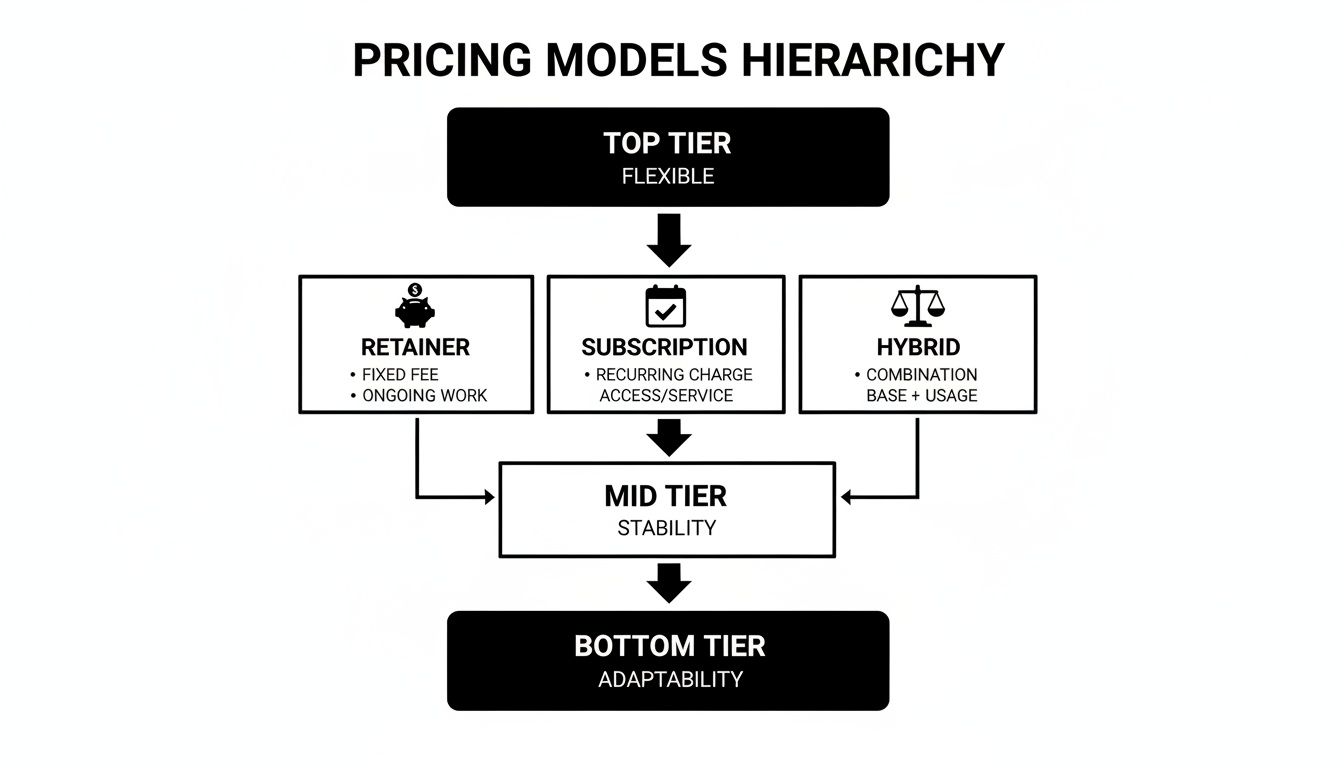
Each model provides a different financial structure, but the goal is always the same: providing the high-touch, personalized services that define elite medical care.
What Is Almost Always Excluded
It’s just as crucial to know what your membership doesn’t cover. Your fee is not a replacement for health insurance. You absolutely need to maintain a robust insurance plan for any medical services that fall outside your primary physician’s direct care.
A common misconception is that the annual fee covers all healthcare costs. In reality, it covers the relationship and access to your doctor, while insurance covers the procedures and external services.
Getting this distinction right is key to budgeting your total healthcare spending accurately.
To make it crystal clear, this table breaks down what’s generally included in your membership versus what you’ll still need insurance or separate payment for.
Concierge Membership Services Included vs Excluded
| Service Category | Typically Included in Membership | Typically Excluded (Requires Insurance/Separate Fee) |
|---|---|---|
| Primary Care Visits | Unlimited, extended consultations with your concierge doctor. | Visits to any other doctor or specialist. |
| Diagnostic Imaging | N/A | MRIs, CT scans, X-rays, and ultrasounds. |
| Laboratory Work | Sometimes includes basic in-office tests (e.g., strep). | Comprehensive blood panels, genetic testing, and specialized lab work. |
| Hospital Care | Your doctor may coordinate and advocate for you during a stay. | All costs associated with hospitalization, including room, board, and surgeon fees. |
| Specialist Care | Coordination and referrals to trusted specialists. | The actual consultation fees and services provided by specialists (e.g., cardiologists, orthopedists). |
| Emergency Services | 24/7 guidance from your doctor on whether to seek emergency care. | Ambulance services and all costs related to an emergency room visit. |
| Surgical Procedures | Pre-operative and post-operative coordination and oversight. | All fees related to the surgery itself, including the surgeon and facility costs. |
Understanding this division of costs is essential. By drawing a clear line between what your membership covers and what insurance is for, you can accurately plan your finances and get the full benefit of personalized care without any unexpected bills.
The Key Factors Driving Concierge Practice Costs

When you start exploring concierge medicine, you’ll notice a surprisingly wide price spectrum. One practice might offer a membership for $3,000 a year, while another elite clinic in the same city commands $30,000. This isn’t random. Several key factors directly shape these price points.
Getting a handle on these drivers is the first step in evaluating the true value behind the numbers. It allows you to intelligently compare different practices and decide which plan offers the right blend of services, expertise, and access for your investment. Let’s break down the four most significant variables.
Patient Panel Size and Exclusivity
The single most influential factor is the size of the physician’s patient panel. Your traditional primary care doctor is often juggling a roster of 2,000 to 3,000 patients, making truly personalized attention a logistical impossibility. Concierge medicine completely flips this model on its head.
A concierge physician deliberately limits their practice size, typically to between 400 and 600 patients. This fundamental shift from a volume-based model to a value-based one is exactly what you’re paying for. It’s what makes same-day appointments, unhurried visits, and direct 24/7 physician access possible.
Think of it like a private tutor versus a crowded lecture hall. The smaller the group, the more focused and personal the attention. A doctor serving only 100 patients will naturally have a higher membership fee than one serving 500, as they offer an exponentially higher degree of personal access.
This exclusivity is the core product. The smaller the panel, the higher the price—but also the more dedicated your physician can be.
Physician Specialty and Expertise
Not all physicians command the same fees, and this holds true in concierge medicine. A top-tier internal medicine or family practice doctor provides incredible value, but a board-certified specialist who has transitioned to a concierge model will almost always charge more.
Their specialized knowledge—and their ability to manage complex conditions within their field—adds a layer of value that justifies a premium.
- Concierge Cardiologist: A cardiologist offering a concierge membership provides not only exceptional primary care but also advanced cardiac risk management, in-depth EKG analysis, and proactive heart health strategies that go far beyond standard practice.
- Endocrinologist or Longevity Expert: A specialist focused on something as specific as hormone optimization or longevity medicine brings a highly sought-after skill set that commands a higher price point.
The physician’s credentials, years of experience, and any additional training in fields like functional or performance medicine also play a major role. You are investing in their specific, hard-won expertise.
Geographic Location and Market Dynamics
Just as real estate prices vary dramatically between cities, so do the costs of running a medical practice. How much does concierge medicine cost in Miami will be a very different number than in a smaller midwestern city.
This difference is driven by simple economic realities:
- Higher Overhead: The rent for a medical office in a prime location like Manhattan or Beverly Hills is substantially higher than in a suburban area.
- Staffing Costs: Competitive salaries for nurses, administrative staff, and medical assistants are much higher in major metropolitan hubs.
- Market Demand: In affluent urban centers, there’s simply a greater demand for premium, personalized healthcare, allowing practices to set higher price points.
A doctor practicing in a high-cost-of-living area has to charge more just to cover their expenses while delivering the same elite level of service. This makes location a powerful, if sometimes overlooked, driver of membership fees.
Scope of Services and Advanced Diagnostics
Finally, the price tag is directly tied to the menu of services included in the membership. A more basic concierge plan might focus primarily on access—guaranteeing you can reach your doctor and get appointments quickly.
More expensive, executive-level plans bundle in a much wider array of high-value services. These often include advanced diagnostics and wellness perks that you just won’t find in standard primary care.
For example, a premium membership might include:
- Advanced Executive Physicals: These go far beyond a standard check-up to include comprehensive biomarker panels, body composition analysis, and advanced cardiac screenings.
- Genetic and Genomic Testing: Offering deep insights into your health predispositions and enabling truly personalized preventive care.
- Integrated Health Coaching: Providing dedicated support for nutrition, fitness, and lifestyle changes to help you reach your goals.
- Cutting-Edge Technology: Some practices invest in powerful in-house tools for services like full-body MRIs or continuous glucose monitoring.
The growth in this area reflects a clear demand for more detailed, proactive care. The global concierge medicine market is projected to grow from USD 23.57 billion in 2025 to USD 49.00 billion by 2032, fueled by patients seeking these advanced, personalized health solutions. You can discover more insights about this expanding market and what is driving its growth. When a practice includes these resource-intensive services, the membership fee naturally reflects that significant added value.
Navigating Insurance and Your Total Healthcare Budget
One of the biggest questions people have when considering concierge medicine is how it fits with their existing health insurance. It’s a crucial point, and the answer is surprisingly straightforward: your concierge membership is not a replacement for health insurance. You absolutely still need a robust insurance plan.
Think of it as having two distinct but complementary tools in your healthcare arsenal. Your membership fee secures what insurance was never designed to provide: an abundance of your physician’s time, unrivaled access, and a proactive, long-term relationship. Your health insurance, on the other hand, is your financial shield against everything else—the major, unpredictable, and often expensive events that can arise.
This partnership is what provides complete, wraparound protection. Your concierge doctor is your day-to-day health strategist, while your insurance acts as the essential safety net for specialist care, hospitalizations, and emergencies.
How Your Membership and Insurance Work Together
To budget effectively, you have to understand this clear division of labor. The membership fee is for the personalized services that insurance plans rarely touch, like hour-long appointments, detailed wellness planning, and 24/7 direct physician access.
Your insurance policy kicks in for all the conventional medical costs. This includes:
- Specialist Consultations: When your concierge doctor refers you to a top cardiologist or orthopedist, your insurance is billed for that visit.
- Hospitalizations and Surgeries: From the room fees to the surgeon’s bill, any costs tied to a hospital stay fall under your insurance coverage.
- Advanced Imaging and Lab Work: Services like MRIs, CT scans, and complex blood panels are typically processed through your insurance.
- Prescription Medications: Your pharmacy benefits don’t change. They continue to be managed by your insurance provider.
Grasping this dual structure is the key to managing your total healthcare spend and avoiding any financial surprises down the road.
Using Your HSA or FSA for Membership Fees
A smart financial strategy many people use involves their tax-advantaged health accounts. It’s often possible to use funds from your Health Savings Account (HSA) or Flexible Spending Account (FSA) to cover your annual membership fee.
But there’s a bit of nuance here. IRS rules generally state that these funds must pay for qualified medical expenses, not just access fees. To navigate this, many concierge practices itemize their fees, allocating portions to specific, covered services like a comprehensive annual physical or detailed wellness assessments.
It’s absolutely critical to confirm this with both the concierge practice and your HSA/FSA administrator before you sign up. Getting this confirmation ensures you can leverage these pre-tax dollars to significantly lower your out-of-pocket cost.
A Realistic Look at Your Total Healthcare Spending
While a core promise of concierge medicine is preventing costly health issues later, it’s important to have a realistic view of your budget. The highly engaged, proactive nature of this model can, paradoxically, lead to an increase in total healthcare costs, at least in the short term.
Why? Because with more time and direct access to your doctor, you’re more likely to be proactive. This often leads to more diagnostic tests, specialist referrals, and early treatments as potential problems are identified and tackled head-on.
One longitudinal study found that patients who joined a concierge practice saw their total health spending jump by over 25% within the first year, with some groups seeing costs climb by as much as 50%. This increase wasn’t from the fee itself, but from higher outpatient and inpatient services as doctors and patients worked together more closely. You can read the full research about these spending patterns for a deeper dive.
This isn’t necessarily a bad thing—it reflects a shift from reactive sick-care to proactive health management. But it’s a vital piece of the financial puzzle. When budgeting for how much concierge medicine costs, you must account for both the membership fee and the potential for increased downstream spending through your insurance.
How to Find the Right Concierge Physician for Your Needs
Understanding the costs and models of concierge medicine is a major first step. But the real key to a successful experience—the element that makes it all worthwhile—is finding the right physician.
This relationship is far more personal and collaborative than anything you’ll find in traditional healthcare, which makes the vetting process absolutely crucial. You aren’t just choosing a doctor; you’re selecting a long-term partner for your health and wellness journey.
This means looking far beyond the credentials hanging on a wall. Your goal is to find a physician whose communication style, medical philosophy, and practice structure align perfectly with your expectations. A great concierge doctor acts as a trusted advisor, so personal compatibility is every bit as important as their medical expertise.
Your Vetting Checklist: Essential Questions to Ask
Before you even think about committing to a membership, it’s vital to have a real consultation, either in person or over a video call. This isn’t just a meet-and-greet; it’s your opportunity to interview the physician and their staff. Come prepared with a list of questions to make sure you cover all the important points and get a genuine feel for the practice.
Here are a few essential questions to guide that conversation:
- Patient Panel Size: “What is your current patient panel size, and do you have a maximum cap?” This tells you exactly how much direct attention you can realistically expect. A smaller panel is the entire point.
- Communication Style: “What’s your primary method for after-hours communication? Will I be reaching you directly, or an on-call service?” This clarifies what 24/7 access actually means in their practice.
- Specialist Coordination: “How do you handle specialist referrals and coordinate care if I have a complex issue or an emergency?” A top-tier concierge doctor quarterbacks your entire healthcare team, not just their own piece of it.
- Preventative Philosophy: “Can you describe your approach to preventative care and wellness planning?” You want to ensure their philosophy aligns with your health goals, whether that’s longevity, peak performance, or managing chronic conditions.
The answers to these questions reveal the very core of the practice’s value. A physician who is transparent, detailed, and patient in their responses is likely to provide that same level of care once you become a member.
Simplifying Your Search with a Curated Network
Let’s be honest: the process of finding, vetting, and interviewing multiple physicians can be incredibly time-consuming. For those who demand the absolute best and prefer a more direct path to excellence, a curated network like Haute MD provides an invaluable service.
Instead of starting your search from scratch, you begin with a pre-vetted selection of elite physicians who have already been evaluated for their expertise, patient outcomes, and commitment to premium service.
Haute MD connects discerning patients with these top-tier doctors, simplifying your search and ensuring that any provider you consider already meets exacting standards for quality and personalized care. For more guidance on this process, our guide to finding a concierge doctor near you offers additional proven strategies.
By leveraging a trusted network, you save significant time and effort. You get to move directly to the final, most important stage: finding the physician who is the perfect personal fit for you.
Answering Your Questions About Concierge Medicine Costs
Stepping into the world of concierge medicine naturally brings up a few practical financial questions. Getting clear on these details is crucial to understanding the investment and ensuring there are no surprises as you embrace this more personalized approach to your health. Let’s tackle some of the most common ones.
Can I Use My HSA or FSA for Membership Fees?
Often, yes—but there’s an important nuance. While the IRS generally doesn’t allow you to use pre-tax funds for a fee that only guarantees access, the portion of your membership fee allocated to specific medical services is a different story. Many concierge practices are savvy to this and provide an itemized breakdown, attributing parts of the fee to qualified expenses like your comprehensive annual physical or specific wellness screenings.
The bottom line: always check with both the concierge practice and your plan administrator beforehand. Confirming eligibility allows you to leverage pre-tax dollars from your Health Savings Account (HSA) or Flexible Spending Account (FSA), which can substantially lower your real out-of-pocket cost.
Is Concierge Medicine Worth It If I Am Healthy?
For those in good health, the value proposition isn’t about treating sickness—it’s about proactively optimizing your wellness to keep you that way. This is where the model truly shines. The longer, unhurried appointments become strategic sessions for building a long-term health and longevity plan.
It’s a shift from reactive care to proactive optimization. This model allows for deep dives into nutrition, fitness, genetic risks, and lifestyle factors to maintain peak health and prevent future problems. You’re not just investing in your lifespan; you’re investing in your healthspan—the years you feel vibrant, energetic, and well.
Do Concierge Doctors Make House Calls?
While it’s not a given at every practice, house calls are making a comeback, especially within premium or executive-level memberships. This service is a return to a more traditional, deeply personal form of medicine and serves as a powerful differentiator for certain physicians.
If having a doctor who can make home visits is important to you, make sure to ask about it directly when you’re vetting potential practices. Those that offer it will have clear guidelines on its availability and how it’s factored into their membership structure.
Finding a physician who aligns perfectly with both your health goals and financial expectations is paramount. Haute MD streamlines this process, connecting you to a curated network of the nation’s most respected concierge doctors. We ensure you find a provider who meets your exacting standards.
Explore the network at https://www.hauteliving.com/hautemd.