


Think of a general medicine doctor as the quarterback of your personal healthcare team. They’re your first call, the expert who knows your history, directs the plays, and ultimately builds a comprehensive strategy to keep you healthy. It’s their job to see the whole picture, from preventing issues before they start to managing complex conditions over the long haul.
Your First Point of Contact in Healthcare
A great general medicine doctor is the physician you build a real relationship with—the one who understands your health history inside and out. They are, at their core, diagnosticians, problem-solvers, and your personal health advocate. Instead of focusing on a single organ system or a narrow disease category, their expertise is incredibly broad, covering the full spectrum of adult health.
This holistic approach is what makes them so essential. They’re equipped to manage everything from a sudden bout of the flu to chronic conditions like diabetes or heart disease that require careful, ongoing management. Crucially, they know when it’s time to bring in a specialist. They don’t just hand you off; they coordinate that care, making sure a visit to a cardiologist or an orthopedist becomes a seamless part of your overall health plan.
The Core Responsibilities
The day-to-day duties of a general medicine doctor are incredibly varied, but they all center on a few key principles. It’s a proactive role, not just a reactive one. The goal is always to keep you healthy, not just to fix problems as they arise.
Below is a breakdown of their primary functions, showcasing just how central they are to your well-being.
Key Responsibilities of a General Medicine Doctor
| Responsibility Area | Description | Examples |
|---|---|---|
| Diagnosis & Treatment | The initial identification and management of a vast range of health issues, from common illnesses to complex, multi-system diseases. | Diagnosing pneumonia, managing a new onset of high blood pressure, treating a skin infection. |
| Preventive Care | Proactive health services designed to prevent disease before it starts or catch it in its earliest, most treatable stages. | Administering flu shots, ordering routine cancer screenings (mammograms, colonoscopies), counseling on diet and exercise. |
| Care Coordination | Serving as the central hub for a patient’s entire healthcare experience, ensuring all specialists and treatments are aligned. | Referring a patient with chest pain to a trusted cardiologist, integrating a physical therapist’s plan after an injury. |
| Chronic Disease Management | Providing continuous, long-term oversight for conditions that require ongoing monitoring, medication adjustments, and lifestyle support. | Managing type 2 diabetes, adjusting medications for heart failure, monitoring patients with asthma or COPD. |
This table illustrates that a general medicine doctor does far more than just treat the common cold; they are the strategic managers of your lifelong health.
A trusted relationship with a general medicine physician is the foundation for navigating the healthcare system. They don’t just treat symptoms; they manage your overall well-being, considering your lifestyle, family history, and personal health goals in every single decision.
The value of this role is becoming more recognized than ever. The global market for primary care physicians is projected to surge from USD 733.32 billion in 2025 to USD 1,092.61 billion by 2034. This isn’t just a random statistic; it reflects a massive societal shift towards valuing continuous, patient-centered care. You can explore the drivers behind this primary care market growth to see why this field is expanding so rapidly. This boom underscores the absolutely critical role these doctors play in modern medicine.
Internist vs. General Practitioner: What’s the Difference?
When you’re looking for a primary care doctor, you’ll often hear the terms ‘internist’ and ‘general practitioner’ (GP) thrown around, sometimes as if they mean the same thing. While both are exceptional general medicine doctors, they actually serve different patient groups and follow distinct training paths.
Getting this distinction right is crucial for choosing the physician best suited to manage your health over the long term.
The single biggest difference comes down to their patient focus. An internist, or internal medicine doctor, specializes exclusively in the diagnosis, treatment, and prevention of diseases in adults. Their training is a deep dive into the complex illnesses and chronic conditions that affect adults, from young professionals to seniors. They are masters at managing the interplay of multiple diseases within a single adult patient.
A general practitioner (GP), on the other hand, is what most people think of as a family doctor. GPs are trained to provide comprehensive healthcare for patients of all ages—from newborns to their great-grandparents. Their scope is intentionally broad, covering pediatrics, adult medicine, and geriatrics, making them the perfect choice for families who value having one trusted physician for everyone.
Training And Scope Of Practice
The educational roadmaps for these doctors diverge significantly after medical school. Internists go through a three-year residency in internal medicine, which is an immersive education in adult diseases impacting the internal organs and body systems. This focused training prepares them to tackle tough diagnostic puzzles and expertly manage severe, chronic illnesses. For a more detailed look, our guide on the difference between internal medicine and primary care breaks it down even further.
General practitioners also complete a three-year residency, but theirs is in family medicine. This curriculum is much broader, covering key areas like pediatrics, obstetrics and gynecology, and adult medicine. The goal is to prepare them to be the central healthcare provider for the entire family.
Here’s a helpful way to think about it: An internist is like a novelist who writes exclusively for an adult audience, exploring complex themes and nuanced characters. A GP is like a versatile author who can masterfully write everything from children’s picture books to adult thrillers. Both are gifted storytellers, but their intended audience defines their craft.
To make this even clearer, we’ve put together a simple table comparing the two specialties side-by-side.
Internist vs. General Practitioner: A Quick Comparison
| Feature | Internist (Internal Medicine Doctor) | General Practitioner (GP) / Family Doctor |
|---|---|---|
| Patient Age | Exclusively adults (typically 18 and older) | All ages, from infants to the elderly |
| Training Focus | Deep, specialized training in complex adult diseases and chronic conditions | Broad training across multiple disciplines, including pediatrics and geriatrics |
| Scope of Practice | Primarily focused on diagnosing and managing diseases of the internal organs and systems in adults | Provides comprehensive, continuous care for the entire family unit |
| Best For | Adults with complex health issues, multiple chronic conditions, or those seeking a specialist in adult medicine | Families seeking a single physician for all members, or individuals who want a doctor to manage their health throughout their entire life |
Ultimately, whether you choose an internist or a GP depends on your personal health landscape and what you need from a primary care relationship.
This diagram helps visualize the core responsibilities that define the role of any great general medicine doctor.
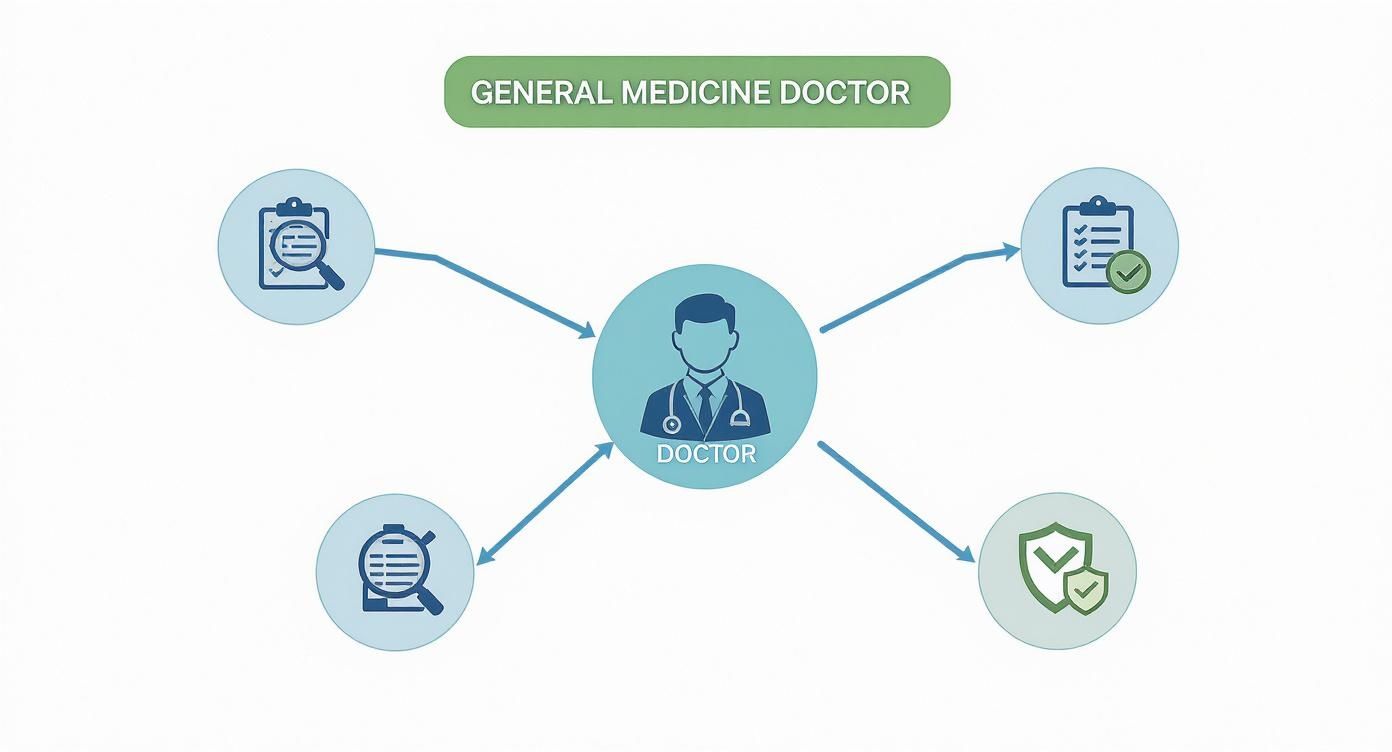
As you can see, the fundamental pillars—diagnosis, management, and prevention—are central to both internists and GPs. The key is finding the one whose expertise aligns perfectly with your needs.
Your choice comes down to this: If you are an adult managing complex or multiple chronic conditions, the specialized expertise of an internist is likely the best fit. If you’re looking for one doctor to provide seamless care for your entire family, a general practitioner is the ideal choice.
What to Expect from Your Doctor’s Visit

Stepping into your doctor’s office shouldn’t be just about putting out a fire—it’s about fireproofing the entire building. A visit with one of the best general medicine doctors is a true partnership, designed to tackle your immediate concerns while building a strategic, long-term plan for your well-being. This is the essence of high-caliber primary care.
The visit kicks off with a detailed conversation. This isn’t just a checklist of symptoms. Your doctor will want to understand your current health, dive into your medical history, and connect the dots with lifestyle factors like diet, exercise, and stress. This dialogue is crucial; it’s how they build a complete, nuanced picture of your health.
From there, you’ll move to the physical examination. This is far more than a routine check of the boxes. It’s a critical data-gathering process. Your doctor will check vital signs—blood pressure, heart rate, temperature—and perform a hands-on assessment of your heart, lungs, and abdomen to gauge their function in real-time.
A Focus On Prevention and Early Detection
A huge part of your doctor’s job is keeping you healthy in the first place, catching potential problems long before they become serious. This is where preventive screenings come into play.
Think of these tests as a sophisticated surveillance system for your body, designed to pick up the earliest warning signs of disease when it’s most treatable. For instance, routine blood work can flag elevated cholesterol or blood sugar levels years before you’d ever feel a symptom. Your doctor will tailor a screening schedule based on your age, family history, and personal risk factors.
Common preventive services include:
- Blood Pressure Screenings: Essential for spotting hypertension, a silent but major risk factor for heart disease and stroke.
- Cholesterol Panels: A lipid panel measures the different types of fat in your blood, giving a clear picture of your cardiovascular risk.
- Cancer Screenings: This covers crucial tests like mammograms, Pap smears, and colonoscopies, which are proven to save lives through early detection.
- Immunizations: Staying current on vaccines for influenza, tetanus, and other diseases is one of the simplest and most powerful preventive tools available.
Preventive care isn’t about waiting for something to break; it’s about actively identifying risks and intervening early. Regular checkups empower you and your doctor to stay one step ahead, turning potential health crises into manageable issues.
Managing Ongoing Health Conditions
For those living with a chronic condition like diabetes, asthma, or hypertension, your general medicine doctor is your health quarterback. These visits are all about managing the game plan: monitoring your condition, fine-tuning medications, and offering practical guidance on lifestyle changes that can genuinely improve your quality of life. The goal is to create a stable, long-term strategy that keeps complications at bay.
During these appointments, your doctor will review your progress, analyze lab results, and troubleshoot any challenges you’re facing. This continuous oversight is absolutely critical for keeping chronic diseases under control. By partnering with a skilled physician, you gain an expert ally committed to helping you navigate your health with confidence and achieve the best possible outcomes.
How to Choose a Board-Certified Physician

Picking the right physician is one of the most critical health decisions you’ll ever make. This isn’t just about finding someone to write prescriptions; it’s about securing a long-term partner for your health journey. The first filter in your search should always be board-certified general medicine doctors—it’s a non-negotiable mark of expertise and dedication.
What Board-Certified Really Means
Let’s clear this up: board certification is a world apart from a basic medical license. Think of a medical license as a driver’s license—it proves someone has the bare-minimum competence to practice.
Board certification, on the other hand, is like earning a professional racing license. It shows a physician has voluntarily gone through years of rigorous specialty training and passed a comprehensive, high-stakes examination to prove their mastery.
And it’s not a one-and-done deal. To keep that certification, doctors must commit to continuous learning and pass recertification exams throughout their careers. This is your assurance that they are current on the latest medical breakthroughs and dedicated to the highest standards of care.
Questions to Guide Your Selection
Once you’ve confirmed a doctor’s credentials, the real evaluation begins. Are they the right fit for you? A physician’s communication style and practice philosophy are just as crucial as their qualifications on paper.
As you evaluate your options, here are the key questions to ask yourself or the doctor’s office:
- What’s their communication style? Do they actively listen and break down complex topics, or do they feel rushed and dismissive?
- How does the office actually run? Is booking an appointment a nightmare? What’s the protocol for after-hours calls or urgent prescription refills?
- Which hospitals are they affiliated with? This is critical. If you ever need to be hospitalized, your doctor’s affiliation dictates where you’ll be treated.
- What is their philosophy of care? Are they focused on proactive, preventive strategies, or are they more reactive, only addressing problems as they pop up?
Choosing a physician is an investment in a relationship. The best doctor-patient partnerships are built on mutual trust, clear communication, and a shared commitment to your long-term health goals.
This choice is becoming even more significant in today’s strained healthcare landscape. Physician shortages are a global issue, with a projected shortfall of 10 million healthcare workers by 2030. This puts immense pressure on general medicine doctors, who serve as the frontline of care, and underscores the need to find a dedicated physician you can truly count on. You can dive deeper into the data with these physician workforce statistics.
Red Flags to Watch For
Knowing what to look for is only half the battle; knowing what to avoid is just as important. Certain red flags can signal a poor fit or a practice that will ultimately fail to meet your needs.
Be wary of any doctor who consistently dismisses your concerns or doesn’t take the time to answer your questions thoroughly. A disorganized or unresponsive office staff is another major warning sign, as are chronically long wait times and a lack of transparency around treatment plans and costs.
Trust your gut. If something feels off during your initial interactions, it probably is. It’s far better to continue your search for a physician who makes you feel heard, respected, and completely confident in your care.
Navigating Insurance and Concierge Medicine
How you pay for medical care isn’t just a financial detail—it fundamentally shapes the entire experience. The choice between a conventional, insurance-based practice and a modern concierge model is one of the most critical decisions you’ll make for your health. It dictates everything from how long you get to speak with your doctor to how quickly you can get an appointment.
Most of us are familiar with the traditional insurance system. You see a doctor in your network, the visit is billed to your provider, and you cover the co-pays, deductibles, and co-insurance. It’s the standard model, but it’s a system built on volume, often leading to frustrating constraints like rushed appointments and a web of referrals just to see a specialist.
The Concierge Medicine Alternative
Concierge medicine flips that model on its head. Instead of billing insurance for every minute of their time, concierge physicians operate on a membership basis. You pay an annual or monthly fee directly to the practice, which covers a level of access and personalized service that is simply impossible in a high-volume setting.
The secret is the dramatically smaller number of patients. By limiting their practice size, these doctors can invest significant time and energy into each person’s health. This isn’t just a minor tweak; it’s a complete shift in the doctor-patient dynamic. It moves the relationship away from a series of brief, transactional encounters toward a proactive, long-term health partnership.
The benefits are tangible and often felt immediately:
- Extended Appointment Times: Forget the 10-minute check-up. Visits often last 30 to 60 minutes, allowing for meaningful conversations and truly comprehensive care.
- 24/7 Physician Access: Most members receive their doctor’s personal cell number. A pressing concern at 9 PM on a Saturday gets a direct response, not an answering service.
- Same-Day or Next-Day Appointments: When you’re sick, you get seen. The model prioritizes urgent needs, eliminating the long waits common in traditional practices.
- Deeply Personalized Care: With a smaller patient panel, your doctor actually knows you. They understand your health history, your lifestyle, and your goals on a profound level.
Concierge medicine is an investment in your time and your health. The membership fee uncouples your physician from the hamster wheel of insurance billing, enabling a healthcare experience that revolves around your needs, not a set of billing codes.
This personalized approach is a game-changer for busy executives, entrepreneurs, or anyone managing complex health issues who requires dedicated oversight from their general medicine doctors. The trade-off is the membership fee, which you pay in addition to your regular health insurance (used for specialists, hospital stays, and major procedures).
For a deeper dive into how these two models stack up, explore this detailed comparison of concierge medicine vs. traditional healthcare. Ultimately, the right choice comes down to what you value most—and whether you see healthcare as a reactive necessity or a proactive investment.
Finding Top General Medicine Doctors Near You

The search for an exceptional physician can feel like a shot in the dark. You’re left sifting through endless online reviews and generic directories, a process that often creates more questions than answers. It’s hard to feel confident you’re choosing a doctor who truly meets—and exceeds—the highest standards of care.
This is where a curated medical network completely changes the game. Instead of leaving you to fend for yourself, platforms like Haute MD cut through the noise by connecting you directly with an elite, hand-picked group of board-certified general medicine doctors. Each physician is rigorously vetted, giving you immediate access to recognized leaders in their fields without the typical frustration.
A curated network essentially acts as a pre-vetted shortlist. It saves you invaluable time and ensures you’re connecting with physicians trusted for their expertise and dedication to personalized, high-quality care.
This curated approach is more critical than ever, as the availability and quality of physicians can vary dramatically by region. Some countries, for instance, report having more than five doctors for every 1,000 people, while others have less than one. You can learn more about these global physician density disparities to understand the landscape.
Using a trusted platform helps you sidestep these challenges entirely. It’s the most direct path to discovering a top-rated physician nearby, letting you build confidence in your healthcare decisions from the very first step.
Your Questions, Answered
Even with a clear map of general medicine, a few questions always come up. Here are straightforward answers to the most common ones, helping you move forward with confidence.
How Often Should I See My Doctor?
There’s no one-size-fits-all answer; it’s entirely based on your personal health landscape. If you’re under 50 and in good health with no chronic issues, checking in every one to three years is a solid strategy for preventive care and keeping your health records current.
Once you’re over 50, however, an annual physical exam becomes non-negotiable. And for those managing chronic conditions like diabetes, high blood pressure, or heart disease, your physician will likely want to see you more frequently—think every three to six months—to keep a close eye on your progress and fine-tune your treatment plan.
The most critical step is an open conversation with your doctor to create a schedule that’s right for you. Proactive planning is the cornerstone of great long-term health.
What Is the Real Difference Between Internal and Family Medicine?
This is a very common point of confusion, but the distinction is actually quite simple. It all comes down to the patient population they’re trained to treat.
- Internal medicine doctors (internists) are specialists who focus exclusively on preventing, diagnosing, and treating diseases in adults. Their training is a deep dive into the complex, often overlapping illnesses that affect adults, making them true experts in managing chronic conditions.
- Family medicine doctors (GPs), on the other hand, are trained to provide comprehensive care for patients of all ages—from newborns to great-grandparents. This broad scope makes them the perfect choice for families who want a single, trusted physician for everyone.
While both can serve as your primary care physician as an adult, an internist’s specialized focus might be a better fit if you’re navigating multiple or complex health issues.
Can a General Medicine Doctor Be My Primary Care Physician?
Yes, absolutely. In fact, that’s exactly their role. A general medicine doctor—whether an internist or a general practitioner—is the most common and ideal choice for a primary care physician (PCP) for adults.
Think of your PCP as the quarterback of your health team. They manage your overall well-being, deliver critical preventive care, and coordinate with specialists whenever you need one. Building a strong, lasting relationship with a great PCP is one of the single most effective things you can do for your long-term health.
Finding a physician who aligns with your standards doesn’t have to be a challenge. Haute MD simplifies the search, connecting you with a curated network of the nation’s most respected, board-certified physicians. Discover a doctor who provides the elite, personalized care you deserve.