



When you type “concierge medicine near me” into a search bar, you’re not just looking for a new doctor. You’re searching for a completely different way to manage your health—one built around direct physician access, proactive wellness, and a genuine partnership that values your long-term goals.
Think of it as a strategic investment in your well-being, designed for people who can’t afford to let their health take a backseat.
Why More People Are Demanding Concierge-Level Care
Let’s be honest: the traditional healthcare system often feels broken. It’s a volume game. Doctors are buried under administrative work and forced to see thousands of patients, which means you get rushed appointments, long waits, and a reactive approach that only addresses problems once they’ve already appeared.
For a busy executive, entrepreneur, or anyone leading a high-performance lifestyle, that model just doesn’t work. Searching for concierge medicine is the first step toward a real alternative.
This model flips the entire script. It all starts with a much smaller, more exclusive patient panel—think a few hundred patients per doctor, not a few thousand. That single change is what makes all the difference.
The Power of Real Access and Unrushed Time
The most obvious benefit is having near-instant access to your physician. Imagine texting your doctor with an urgent question or booking a same-day appointment without a fight. This isn’t some far-fetched luxury; for people with demanding schedules, it’s a practical necessity.
But what you’re really getting back is time—the most precious resource in healthcare. Appointments aren’t rushed 10-minute affairs. They’re typically 30 to 60 minutes, sometimes longer, giving you the space for real, in-depth conversations about your health.
- Comprehensive Health Strategy: You can move beyond a basic check-up to map out complex goals, whether that’s optimizing your metabolic health or building a personal longevity plan.
- Detailed Diagnostics: There’s finally time to go through lab results line by line, understand what they truly mean, and craft a precise action plan together.
- A True Partnership: This is how you build a real, trusting relationship with your doctor, which studies have shown leads to better health outcomes.
When you remove the time pressure and administrative chaos of the old system, your doctor can finally function as a true health partner and strategist, not just a problem-solver who’s always rushing to the next patient.
Shifting from “Sick Care” to Proactive Wellness
Perhaps the most important change is the philosophical one: moving away from reactive “sick care” and toward proactive health optimization. The goal isn’t just to treat you when you’re ill; it’s to keep you from getting sick in the first place.
This is done through highly advanced annual physicals that go far beyond standard screenings. These exams use sophisticated diagnostics to spot risk factors and optimize your health long before symptoms ever show up.
This proactive approach is especially critical for those in high-stakes careers. Things like managing stress, improving sleep quality, and maintaining peak physical and mental performance become central to your care plan, not just afterthoughts. It’s a clear strategic advantage that helps you stay on top of your game.
The demand for this kind of personalized care is skyrocketing. The concierge medicine market is projected to jump from USD 23.57 billion in 2025 to an incredible USD 49.00 billion by 2032. As this in-depth industry analysis shows, patients are actively seeking out a white-glove experience that the old models simply can’t deliver.
This is about more than just convenience. It’s about managing your most critical asset—your health—with the same focus and foresight you apply to your business or financial portfolio. When you choose concierge care, you’re choosing a system designed to fuel your vitality and performance for the long haul.
Decoding Membership Models and Financial Realities
As you start looking for a concierge doctor, one of the first things to get straight is the cost. It’s important to see this as more than just paying for doctor visits; you’re investing in a personalized healthcare system built around you. That annual membership fee is what unlocks this highly responsive, proactive approach to your health.
The price tag isn’t one-size-fits-all. It can swing quite a bit depending on how comprehensive the services are, the doctor’s specific expertise, and even where the practice is located. Naturally, a physician in a major city like New York or Los Angeles will have a different cost structure than one in a smaller town. The real key is to look beyond the number and weigh the genuine value you’re getting in return.
Understanding the Spectrum of Annual Fees
For high-quality, comprehensive concierge care, you can generally expect annual fees to fall somewhere between $2,000 and $5,000. Some top-tier executive health programs, however, can go for $10,000 or more. These often include a much deeper suite of services like advanced diagnostics and integrated wellness coaching.
It helps to think of these as different tiers of service, each tailored to specific health goals and lifestyles.
To give you a clearer picture, here’s a breakdown of what you might find at different price points.
Concierge Membership Tiers Explained
| Membership Tier | Typical Services Included | Ideal For | Estimated Annual Fee Range |
|---|---|---|---|
| Essential Access | Same-day/next-day appointments, 24/7 direct physician access (cell/text), extended visits. | Individuals wanting reliable, fast access to their primary care physician. | $2,000 – $3,500 |
| Comprehensive Wellness | All Essential services, plus a highly detailed annual physical, preventive screenings, and basic health coaching. | Patients focused on proactive health and preventative care. | $3,500 – $6,000 |
| Executive & Longevity | All Comprehensive services, plus advanced genomic testing, in-depth metabolic analysis, personalized nutrition/fitness plans, and extensive specialist coordination. | Executives and individuals seeking the most advanced, data-driven approach to long-term health optimization. | $6,000 – $10,000+ |
Ultimately, the right tier is the one that aligns with your personal health philosophy and how hands-on you want your care to be.
The infographic below really nails down the core value pillars your membership fee is supporting.
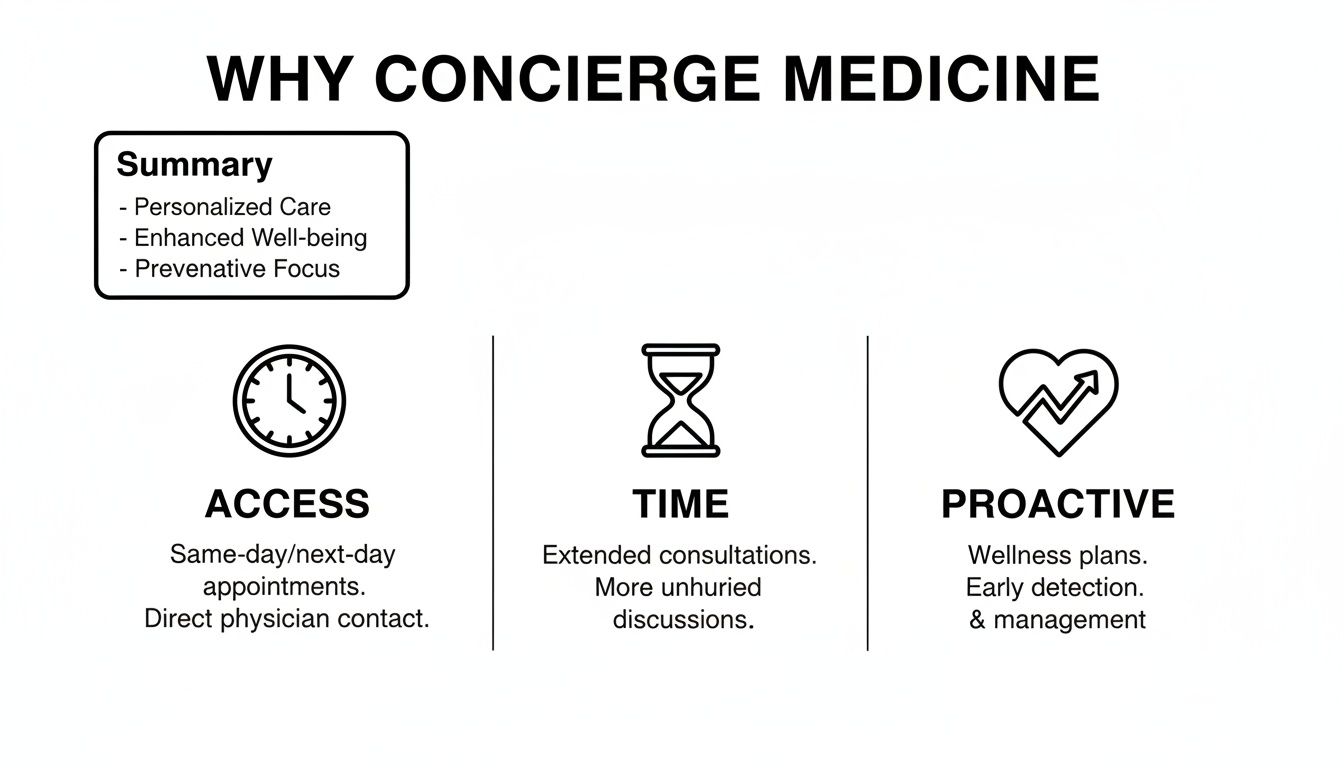
It’s these three things—unparalleled access, dedicated time, and a proactive health strategy—that truly define the experience.
What Your Membership Fee Typically Covers (And What It Doesn’t)
Getting clarity on what your fee includes is non-negotiable. The annual membership is primarily a retainer for all the services that insurance companies just don’t cover. It’s what guarantees your doctor’s availability and highly personalized attention.
What’s Usually Included:
- Direct 24/7 access to your physician via their personal cell or a secure messaging app.
- Same-day or next-day appointments that start on time.
- Extended, unrushed consultations, often 30-60 minutes long.
- A comprehensive annual wellness exam that goes far beyond a standard physical.
- Coordination of your care with any specialists you need to see.
What’s Typically Excluded (and billed to your insurance):
- Visits to specialists like cardiologists, dermatologists, or orthopedists.
- Any hospitalizations or trips to the emergency room.
- Surgical procedures.
- Advanced imaging like MRIs and CT scans, plus most lab work.
- Prescription drugs.
A helpful way to think about it: Your membership secures the quarterback for your health team—your primary physician—while your insurance covers the rest of the players and the stadium when a big game (a major health event) happens.
The Role of Health Insurance
One of the biggest myths is that concierge medicine replaces health insurance. That’s absolutely not the case. You still need a good insurance plan. The two work together.
Your concierge doctor’s office will typically bill your insurance for any medically necessary services, just like a traditional practice. The membership fee simply covers the enhanced access and personalized care that insurance doesn’t recognize.
This hybrid model is clearly catching on. The global concierge medicine market was valued at USD 20.6 billion and is on track to hit USD 47 billion by 2034. This boom is driven by patients demanding better care and, increasingly, by corporations adding it to their executive health benefits—a segment growing at a 10% CAGR. You can dive into the full market analysis of concierge medicine’s growth to see the trends shaping the industry.
Once you have a handle on these financial realities, you can confidently find a service tier that matches your budget and health ambitions, ensuring you get the exact level of proactive care you’re looking for.
A Modern Search Strategy for Local Providers

Finding the right physician in your area takes more than just typing “concierge medicine near me” into Google. That’s a decent starting point, of course, but an effective search is all about precision. You need to use the right language to find the specific kind of elite care you’re looking for.
Think like the physicians you want to find. The best doctors in this field often use very specific terms to describe their practices. When you adopt their language in your search, you cut through the noise and zero in on the exact providers who align with your standards.
It’s about moving from a broad, generic search to a highly targeted one that speaks the language of private health and personalized medicine.
Mastering Your Search Queries
Better keywords lead to better results. It’s that simple. Even small tweaks to your search terms can make a huge difference in the quality of the practices you uncover. Try experimenting with different combinations that include your city, a specific neighborhood, or even your zip code to get hyper-local.
Here are a few powerful search strings I’ve seen work well for clients:
- For Executive-Level Care:
- “Executive health physician [Your City]”
- “Private internal medicine [Your Neighborhood]”
- “CEO health program [Your State]”
- For Model-Specific Searches:
- “Direct pay primary care [Your Zip Code]”
- “Membership medicine doctor near me”
- “Retainer-based physician [Your City]”
These kinds of queries are far more likely to surface the practices that have built their entire service model around the high-touch, comprehensive care you expect. You’ll bypass the generic listings and get straight to the physicians who truly specialize in this space.
Leveraging Digital Tools to Analyze Practices
Once you have a shortlist of promising names, the real work begins. Your goal is to get a feel for each practice’s quality and philosophy long before you ever pick up the phone. This is where a critical eye and a few digital tools become your best friends.
Start by digging into their online presence. A polished website is a good first sign, but you need to go deeper. Look for detailed service descriptions, a clear breakdown of their membership model, and authentic physician bios that give you a real sense of their approach to patient care.
Next, head over to Google Maps. Searching for the practice’s name will not only confirm their location but also pull up a goldmine of patient reviews. Read these carefully, looking for recurring themes.
Pay close attention to what people say about communication, the professionalism of the staff, and whether the doctor truly listens. Real reviews often share specific stories, good or bad, giving you a much richer picture than a simple star rating ever could.
This initial digital reconnaissance helps you build a mental picture of the practice’s culture. It’s a vital step in narrowing your list down to the most serious contenders for your healthcare partnership.
The Power of Curated Networks
While you can certainly find a great doctor through a manual search, it’s a time-consuming process that requires a lot of effort to properly vet every option. This is exactly why so many discerning patients are now turning to curated medical networks as a trusted shortcut.
Platforms like Haute MD serve a very specific purpose: they do the heavy lifting for you. Instead of leaving you to sift through endless search results and questionable reviews, these networks have already done the vetting. They typically operate on an invitation-only basis, ensuring every physician on their platform has already met an incredibly high standard of excellence.
A curated network offers a few key advantages:
- Pre-Vetted Quality: Doctors are usually chosen based on board certifications, peer recognition, patient outcomes, and a proven commitment to personalized medicine. You’re essentially starting your search with a pre-qualified list of the best.
- Specialty Focus: These platforms make it easy to find a doctor who specializes in exactly what you need, whether that’s executive health, longevity medicine, or preventive cardiology.
- Trust and Credibility: Being featured on a reputable network like Haute MD is a powerful signal of trust. It tells you that a physician is recognized by their peers as a leader in the field.
Using a network like this completely changes the search process. You’re no longer starting from scratch with a sea of unknowns. Instead, you begin with a select group of top-tier local providers, making it the most efficient and reliable path to finding the sophisticated, proactive healthcare you need. It allows you to save your energy for the final, most important step: finding the right personal fit.
How to Properly Vet Your Shortlist of Physicians

You’ve done the initial legwork and have a handful of promising candidates. Now the real work begins. This is the part where you look past the polished websites and marketing materials to gauge the actual quality and, just as importantly, the personal fit of each physician.
Think of this as building a long-term health partnership. It requires digging into the details that truly matter—verifying credentials, understanding a doctor’s unique expertise, and getting a real feel for their practice’s culture. This methodical approach ensures your final decision is grounded in substance.
Verifying Credentials and Clinical Expertise
First things first: board certification. This is the absolute baseline. It’s a non-negotiable credential that proves a physician has met rigorous standards in their specialty and is committed to staying current. Don’t just take their website’s word for it.
You can—and should—verify a doctor’s status yourself. The American Board of Medical Specialties (ABMS) has a straightforward online portal for this exact purpose. A quick check provides instant peace of mind.
With that confirmed, it’s time to look deeper. What are their sub-specialties or areas of passion? Are you focused on longevity and preventive cardiology? Do you need a true expert in metabolic health or hormone optimization? The best concierge physicians aren’t just generalists; they often have deep, specific expertise that aligns with proactive wellness goals.
- Scrutinize their professional bio. Look for fellowships, specialized certifications, or published research in areas that matter to you.
- Analyze their services. Do they offer advanced diagnostics like genomic testing or detailed metabolic analysis? This shows a commitment to cutting-edge, personalized care.
- Check their affiliations. Are they connected with reputable hospitals or medical institutions?
This level of detail helps you match your specific health ambitions with a physician who has the precise skills to help get you there.
Assessing the Practice’s Digital Footprint and Culture
A physician’s online presence can be incredibly revealing. Start by spending some real time on their website, reading any articles or blog posts they’ve published. Does the content feel genuinely educational and patient-focused, or does it come across like a sales pitch?
Next, head to the patient reviews, but learn to read between the lines. A single bad review isn’t a deal-breaker, but patterns are everything.
Consistent praise about a doctor being a “great listener” or the staff being “incredibly responsive” are huge green flags. On the flip side, repeated complaints about disorganized communication or billing issues are red flags you absolutely cannot ignore.
The professionalism of the office staff is another critical tell. When you make that first call, pay close attention. Was the person you spoke with helpful, knowledgeable, and respectful of your time? The front office is your gateway to the practice and often a direct reflection of its culture.
This initial interaction says a lot about the white-glove service you can expect. Patients are demanding this higher level of service and direct access, which is why the concierge medicine market is thriving in North America—a region that holds about 45% of the global market share. As the U.S. market grows from USD 7.35 billion toward USD 8.09 billion, driven by the demand for unhurried, meaningful consultations, the quality of every interaction counts. You can read more about the dominant trends in the concierge medicine market to understand the forces behind this patient-first model.
Spotting Key Green Flags and Red Flags
As you weigh your options, certain signals will quickly tell you if you’re on the right path or if you should be wary. Knowing what to look for can save you from a major headache down the road.
Green Flags to Look For:
- Transparent Pricing: The membership structure is laid out clearly, with no ambiguity about what is and isn’t included.
- Focus on Evidence-Based Medicine: The physician’s approach is rooted in data, referencing clinical research and measurable outcomes.
- Collaborative Tone: The communication feels like a partnership, where your personal goals are the centerpiece of the care plan.
Red Flags to Avoid:
- High-Pressure Sales Tactics: If you feel rushed into signing a contract or the conversation is more about “perks” than your health, walk away.
- Opaque or Hidden Fees: It shouldn’t be difficult to get a straight answer about the total cost or potential extra charges.
- Overpromising Results: Be cautious of any provider who guarantees specific outcomes, particularly for complex health issues. Medicine has nuances, and an honest doctor acknowledges them.
This framework gives you a clear, structured way to assess each physician, helping you find not just a doctor, but the right partner for your proactive health journey.
Key Questions for Your Initial Consultation
Think of your first meeting with a potential concierge doctor—often called a “meet and greet”—as more than just a casual chat. It’s your opportunity to interview a key partner for your long-term health. This is where you get past the glossy brochures and website copy to see if the doctor’s philosophy and practice style are the right fit for you.
Walking in with a list of thoughtful questions is critical. You’re not just asking about office hours; you’re digging into the very core of their care model. The objective is to leave with a crystal-clear picture of how they operate and how they’d handle your unique health needs, from routine check-ups to unexpected emergencies.
This is your due diligence. The depth and quality of their answers will tell you everything you need to know about whether they offer a truly personalized partnership or just a standard practice with a high-end price tag.
Probing Their Care Philosophy and Practice Style
Before you get into the nuts and bolts, you need a solid grasp of the physician’s overall approach to medicine. Do they simply react to problems as they pop up? Or are they genuinely committed to a proactive, preventive strategy aimed at optimizing your health for decades to come? Pay close attention to the words they choose—it’s incredibly telling.
You want to hear a collaborative, patient-focused tone. Their answers should make it clear that you’ll be an active participant in your health journey, not just someone who passively receives instructions.
Here are a few questions to get to the heart of their philosophy:
- “Can you describe what you see as the ideal patient-physician relationship?” This is a great open-ended question that reveals volumes about their communication style and whether they truly value partnership.
- “What’s your philosophy on preventive medicine and longevity?” A great answer will go far beyond annual physicals. Listen for mentions of advanced diagnostics, highly personalized wellness plans, or specific strategies for health optimization.
- “How do you typically manage a patient with complex health goals or several chronic conditions?” Their response here will highlight their experience level in coordinating multifaceted care and navigating intricate health profiles.
A truly exceptional concierge physician will talk about personalized medicine with genuine passion. Their answers should feel detailed and authentic, not like they’re just reading from a script about “great customer service.” They should have a clear vision for helping patients achieve their best possible health.
Understanding Logistics and Urgent Care Access
Once you have a feel for their approach, it’s time to get practical. The main draw of concierge medicine is superior access, but what “access” actually means can differ dramatically from one practice to another. You need to know exactly how they handle communication and urgent situations.
A vague promise of “24/7 access” isn’t good enough. You need to know the specific protocol for reaching them after hours, on a weekend, or during a holiday. Getting absolute clarity on this upfront is non-negotiable and avoids major frustration down the road.
Drill down on the operational details with these questions:
- “What’s the exact process if I have an urgent need after hours or on a weekend? Will I speak directly with you, or with a covering physician?” This is a crucial distinction. The peace of mind that comes from knowing you can reach your doctor is often the very reason you’re considering this model.
- “How involved are you in coordinating care with specialists?” A top-tier concierge doctor doesn’t just write a referral and send you on your way. They act as your health quarterback, actively managing the process to ensure all your providers are aligned.
- “Could you share an example of a time you’ve advocated for a patient within the larger healthcare system?” This question gets to their commitment. A great story might involve successfully appealing an insurance denial or pulling strings to get a patient in quickly with a world-renowned specialist.
By asking these pointed questions, you’ll be fully equipped to choose a physician who has not only the right credentials but also the right mindset and operational framework to be the dedicated health advocate you deserve.
Your Questions About Concierge Healthcare, Answered
If you’re starting to look for concierge medicine near you, you’re bound to have questions. It’s a completely different way of approaching healthcare, so getting clear on the details is essential before you commit. Let’s walk through some of the most common things people ask, so you can decide if this personalized model is the right fit for your life.
Think of this as the conversation you’d have with a trusted advisor—straightforward answers to help you move forward with confidence.
Is Concierge Medicine Really Worth the Money?
For most of my clients, the value isn’t just about the fee—it’s about buying back their time and gaining peace of mind. It’s an investment in your single most important asset: your health. The membership fee essentially funds a proactive partnership with a physician who is dedicated to keeping you well, not just treating you when you’re sick.
That fee covers all the things traditional insurance won’t, like unlimited, unhurried appointments, deep-dive wellness planning, and obsessive care coordination. Over time, that kind of proactive attention can lead to dramatically better health outcomes and, frankly, can even reduce future healthcare costs by catching serious issues before they become major medical events.
Do I Still Need to Keep My Health Insurance?
Yes. 100% yes. This is probably the most important thing to get right. Your concierge membership fee is not a replacement for a health insurance plan. You absolutely need to maintain your insurance coverage for all the medical costs that fall outside of your primary physician’s direct care.
Here’s the simplest way to think about it:
- Your concierge membership pays for the premium service, direct 24/7 access to your doctor, and the highly personalized care they provide.
- Your health insurance is for everything else—specialist visits, hospital stays, emergency room trips, surgeries, expensive imaging like MRIs, and most prescription drugs.
The two systems work together. Your membership gives you the elite, high-touch oversight, while your insurance is the critical financial safety net for everything else.
What’s the Difference Between Concierge Medicine and DPC?
This one causes a lot of confusion because people often use the terms interchangeably. While both use a membership model for better care, there’s a fundamental difference in how they work with insurance.
Most concierge practices continue to bill your health insurance for standard services (like office visits) on top of the annual membership fee. It’s a hybrid approach that adds a layer of premium access and service onto the traditional insurance system.
In contrast, Direct Primary Care (DPC) practices almost always cut out insurance entirely. Your membership fee is designed to cover all the primary care services they offer, period. DPC is often geared toward making primary care more affordable and accessible by operating outside the insurance bureaucracy, whereas concierge medicine is positioned as a true white-glove service for those who demand the highest level of personalization.
How Does a Curated Network Actually Help Me?
Let’s be honest, finding a truly top-tier physician on your own is a huge pain. A quick search for “concierge medicine near me” will flood you with options, and it’s nearly impossible to tell the genuinely exceptional doctors from the ones with just good marketing.
This is where a curated network becomes so valuable.
Instead of making you dig through hundreds of profiles and questionable online reviews, a trusted network has already done the heavy lifting. By hand-selecting and inviting only distinguished, board-certified physicians, these platforms give you an immediate shortlist of the best in your area. You can be confident you’re connecting with a doctor who is known for exceptional patient care and a real commitment to personalized medicine.
Finding the right physician is more than just checking boxes on a list of credentials; it’s about finding a true partner for your long-term health. Haute MD takes the guesswork out of this entire process by connecting you directly with the nation’s top, pre-vetted specialists in executive health and concierge care. Explore our network to find a trusted physician near you.