


The main upsides of preventive health care are catching disease early, saving a significant amount of money in the long run, and boosting your overall quality of life. This proactive mindset reframes health entirely—it’s not just about the absence of sickness, but about managing and optimizing your well-being like a strategic asset for peak performance.
It’s a fundamental shift from treating problems as they pop up to managing your health proactively.
Shifting from Treatment to Strategic Health Management

For discerning individuals and high-achievers, managing personal health demands the same rigor and foresight as managing a financial portfolio. The traditional medical model, often called reactive care, typically waits for symptoms to flare up before taking any action. This is like waiting for a company’s stock to crash before re-evaluating your investment strategy—it’s inefficient and often leads to significant, avoidable losses.
Modern preventive health care, on the other hand, is the equivalent of sophisticated portfolio management. It uses data from advanced diagnostics, regular screenings, and lifestyle assessments to spot risks and opportunities for optimization long before a crisis hits. This isn’t just about dodging illness; it’s about building a foundation of robust health that fuels sustained energy, mental clarity, and professional longevity.
The Old vs. New Health Paradigm
The philosophical gap between these two approaches is stark. Reactive medicine asks, “What’s wrong with you?” Preventive medicine asks, “How can we keep you operating at your absolute best and stop problems before they even start?”
Think about these core differences:
- Reactive Care: Its entire focus is on treating symptoms and managing diseases that are already there. It’s essentially an “emergency response” model.
- Proactive Care: The focus here is on identifying risk factors and optimizing biological functions to prevent issues from ever developing. It’s a “strategic surveillance” model.
This proactive stance is especially critical for professionals whose performance is directly tied to their physical and mental well-being. A health issue that sidelines an executive for weeks can have profound financial and operational consequences, making the investment in prevention a clear business imperative.
The core concept is simple yet powerful: your health is your most valuable asset. Protecting and growing this asset through a deliberate, data-driven strategy yields returns that compound over a lifetime, impacting everything from your career trajectory to your personal fulfillment.
Adopting a Proactive Mindset
Making this switch involves more than just booking an annual physical. It means partnering with a healthcare provider who understands the goal is optimization, not just disease detection. It requires a commitment to understanding your own biometrics and taking targeted actions based on that data. You can learn more about the foundations of this approach by exploring what is preventive medicine and its core principles.
The table below really breaks down the key distinctions between the conventional approach and the modern, strategic model of health management. It crystallizes why a proactive strategy is becoming the new standard for those who refuse to leave their well-being to chance.
Reactive vs. Proactive Health: A Paradigm Shift
| Aspect | Traditional Reactive Care | Modern Preventive Care |
|---|---|---|
| Philosophy | “Break-fix” model; address symptoms as they arise | “Optimize and protect” model; manage health like an asset |
| Timing | Intervention occurs after disease is present | Intervention is continuous and preemptive |
| Goal | Cure illness and manage chronic conditions | Maximize healthspan and prevent disease onset |
| Data Usage | Basic labs to diagnose current problems | Advanced diagnostics to predict future risk |
| Patient Role | Passive recipient of treatment | Active partner in a personalized health strategy |
| Outcome | Restoration to a baseline level of health | Achievement of peak physical and cognitive performance |
Ultimately, this comparison shows that proactive care isn’t just a different method—it’s a different goal entirely. It’s about moving beyond simply “not being sick” to achieving a state of sustained high performance.
The Clinical Power of Early Detection

One of the most powerful benefits of preventive health care is its ability to shift the scales from reaction to foresight. Think of your health management in two distinct modes: “emergency response” versus “strategic surveillance.” Conventional medicine is brilliant at emergency response—dealing with the fallout of a heart attack or treating a late-stage tumor.
But that reactive approach means you’re already on the defensive, managing damage that’s already done. Strategic surveillance, the very heart of preventive medicine, is fundamentally different. It uses sophisticated tools and regular assessments to monitor your internal environment, catching the subtle signs of trouble long before they erupt into a full-blown crisis.
This proactive stance isn’t just about dodging disease. It’s about preserving optimal function and extending your healthspan—the years you spend in vibrant, high-performing health. By catching risks in their earliest, most manageable stages, you slash the need for invasive, expensive, and life-disrupting treatments down the road.
Transforming Outcomes for Critical Health Threats
Nowhere is the power of early detection more obvious than in tackling today’s two biggest health threats: cardiovascular disease and cancer. These conditions are notorious for developing silently over years, sometimes decades, before the first noticeable symptom appears. By that point, the underlying problem is usually advanced.
Preventive screenings act as your biological early-warning system. They give you and your physician a clear view of what’s happening beneath the surface so you can intervene with precision.
- For Cardiovascular Health: A standard cholesterol test offers a blurry, incomplete snapshot. Advanced lipid panels, on the other hand, measure the size and density of cholesterol particles, giving you a far more accurate picture of your actual risk. Likewise, a C-reactive protein (CRP) test can spot the low-grade inflammation that drives arterial plaque, years before it could trigger a cardiac event.
- For Cancer Prevention: Screenings like mammograms and colonoscopies are designed to find abnormalities at their most nascent stages. Catching and removing precancerous polyps during a colonoscopy, for example, prevents them from ever becoming malignant. You can explore preventive cardiology in our detailed guide to see how these advanced diagnostics are changing the game.
This early interception is everything. It shifts the goal from treating an established disease to preventing its very formation, safeguarding your health and vitality for the long haul.
Early detection does more than just improve survival rates; it preserves quality of life. The treatments required for an early-stage issue are often far less aggressive and disruptive than those needed to combat an advanced condition, safeguarding your energy, career, and personal time.
The Proven Impact of Proactive Screening
The data backing this surveillance model is overwhelming. Early detection through proactive screening is completely changing cancer outcomes. In major U.S. markets, dedicated mammography and colonoscopy programs have slashed colorectal cancer mortality by 42% since 2000.
The American Cancer Society reports that these kinds of interventions have saved over 1.5 million lives by 2023. This isn’t a minor improvement; it’s the difference between finding a small, smoldering ember and battling a raging inferno.
Cornerstone Screenings: Your Early Warning System
To build an effective health surveillance strategy, certain cornerstone screenings are non-negotiable. Don’t think of these as just tests. They are high-resolution data points that create a detailed map of your current and future health, providing the actionable intelligence needed for targeted interventions.
A robust preventive plan should always include:
- Advanced Lipid Panels (e.g., NMR LipoProfile): This goes way beyond basic cholesterol numbers to analyze particle size and number, which are far more predictive of heart disease risk.
- High-Sensitivity C-Reactive Protein (hs-CRP): This test measures systemic inflammation, a critical—and often silent—driver of atherosclerosis and other chronic diseases.
- Coronary Artery Calcium (CAC) Scan: A quick, non-invasive CT scan that directly visualizes calcified plaque in your coronary arteries. It gives you a direct look at your real-world heart attack risk.
- Comprehensive Cancer Screenings: This means age and risk-appropriate mammograms, colonoscopies, Pap tests, and PSA tests, forming a critical defense against the most common malignancies.
By embracing this data-driven, strategic approach, you’re no longer just a passenger on your health journey. You become the pilot, using advanced navigation tools to steer clear of hazards and chart a direct course toward sustained longevity and peak performance. The clinical benefits are undeniable, offering a clear path to a longer, healthier, and more productive life.
Calculating the Financial ROI of Your Health
We all know the saying, “health is wealth.” It’s a nice platitude, but let’s move beyond the cliché and look at the hard numbers. Investing in your health isn’t an expense; it’s one of the highest-yield financial strategies you can deploy, with a clear, measurable return on investment (ROI).
Viewing preventive care through a financial lens reveals its true value. Think of it like maintaining a high-performance vehicle. You wouldn’t skip routine oil changes or diagnostics on a finely tuned machine and just wait for the engine to seize. That would guarantee a catastrophic, expensive failure. The exact same logic applies to your body—your most valuable asset.
Investing in executive physicals, advanced diagnostics, and lifestyle coaching is the equivalent of that premium maintenance. These proactive measures are designed to preempt the colossal healthcare costs that come with the chronic diseases that slowly build over decades, like type 2 diabetes, cardiovascular disease, or late-stage cancer.
Preempting Catastrophic Healthcare Costs
The financial model of standard, reactive medicine is fundamentally broken. It’s designed to wait for a crisis—a heart attack, a stroke, a grim cancer diagnosis—and then deploy incredibly expensive, often invasive interventions. This means emergency surgeries, long hospital stays, and a potential lifetime dependency on costly medications.
Preventive care flips this reactive model on its head.
By identifying your specific risks early, you can neutralize them with targeted, low-cost lifestyle changes or minor medical interventions. A classic example is catching prediabetes through regular biomarker screening. This opens the door for a precise nutrition and exercise strategy, a fix that costs a tiny fraction of managing full-blown diabetes, which can easily run into tens of thousands of dollars every single year.
The economic principle is brutally simple: an ounce of prevention is worth a pound of cure. In today’s terms, that often means saving tens or even hundreds of thousands of dollars over a lifetime. It’s the difference between making a minor course correction and launching a full-blown salvage operation.
The power of this approach is crystal clear in cardiology. Imagine catching the seeds of heart disease before they ever have a chance to grow—that’s the entire premise of preventive cardiology. The upfront investment yields exponential returns, saving up to 25% on lifetime healthcare costs for an individual.
In the real world, discerning patients work with concierge physicians who integrate data from wearables with electronic health records. This allows them to spot something like rising hypertension early on, when it’s still 90% reversible with lifestyle changes. This strategy doesn’t just extend life expectancy by an average of 5-7 years; it preserves the quality of those years, allowing CEOs and entrepreneurs to maintain peak performance without the drag of chronic illness. You can explore more about these initiatives propelling preventive health care on ihealthcareanalyst.com.
Protecting Your Greatest Asset: Your Earning Potential
Beyond the direct medical savings, one of the most significant—and often overlooked—returns of preventive health is the protection of your earning potential. For CEOs, entrepreneurs, and elite professionals, your cognitive and physical function are non-negotiable assets. Your ability to think clearly, lead effectively, and perform under immense pressure is directly tied to your underlying health.
Chronic illness doesn’t just drain your bank account; it drains your energy, focus, and productivity.
- Sustained Cognitive Function: Proactive health strategies that optimize sleep, nutrition, and hormone levels are a direct investment in brain health, building a powerful defense against cognitive decline.
- Reduced Absenteeism: By preventing illness before it starts, you minimize sick days and the massive productivity loss that comes with being unwell or recovering from major medical procedures.
- Enhanced Professional Longevity: Maintaining peak physical and mental condition allows you to stay in the game longer, extending your highest-earning years and maximizing your career’s entire financial arc.
Ultimately, investing in your health is a direct investment in your professional capacity. It ensures you have the vitality and resilience required to navigate a demanding career for the long haul, securing both your health and your financial future. This transforms health from a passive concern into an active driver of lifelong success.
Building Your Personalized Preventive Health Roadmap
Knowing the why behind preventive health is one thing. Translating that knowledge into a concrete, personalized action plan is where the real work begins. The old-school annual physical is no longer the gold standard. A modern preventive health roadmap is a dynamic, data-driven strategy built around your specific age, genetics, and lifestyle.
This isn’t about ticking off boxes on a generic checklist. It’s about architecting a multi-decade plan for sustained health and high performance. The entire goal is to shift from reacting to problems to actively anticipating them, leveraging advanced diagnostics and targeted interventions to optimize your biology at every stage of life.
Charting Your Course by Decade
Your health risks and opportunities for optimization are not static; they evolve as you age. A truly effective preventive strategy acknowledges this, recalibrating its focus with each passing decade. The foundation you build in your 30s is precisely what provides the resilience you’ll need in your 50s and beyond.
Think of it as an investment in your future self—one that generates compounding returns in both vitality and longevity.
This timeline shows the clear return on investment from a proactive health strategy. The initial investments you make don’t just pay for themselves; they lead to significant long-term savings and enhanced performance down the line.
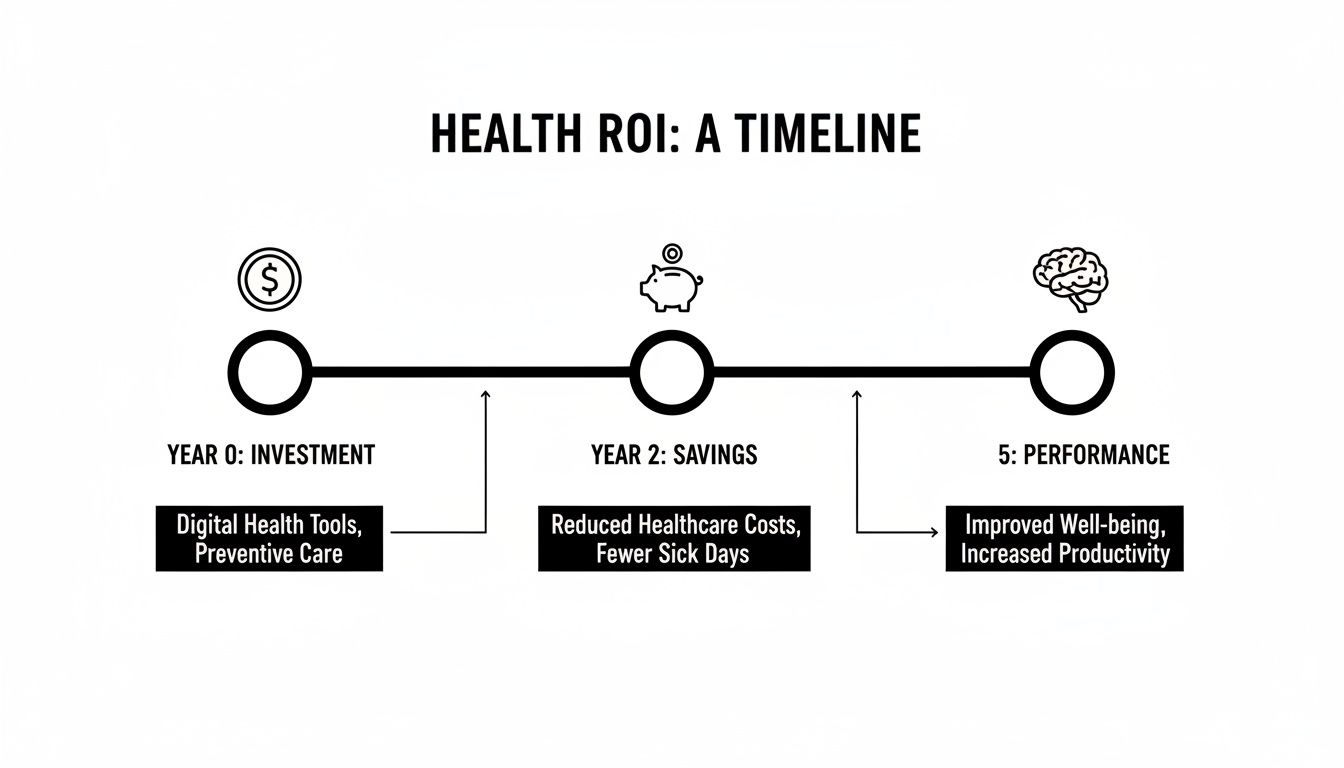
The key takeaway is simple: small, consistent investments in your health early on prevent catastrophic costs later, all while boosting your capacity to perform at your peak.
Key Preventive Health Milestones by Decade
The following table outlines the core screenings and more advanced assessments recommended for each decade of adult life. It’s not meant to be a rigid prescription, but rather a framework for a high-level conversation with a physician who specializes in preventive or executive medicine.
| Age Decade | Core Screenings & Vaccinations | Advanced & Lifestyle Assessments |
|---|---|---|
| 30s | Comprehensive physical, baseline bloodwork (lipids, glucose), blood pressure checks, tetanus/diphtheria booster, HPV vaccine series (if not completed). | Foundational biomarker analysis (hs-CRP, ApoB), initial body composition scan (DEXA), basic genetic screening for hereditary risks, establishing a relationship with a primary care physician focused on optimization. |
| 40s | All 30s screenings plus mammograms (for women, based on risk), colonoscopy pre-screening (risk assessment), regular skin cancer checks. | Coronary Artery Calcium (CAC) scan for heart disease risk, advanced hormone panels (testosterone, thyroid), initial cognitive baseline testing, deeper genomic analysis for metabolic and longevity markers. |
| 50s+ | All 40s screenings plus routine colonoscopies, shingles vaccine, pneumococcal vaccine, bone density screening (DEXA). | Comprehensive hormone optimization therapy, advanced cancer screenings (e.g., liquid biopsy), regular carotid artery ultrasound, detailed neurocognitive assessments to track brain health and function. |
This table provides a starting point, but the real value comes from layering in personalized data to create a strategy that is uniquely yours.
Moving Beyond the Standard Checklist
The true power of modern preventive medicine lives in the “Advanced & Lifestyle Assessments” column. While standard screenings are absolutely vital for catching common diseases, the advanced diagnostics give you a high-resolution map of your unique biology.
This is where elite executive health programs really separate themselves from the pack. They move past population-level averages to zero in on your specific risk factors and opportunities for peak performance.
A personalized health roadmap isn’t just about preventing disease; it’s about building a biological foundation that supports your ambitious personal and professional goals for a lifetime. It’s the ultimate strategy for protecting your most valuable asset.
For example, genomic testing might reveal a genetic predisposition to high cholesterol that lifestyle changes alone can’t fix, prompting a much earlier and more aggressive intervention. In the same way, comprehensive biomarker analysis can uncover the subtle inflammation or hormonal imbalances that are quietly sapping your energy and cognitive function, long before they show up as a diagnosable condition.
This level of detail allows you and your physician to make precise, targeted decisions. You’re no longer navigating your health with a blurry map but with a high-definition GPS showing exactly where you are, where you’re headed, and the best route to get there. By adopting this forward-thinking strategy, you take direct control over your health trajectory.
Of course. Here is the rewritten section, crafted to meet all the specified requirements for a human-like, expert voice and style.
How to Access Elite Preventive Medicine
Knowing that world-class preventive care exists is one thing. Actually getting access to it is a completely different challenge. For discerning individuals, the standard healthcare system simply isn’t built to deliver the forward-thinking, deeply personalized strategies required for true health optimization. The solution isn’t about finding a slightly better primary care doctor; it’s about plugging into specialized networks and platforms designed to connect you with the physicians operating at the absolute forefront of medicine.
This isn’t your traditional referral from a family doctor. We’re talking about curated platforms that do the heavy lifting—rigorously vetting and gathering the leading minds in fields like concierge medicine, preventive cardiology, and longevity science. These aren’t just general practitioners. They are innovators who have built their entire practice around proactive, data-driven health management.
For the patient, the value is immediate: direct, streamlined access to this elite tier of medical talent. It’s about forging a partnership with a physician who treats your health with the same strategic intensity you apply to your own business or investment portfolio.
The White-Glove Experience in Modern Medicine
So what really defines this top-tier level of care? It comes down to a deeply personalized, high-touch approach often called a “white-glove” experience. This is the polar opposite of a rushed, 15-minute annual physical. Instead, it’s a relationship built on a foundation of time, direct access, and profound analytical insight.
This model completely rejects the one-size-fits-all protocols that dominate conventional medicine. Your health strategy isn’t pulled from a textbook; it’s built from the ground up, based on your unique genetic blueprint, your real-time biomarker data, and your specific personal goals.
The core principle is that you are not a statistic. You are a unique biological system, and your health plan should reflect that individuality with precision and depth.
For example, an entrepreneur laser-focused on maintaining peak cognitive function for the next decade might work with a longevity expert who integrates advanced neurocognitive testing with metabolic optimization. Or consider an executive with a family history of heart disease. They could connect with a top preventive cardiologist to design a strategy targeting specific inflammatory markers and arterial health metrics—going lightyears beyond standard cholesterol checks. If you’re new to this concept, you can learn more about what concierge medicine is and how it works in our detailed guide.
Finding Your Health Care Partner
The goal is to find a physician who functions less like a simple doctor and more like your personal health strategist. These curated networks take the guesswork out of that search, providing a trusted directory of pre-vetted specialists who are proven leaders in their fields.
- Specialized Expertise: These platforms are your gateway to finding experts in niche but critical areas—think hormone optimization, advanced metabolic care, or performance psychiatry.
- Proven Track Records: The physicians featured aren’t just names in a database. They are hand-picked based on their credentials, patient outcomes, and a demonstrated commitment to innovative, evidence-based medicine.
- Seamless Connection: The entire process is designed for efficiency, connecting you directly with practices that already understand the unique demands and expectations of high-performing individuals.
This curated approach strips away the uncertainty and frustration of finding genuinely exceptional medical care. It ensures that your investment in preventive health is guided by a true expert—someone dedicated to helping you hit your long-term wellness and performance goals. Ultimately, it’s about creating a health partnership built on trust, data, and a shared commitment to proactive excellence.
Got Questions About Preventive Health Care? Let’s Clear Them Up.
Even when you see the clear clinical and financial upside, stepping into a proactive approach to your health can bring up some practical questions. It’s a huge departure from the conventional medical experience most of us are used to.
Here, we’ll tackle some of the most common questions head-on. The goal is to give you direct, actionable answers so you can move forward with confidence.
“Isn’t Preventive Care Just for Older People?”
Absolutely not. This is one of the most persistent—and dangerous—myths out there. While it’s true that screening schedules get more intensive as we age, preventive health is a lifelong game. And the biggest returns come from starting early.
Think of your 30s and 40s. This isn’t just a waiting period; it’s the prime window to build a powerful foundation. This is when you can establish robust baseline health data, lock in foundational lifestyle habits, and get ahead of genetic risks before they even have a chance to show up. It’s like building “health capital”—a deep reserve of resilience that will pay you back for decades.
For high-performers, this early investment directly translates into sustained energy, sharper thinking, and a dramatically lower risk of being knocked off your game by a health crisis during your peak career years. Starting early isn’t about avoiding disease later; it’s about maximizing your performance now.
“My Annual Physical Came Back Normal. Isn’t That Good Enough?”
A standard annual physical is a decent check-in, but it’s really just the bare minimum. Think of it like a standard-definition photo of your health. It’s good for spotting big, obvious problems that are already there, but it lacks the resolution to see the subtle trends that actually predict future issues.
Elite preventive care is like upgrading to a high-resolution, full-motion picture of your health. It goes layers deeper than a basic blood count and cholesterol check.
This advanced approach brings in a whole suite of sophisticated tools:
- Comprehensive Biomarker Panels: We’re talking about going way beyond the basics to measure things like inflammation (hs-CRP), insulin resistance, and specific lipoprotein particles (ApoB) that are far more predictive of future disease.
- Genetic Testing: This gives you a look at your personal blueprint, revealing your unique predispositions. That knowledge allows for surgical-strike risk mitigation strategies.
- Advanced Cardiac Imaging: Tools like a Coronary Artery Calcium (CAC) scan let you see plaque buildup directly. It’s a real-world look at your heart attack risk that standard blood tests can completely miss.
This isn’t just about finding sickness. It’s about optimizing wellness and accurately forecasting what’s coming down the road. It answers not just “Am I sick?” but the far more important question: “How can I operate at my absolute peak while strategically shutting down future risks?”
“How Does Concierge Medicine Fit Into All This?”
Concierge medicine takes preventive care from a once-a-year transaction and turns it into an ongoing, personal partnership. It solves the single biggest problem in the traditional healthcare system: time. Instead of being rushed through a 15-minute slot, you get unparalleled access to your physician for continuous oversight and strategic planning.
A great concierge doctor acts as your personal health CEO. They become the central hub for your well-being, taking the lead on everything from interpreting complex diagnostic data to connecting you with other world-class specialists. This model finally provides the time and focus needed to build a health plan that’s truly yours.
This isn’t just about better service; it’s a fundamentally better model of care. The concierge framework is specifically built to support the deep, data-driven analysis and continuous fine-tuning that define world-class preventive medicine.
This partnership allows for a plan that weaves all the pillars of health—nutrition, fitness, sleep, stress, and mental well-being—into a single, cohesive strategy. It ensures your health plan is a living document, constantly adapting to new data and your evolving goals in life.
“Okay, I’m In. What’s the Very First Step?”
The single most important first step is to find and partner with a physician who specializes in this proactive, preventive approach. Your mission is to find an expert who thinks beyond the standard rulebook and is obsessed with understanding your unique biology, your lifestyle, and your long-term ambitions. You need a partner, not just a provider.
An excellent starting point is a comprehensive executive physical. This initial deep-dive assessment goes far beyond a standard check-up. It establishes your detailed health baseline and immediately pinpoints key areas for optimization or further investigation. It’s the foundational data-gathering that informs the entire strategy from that point on.
Finding the right physician can be a challenge, which is why a trusted, curated platform is so valuable. It cuts through the noise and connects you with vetted, top-tier physicians who are recognized leaders in preventive, executive, and longevity medicine. This ensures you start your journey with a true expert who is perfectly aligned with your goal of achieving sustained, high-performance health.
Your health is your single most valuable asset. The most important investment you can make is finding the right medical partner to protect and optimize it. Haute MD provides direct access to a curated network of the nation’s leading physicians, from preventive cardiology to longevity medicine. Find a vetted, top-tier specialist and begin building your personalized health roadmap today.