



A board-certified cosmetic dermatologist is a medical doctor who has survived a grueling, multi-year training gauntlet focused exclusively on the skin. After medical school, they complete an intensive dermatology residency and pass rigorous board examinations, cementing their status as the most qualified experts in skin health, function, and aesthetics.
This certification isn’t just a piece of paper—it’s the gold standard, your guarantee of an elite level of skill.
Why Board Certification Is Your Ultimate Assurance
Navigating the world of cosmetic treatments can feel like wandering through a maze blindfolded. You’re bombarded with titles like “aesthetician,” “skin expert,” and “med spa technician,” making it nearly impossible to know who to trust.
But there’s one credential that cuts straight through the noise: board certification.
Think of it this way: you wouldn’t ask a general contractor to perform open-heart surgery. You’d demand a fellowship-trained cardiac surgeon who has dedicated their entire career to mastering that one incredibly complex field. The exact same principle applies to your face and skin. A board-certified cosmetic dermatologist has a profound, medical-grade understanding of skin anatomy, physiology, and pathology that simply can’t be replicated by a weekend course or a few months of on-the-job training.
The Real-World Implications of Expertise
This distinction is about far more than a fancy title; it directly impacts your safety, your experience, and your results. A true expert blends the steady hand of a physician with the discerning eye of an artist. They don’t just inject a syringe of filler—they diagnose, strategize, and execute a comprehensive plan designed for your unique skin health and aesthetic goals.
This deep medical foundation is critical for several reasons:
- Safety: They can spot underlying skin conditions or health issues that could turn a routine procedure into a complication.
- Precision: Their intimate knowledge of facial anatomy—muscles, nerves, and blood vessels—ensures injectables and energy devices are used both effectively and safely.
- Contingency: In the rare event of an adverse reaction, they have the advanced medical training to manage it immediately and correctly.
Their expertise is your best defense in a largely unregulated market. You can dive deeper into these critical differences in our guide explaining why elite dermatologists outperform med spas.
The decision to trust someone with your appearance is significant. Board certification acts as a powerful filter, ensuring the provider you choose has met the highest possible standards for knowledge, skill, and ethical practice in the field of dermatology.
To make this distinction crystal clear, let’s look at the staggering differences in training and authority.
Board Certified Dermatologist vs Other Providers At a Glance
The gap in qualifications between a board-certified dermatologist and other providers is vast. This table breaks down exactly what sets them apart.
| Qualification | Board Certified Dermatologist | Aesthetician / ‘Skin Expert’ | Med Spa Technician |
|---|---|---|---|
| Education | 8+ years of post-graduate medical education and residency | Varies; often a certificate program (weeks to months) | Varies; often brief, on-the-job or device-specific training |
| Medical Authority | Licensed Medical Doctor (MD/DO) | Not a medical professional; licensed for cosmetic services | Not a medical professional; operates under supervision |
| Scope of Practice | Can diagnose, prescribe, and perform all medical and cosmetic procedures | Limited to non-invasive surface treatments (e.g., facials) | Limited to specific devices as trained |
| Accountability | Accountable to a medical board and rigorous ethical standards | Accountable to a state cosmetology board | Varies by state; often minimal oversight |
As you can see, the credentials are not even in the same league. When you choose a board-certified dermatologist, you are choosing a medical specialist with a level of accountability and expertise that other providers simply cannot offer.
The Rigorous Journey to Board Certification
The title “board-certified cosmetic dermatologist” isn’t just a label; it’s a testament to a grueling, decade-long commitment to mastering the most complex organ of the human body. This journey is far more demanding than most people realize, ensuring that only the most dedicated and knowledgeable physicians earn the right to be called true skin experts. It’s a marathon of medical education, not a sprint.
The path begins with a four-year undergraduate degree, followed by four intensive years of medical school. Here, aspiring dermatologists build the foundational medical knowledge to understand the intricate connections between skin health and overall systemic well-being. This phase alone represents eight years of dedicated scientific study before specialization even begins.
The Crucible of Dermatology Residency
After earning their medical doctorate (MD or DO), the real test starts: securing a spot in a dermatology residency program. These positions are among the most competitive in all of medicine, with an incredibly high bar for entry. Acceptance means embarking on a demanding four-year specialized training program that immerses the physician in every facet of skin, hair, and nail health.
This isn’t just about learning cosmetic procedures. The residency curriculum is a deep dive into thousands of skin conditions, from common issues like acne and eczema to rare and complex diseases like skin cancer, autoimmune disorders, and severe infections. Trainees spend thousands of hours in clinical settings, diagnosing and treating patients under the direct supervision of seasoned experts.
This extensive medical training is the bedrock of a cosmetic dermatologist’s expertise. It equips them with the ability to not only enhance your appearance but also to protect your health, recognizing subtle signs of underlying medical issues that other practitioners might miss.
During this period, they develop a profound understanding of skin anatomy, physiology, and pathology. This knowledge is what allows them to perform cosmetic treatments with an unmatched level of precision and safety.
The Final Hurdles: Certification and Lifelong Learning
Upon successfully completing the residency, the final major obstacle is the certification examination administered by the American Board of Dermatology (ABD). This comprehensive, multi-day exam is notoriously difficult, designed to rigorously test a candidate’s knowledge across the entire field of dermatology. Passing this exam is the final step to earning the official designation of a board-certified dermatologist.
But the commitment to excellence doesn’t end there. Board certification is not a one-time achievement. To maintain their status, dermatologists must engage in continuous medical education, a process known as Maintenance of Certification (MOC). This ensures they remain at the forefront of medical advancements, new research, and emerging technologies in both medical and cosmetic dermatology.
This infographic simplifies the patient’s journey, showing how to move from feeling overwhelmed to feeling confident by choosing a properly credentialed expert.
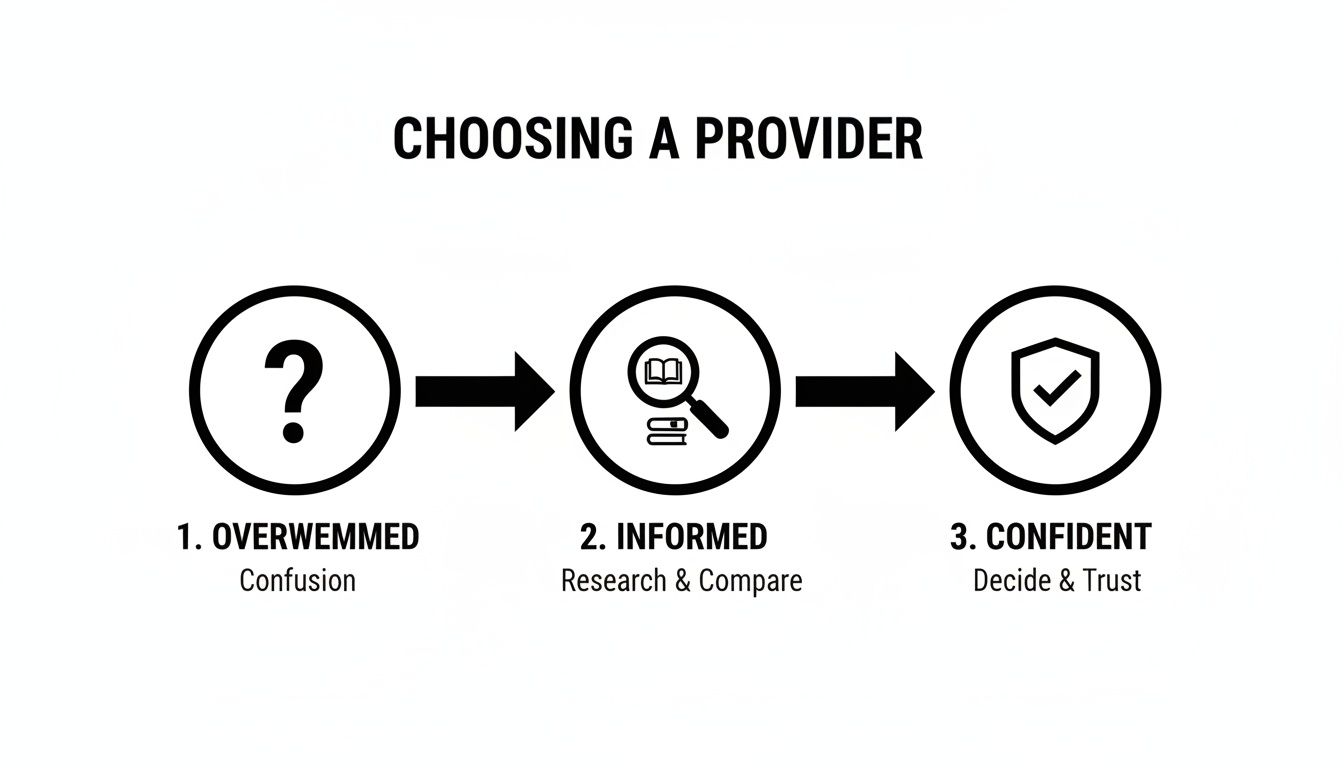
Ultimately, this long and arduous path is your greatest assurance of quality. It proves that the physician you trust with your appearance has invested over a decade of their life to achieve the highest possible standard of medical excellence—a qualification that simply cannot be replicated by any weekend course or certificate program. This dedication is what separates a true expert from the rest.
How Certification Protects Your Safety and Guarantees Results
Choosing a cosmetic provider isn’t just about aesthetics; it’s a critical decision about your health. The exhaustive training a board-certified cosmetic dermatologist goes through isn’t just about mastering techniques. It’s about developing the profound medical judgment needed to protect you from harm and deliver predictable, beautiful results.
In an industry where procedures are becoming more common, the risks from untrained hands are alarmingly real. Complications like burns, infections, scarring, or just plain unnatural outcomes almost always stem from a basic lack of medical understanding. A weekend course on running a laser is no substitute for a decade of medical education.
That deep-seated medical knowledge is your ultimate safety net. A board-certified expert’s ability to minimize risks while maximizing results is a direct product of their rigorous, comprehensive training in the science of skin.
The Diagnostic Advantage in Aesthetic Medicine
One of the biggest safety benefits of choosing a board certified cosmetic dermatologist is their diagnostic skill. They are physicians first. Before they ever think about a cosmetic treatment, their primary job is to understand the actual health and biology of your skin.
They can spot subtle signs of underlying medical issues—like rosacea, pre-cancers, or autoimmune disorders—that could be made much worse by the wrong aesthetic procedure. For example, performing an aggressive laser treatment on someone with undiagnosed melasma could actually make the hyperpigmentation darker and harder to treat.
A technician without this medical background would almost certainly miss these vital details, potentially moving forward with a treatment that’s not just ineffective but outright harmful. This diagnostic foresight is essential for building a treatment plan that is both safe and truly customized to you.
Mastering Treatment and Managing Complications
Aesthetic medicine is not about pushing a button. It’s about knowing which machine to use, the exact settings for a specific skin type, and how to combine different treatments for the best possible outcome.
Take laser resurfacing. An untrained operator might apply a one-size-fits-all approach, risking burns, permanent pigment changes, or scarring. A board-certified cosmetic dermatologist, on the other hand, understands the physics of how light-based devices interact with skin at a cellular level.
This expertise allows them to:
- Select the right device from a huge array of options for your specific skin tone and goals.
- Calibrate settings with surgical precision to target concerns without damaging surrounding tissue.
- Anticipate and manage any adverse reactions with immediate, effective medical care.
This level of skill is your assurance of both safety and a beautiful, natural-looking result.
The ability to expertly handle an unexpected complication is a non-negotiable part of patient safety. A board-certified dermatologist is medically equipped to manage adverse events, a skill that technicians or aestheticians simply do not possess. This distinction is paramount when you’re entrusting someone with your health.
The American Academy of Dermatology emphasizes that these specialists possess unmatched expertise from years of dedicated education, which dramatically reduces complication risks in popular treatments like wrinkle reduction and scar revision. As demand grows for procedures addressing age spots, fat reduction, and anti-aging, these experts deliver safer, more effective results grounded in a deep understanding of skin science. You can learn more about the expert approach to cosmetic treatments directly from the leaders in dermatology.
Ultimately, investing in a board-certified provider is an investment in your well-being. Their certification is a promise of medical excellence—one that protects your health and ensures your aesthetic journey ends with the refined, graceful results you deserve.
The Advanced Treatments Only Top Dermatologists Offer
While plenty of practitioners can administer basic injectables, a board‑certified cosmetic dermatologist operates in an entirely different league. Their profound understanding of skin biology and anatomy allows them to master—and often artfully combine—the most powerful technologies available today.
These aren’t just treatments; they’re strategic interventions. The goal is to create harmonious, natural-looking results that a less-trained provider simply can’t replicate. The real expertise isn’t just in firing up a machine, but in knowing precisely how, when, and on whom to use it. That clinical judgment, sharpened over thousands of hours in residency and ongoing education, is what elevates a standard procedure into an exceptional outcome.
Let’s explore some of the next-level treatments that have become the hallmarks of elite dermatological care.
Next-Generation Skin Rejuvenation and Resurfacing
The days of aggressive lasers that demand weeks of social downtime are largely over. Today’s top dermatologists use advanced devices that deliver stunning results with far greater precision and much less recovery. These technologies do more than just polish the surface; they fundamentally remodel the skin from the inside out.
- Fractional and Picosecond Lasers: Forget the older ablative lasers that stripped away the entire top layer of skin. Modern fractional lasers create microscopic treatment zones, triggering a powerful collagen-building response while leaving the surrounding tissue untouched. This clever approach dramatically accelerates healing and minimizes risks. Picosecond lasers take it a step further, firing at unbelievable speeds to shatter pigment without generating excessive heat, making them a game-changer for stubborn discoloration and tattoo removal.
- Radiofrequency (RF) Microneedling: This is a brilliant combination of two powerhouse treatments. It merges the collagen-boosting effect of microneedling with the skin-tightening force of radiofrequency energy. Tiny needles deliver controlled heat deep into the dermis, igniting a robust healing process that tightens skin, smooths scars, and refines texture far more effectively than either modality could on its own.
The objective here isn’t to create a “new” face. It’s to restore the skin’s own vitality and structural integrity. A premier dermatologist uses these tools to smooth away textural irregularities, erase years of sun damage, and rebuild a firm, resilient foundation for your skin.
Advanced Volume Restoration and Biostimulation
Fillers are everywhere, but a board-certified cosmetic dermatologist sees volume restoration as a form of facial architecture. It’s not about just filling a line. It’s about deeply understanding facial anatomy and the aging process to rebuild youthful contours in a way that looks completely natural.
An expert doesn’t just chase wrinkles. They rebuild the underlying support structures of the face, using biostimulatory agents to encourage the body’s own collagen production for results that are both beautiful and long-lasting.
Instead of relying solely on hyaluronic acid fillers, these experts often turn to biostimulators like Sculptra (poly-L-lactic acid) or Radiesse (calcium hydroxylapatite). These products don’t just add immediate volume. They act as a signal, prompting your body to ramp up its own collagen production over several months. The result is a gradual, subtle, and incredibly durable lift and rejuvenation that looks like your skin, only better. This is a cornerstone of the modern approach to aesthetic medicine. You can learn more about these principles in our guide to modern aesthetic treatments.
Top dermatologists are also navigating the latest aesthetic challenges. With 1 in 8 Americans having tried GLP-1 drugs for weight loss, a new concern—”Ozempic face”—has emerged due to rapid volume loss. Experts are addressing this with specialized neck treatments and deeper microneedling protocols. They are also pioneering new tech that remodels collagen around the mouth with faster recovery times, all while exploring the growing field of regenerative therapies that merge in-office procedures with systemic longevity strategies.
How to Vet Your Provider During a Consultation

The initial consultation is far more than just a medical appointment. It’s your chance to interview a potential provider and decide if they are the right partner for your aesthetic journey. This is where you confirm their expertise, get a feel for their aesthetic philosophy, and determine if you’re comfortable placing your face—and your safety—in their hands.
Walking in prepared with the right questions completely changes the dynamic. You shift from being a passive patient to an active, informed participant steering your own care. A true professional will not only welcome your diligence but will answer your questions with transparency and confidence.
Key Questions to Uncover True Expertise
Don’t be shy. This is the time to ask direct questions about qualifications and experience. The answers you receive will tell you everything you need to know about their skill, dedication, and suitability for your specific goals. Any genuinely qualified board certified cosmetic dermatologist will be proud to discuss their background.
Here are the non-negotiable questions to ask:
- “Are you a board-certified dermatologist?” This is the single most important question. Follow up by asking for the specific board—the only acceptable answer is the American Board of Dermatology.
- “What is your specific training with this device or procedure?” For something like a laser or RF microneedling, probe deeper than their residency. Ask about the advanced fellowship training or manufacturer-led courses they’ve completed.
- “How many times have you performed this particular treatment?” In aesthetics, experience is everything. An expert should have a significant track record with the exact procedure you’re considering. Hundreds, if not thousands, of times is a good sign.
- “How do you manage potential complications?” Their response should be calm, clear, and systematic. A prepared, safety-first approach is what you’re looking for, not a dismissive “it rarely happens.”
These questions cut through the marketing fluff and get to the heart of what matters: proven skill and an unwavering commitment to patient safety. A vague or hesitant answer to any of these is a major red flag.
How to Spot Critical Red Flags
Just as important as asking the right questions is knowing how to recognize the warning signs of a provider who isn’t a good fit. True experts prioritize patient education, safety, and well-being over making a sale.
Be wary of any practitioner who:
- Uses high-pressure sales tactics. You should never feel rushed into a decision or pushed to buy a package “today only.”
- Offers generic, one-size-fits-all plans. A top-tier dermatologist customizes every treatment plan to your unique anatomy, skin quality, and goals.
- Avoids discussing their credentials. Transparency is mandatory. If they deflect or get defensive when you ask about certification, it’s time to walk away.
- Downplays the risks. Every medical procedure carries potential risks. An ethical provider will have an open, honest conversation about them, ensuring you give truly informed consent.
A consultation should feel like a collaborative partnership focused on your goals and safety. If it feels more like a sales pitch, that’s your cue to seek a second opinion. A premier provider’s primary goal is to build trust, not to close a deal.
Evaluating Before-and-After Photos
A provider’s photo gallery is their professional portfolio. But you have to look with a discerning eye, because not all before-and-afters are created equal. It’s easy to create misleading images.
When you’re reviewing their work, use this simple checklist:
- Consistent Lighting and Angles: Are the “before” and “after” shots taken under identical conditions? Watch out for changes in lighting, angles, or patient expressions that can fake a better result.
- High-Resolution Images: Blurry or low-quality photos can easily hide imperfections, uneven results, or even signs of digital editing.
- Authentic, Natural-Looking Results: Do the patients look refreshed and harmonious, or do they look “done” and unnatural? The best work makes people look like a better version of themselves.
- Patients with Similar Features: Look for examples of patients who share your age, skin type, and facial structure. This gives you a much more realistic idea of the outcomes you can expect.
Connecting You with Vetted Leaders in Dermatology
Let’s be honest: navigating the world of aesthetic medicine can feel like a minefield. You’re bombarded with social media influencers, paid directories, and flashy marketing campaigns that make it nearly impossible to tell who has genuine expertise and who just has a clever promotion strategy. This is where Haute MD cuts through the noise. We connect you directly with a genuinely elite board-certified cosmetic dermatologist.
Your peace of mind is everything. That’s why our network isn’t some open-for-all listing service; it’s a curated, invitation-only collection of the nation’s most respected physicians. The vetting process is intense, ensuring every single provider represents the absolute pinnacle of skill, safety, and patient care. We do the exhaustive background work so you can focus on your results.
The Haute MD Standard of Excellence
Every professional in the Haute MD network is more than just board-certified—they’re recognized leaders in their field. These are the physicians celebrated for their artistic eye, their technical mastery, and their unwavering commitment to creating natural, harmonious outcomes. They are the innovators who stay ahead of the curve, offering the most advanced, evidence-based treatments available today.
This focus on the highest echelons of care is reflected in their standing. In the United States, board-certified cosmetic dermatologists command significantly higher earnings than their general dermatology counterparts, often exceeding $500,000 annually and reaching $1 million or more for the top tier of practitioners. This isn’t just about money; it’s driven by the booming demand for elective aesthetic procedures that require a rare blend of medical authority and artistic vision. This financial edge underscores their skill and positions them as key players in luxury wellness, delivering the transformative beauty outcomes discerning patients seek. You can discover more about the distinctions in cosmetic dermatology on int.livhospital.com.
Choosing a provider from the Haute MD network means you are selecting a professional whose reputation is built on delivering exceptional, premium care. It’s an investment in predictable results, unparalleled safety, and a seamless, confidential patient experience.
Your Direct Path to a Trusted Expert
Our platform brings together all the critical themes we’ve discussed—rigorous training, unwavering patient safety, and cutting-edge innovation—and delivers them through a network of trusted professionals. We provide the direct connection you need to an expert who truly understands the nuances of aesthetic medicine and is dedicated to achieving your specific goals. For more expert-backed advice, explore our guide on how to find the best dermatologist near you.
Ultimately, your journey to rejuvenation should be built on a foundation of absolute trust. By choosing an Haute MD expert, you are ensuring your care is in the hands of a true leader—one who delivers not just remarkable results, but the profound peace of mind that comes with knowing you’ve chosen the absolute best.
Frequently Asked Questions
When you’re considering a cosmetic procedure, it’s natural to have questions. Here are straightforward answers to some of the most common ones we hear, designed to give you clarity and confidence.
What Is the Difference Between a Cosmetic Surgeon and a Dermatologist?
This is a critical distinction, and frankly, it’s everything when it comes to your safety. A board-certified cosmetic dermatologist is a medical doctor who has completed years of intensive residency training focused exclusively on skin, hair, and nails. They are the undisputed experts in skin health, spending years diagnosing and treating thousands of conditions before ever specializing in aesthetics.
“Cosmetic surgeon,” on the other hand, can be a confusing and sometimes misleading title. The training path isn’t standardized and can vary dramatically. It often lacks the deep, foundational dermatological expertise that is so crucial. A dermatologist’s entire world revolves around the skin, giving them an unmatched understanding of how to deliver beautiful aesthetic results while protecting the long-term health of your body’s largest organ.
How Can I Verify a Dermatologist Is Board Certified?
Verifying a doctor’s credentials is not just smart—it’s essential. Any true professional will be proud of their certification and completely transparent about it. You can check a physician’s status in just a few minutes on the official websites of the certifying boards.
These are the two main resources you’ll need in the United States:
- The American Board of Dermatology (ABD): This is the primary certifying body for dermatologists in the U.S. Their website features an easy-to-use verification tool.
- The American Academy of Dermatology (AAD): As the leading professional organization for dermatologists, the AAD also provides resources to find and confirm the credentials of its members.
If a provider ever seems hesitant or evasive when you ask about their board certification, consider it a major red flag.
Trust, but verify. A few moments of online research provide the ultimate peace of mind, confirming your chosen provider has met the highest national standards for skill, knowledge, and safety in dermatology.
Does It Cost More to See a Board Certified Expert?
While the initial fee for a consultation or procedure with a board-certified cosmetic dermatologist might be higher than at a local medspa, it’s a mistake to view it as just a cost. Think of it as an investment in your safety, your face, and your long-term results.
That higher fee reflects nearly a decade of rigorous medical training, superior diagnostic skills, and a profoundly lower risk of something going wrong. An injection or laser treatment performed improperly by someone with less training can lead to complications that are not only expensive to fix but also emotionally devastating.
In the end, choosing a board-certified expert often saves you money, time, and a tremendous amount of anxiety. You’re not just paying for a procedure; you’re paying for the peace of mind that comes from knowing you’re in the hands of a true medical specialist who can deliver predictable, beautiful outcomes and expertly manage any situation that might arise.
Finding the right expert is the single most important decision in your aesthetic journey. The Haute MD network eliminates the guesswork by providing a curated directory of the nation’s most elite, pre-vetted physicians. Skip the uncertainty and connect directly with a top-tier professional dedicated to excellence by visiting Haute MD network.