



That little bump you just discovered on the inside of your lip can be surprisingly unsettling. The good news? In almost all cases, it’s something harmless and quite common. More often than not, the culprit is a mucocele, a tiny, fluid-filled sac that pops up after you’ve accidentally bitten your lip.
Knowing the likely causes can help put your mind at ease, but nothing replaces a professional look-see for a definitive answer.
Decoding That Unsettling Bump Inside Your Lip
Finding an unexpected lump anywhere is enough to make your heart skip a beat, and the sensitive, delicate tissue inside your mouth is no different. Before you let your mind race, it’s important to know that the inner lip is a very common spot for all sorts of benign (non-cancerous) growths. These bumps often appear out of the blue and can usually be traced back to simple, everyday actions.
Just think about how often you might bite your lip while lost in thought, chewing a meal, or even in your sleep. That tiny moment of trauma is one of the leading triggers. Your mouth is a busy place—constantly dealing with different foods, temperature changes, and mechanical stress. All that activity can easily lead to small, temporary lesions.
The Most Common Culprit: A Mucocele
Think of your mouth as having thousands of microscopic pipelines, called salivary ducts, that carry saliva from glands to keep everything moist. A mucocele, also called a mucous cyst, is essentially a tiny plumbing problem. When one of these ducts gets damaged—usually from a bite—saliva can’t flow out properly. It gets trapped under the skin, forming a soft, squishy, and often clear or bluish-looking bubble.
This is an incredibly common occurrence. You bite down a little too hard on your lower lip, and a day or two later, a soft, painless bump appears. It’s a classic story. A comprehensive 11-year study analyzing thousands of oral lesions found they affected 10.7% of patients. Mucoceles were the single most frequent diagnosis, making up 25% of all cases.
Interestingly, a whopping 76.2% of these harmless cysts showed up on the lower lip, which confirms exactly why that spot is such a hotspot for these bumps.
To give you a clearer picture, here’s a quick rundown of the usual suspects.
Common Inner Lip Bumps at a Glance
| Type of Bump | Common Appearance | Typical Cause or Trigger |
|---|---|---|
| Mucocele | Soft, round, fluid-filled; often bluish or clear | Minor trauma, like biting the lip |
| Aphthous Ulcer | Small, painful, shallow sore; white/yellow center, red border | Stress, certain foods, minor injury |
| Fibroma | Firm, smooth, dome-shaped lump; same color as the lip | Chronic irritation, like rubbing against teeth |
| Cold Sore (HSV-1) | Cluster of painful, fluid-filled blisters (less common inside) | Viral infection (herpes simplex virus) |
As you can see, several different things can cause a bump, and they often share overlapping features.
Why You Shouldn’t Rely on Self-Diagnosis
While a mucocele is a very likely candidate, it’s just one piece of a larger puzzle. That bump could also be:
- Aphthous Ulcers (Canker Sores): Those notoriously painful, small white or yellow sores surrounded by a red halo.
- Fibromas: Firm, smooth, scar-like lumps that form from chronic irritation, like a lip constantly rubbing against a rough tooth or dental work.
- Viral Sores: Lesions from viruses like oral herpes can sometimes appear as painful blisters, though they are more common on the outer lip.
Because these conditions can look so similar to an untrained eye, trying to diagnose it yourself can lead to one of two problems: needless anxiety over something harmless, or brushing off something that really does need a doctor’s attention.
Getting an accurate diagnosis is the only way to be sure. Consulting with a board-certified dermatologist or an oral surgeon is the best path forward for a precise evaluation and a care plan that’s right for you.
Exploring Common and Harmless Lip Bumps

While the mind can jump to worst-case scenarios, the vast majority of bumps that appear on the inside of the lip fall into a handful of very common, non-cancerous categories. Getting to know the distinct characteristics of each one can demystify what you’re seeing and give you a much clearer path forward.
Each of these conditions has its own unique origin story, from a blocked gland to simple chronic irritation. Let’s break down the top three benign bumps that dermatologists see day in and day out. By learning their tell-tale signs, you’ll be far better equipped to understand what’s going on with your own inner lip.
Mucoceles: The Blocked Salivary Gland
A mucocele, often called a mucous cyst, is probably the most frequent cause of a soft, squishy bump inside the lip. The easiest way to think of it is as a tiny, harmless water balloon that forms when a salivary gland duct gets blocked or injured.
This usually happens after a minor trauma—like accidentally biting your lip. The saliva, now unable to get to the surface, simply pools under the skin, creating a painless, fluid-filled dome. You’ll often notice a smooth, squishy bump that might have a slightly clear or bluish tint. They’re most common on the lower lip and, thankfully, often go away on their own.
Aphthous Ulcers: The Painful Canker Sore
Far more memorable—and painful—than a mucocele is the aphthous ulcer, which everyone knows as a canker sore. This isn’t a fluid-filled sac like a mucocele; it’s a shallow, open sore. It typically shows up as a small, round lesion with a white or yellowish center circled by a distinct red, inflamed border.
While the exact cause of canker sores remains a bit of a mystery, they aren’t contagious. They are, however, often linked to very specific triggers.
- Minor Mouth Injury: Biting your cheek or lip, or even irritation from dental work.
- Dietary Factors: Sensitivities to acidic or sharp foods like citrus fruits, strawberries, or potato chips.
- Emotional Stress: Periods of high stress are a notorious trigger for outbreaks.
- Hormonal Shifts: Some women find they appear in sync with their menstrual cycle.
Though intensely painful, a single canker sore usually heals up on its own within one to two weeks without leaving a scar.
A key differentiator between a canker sore and other bumps is the pain level. A mucocele is typically painless to the touch, whereas a canker sore will be quite tender and can make eating or talking genuinely uncomfortable.
This distinction is one of the most useful clues for an initial self-assessment. The presence of significant pain often points away from a simple mucous cyst and squarely toward an inflammatory ulcer.
Fibromas: The Scar-Like Growth
What if the bump on your lip feels firm, smooth, and more like a solid piece of tissue than a bubble of fluid? You might be dealing with an oral fibroma. This is a totally benign, scar-like growth made of fibrous connective tissue. It’s essentially the body’s way of protecting an area that has been repeatedly irritated over time.
Think of it like a callus that forms on your hand from constant friction. Inside the mouth, this can be caused by:
- Habitually biting your lip or cheek.
- Constant rubbing against a rough tooth edge.
- Persistent irritation from dentures or braces.
Fibromas develop slowly and feel like a firm, dome-shaped lump just under the surface. They are usually the same color as the surrounding lip tissue and are completely painless. Unlike mucoceles or ulcers, fibromas don’t resolve on their own. They’ll remain unless they are professionally removed, which is a simple procedure your dermatologist can perform in the office.
When a Bump Is Caused by a Virus or Infection
While physical irritation is the usual suspect behind most inner lip bumps, sometimes the culprit is microscopic. Certain viral infections can show up as lesions inside the mouth, creating bumps that look and feel completely different from a harmless mucocele or fibroma. Figuring out these infectious causes is critical, because managing them means treating the underlying virus, not just snipping off the bump.
Unlike a simple blocked gland, a viral bump signals an active infection that could be contagious and demands a specific medical game plan. Two of the most common viral players are the herpes simplex virus (HSV-1) and the human papillomavirus (HPV). Telling these apart from more benign bumps is a specialist’s job, as the treatment paths couldn’t be more different.
Oral Herpes Simplex Virus (HSV-1)
Most people hear “herpes” and immediately think of cold sores on the outside of the lips. But the herpes simplex virus can absolutely cause lesions inside the mouth, too. This is especially true during a primary (first-time) infection. Once you have the virus, it stays dormant in your body for life, with the potential to reactivate during times of stress, sickness, or even too much sun.
When HSV-1 pops up on the inner lip, it doesn’t form a single, smooth lump. Instead, it typically shows up as a cluster of small, painful blisters filled with clear or yellowish fluid. These blisters eventually burst, leaving behind shallow, raw ulcers that can be incredibly uncomfortable.
A big clue that you’re dealing with a primary HSV-1 outbreak inside the mouth is feeling like you have the flu. It’s not uncommon to run a fever, have swollen lymph nodes, and feel generally run down along with the painful blisters, which can take up to three weeks to heal completely.
Oral Human Papillomavirus (HPV) Lesions
Another virus that can cause a bump on the inner lip is the human papillomavirus, or HPV. Certain strains of HPV are known to cause painless, wart-like growths on mucous membranes, including the inside of your lips and cheeks. Medically, these are often called squamous papillomas.
Unlike the blistery, painful clusters from herpes, an oral HPV lesion usually appears as a single, cauliflower-like growth. It might be white or the same pinkish color as the tissue around it, and it has a tell-tale bumpy or finger-like texture. While these are almost always benign, they absolutely require a proper diagnosis to rule out any higher-risk HPV strains.
Because they’re caused by a virus, both oral herpes and HPV lesions come with their own set of rules:
- Contagion: Both viruses can be contagious through direct contact, like kissing.
- Diagnosis: A visual exam is often enough for a trained eye, but a doctor might take a swab or a small tissue sample (biopsy) to be 100% sure.
- Treatment: Herpes is managed with antiviral medications, while HPV lesions might be removed surgically or with other in-office procedures.
Given their infectious nature and the need for specific treatments, any bump you suspect might be viral needs to be checked out by a board-certified dermatologist.
Recognizing the Warning Signs of a Serious Condition
While the vast majority of inner lip bumps are completely benign, it’s wise to understand the subtle signs that could point toward something more serious. This knowledge isn’t meant to cause alarm. Instead, it empowers you to be a proactive advocate for your own health, helping you recognize when a simple bump warrants a closer look from a medical professional.
Most harmless bumps, like mucoceles or canker sores, come and go. They often have a clear cause—like accidentally biting your lip—and follow a predictable healing pattern. A potentially more serious lesion behaves differently. It often lingers without explanation and changes over time. Getting a feel for this distinction is the first step toward early detection and, ultimately, peace of mind.
This simple decision guide can help you visually distinguish between some of the common viral causes behind lip bumps.
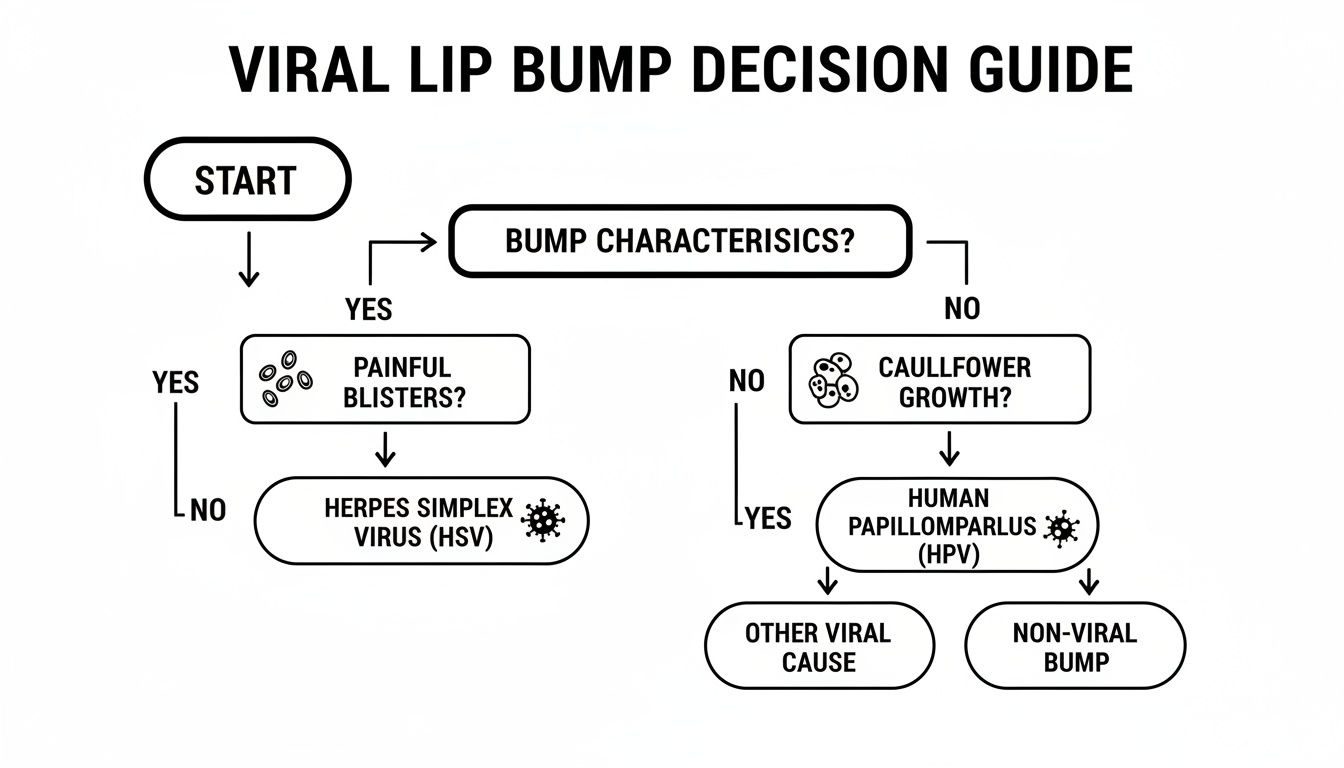
The key takeaway here is that features like painful blisters or cauliflower-like textures often point toward viral infections, which require a completely different diagnostic and treatment approach than simple traumatic bumps.
Precancerous Changes to Be Aware Of
Sometimes, a change inside the mouth isn’t a distinct bump but rather a patch of altered tissue. These are known as oral potentially malignant disorders (PMDs), and they represent the earliest warning signs of cellular changes that could, over time, develop into cancer. They don’t always cause a classic “bump on the inside of the lip,” but they are absolutely crucial to recognize.
Two of the most common PMDs you should know about are:
- Leukoplakia: These are thick, white or grayish patches that can’t be scraped off. They can appear anywhere inside the mouth, including the inner lip.
- Erythroplakia: This is a flat or slightly depressed red patch that often has a velvety texture. While it’s less common than leukoplakia, erythroplakia has a much higher potential to become malignant.
The presence of these patches, especially if you have risk factors like a history of tobacco or heavy alcohol use, should always prompt an immediate visit to a dermatologist or oral surgeon.
Critical Red Flags That Demand Immediate Attention
Beyond PMDs, certain characteristics of a bump itself are considered major red flags. Think of these as the body’s signals that something isn’t right. If you notice a bump on your inner lip accompanied by any of the following symptoms, it’s time to stop the wait-and-see approach and schedule an evaluation right away.
The “two-week rule” is a standard guideline in dermatology and oral medicine: any sore, ulcer, or lump that does not heal or significantly improve within 14 days needs a professional assessment. No exceptions.
Here are the specific warning signs to watch for:
- A sore that doesn’t heal: This is the most critical red flag. Benign sores resolve; persistent ones do not.
- A lump that feels hard and fixed: Unlike a soft, movable mucocele, a firm lump that feels stuck to the underlying tissue is concerning.
- Unexplained bleeding: A bump that bleeds easily when touched or for no apparent reason.
- Persistent pain or numbness: Any lasting pain, tenderness, or loss of sensation in the lip or surrounding area.
- Difficulty chewing or swallowing: This happens if the bump starts to interfere with normal mouth function.
- Changes in color: A lesion with patches of red, white, or dark brown/black is a serious sign.
Although the lifetime risk for lip cancer is relatively low at around 0.1%, early detection dramatically improves outcomes. It’s crucial to take any persistent or unusual oral lesion seriously.
Not all inside lip bumps are harmless. Some may signal those oral potentially malignant disorders, which carry a significant risk of transforming into cancer—particularly in tobacco users. A large hospital study of over 3,000 patients with oral lesions found that PMDs were the most common type of lip lesion, accounting for a staggering 37.4% of cases. These were most often found on the lower lip (54.1%) or at the corners of the mouth (30.9%). You can learn more about these important findings from the National Institutes of Health.
To help you sort through this, here’s a quick comparison of what we typically see with benign bumps versus the signs that should make you pick up the phone.
Benign Bumps vs Potentially Malignant Lesions
| Feature | Typically Benign (e.g., Mucocele, Fibroma) | Potentially Concerning Signs |
|---|---|---|
| Onset & Duration | Often appears after minor trauma (like a bite); heals within a week or two. | No clear cause; persists for more than 2 weeks without healing. |
| Texture & Mobility | Soft, fluid-filled, or rubbery; easily movable under the skin. | Hard, firm, and feels “fixed” or attached to deeper tissue. |
| Sensation | Usually painless or only mildly tender. | Persistent pain, numbness, or a tingling sensation in the area. |
| Color | Uniformly pink, bluish, or flesh-toned. | Contains patches of white, red, or dark brown/black. |
| Borders | Smooth, round, and well-defined. | Irregular, poorly defined borders. |
| Bleeding | Bleeds only if irritated or ruptured. | Bleeds easily with minimal contact or for no reason at all. |
| Growth | Stays the same size or shrinks over time. | Grows progressively larger or changes shape. |
| Associated Symptoms | Generally an isolated issue. | May be accompanied by difficulty swallowing, chewing, or speaking. |
Remember, this table is a guide, not a diagnostic tool. The key takeaway is that persistence and change are the two biggest warning signs. If a bump on your lip is new, changing, or just won’t go away, it’s always best to have it checked out by an expert.
What to Expect During Your Doctor’s Appointment

Walking into a specialist’s office with a new, unexplained bump on your lip can be nerve-wracking. But knowing what the diagnostic process looks like can turn that anxiety into a feeling of control. Think of this appointment as a collaborative investigation—a conversation designed to get you clear, definitive answers.
It all starts with a simple discussion. Your doctor will want to know your story: your overall medical history, any habits like lip biting, and the specifics of the bump itself. When did you first notice it? Has it changed in size or color? Is it causing any pain? This background information provides critical clues before the physical exam even begins.
The Physical Examination
Next, your specialist will perform a careful visual and tactile assessment. This is much more than a quick peek; it’s a detailed evaluation where they will gently feel (palpate) the lesion to understand its physical properties.
They’re looking for specific characteristics, including:
- Size and Shape: Is it perfectly round or more irregular? Large or tiny?
- Texture: Does it feel soft and squishy, like a fluid-filled mucocele, or is it firm and dense like a fibroma?
- Mobility: Can the bump be moved around easily, or does it feel anchored to the deeper tissue?
- Color: Is it clear, bluish, red, white, or the same color as the surrounding lip?
This hands-on part of the exam provides a wealth of information. A soft, movable, slightly bluish bump, for example, points strongly toward a harmless mucocele. A hard, fixed lesion, on the other hand, might signal the need for a closer look. Understanding what a dermatologist treats helps clarify why they are experts at interpreting these subtle signs on skin and mucous membranes.
Deciding on a Biopsy
More often than not, an experienced dermatologist or oral surgeon can make a confident diagnosis based on the exam alone. However, if the bump has unusual features or if there’s any uncertainty, they might recommend a biopsy.
A biopsy is a straightforward, minimally invasive procedure where a tiny piece of tissue is removed for analysis under a microscope. It’s the gold standard for confirming a diagnosis and ruling out anything serious.
Don’t let the word “biopsy” alarm you. It’s a proactive step to ensure 100% accuracy, not a sign that something is wrong. The procedure is usually done right in the office with local anesthesia, so you won’t feel a thing. The sample is then sent to a pathologist who provides the definitive answer. By understanding these steps, you can walk into your consultation not with apprehension, but as an informed partner on the path to getting clarity and peace of mind.
Modern Treatment Options for Inner Lip Bumps
Once your doctor has pinpointed the exact cause of the bump on your inner lip, the path forward becomes much clearer. The right treatment is entirely dependent on the diagnosis, with options ranging from simple home care for minor irritations to precise in-office procedures for more stubborn growths.
For something as common as an aphthous ulcer (a canker sore), the immediate goal is to soothe the discomfort and help it heal faster. Over-the-counter topical gels containing benzocaine can offer temporary numbness, while simple saltwater rinses are great for keeping the area clean and tamping down inflammation. If you’re dealing with particularly severe or recurrent sores, your dermatologist might prescribe a stronger corticosteroid paste to apply directly to the ulcer.
Professional Removal for Persistent Bumps
Now, if you’re dealing with a persistent mucocele or a firm fibroma that just won’t go away on its own, your doctor has a few minimally invasive tricks up their sleeve. These modern techniques are designed to remove the bump safely and effectively, with a focus on being quick, precise, and minimizing any potential scarring.
A few of the most common procedural options include:
- Surgical Excision: This is the traditional gold standard for a reason. After numbing the area with a local anesthetic, the doctor uses a small scalpel to carefully remove the entire bump.
- Laser Ablation: A highly focused beam of light is used to vaporize the unwanted tissue. It offers incredible precision and leads to very little bleeding.
- Cryotherapy: This technique flash-freezes the bump with liquid nitrogen. This causes the tissue to break down and eventually fall off on its own.
Each of these is typically a one-and-done procedure performed right in the office, offering a permanent fix for these types of benign growths. Your specialist will walk you through which option makes the most sense for your specific situation.
The real beauty of these modern removal techniques is their focus on preserving healthy tissue. By targeting only the bump itself, specialists can ensure a faster recovery and a much better cosmetic outcome compared to older, more invasive methods.
The Importance of Expert Care
Choosing the right treatment—and performing it flawlessly—really requires a specialist’s touch. A board-certified dermatologist brings the diagnostic skill and procedural expertise needed to manage these conditions with confidence. For a deeper dive, you can explore our insights on why elite dermatologists outperform med spas, which highlights the immense value of specialized medical care for both health and cosmetic concerns.
Ultimately, the goal is a personalized treatment plan that not only resolves the issue but also prioritizes your comfort and long-term well-being. This ensures the best possible result for any bump on the inside of your lip.
Answering Your Questions About Lip Bumps
After going through all the potential causes and treatments, you probably have a few more practical questions. That’s completely normal. Getting clear, straightforward answers can give you the confidence you need to figure out your next steps. Let’s tackle some of the most common concerns patients have.
We’ll cover whether that bump is contagious, how long you should wait before calling a doctor, and which specialist is the right one to see. The goal here is to clear up any lingering confusion and give you the practical knowledge you need to take control of your health.
Is a Bump on the Inside of My Lip Contagious?
This is a big one, and the answer is simple: it completely depends on what caused it. Understanding the difference is crucial for your health and for those you’re close to.
The good news is that most of the common bumps you’ll find inside your lip are not contagious at all. This includes things like:
- Mucoceles: These are just harmless, fluid-filled sacs that form when a salivary gland gets blocked. You can’t pass them to anyone.
- Fibromas: Think of these as a form of scar tissue, a firm little lump that develops from repeated irritation. They are not infectious.
- Aphthous Ulcers (Canker Sores): While painful, canker sores are triggered by inflammation, not a transmissible infection.
However, if a virus is the culprit, then yes, the bump can be contagious. The classic example is oral herpes (HSV-1), which creates painful blisters. These can easily be spread through direct contact, like kissing. Without a professional diagnosis, you can’t know for sure, which is why getting it checked out is so important.
How Long Should I Wait Before Seeing a Doctor?
Figuring out when to switch from “wait-and-see” mode to making a doctor’s appointment is a common dilemma. Fortunately, dermatologists and oral health experts have a straightforward guideline that works well for most situations.
There’s a general guideline known as the “two-week rule.” If any bump, sore, or unusual spot inside your mouth doesn’t show clear signs of healing or go away completely within two weeks, it’s time to schedule an evaluation.
Of course, you should book an appointment much sooner if you notice any red flags. This includes any bump that’s growing quickly, is unusually painful, bleeds for no reason, or starts getting in the way of eating, talking, or swallowing. Don’t wait on those.
Should I See a Dentist or a Dermatologist?
When you find a bump on your inner lip, it can be confusing trying to figure out which specialist to call. The good news is that you have excellent options, as both dentists and dermatologists are highly qualified to diagnose and treat these kinds of oral issues.
A board-certified dermatologist is an excellent starting point. Their specialty covers everything related to skin and mucous membranes, which includes the delicate lining inside your mouth. If your case is a bit more complex or requires surgical removal, they might refer you to an oral and maxillofacial surgeon.
Ultimately, either specialist can get you a definitive diagnosis and map out the right treatment plan for your specific situation.
Finding the right expert is the most critical step toward getting answers and peace of mind. The Haute MD network is your direct link to the nation’s leading, board-certified physicians, ensuring you receive exceptional care from a trusted professional. Find a top-tier specialist near you today.