



When you see a price tag for a hip replacement, it’s easy to get sticker shock. In the United States, the average cost of hip replacement can swing wildly, from $28,000 on the low end to well over $70,000 for a premium experience.
But that range isn’t just about a procedure; it’s about an investment. A higher price often signals access to elite surgeons, superior implant technology, and a seamless, high-touch patient journey. The first step in making an empowered decision is understanding what that investment truly buys you.
Understanding the Real Cost of Hip Replacement
For the discerning patient, the conversation around a premier hip replacement has to shift from price to long-term value. This is less about buying a medical service and more about investing in a future free from pain and limitations.
Think of it this way: a higher cost often unlocks a different caliber of care. Every detail, from the pre-operative planning to the post-operative recovery, is meticulously managed for an optimal outcome. You’re not just paying for surgery; you’re securing direct access to the nation’s top orthopedic specialists and the most advanced techniques available.
Why Such a Wide Cost Variance Exists
That significant price difference isn’t arbitrary. It’s a direct reflection of expertise, technology, and service level. For 2025-2026, the average cost of hip replacement surgery in the U.S. is projected to range from $28,000 to over $45,000, making it one of the most expensive procedures in the world.
For premium cases, that figure can easily exceed $70,000. These costs have surged since 2020, driven by inflation and labor shortages. The advanced implants alone can account for up to 40% of the total bill.
The goal is to move beyond the sticker price and evaluate the comprehensive value you receive. This includes the surgeon’s track record, the quality of the implant, the level of personalized care, and the support provided throughout your recovery journey.
This financial commitment also covers critical non-surgical elements. It’s also worth noting that for some, exploring alternatives to surgery is a valid first step. If you’re looking into other joint health options, you might be interested in learning about the potential of stem cell therapy for joints in our detailed guide.
Hip Replacement Cost Components at a Glance
So, where does all that money go? Breaking down the bill reveals a few key areas where your investment is allocated. This table gives a high-level snapshot of the primary expenses that make up the total cost.
| Expense Category | Typical Percentage of Total Cost | What It Covers |
|---|---|---|
| Surgeon & Anesthesiologist Fees | 20-30% | The expertise and time of the surgical and anesthesia teams. |
| Hospital or Facility Fees | 40-50% | Use of the operating room, nursing care, and room and board. |
| Implant & Medical Supplies | 20-30% | The cost of the prosthetic hip joint and other surgical materials. |
| Pre-Op & Post-Op Care | 5-10% | Consultations, imaging (X-rays, MRI), and initial physical therapy. |
Seeing this breakdown helps clarify that you’re not just paying for an hour in the operating room. You’re funding a comprehensive ecosystem of care designed for a successful, lasting outcome. We’ll dive deeper into each of these components later in the guide.
Breaking Down Your Surgical Bill Line by Line
When you get a detailed estimate for your hip replacement, it can feel like trying to read a foreign language. That big number at the bottom—often tens of thousands of dollars—isn’t just a single charge. It’s a bundle of highly specialized services and medical products, each with its own specific value. Understanding what goes into that final figure helps demystify the cost and lets you see exactly what you’re investing in.
Think of it like commissioning a custom-built performance car. The final price includes the high-performance engine, the meticulously engineered chassis, the advanced electronics, and the master craftsmanship required to assemble it all. Your surgical bill is no different; it combines every essential component needed for a successful, lasting outcome.
This diagram shows how the total cost typically breaks down into the major categories, from the surgeon’s expertise to the facility and the implant itself.
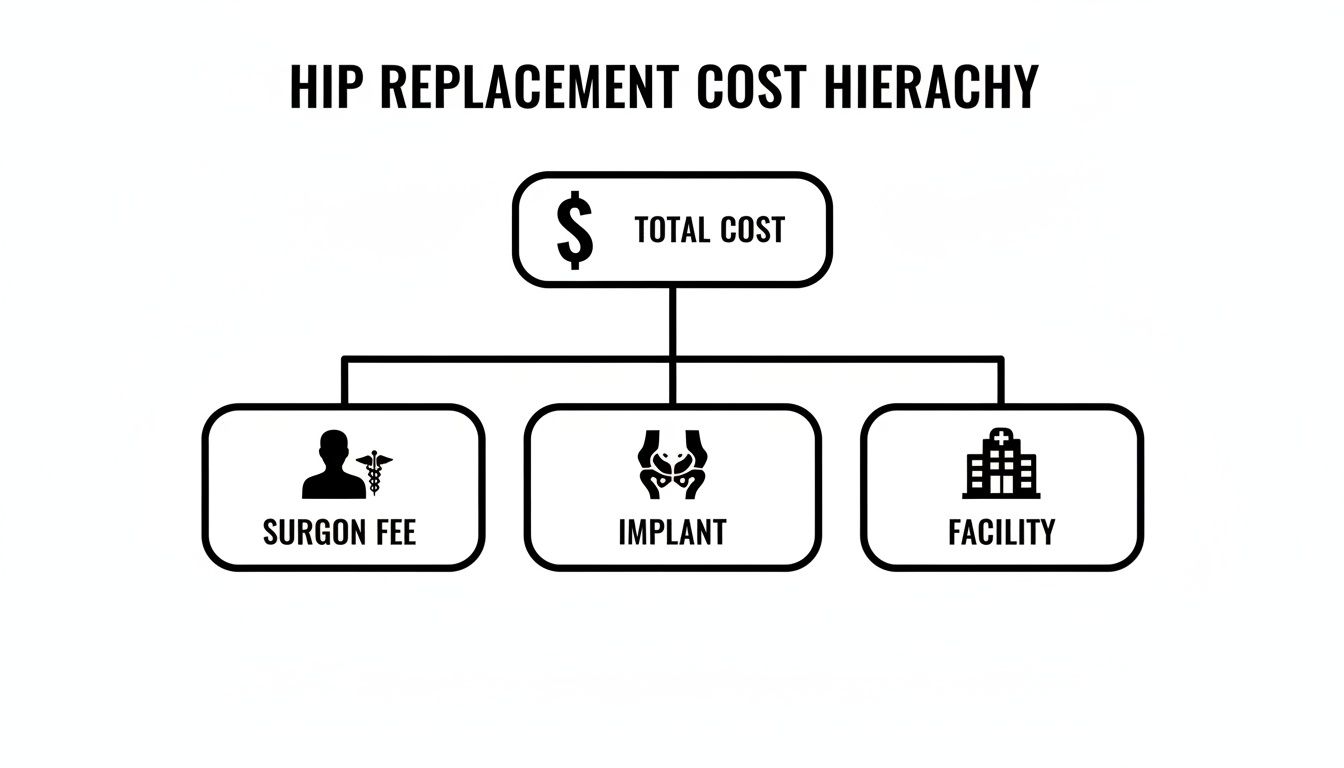
As you can see, the facility fees usually make up the largest piece of the pie, followed by the surgeon’s fee and the cost of the physical implant. Let’s pull each of these apart.
The Surgeon and Anesthesia Fees
This is the fee for the human expertise at the very top of the pyramid. Your surgeon’s fee isn’t just for the two hours they spend in the operating room. It’s for the decade of education, the grueling fellowship training, and the thousands of hours of surgical experience they’ve accumulated to master their craft.
- Surgeon’s Fee: This covers everything from the initial consultation and surgical planning to the procedure itself and the critical post-op monitoring. For an elite surgeon, this fee is a premium paid for a proven history of exceptional results and low complication rates.
- Anesthesiologist’s Fee: This physician specialist is entirely dedicated to your safety and comfort during the surgery. Their fee includes the pre-op evaluation, the administration and management of anesthesia, and the constant monitoring of your vitals from start to finish.
Essentially, you are paying for the “pilots”—the two doctors in the room whose skill and judgment guide the entire process.
Hospital or Surgical Facility Fees
This is often the single biggest line item on the bill, frequently accounting for 40% to 50% of the entire cost. This charge covers the immense overhead needed to run a world-class surgical environment.
Think of the facility fee as the cost to rent a highly specialized, all-inclusive venue. It includes the operating room itself, all the cutting-edge surgical technology, the recovery room, and the entire team of highly trained nurses and technicians who support your surgeon.
These fees cover a massive range of critical services:
- Operating Room Use: The cost to reserve, prepare, and sterilize the surgical suite.
- Nursing and Staff Care: The salaries of the entire clinical team assisting before, during, and after your operation.
- Room and Board: For an overnight stay, this includes your private room, meals, and 24/7 medical supervision.
- Sterilization and Supplies: Every sterile instrument, drape, gown, and general medical supply used is wrapped into this cost.
This fee ensures the entire environment meets the absolute highest standards of safety and efficiency—something that is completely non-negotiable for a procedure like this.
The Implant Itself
The prosthetic hip joint is a marvel of biomedical engineering, designed to mimic your natural movement and hold up for decades. The implant’s cost can vary quite a bit, but it typically represents 20% to 30% of the final bill.
Premium implants, often made from advanced materials like ceramic-on-ceramic or specialized titanium alloys, naturally come with a higher price tag. In return, they offer superior durability and lower wear rates over time. This is a direct investment in the longevity of your new hip, potentially saving you from a far more complex and costly revision surgery years down the road.
Ancillary Services and Diagnostics
Finally, the bill will include several smaller, but essential, charges that support the main event. These are crucial for accurate diagnosis, meticulous planning, and a smooth recovery.
- Pre-Operative Imaging: This includes costs for X-rays and sometimes an MRI, which gives your surgeon a precise blueprint of your joint.
- Lab Work: Pre-surgical blood tests and other screenings are mandatory to confirm you are healthy enough for surgery.
- Post-Operative Medications: This covers the initial doses of pain relievers and blood thinners you receive at the facility.
- Initial Physical Therapy: The very first rehabilitation sessions often begin in the hospital to kick-start your recovery.
By seeing how these individual pieces fit together, the total cost of a hip replacement becomes less of an intimidating number and more of a clear, itemized investment in your future.
What Factors Influence Your Final Price Tag

The huge range you see in the average cost of hip replacement isn’t arbitrary. It’s driven by a clear set of variables. Understanding what’s behind the numbers helps you see why a premium procedure commands a higher price and how that investment translates into lasting value and, most importantly, peace of mind.
Think of it like buying a fine Swiss watch. Any number of timepieces can tell you the hour, but the final price comes down to the master watchmaker’s reputation, the quality of the internal movement, and the rarity of the materials. In the same way, the cost of your hip replacement reflects the expertise, technology, and location you choose for your care.
Geographic Location and Market Dynamics
Where you have your surgery plays a major role in the final bill. It’s no surprise that major hubs with a high cost of living, like Los Angeles or New York City, have higher overhead for surgical facilities and their staff. That reality sets a higher baseline price for medical procedures across the board.
But it goes beyond simple living costs. These premier markets are also home to the world’s leading medical institutions and the most sought-after surgeons. This concentration of top-tier talent creates a competitive, high-value environment where facilities invest heavily in the latest technology and patient amenities, which naturally influences the overall cost.
The Surgeon’s Reputation and Experience
Without question, the most critical factor driving the value of your procedure is the surgeon’s expertise. An elite orthopedic surgeon with a national reputation and thousands of successful procedures has refined their craft to a level of precision that minimizes risk and truly optimizes outcomes. Their fee directly reflects this deep well of experience.
Choosing a top surgeon isn’t just about paying for a successful surgery today; it’s about investing in a lower likelihood of complications and revision surgeries tomorrow. Their skill can lead to less invasive procedures, faster recovery times, and a more durable, natural-feeling joint for decades to come.
You’re paying for the nuanced judgment that only comes from years of dedicated focus in a sub-specialty—the very thing that ensures the best possible result for your unique anatomy and lifestyle.
Surgical Approach and Implant Technology
The specific techniques and materials used in your surgery are also major cost determinants. The choice between a traditional posterior approach and a more advanced, muscle-sparing technique like the anterior approach can affect facility time and the complexity of the procedure, which in turn influences the cost.
Even more significant is the implant itself—a critical investment in your future mobility. While standard implants are effective, premium options made from advanced materials offer distinct, tangible advantages.
- Ceramic-on-Ceramic Implants: Known for their exceptional durability and extremely low wear rates, these are often the go-to for younger, more active patients. They carry a higher upfront cost but can easily last 25 years or more.
- Advanced Titanium Alloys: These materials are prized for their biocompatibility and ability to integrate with your natural bone, promoting superior long-term stability.
- Dual Mobility Components: This advanced design offers an enhanced range of motion and an exceptionally low risk of dislocation, making it a preferred choice for complex cases or for patients who demand maximum joint security.
The cost of these advanced implants is a key piece of the total bill. Implant costs can reach $10,000-$15,000 for premium brands in the U.S., making up as much as 35% of a $40,000 procedure. This evolution in implant technology empowers you to access cutting-edge solutions that blend fiscal awareness with superior, long-lasting outcomes. You can learn more about the global impact of implant pricing on surgical costs.
The table below breaks down how these choices can push your total cost higher or lower.
Key Factors Driving Hip Replacement Cost Variation
| Cost Factor | Lower Cost Scenario | Higher Cost Scenario (Premium Care) |
|---|---|---|
| Geographic Location | Surgery in a smaller city or region with a lower cost of living. | Procedure in a major metropolitan hub like NYC or LA with higher overhead costs. |
| Surgeon & Facility | A general orthopedic surgeon at a community hospital. | A nationally recognized, sub-specialized surgeon at a leading academic medical center. |
| Surgical Approach | Traditional posterior approach; may involve a longer hospital stay. | Minimally invasive anterior approach, often allowing for outpatient or short-stay surgery. |
| Implant Technology | Standard cobalt-chromium and polyethylene implant. | Advanced ceramic-on-ceramic or dual-mobility implant designed for longevity and high activity levels. |
| Anesthesia | General anesthesia administered by a standard anesthesiology team. | Regional anesthesia (spinal block) with sedation, potentially reducing side effects and recovery time. |
| Post-Op & Rehab | Standard physical therapy protocol at a local clinic. | Personalized, one-on-one physical therapy with a specialized DPT, possibly including in-home sessions. |
Ultimately, each of these factors contributes to the final number. By understanding the “why” behind the cost, you can make an informed decision that aligns with your health goals and financial planning.
Navigating Your Payment and Financing Options
Figuring out how you’ll pay for your hip replacement is every bit as important as choosing the right surgeon. Most people are familiar with the traditional insurance route, but it’s often a tangled mess of pre-authorizations, network limitations, and surprise bills.
For busy professionals who live by clarity and efficiency, that uncertainty is a non-starter. This is why many are now opting for more direct, patient-focused models that put transparency and control back where they belong—in your hands. These alternatives strip away the administrative headaches, letting you focus on what really matters: your recovery.
The Rise of Cash-Pay and Bundled Pricing
The cash-pay model is as straightforward as it sounds. You pay the provider directly for your care, completely sidestepping the frustrating back-and-forth of insurance billing. It’s an approach that delivers a level of financial clarity the traditional system just can’t offer.
One of the biggest wins of this model is the move toward bundled pricing. Think of it as an all-inclusive package for your surgery. Instead of getting a dozen different bills from the surgeon, anesthesiologist, hospital, and lab, you get a single, upfront price covering the entire experience.
A bundled payment wraps up all the costs tied to your procedure—from the first consultation and surgical fees to the facility charges and initial post-op care—into one transparent figure. This kills the risk of surprise bills and lets you budget with absolute confidence.
This predictability is a massive draw for anyone who manages their personal or business finances with precision. No guesswork, no hidden fees.
The Concierge Orthopedics Advantage
Taking this a step further is concierge orthopedics, a model that delivers a true white-glove medical experience. This is healthcare built for people who demand the same caliber of service from their medical team as they do from their wealth manager or personal attorney.
With a concierge model, your investment buys far more than a successful surgical outcome. It unlocks a seamless, highly coordinated journey designed around your needs and your schedule.
- Direct Surgeon Access: You get direct, unfiltered communication with your surgeon. This means unhurried consultations and meticulously personalized pre-operative planning.
- Dedicated Care Coordination: A personal care coordinator manages every logistic, from scheduling appointments to arranging post-op support, freeing you from the administrative drain.
- Privacy and Comfort: Procedures are often done in private, specialized surgical centers, guaranteeing a discreet and comfortable environment far from the chaos of a large hospital.
- Predictable, All-Inclusive Costs: Just like the broader cash-pay model, concierge services run on a transparent, bundled-fee basis. You know the full cost before you commit.
This isn’t just about convenience; it’s about creating the ideal environment for healing. By eliminating external stressors, the concierge model allows you to pour all your energy into recovery. The value of this approach is becoming more widely recognized, and our guide on private medical care costs offers more insights.
Practical Financing Strategies
Even with transparent pricing, a world-class hip replacement is a significant investment. The good news is that several financing strategies are available to help you manage the cost without ever compromising on the quality of your care.
- Health Savings Accounts (HSAs) and Flexible Spending Accounts (FSAs): If you have an HSA or FSA, you can use these tax-advantaged funds to pay for your surgery. It’s one of the smartest ways to cover medical costs, since you’re using pre-tax dollars.
- Medical Loans and Personal Lines of Credit: Many financial institutions offer loans specifically for medical procedures, often with competitive interest rates and clear repayment plans that let you spread the cost over time.
- Provider Payment Plans: Some elite surgical practices and concierge groups offer their own in-house financing or payment plans for qualified patients, providing a direct and simple way to manage the investment.
By exploring these modern payment and service models, you can design a healthcare experience that aligns with your expectations for quality, transparency, and personal control.
A Global Perspective on Hip Replacement Costs

While the U.S. is home to many of the world’s most talented surgeons, the staggering average cost of hip replacement has led savvy patients to look beyond our borders. They’re discovering elite medical destinations abroad where world-class care is available at a fraction of the price. This isn’t about cutting corners; it’s about optimizing value.
For many, this global approach means accessing top-tier care while freeing up significant capital for other wellness investments or personal goals. The idea is simple: you identify a leading, internationally credentialed specialist in a stable, medically advanced country and benefit from the economic efficiencies of a different healthcare system.
It’s not just about finding a lower price—it’s about recognizing that surgical excellence is a global commodity. For an astute individual, paying $60,000 for a procedure in the U.S. that can be performed for $15,000 by an equally qualified, internationally trained specialist abroad is just smart financial strategy.
The Value Proposition of Medical Travel
The savings can be dramatic, often without sacrificing the standards you expect. When you look at the global market, countries like India and Poland have become premier hubs for orthopedic surgery. Hip replacements in India can range from $6,000 to $12,000, while Poland offers similar procedures from $5,500 to $12,000.
These facilities often boast rigorous JCI accreditation, appealing to high-net-worth individuals seeking to save up to 80%. High-volume centers of excellence in India, for example, leverage incredible efficiency to keep costs down. Meanwhile, Poland’s EU-regulated expertise and short wait times are attracting a growing number of medical travelers. You can explore more about these global cost comparisons and what drives them.
This approach completely redefines the investment. The capital saved by choosing an international surgeon could fund an entire year of personalized wellness coaching, advanced diagnostics, or other longevity-focused therapies—turning a single medical expense into a comprehensive health strategy.
This strategic choice allows a patient to receive care from a world-renowned specialist and use the remaining funds for other high-value investments in their long-term health and well-being.
Logistics and Ensuring Quality of Care
Of course, the idea of traveling for surgery brings up logistical questions. This has given rise to a sophisticated industry of curated medical journey providers who manage every detail, creating a seamless, white-glove experience from start to finish.
These services handle all the complexities for you, ensuring a smooth and stress-free process:
- Vetting Surgeons and Facilities: They identify and partner only with top-tier, internationally accredited surgeons and hospitals with proven track records.
- Coordinating Travel and Accommodations: All flights, private transport, and luxury recovery accommodations are arranged on your behalf.
- Managing Medical Records and Communication: They ensure a smooth transfer of all necessary medical information and facilitate clear communication with your chosen surgical team.
- Post-Operative Support: Planning extends to your return home, with arrangements for follow-up care and remote consultations to monitor your recovery.
By engaging a professional service, you ensure the highest standards of care are maintained at every step, no matter where in the world your operating room is located. This makes global medical care a viable and highly attractive option for those who demand both excellence and financial intelligence.
Questions to Ask Before Choosing Your Surgeon
Choosing your surgeon is the single most important decision you will make in your hip replacement journey. When you’re investing in a premium outcome, your consultation should feel less like a standard doctor’s appointment and more like a high-level strategic meeting. You aren’t just a patient; you’re a partner in your own care, and your questions should reflect that.
Going into this conversation prepared with the right inquiries empowers you to vet an elite surgical team with confidence. The goal is to move beyond the basics and gain total clarity on the expertise, technology, and service you’ll receive. This ensures your significant investment is placed in the hands of a provider who aligns perfectly with your expectations for a pain-free, active future.
Vetting Technical Expertise and Experience
Start by digging into the specifics of the surgeon’s practice and their direct experience with the procedure they recommend for you. Top surgeons will welcome detailed questions and provide transparent, data-backed answers.
- Implant-Specific Experience: “How many procedures have you performed using the exact implant model you’re recommending for me, and what is your personal revision rate with it?” This question moves beyond general experience to specific, relevant expertise.
- Surgical Volume: “What is your annual volume for hip replacements, and specifically for the anterior approach (or whichever is recommended)?” High volume often correlates with higher proficiency and lower complication rates.
- Complex Case History: “Can you share your experience with patients who have a similar activity level or anatomical complexity to mine?” This helps you gauge their ability to handle cases that aren’t perfectly textbook.
Clarifying Financial and Logistical Details
For discerning patients, financial transparency and seamless logistics are non-negotiable. Asking direct questions about the business side of the practice ensures there are no surprises and that the service level matches the price tag. These inquiries are crucial for understanding the complete financial picture beyond just the average cost of hip replacement.
An elite practice should be able to provide a comprehensive, all-inclusive quote with no hidden variables. If they can’t answer these questions clearly and confidently, it may be a red flag regarding their operational sophistication and patient-centric focus.
Ask these direct financial questions:
- Bundled Pricing: “Do you offer a single, all-inclusive bundled price? What, specifically, does it cover from pre-op diagnostics to the final follow-up visit?”
- Post-Operative Support: “What does your post-operative communication and support protocol look like? Will I have direct access to you or a dedicated clinical coordinator for any concerns?”
- Contingency Planning: “How are unexpected costs, such as a longer-than-planned hospital stay or a rare complication, handled within your pricing structure?”
These sophisticated questions transform your consultation from a passive experience into an active partnership. For a deeper dive, our guide on what to ask an orthopedic surgeon provides even more valuable insights. By arming yourself with this knowledge, you can make a final decision with complete confidence, ensuring the surgeon you choose is the perfect fit for your investment.
Frequently Asked Questions
When you’re exploring a procedure like hip replacement, it’s natural to have questions, especially about the financial side. Here are some straightforward answers to the things patients most often ask.
Is a More Expensive Hip Implant Always Better?
Not necessarily. It’s easy to assume that a higher price tag on materials like ceramic-on-ceramic or advanced titanium alloys guarantees a better result. While these premium implants offer incredible longevity, the “best” implant is the one that’s right for you.
An elite surgeon isn’t focused on the most expensive option; they’re focused on the one with the best clinical track record for a patient with your specific profile. Your age, how active you are, your bone quality, and your unique anatomy all play a critical role in this decision. Ultimately, the surgeon’s skill in perfectly placing the implant is far more important for a successful outcome than any small cost difference between high-end models.
Does Insurance Cover Minimally Invasive Hip Replacement?
Yes, in most cases. The majority of insurance plans, including Medicare, recognize minimally invasive hip replacement as a standard of care and do cover it. It’s a well-established technique with proven benefits.
However—and this is key—the specifics depend entirely on your plan. The surgeon’s fee or the facility fee might be higher for these advanced approaches. This could mean a larger out-of-pocket expense depending on your deductible and coinsurance. For those paying with cash or through a concierge program, the faster, smoother recovery often makes any extra investment well worth it.
The bottom line is that coverage is available, but your final financial responsibility comes down to your individual insurance plan. Always call your provider and verify coverage for your specific surgeon and procedure to avoid any surprises down the road.
What Are the Hidden Costs I Should Budget For After Surgery?
The surgeon’s bill is just one piece of the puzzle. To get a truly realistic financial picture and ensure your recovery is as smooth as possible, you need to account for the other costs that pop up after you head home.
These are the expenses people often forget to factor in:
- Prescription Medications: Pain relievers, anti-inflammatories, and blood thinners are almost always billed separately from the main surgical package.
- Durable Medical Equipment: You’ll likely need to rent or buy a few things to make your home safe and comfortable. Think a raised toilet seat, a walker, shower chairs, or a grabber tool.
- Home Health Services: Some patients, especially those who live alone, might need a home health aide for a short time to help with daily tasks.
- Transportation: Don’t forget to budget for gas, parking, or ride-share costs for all your follow-up appointments and physical therapy sessions.
And if you’re traveling for your surgery, you’ll need to add accommodation and travel costs for both yourself and a companion. The best concierge packages from top-tier providers often bundle many of these post-op services together, giving you much-needed predictability and peace of mind.
Finding the right specialist is the most critical step in your journey. At Haute MD, we connect discerning patients with the nation’s leading, rigorously vetted physicians to ensure you receive world-class care. Explore our network of elite orthopedic specialists today. Learn more here.