



For anyone managing diabetes, the banana question always seems to pop up. It’s a source of endless confusion, but the truth is refreshingly simple: you can absolutely eat bananas with diabetes. The secret isn’t about avoiding them entirely, but about being smart and strategic.
Debunking the Banana Myth

The fear around bananas comes from their natural sugar and carb content. And yes, it’s true that a large, overripe banana eaten alone can send blood sugar on a rollercoaster. But that narrow view misses the bigger picture. With the right approach, bananas can be a safe, nutritious, and incredibly convenient part of a well-rounded diabetes meal plan.
Success boils down to three factors: ripeness, portion size, and pairing. Think of it this way: a smaller, greener banana has a much gentler impact on blood sugar than its spotty, overripe cousin. Likewise, eating half a banana with a handful of nuts creates a completely different metabolic response than eating a whole one on an empty stomach.
Key Principles for Banana Consumption
Before we get into the nitty-gritty science, let’s establish the ground rules. These core principles are what transform a banana from a questionable fruit into a manageable—and enjoyable—one.
- Prioritize Ripeness: Always reach for bananas that are still a bit green at the tips. These contain more resistant starch, a type of fiber that digests slowly and has a much smaller effect on your glucose levels.
- Master Portion Control: A whole, large banana often delivers too much carbohydrate in one sitting. A good rule of thumb is to stick with a small banana or just half of a medium one to keep your carb count in a healthy range.
- Pair Strategically: This is non-negotiable. Never eat a banana by itself. Always combine it with a source of protein and healthy fat, like Greek yogurt, a handful of almonds, or a spoonful of peanut butter, to slow down sugar absorption and prevent a sharp spike.
By applying these simple strategies, you can enjoy the nutritional benefits of bananas—like their rich potassium and fiber content—without derailing your blood sugar management. It’s all about shifting from a mindset of restriction to one of smart incorporation.
This table offers a quick summary of how to put these foundational ideas into practice.
Quick Guide to Eating Bananas with Diabetes
Here’s a snapshot of the key factors to consider when you want to add bananas to your meal plan without causing a blood sugar spike.
| Factor | Key Consideration | Impact on Blood Sugar |
|---|---|---|
| Ripeness | Choose greener bananas over fully ripe or spotted ones. | Greener bananas have a lower glycemic index, leading to a slower, more gradual rise. |
| Portion Size | Limit your serving to half a medium banana or one small banana. | Smaller portions reduce the total carbohydrate load, minimizing the potential glucose spike. |
| Pairing | Always eat bananas with a source of protein or healthy fat. | Protein and fat slow digestion, blunting the speed at which sugar enters the bloodstream. |
Mastering these three elements puts you in control, allowing you to confidently enjoy this versatile fruit.
Understanding How Bananas Affect Blood Sugar
To figure out if bananas have a place in your diet, we need to look at how they interact with your body’s glucose levels. The conversation really boils down to two key concepts that act like a nutritional GPS for your blood sugar: the Glycemic Index (GI) and Glycemic Load (GL).
Think of the Glycemic Index as the speedometer for food. It tells you how quickly a carbohydrate-containing food makes your blood sugar rise. Foods with a high GI are like a sports car hitting the gas—they cause a fast, sharp spike. Low-GI foods are more like a steady family sedan, leading to a slower, more manageable climb.
But speed isn’t the whole story. That’s where Glycemic Load comes in. Consider GL the fuel tank gauge. It takes both the speed (GI) and the amount of carbs in a serving into account. This gives you a much more realistic picture of a food’s total impact on your blood sugar, because a food can have a high GI but a low GL if you only eat a tiny bit.
Why Ripeness and Starch Matter
This is where things get interesting with bananas. Unlike a lot of other fruits, a banana’s impact on blood sugar isn’t a single, fixed number. In fact, its GI can range anywhere from 31 to 62, which is a huge swing.
The secret is ripeness. A green, underripe banana is packed with something called resistant starch. Just as the name implies, this type of starch “resists” digestion in your small intestine.
Instead of breaking down into sugar quickly, resistant starch travels down to your large intestine, where it acts more like a prebiotic fiber. This process results in a much gentler effect on your blood glucose levels.
This is why an unripe banana has a low GI, often around 31-48.
As that same banana ripens and turns yellow, its chemistry changes. That beneficial resistant starch converts into simple sugars, which is why a ripe banana tastes so much sweeter. This transformation bumps its GI up closer to 62, meaning it will raise your blood sugar more quickly.
Understanding this simple shift gives you direct control. Choosing a greener banana can make it a much friendlier fruit for your glucose management. You can learn more about how different foods impact your energy in our guide to understanding diabetes fatigue after eating.
The Nutritional Upside of Bananas
When we talk about bananas and diabetes, the conversation almost always defaults to carbs and sugar. But that’s only half the story. Focusing on sugar alone is like judging a high-performance car by its paint job—you miss the powerful engine and advanced safety features working under the hood.
Bananas are a nutritional powerhouse, loaded with compounds that can actively support your metabolic health. For anyone managing diabetes, these “features” are precisely what can make a banana a smart addition to a well-planned diet, not something to fear.
Fiber: Your Built-In Braking System
One of the most valuable players here is dietary fiber, and a medium banana packs a solid 3 grams of it. Think of this fiber as a natural braking system for your digestion.
When you eat a banana, especially one that’s still a bit green, its fiber gets to work. It slows down how quickly the carbohydrates are broken down and absorbed into your bloodstream. This is critical because it helps prevent the sharp, rapid glucose spike that can follow a carb-heavy snack, leading to a much gentler, more gradual rise.
Even better, a good chunk of this fiber is resistant starch, which acts as a prebiotic. This means it literally feeds the good bacteria in your gut. A healthy gut microbiome is increasingly being recognized as a cornerstone of good metabolic health.
More Than Just Carbs: A Nutrient Breakdown
Beyond fiber, bananas are packed with essential vitamins and minerals that are particularly important for people with diabetes, who often face a higher risk of heart-related issues.
- Potassium: A medium banana delivers about 422 mg of potassium, which is roughly 9% of what you need in a day. Potassium is crucial for managing blood pressure and supporting overall heart health—two major priorities in diabetes care.
- Magnesium: With around 32 mg per medium banana, this mineral is a key player in insulin signaling and glucose metabolism. Getting enough magnesium has been linked to better insulin sensitivity, which helps your cells use glucose more effectively.
While a medium 150g banana has 21g of carbs per 100g, it’s balanced by 3.3g of fiber that slows sugar absorption and supports gut health. This nutritional synergy is often overlooked. For a deeper dive, explore more detailed banana nutrition facts to understand their full potential.
This combination of fiber, potassium, and magnesium shows that when you ask if bananas are good for diabetics, you have to look past the sugar content. These nutrients work together to support stable blood glucose, promote a healthy heart, and enhance your body’s own ability to manage sugar. Adding a small, less-ripe banana into your diet can be a proactive and tasty step toward better health.
How to Eat Bananas Without Spiking Your Blood Sugar
Knowing that bananas are packed with good stuff is one thing, but figuring out how to actually eat them without sending your blood sugar on a roller coaster is the real challenge. The goal isn’t restriction. It’s about being smart. You need to shift your thinking from “Can I eat this?” to “How should I eat this?”
There are two game-changing rules that can turn a banana from a questionable food into a confident ‘yes’: strategic portioning and intelligent pairing. Think of these as your personal guardrails against a glucose spike, letting you enjoy this fruit without derailing your health. By mastering these simple moves, you stay in the driver’s seat of your metabolic response.
Portion Control is Non-Negotiable
When you have diabetes, the size of the banana you eat matters. A lot. A large, ripe banana can easily pack over 30 grams of carbohydrates, which is often way too much for a single snack or meal. The trick is to get the flavor and nutrients without the overwhelming carb hit.
Your new best practice? Think in halves. Sticking to half a medium banana or grabbing one small one is the single most effective way to manage its impact. This simple adjustment keeps the carbohydrate load manageable and dramatically lowers the risk of a sharp rise in blood sugar.
Even in smaller portions, you’re still getting significant nutritional value.
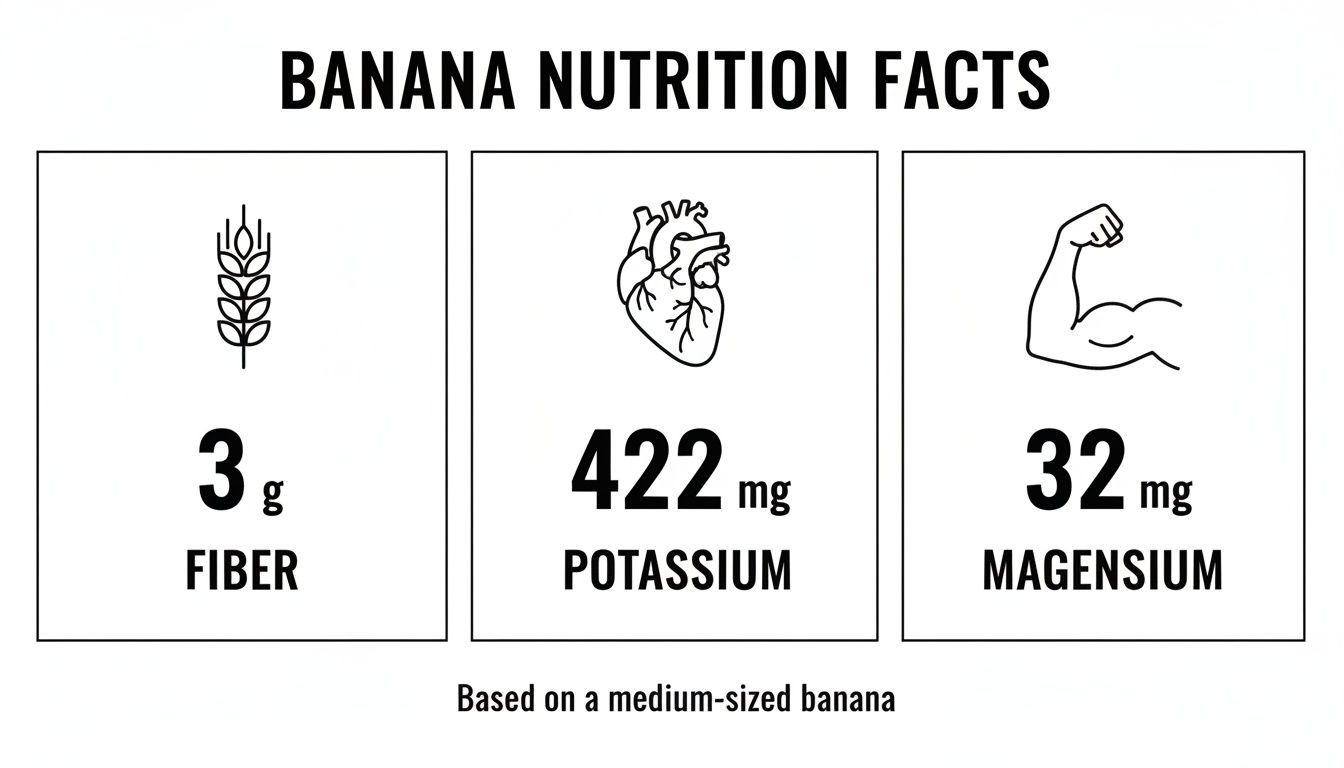
As you can see, bananas offer valuable fiber, potassium, and magnesium—all critical players in heart health and metabolic function.
Pair with Protein and Healthy Fats
Eating a banana all by itself is like sending its natural sugars on an express train straight to your bloodstream. To stop this from happening, you have to pair it with friends—specifically, protein and healthy fats. Think of these pairings as a sophisticated braking system for your digestion.
The Pairing Principle: Protein and fat slow down gastric emptying, which is the speed at which food leaves your stomach. This means the banana’s carbohydrates are released into your system much more slowly and steadily, preventing that dreaded sugar spike.
This isn’t just a theory; it’s a proven metabolic strategy that works. For example, pairing half a banana with a spoonful of almond butter or a side of plain Greek yogurt creates a balanced, satisfying snack that effectively blunts the glycemic response. You can learn more about how small dietary shifts create massive ripple effects in our guide on how to improve metabolic health.
To give you a clearer picture of how these strategies work in the real world, let’s compare the two approaches.
Banana Consumption Strategy Comparison
| Consumption Method | Estimated Glycemic Response | Key Benefit |
|---|---|---|
| Banana Alone | Rapid, high spike in blood glucose followed by a potential crash. | Quick energy source, but not ideal for glucose stability. |
| Banana with Protein/Fat | Slower, more gradual rise in blood glucose, avoiding a sharp peak. | Sustained energy and better blood sugar control. |
The difference is night and day. Simply adding a healthy fat or protein source completely changes the metabolic equation, turning a potential problem into a safe and nutritious choice. This simple habit is fundamental to managing your blood sugar effectively.
Why Green Bananas Are Your Best Friend
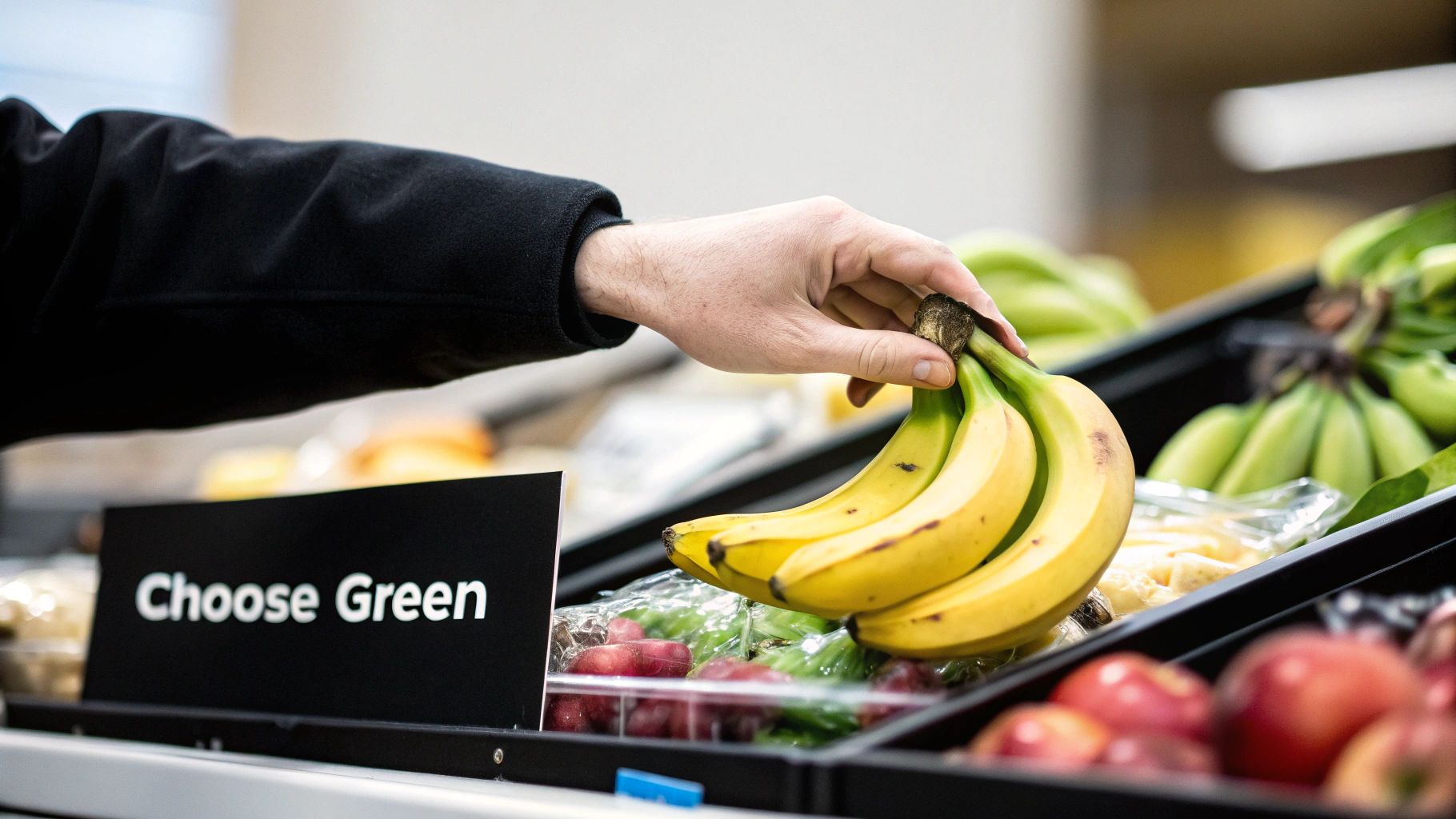
When it comes to bananas and diabetes, not all bananas are created equal. The difference between a fruit that’s friendly to your blood sugar and one that can send it soaring often comes down to a simple choice you make at the grocery store: its color.
The magic is in the chemistry of ripening. As a banana shifts from green to yellow, a massive transformation happens inside. An underripe, greenish banana is packed with resistant starch, a type of carbohydrate your body doesn’t easily digest. Think of it as a stealth fiber.
This resistant starch travels through your digestive system largely untouched until it hits the large intestine. The result? A much slower, more controlled release of glucose into your bloodstream—exactly what you want for stable blood sugar management.
The Ripening Spectrum Explained
As that banana continues to sit on your counter, enzymes get to work breaking down that beneficial resistant starch, converting it into simple sugars like fructose and glucose. This is precisely why a yellow banana is so much sweeter and softer than a green one.
Here’s how to think about it:
- Green Bananas: These have the highest amount of resistant starch and the lowest sugar content. Their firm texture and less-sweet flavor are tell-tale signs of a lower glycemic impact.
- Yellow Bananas: This is the classic, ready-to-eat banana. It has a balanced sweetness and texture, but also a higher sugar content and a more moderate glycemic index.
- Spotted Brown Bananas: Now we’re at peak sweetness. Nearly all the resistant starch has converted to simple sugar, making these the most likely to cause a rapid blood sugar spike.
For anyone managing diabetes, the takeaway is crystal clear: a firmer, greener banana is always the superior choice. It delivers the nutritional benefits without the high-speed sugar delivery of its riper cousins.
Choosing a banana that’s still slightly green at the tips is a simple but powerful strategy. It allows you to confidently fit this fruit into your diet, getting its potassium and fiber while keeping your glucose levels steady and predictable. That small shift in selection can make all the difference.
When to Talk to Your Doctor About Your Diet
While this guide lays out powerful, evidence-based strategies, your health journey is uniquely your own. No two people with diabetes respond to food in the exact same way. Think of your body as a finely tuned instrument; what works perfectly for one person might need a slight adjustment for another. This is where personalized care isn’t just a luxury—it’s essential.
The single best way to know how your body handles a banana is to test your blood glucose. By checking your levels right before you eat and then again one to two hours afterward, you get precise, real-time data. This isn’t a test you pass or fail. It’s an empowering tool that gives you a clear window into your personal metabolic response.
If you find that even a small, green banana paired with protein consistently sends your blood sugar higher than you’d like, that’s a great signal to seek professional guidance.
Taking Proactive Steps for Your Health
Consistently high readings or feeling unsure about incorporating new foods are not signs of failure. Far from it. They are opportunities to refine your approach with an expert who can help you interpret your body’s signals and fine-tune your nutrition plan.
Consider reaching out to one of these professionals:
- A Registered Dietitian (RD): They can create a personalized meal plan that incorporates the foods you enjoy—like bananas—in a way that supports stable blood sugar.
- An Endocrinologist: This medical doctor specializes in hormone-related conditions, including diabetes. They can adjust medications and provide advanced care strategies.
Consulting an expert isn’t about fixing a problem; it’s about proactively mastering your health. It’s a collaborative step toward creating a sustainable, enjoyable diet that keeps you feeling your best and in complete control.
Working with a specialist transforms uncertainty into confidence. For those seeking top-tier care, understanding the role of an endocrinologist and metabolism expert can provide invaluable guidance on your health journey. They help you build a plan that is not only effective but also perfectly tailored to your lifestyle and personal health goals, ensuring long-term success.
Common Questions About Bananas and Diabetes
Navigating the details of a diabetes-friendly diet brings up a lot of practical, “what if” scenarios. When it comes to fitting bananas into your routine, having clear, straightforward answers is the key to feeling confident in your choices.
Let’s tackle some of the most common questions head-on. You’ll see how each answer circles back to our core principles: smart portioning, choosing less-ripe bananas, and the non-negotiable rule of strategic pairing.
What Is the Best Time of Day to Eat a Banana?
Timing can make a huge difference in how your body handles a banana’s carbohydrates. For most people, the ideal time is with a protein-heavy breakfast or as a pre-workout snack. The physical activity that follows helps your muscles soak up the glucose for energy, preventing it from lingering in your bloodstream and causing a spike.
On the other hand, eating a banana alone on an empty stomach or late at night before bed is usually a bad idea. Without any activity to buffer the carb load, you’re far more likely to see a significant blood sugar rise.
Are Banana Chips a Good Option for Diabetics?
It’s best to steer clear of banana chips entirely. The dehydration process massively concentrates the natural sugars and calories. It becomes incredibly easy to eat a huge amount of carbohydrates in just a handful of bites.
To make matters worse, most commercially sold banana chips are fried, adding unhealthy fats while stripping away the nutritional benefits of fresh fruit. A small, slightly green banana will always be the superior choice for managing your blood sugar.
Can I Put Bananas in a Smoothie?
Yes, but you have to build the smoothie the right way. Blending fruit obliterates its fiber structure, which can make the sugar absorb much faster. To counteract this, you need to turn your smoothie into a balanced, slow-digesting meal.
Use only half of a small, greenish banana and then load it up with ingredients that slow everything down. Think protein (like plain Greek yogurt or unflavored protein powder), healthy fats (avocado, chia seeds), and even more fiber (spinach, kale). This combination turns a potential sugar bomb into a balanced, glucose-friendly option.
How Do Bananas Compare to Other Fruits Like Berries?
Berries almost always have a lower glycemic impact than bananas. Their high fiber and water content make them an excellent, low-sugar choice for anyone with diabetes.
But the comparison isn’t always that simple. While a ripe, yellow banana has a much higher GI than fruits like apples or berries, a small, green banana can have a surprisingly manageable effect on blood sugar. It all comes back to ripeness and portion size, no matter which fruit you’re eating.
Finding the right medical expert to guide your nutritional choices is crucial for long-term health. At Haute MD, we connect you with the nation’s top, vetted specialists in metabolic care and longevity medicine. Discover a trusted physician to create a personalized plan that works for you by exploring our network at https://www.hauteliving.com/hautemd.