



When you’re trying to breathe easier, the last thing you want is a surprising side effect. So, if you’re asking, “Does Symbicort cause weight gain?” you deserve a straight answer.
Here’s the bottom line: based on the official clinical trials used for FDA approval, significant weight gain from Symbicort is not an expected side effect for most people. It’s not listed by the manufacturer as a common issue.
But that’s not the whole story. Patient experiences shared online and in doctors’ offices paint a more complicated picture, leaving many confused. Let’s clear that up.
Setting the Record Straight on Symbicort and Weight
The gap between the clinical data and real-world stories can be frustrating. To make sense of it, we need to look at where the information comes from and what it actually means.
The gold standard for getting a drug approved is the randomized controlled trial. For Symbicort, which combines budesonide and formoterol, these studies were massive. Since its FDA approval for asthma in 2006 and COPD in 2009, trials involving thousands of adults and children have consistently found no statistically significant link to weight gain.
One key study even focused on children for 12 weeks and found that weight remained stable across all groups—including those on Symbicort and a placebo. The data from these initial controlled studies was clear and consistent.
Clinical Trials vs. Patient Reports
So, if the trials are so clear, where does all the concern come from?
It comes from the real-world experiences of people using the medication every day. While not as structured as a formal study, the sheer volume of anecdotal reports from patients who notice gradual weight gain after starting Symbicort is hard to ignore.
This is a classic case of clinical data not fully matching individual outcomes.
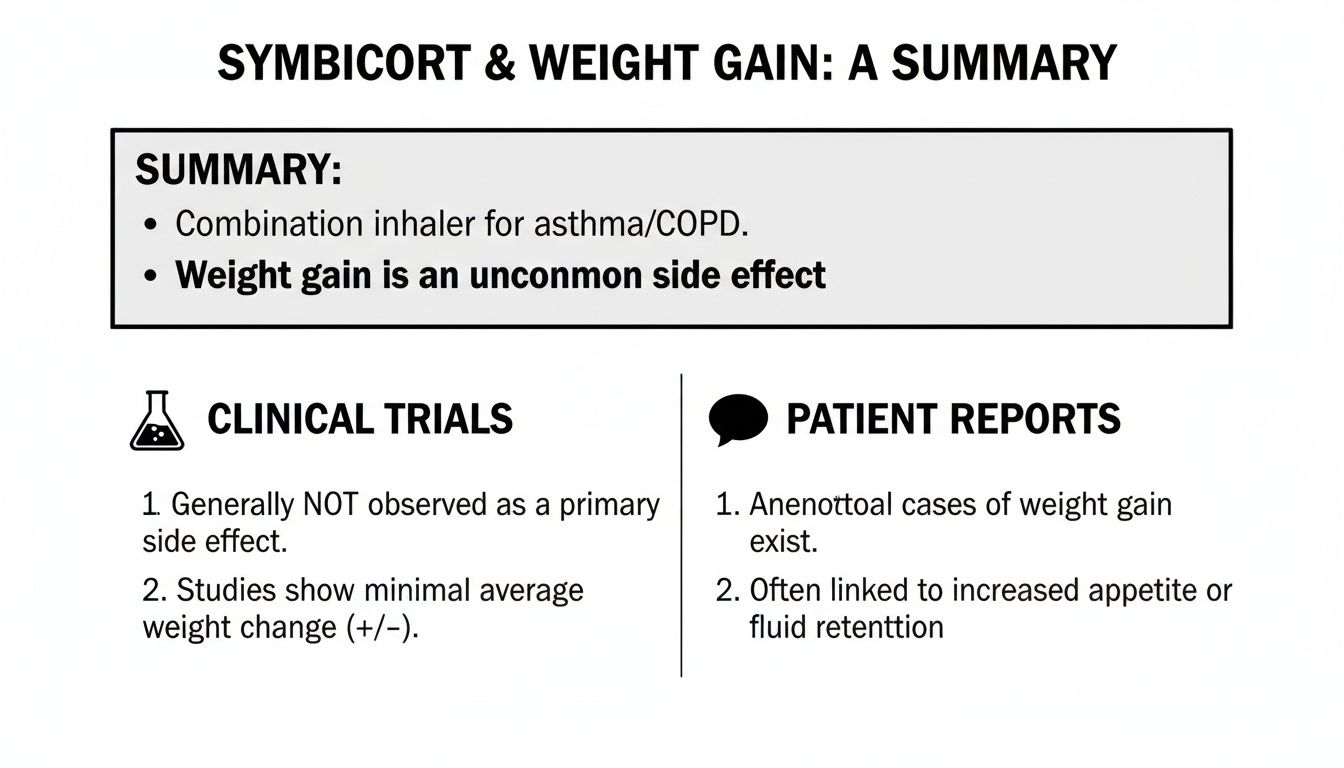
The data tells us that, on average, weight gain isn’t an issue. But that average can hide the fact that a smaller subgroup of users might be having a very different experience.
To give you a clearer perspective, here’s a quick comparison of the evidence.
Symbicort and Weight Gain Evidence at a Glance
| Evidence Source | Key Finding on Weight Gain | Primary Population Studied |
|---|---|---|
| FDA Clinical Trials | No statistically significant weight gain compared to placebo. | Thousands of adults and adolescents with asthma or COPD in controlled settings. |
| Manufacturer Data | Weight gain is not listed as a common or frequent side effect. | Post-market surveillance and cumulative trial data. |
| Patient Anecdotal Reports | A notable number of users report gradual, unexplained weight gain. | Individuals sharing personal experiences online and with clinicians. |
This table highlights the core discrepancy: the rigorous, controlled data shows stability, while the less formal but voluminous patient reports suggest a potential link for some.
Why Does This Discrepancy Exist?
It’s easy to dismiss patient reports, but that’s a mistake. Several valid factors could explain why some people gain weight while the broad clinical data says they shouldn’t.
- A Return to Health: This is the most common and often overlooked reason. When your asthma or COPD is well-controlled, you feel better. You can be more active, but your appetite might also return with a vengeance. Better breathing and more energy can naturally lead to weight changes if your caloric intake increases.
- Individual Sensitivity: We all metabolize medications differently. It’s entirely possible that a small percentage of people are more sensitive to the systemic effects of the inhaled corticosteroid (budesonide), even at low doses.
- Dose and Duration: Most initial clinical trials are relatively short—weeks or months, not years. Some newer research suggests that long-term use or higher doses of inhaled corticosteroids might have subtle, cumulative effects not captured in those early studies.
Understanding these nuances is the first step. Next, we’ll dive into the pharmacology to see why an inhaled steroid like Symbicort is fundamentally different from an oral steroid like prednisone, what the latest research shows, and how you can proactively manage your health while getting the respiratory relief you need.
Why Inhaled Steroids Are Different From Steroid Pills
To understand why Symbicort doesn’t typically cause weight gain, we have to look at how it works. The difference between an inhaled steroid like Symbicort and an oral steroid pill like prednisone comes down to one critical concept: local versus systemic delivery.
Think of it this way. If your lungs are a single, thirsty plant in a sprawling garden, using Symbicort is like using a precision watering can. You deliver the medicine—the “water”—directly to the inflamed airways, targeting the problem at its source with minimal spillage.
Taking a steroid pill, on the other hand, is like turning on a powerful sprinkler system that soaks the entire garden. The medication floods your bloodstream, affecting every cell and system in your body. This widespread, or systemic, exposure is what triggers the well-known side effects of oral steroids, from increased appetite to fluid retention and weight gain.
Targeted Action Minimizes Systemic Effects
Symbicort contains budesonide, a type of medicine known as an inhaled corticosteroid (ICS). When you use the inhaler, the drug becomes a fine mist that you breathe directly into your lungs.
The entire purpose of an inhaled steroid is to concentrate the medicine in the airways while ensuring only a tiny amount gets absorbed into the rest of the body. It’s a design principle meant to avoid the systemic side effects of oral steroids.
Because the dose is small and applied right where the inflammation is, only a minuscule fraction ever makes it into your bloodstream. This is a fundamental feature of a modern, personalized approach to asthma treatment, maximizing respiratory benefits while sidestepping unwanted effects elsewhere.
The Difference in Dosage
It also comes down to the sheer amount of medication involved. The steroid dose in a puff of Symbicort is measured in micrograms (mcg)—an incredibly small unit. Oral steroid doses are measured in milligrams (mg), which is a unit 1,000 times larger.
Let’s put that into perspective:
- Symbicort (Budesonide): A standard dose might be 160 mcg, delivered with precision to the lungs.
- Prednisone (Oral Steroid): A common dose for an asthma flare-up can start at 40 mg—that’s 40,000 mcg—which then circulates throughout your entire body.
This huge gap in both dosage and delivery method is why their side effect profiles are worlds apart. While systemic steroids can absolutely impact metabolism and appetite, inhaled steroids like Symbicort act more like a highly targeted, localized therapy. It’s this precise action that explains why significant weight gain is not a typical or expected outcome for most people.
What the Clinical Evidence Actually Reveals
When we dig into the clinical data on Symbicort and weight gain, the answer isn’t a simple yes or no. The evidence comes from two very different sources: the initial, highly controlled clinical trials used for FDA approval, and the long-term observational data gathered over years of real-world use. You have to look at both to understand the full picture.
First, let’s look at the rigorous clinical trials. In these carefully managed studies, researchers found that weight gain was not a statistically significant side effect. Participants taking Symbicort simply didn’t gain more weight than those taking a placebo. This is why you won’t see “weight gain” listed as a common side effect on the official drug label.

But that’s not the end of the story. The data collected from years of everyday patient use starts to tell a more subtle story. This is where we see a faint but important connection emerge.
The Dose-Dependent Relationship
More recent research has uncovered what’s known as a “dose-dependent” relationship, especially in pediatric patients. In plain English, this means the likelihood of seeing an effect on weight seems tied to the strength of the inhaled corticosteroid (ICS) dose used over a long period.
A pivotal 2018 retrospective study laid this out clearly. It found that children on high-dose inhaled corticosteroids saw a significantly greater increase in their Body Mass Index (BMI) each year compared to those on low-dose treatments.
Specifically, the high-dose group saw an average BMI increase of 0.369 kg/m² per year, whereas the low-dose group’s increase was smaller, at 0.195 kg/m² per year. You can dive into the specifics of this research published in PubMed.
This finding helps explain the discrepancy. The initial, shorter-term trials likely didn’t run long enough to detect this gradual change. It suggests that sustained, high-dose use could, for some people, contribute to a slow creep in weight. The conversation shifts from “Does it cause weight gain?” to a more precise question: “At what dose, and over how much time?”
This distinction is critical: the evidence suggests that for most users on standard, low-to-moderate doses, weight gain is unlikely. The risk becomes more pronounced with sustained, high-dose therapy, which is typically reserved for more severe cases.
Real-World Data vs. Clinical Trials
So, why the difference between the pristine environment of a clinical trial and messy reality? Clinical trials are designed to isolate a drug’s effect under ideal, controlled conditions, often for just a few months. They’re absolutely essential for establishing a drug’s fundamental safety and effectiveness.
Long-term observational studies, on the other hand, reflect the complexities of everyday life. They follow patients for years, capturing the cumulative effects of a medication alongside countless other variables—diet, lifestyle, other health conditions. This is where we spot the subtle, long-term trends that short-term trials can miss.
This is especially relevant for a chronic condition requiring lifelong management. An acute asthma flare-up, for instance, might be treated with a short course of powerful systemic steroids. But long-term control relies on daily inhaled medications. Our guide to acute asthma exacerbation treatment explores this difference further. Understanding both types of evidence helps clinicians and patients make far more informed decisions for the long haul.
While clinical data gives us a bird’s-eye view, it doesn’t always capture the nuances of individual experiences. If the formal studies say the risk of weight gain with Symbicort is low, why are there so many patient stories that seem to say the exact opposite? The answer lies in the space between population statistics and personal reality.https://www.youtube.com/embed/xfPJfSTKZgs
These personal accounts—shared in patient communities and online forums—aren’t scientific proof, but they are absolutely valid. They highlight a fundamental truth of medicine: a single medication can affect different people in dramatically different ways. Your personal journey and observations matter, and these stories provide context and validation for your concerns.
Many of these anecdotes follow a familiar arc. Someone starts Symbicort, their breathing improves dramatically, but over a few weeks or months, they notice the number on the scale creeping up. This happens even when their diet and exercise habits haven’t changed at all.
Why Do Some People Report Weight Gain?
When a patient reports an unexpected change, it’s our job to look beyond the broad strokes of large-scale trials. Several factors could be contributing to these real-world experiences, and they often work in concert.
- Improved Appetite and Well-Being: Often, the cause is rooted in a positive outcome. When Symbicort finally gets your asthma or COPD under control, you simply feel better. This can restore a healthy appetite, reduce fatigue, and allow you to enjoy meals again, which might subtly increase your calorie intake.
- Individual Metabolic Responses: Just as we all have unique fingerprints, we have unique metabolic profiles. A small subset of individuals may be more sensitive to the corticosteroid component (budesonide), even in its inhaled form. This sensitivity could potentially influence fluid balance or fat metabolism in a way that isn’t statistically significant across a large population but is very real for the person experiencing it.
- Concurrent Health Factors: Weight is incredibly complex, influenced by everything from age and thyroid function to other medications and subtle lifestyle shifts. Sometimes, starting a new medication like Symbicort coincides with other changes, making it difficult to isolate a single cause.
Acknowledging the Numbers in Patient Stories
The experiences patients share often include specific—and sometimes surprising—figures. A look into patient forums reveals these anecdotal spikes with striking clarity. For instance, in one COPD Foundation thread, multiple users reported gaining 15-20 lbs within two months of starting Symbicort.
One person detailed gaining 15 lbs despite maintaining a consistent diet and exercise routine—a story that mirrored another user’s 20 lbs gain. While not validated by controlled trials, these accounts underscore the absolute importance of individual monitoring and open communication with your physician.
Your experience is your reality. If you notice a change after starting a new medication, it deserves to be investigated with your doctor, regardless of what broad statistics say.
Ultimately, these stories are a powerful reminder that medicine is deeply personal. Acknowledging them allows for a more complete and compassionate understanding of how a medication like Symbicort works in the real world—one person at a time.
How to Proactively Manage Your Health on Symbicort

Knowing the details behind Symbicort and weight is one thing. Taking decisive action is another entirely. If you have concerns, the goal is to move from passive worry to a proactive partnership with your physician, and that begins with gathering clear, objective information about your own body.
Start by establishing a simple baseline. For the next month, commit to tracking a few key metrics. This isn’t about judgment or restriction; it’s about collecting data. Good data transforms a vague conversation with your doctor into a productive, targeted strategy session.
Your Personal Health Dashboard
Create a simple log to monitor what’s happening. This consistent tracking provides the concrete evidence needed for an effective consultation, moving the conversation beyond “I think I’ve gained weight” to specific, observable trends.
- Weekly Weight: Weigh yourself just once a week. Do it at the same time and under the same conditions to get a clear picture of the trend, not daily fluctuations.
- Daily Activity: Make a note of your exercise or general movement. It’s common to find that as breathing improves, so does your energy and activity level.
- Food Journal: Briefly log your meals. Sometimes, simply feeling better and breathing easier can lead to an improved appetite and increased calorie intake without you even realizing it.
This personal data is invaluable. It helps you and your physician pinpoint whether a change in weight is truly linked to the medication, a reflection of lifestyle adjustments, or perhaps another underlying factor altogether. For those seeking the highest level of precision, specialized assessments can offer deeper insights. You can explore this elite approach in our practical guide on metabolic testing for weight loss.
Empowering Your Doctor’s Visit
Armed with a month of personal data, you’re ready for a collaborative discussion with your healthcare provider. The objective is clear: optimize your treatment plan to ensure you get the maximum respiratory benefit with minimal, if any, unwanted side effects.
The most effective medical partnerships are built on shared information and mutual respect. Arrive at your appointment prepared to not just ask questions, but to provide clear data on your personal experience.
When you meet with your doctor, be prepared to discuss specific, actionable points. Your goal is to frame the conversation around finding the best path forward for your total well-being, not just your lung function.
Here are the critical questions to guide your discussion:
- Is My Dose Optimized? Ask your doctor if you’re on the lowest possible dose of Symbicort that effectively controls your symptoms. Since corticosteroid side effects are dose-dependent, this is the most logical first step in any management strategy.
- Could Other Factors Be Involved? Work with your doctor to systematically rule out other common causes of weight gain. This could include anything from thyroid issues to changes in your other medications or even subtle lifestyle shifts.
- What Are My Alternatives? If your concerns about weight gain persist even after dose optimization, it’s time to inquire about other treatment options. These could include non-steroidal combination inhalers or, for certain types of severe asthma, highly targeted biologic therapies.
This structured, data-driven approach elevates you from a passive recipient of care to an active, informed participant in your health journey. It ensures your concerns are heard, validated, and addressed with a clear, medically sound strategy tailored specifically to you.
Answering Your Questions About Symbicort

Here are direct, clear answers to the most common questions our physicians hear regarding Symbicort, weight management, and treatment decisions.
If I Gain Weight on Symbicort, Should I Stop Taking It?
Absolutely not. You should never stop taking Symbicort—or any prescribed respiratory medication—without speaking directly with your doctor.
Abruptly stopping your inhaler can trigger a severe and dangerous flare-up of your asthma or COPD. The immediate risk to your breathing far outweighs any concern about minor weight changes.
The correct first step is to schedule a consultation. Your physician can properly assess the situation, determine if the medication is even a factor, and discuss a better path forward. This might involve simple dose adjustments or exploring other treatments that better fit your overall health goals without compromising your respiratory control.
Are There Alternatives to Symbicort With Less Risk of Weight Gain?
Yes, several other options exist, though it’s critical to remember that Symbicort’s direct link to weight gain is already exceptionally low for most people. If this remains a key concern, your physician can certainly explore alternatives based on your unique health profile.
Other classes of treatment include:
- Non-steroidal combination inhalers that use different drug mechanisms to manage airway inflammation and constriction.
- Leukotriene modifiers, which are oral medications like montelukast that target different inflammatory pathways involved in asthma.
- Biologic therapies, which are highly advanced, injectable treatments for severe asthma. Interestingly, some research suggests certain biologics may even be associated with a modest decrease in BMI over time.
Selecting the right therapy is a highly personalized decision. It demands a collaborative conversation with a physician who understands the nuances of your specific condition.
Can Diet and Exercise Offset Potential Weight Gain?
Without a doubt. A proactive lifestyle is your single most powerful tool for managing your weight, regardless of what medications you take.
Since any potential weight effect from Symbicort is typically minimal, a well-structured diet and consistent physical activity can more than counteract it.
In fact, one of the greatest benefits of using Symbicort effectively is that it improves your ability to breathe. This makes exercise easier and more enjoyable, directly supporting both your weight management goals and your overall sense of well-being. Focusing on whole foods, sensible portions, and regular movement builds a robust foundation for lifelong health.
Does the Dose of Symbicort Matter for Weight Gain?
Yes, the clinical data strongly indicates a dose-dependent relationship. This means that consistent, long-term use of higher doses of inhaled corticosteroids is more closely associated with potential changes in Body Mass Index (BMI) than lower doses are.
This is precisely why physicians always aim to find the lowest effective dose that keeps your respiratory symptoms fully under control. It’s a foundational principle of modern medicine: optimizing treatment to deliver maximum benefit with minimum risk.
If you are on a high dose of Symbicort and find yourself asking, “Could this be causing weight gain in my specific case?” it’s an excellent and important question to raise with your doctor.
Finding a physician who understands the nuances of advanced respiratory treatments and prioritizes your total well-being is essential. The Haute MD network connects you with the nation’s leading medical specialists, each vetted for their elite expertise and commitment to premium patient care. Discover a provider who aligns with your standards. Find your specialist on Haute MD.