



One of the biggest questions patients have is, “What will my recovery actually look like?” The good news is that recovery from minimally invasive spine surgery is almost always faster and less intense than with traditional open surgery. Because we use smaller incisions and gently work around muscles instead of cutting through them, your body has a huge head start on the healing process.
This means you get back to your life sooner, with less pain along the way. Your journey is all about smart, steady progress.
What to Expect from Your Recovery Journey

Starting your recovery can feel a little daunting, but knowing the road ahead makes all the difference. The whole concept of “minimally invasive” is your core advantage here.
Let’s use an analogy. Traditional open surgery is like knocking down a whole wall just to get to a faulty electrical wire. To fix the wire, you first have to cause a lot of collateral damage that then needs to be repaired. Minimally invasive spine surgery (MISS), on the other hand, is like an expert electrician opening a small, precise panel in the wall. The neurosurgeon uses highly advanced instruments and tiny incisions to access and fix the problem, leaving the surrounding muscles and tissues almost entirely undisturbed. You can explore more about what a neurosurgeon treats in our guide on the topic.
This targeted approach is precisely why the benefits are so significant.
The Benefits of a Gentler Approach
Because your muscles are spared from major trauma, the advantages really start to stack up and directly shape your minimally invasive spine surgery recovery:
- Less Post-Operative Pain: You’ll find you need far less reliance on strong pain medications.
- Shorter Hospital Stays: Many of our patients are able to go home the very same day or the next morning.
- Reduced Risk of Infection: With smaller incisions, there’s less tissue exposure and the site closes up much faster.
- Faster Return to Activity: We’re often talking about getting back to light activities within weeks, not months.
Setting Realistic Expectations
While recovery is faster, it’s still a process. It demands patience and, most importantly, following your surgeon’s specific game plan. Your body needs uninterrupted time to heal tissue or, in the case of a fusion, grow new bone. The first few weeks are all about protecting the surgical work while gently reintroducing movement.
The goal isn’t to sprint back to 100% overnight. It’s to build a strong, stable foundation for your spine that will serve you for years to come. Think of healing as a marathon, not a sprint—every small step forward is a victory.
This philosophy has been proven time and again. Studies consistently show that MISS leads to better outcomes and quicker recoveries. For a common procedure like a lumbar discectomy, this can mean a recovery of just a few weeks. Even more impressively, research on elite athletes who had minimally invasive fusions showed an incredible 82% return-to-sport rate. These aren’t just numbers; they represent people getting back to the lives and activities they love.
The First 48 Hours: Setting the Stage for Success
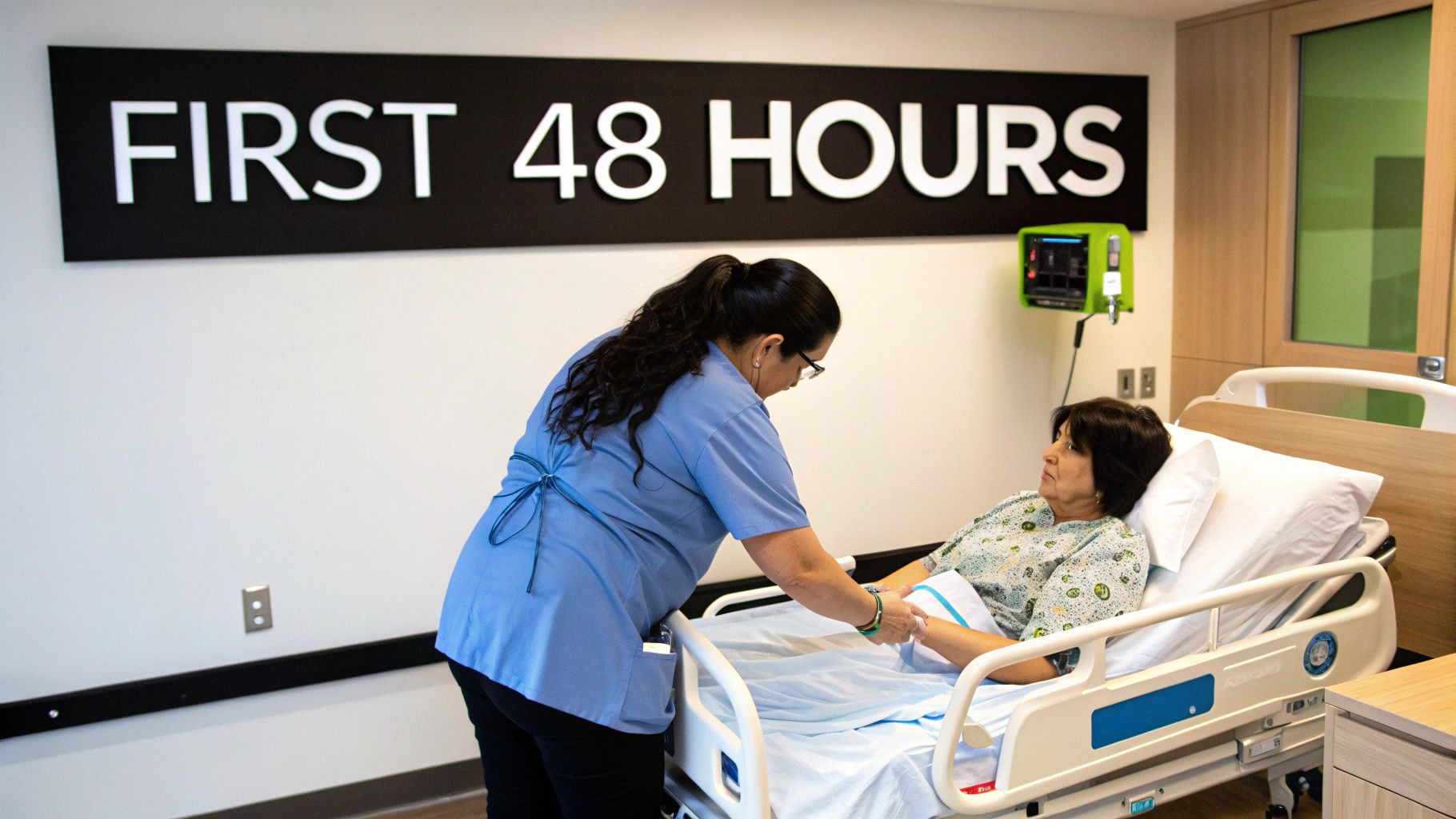
The first 48 hours after your surgery are less about waiting and more about actively launching your recovery. This is a carefully orchestrated period where your medical team lays the foundation for your entire healing process. What happens here truly sets the tone for the weeks and months to come.
When you wake up from anesthesia, you’ll be in a calm, controlled recovery room. The immediate focus is simple: ensuring you’re stable, monitoring your vitals, and getting ahead of any post-operative pain before it has a chance to build.
Immediate Post-Op Care and Pain Management
Your comfort is the top priority. Pain management often begins right away, with medications delivered through your IV to provide steady relief. Some patients are given a patient-controlled analgesia (PCA) pump. This is a small device with a button that lets you safely administer a pre-set dose of pain medicine yourself, putting you in the driver’s seat of your own comfort.
The best approach to pain is to be proactive, not reactive. Tell your nurse how you’re feeling. Staying ahead of the pain is far more effective than trying to catch up to it once it becomes severe.
Beyond managing discomfort, the team will keep a close eye on your small incision site. The sterile dressing is designed to stay put, protecting the area and preventing infection. This is a common approach for post-procedural care, and you can see similar principles in our guide to care after a breast biopsy. Nurses will check for any unusual swelling or drainage to make sure everything is healing exactly as it should. It’s also completely normal to feel a bit groggy or nauseous from the anesthesia—this is common and easily managed.
Why Early Movement is So Important
It might sound like the last thing you want to do, but moving is one of the most critical parts of these first couple of days. We’re not talking about running laps, of course. This is about gentle, purposeful activity.
Within hours of your surgery, a nurse will likely help you sit up on the edge of the bed. Soon after that, you’ll be encouraged to take your first short, assisted walk—maybe just to a chair in your room or to the bathroom. Why the hurry?
- It boosts circulation, which is essential for preventing dangerous blood clots.
- It “wakes up” your core and leg muscles, keeping them from getting stiff and weak.
- It helps your digestive system get back on track and returns your body to its normal rhythm.
Your team, including nurses and often a physical therapist, will show you exactly how to move safely. They’ll teach you the “log roll” technique—a way of getting in and out of bed without twisting your spine. Every small movement is a victory, building both your confidence and your body’s ability to heal itself. This early mobilization is truly a cornerstone of a successful minimally invasive spine surgery recovery.
Taking Control of Your Recovery: Pain and Incision Care at Home
Heading home after your surgery is a huge step forward. You’re back in your own space, which is great, but it also means the ball is in your court. Your two most important jobs right now are managing your pain effectively and taking meticulous care of your incision.
Think of your pain management like a controlled descent. In the first few days, your surgeon will have you on prescription-strength pain medication. The single biggest piece of advice I can give patients is to stay ahead of the pain. Take your medication on the schedule you’re given, before the discomfort gets intense. It’s far easier to keep pain at a low level than it is to wrestle it back down from a peak.
As the days go by, you’ll notice the sharp, initial pain starting to fade. That’s your signal to start tapering off the heavy-duty medication.
Moving From Prescription to Over-the-Counter Relief
This is where you begin to swap out a dose of your prescribed medication for an over-the-counter option, like acetaminophen (Tylenol) or ibuprofen (Advil), assuming your surgeon has cleared it. Over time, you’ll rely on the prescription less and less, eventually using just the OTC options as needed. This methodical step-down is crucial for avoiding dependence and the side effects that can come with stronger narcotics.
But pills are only half the battle. Some of the most powerful tools in your recovery don’t come from a pharmacy bottle.
- Ice Is Your Best Friend: Applying an ice pack for 15-20 minutes at a time is one of the best things you can do. It’s a game-changer for reducing swelling and numbing the area. Just be sure to wrap the pack in a thin towel to protect your skin.
- Get Comfortable with Pillows: Your body will tell you what feels right. When you’re on your back, try propping pillows under your knees. If you’re a side-sleeper, place one between your knees. These simple adjustments take a surprising amount of pressure off your spine.
- Movement Is Medicine: You need to avoid anything strenuous, of course, but don’t just stay in bed. Short, gentle walks around your house are fantastic for circulation, which speeds up healing and prevents you from getting stiff and sore.
These small, consistent efforts really add up, creating a solid foundation for your healing.
Protecting Your Incision: Your Shield Against Infection
Proper wound care is absolutely non-negotiable. The beauty of minimally invasive surgery is the small incisions, often sealed with surgical glue or Steri-Strips and covered by a simple dressing. Your main job here is to keep that area clean and—most importantly—dry.
Think of your incision as a locked door that’s protecting you from infection. Keeping it clean and dry ensures that door stays firmly shut. This means no soaking in a bathtub, hot tub, or swimming pool until your surgeon gives you the green light.
You’ll get specific instructions on showering, but the general rule is to let the water run over the dressing without scrubbing. Afterwards, gently pat the area completely dry with a fresh, clean towel.
It’s also critical that you know what to look for. A little bruising or faint redness right around the incision is perfectly normal, but some signs are clear red flags.
When to Call Your Surgeon’s Office
Don’t ever hesitate to pick up the phone if you see something that worries you. Catching a problem early is the key to preventing a real complication. Call your team immediately if you notice:
- Spreading Redness or Swelling: The skin around the incision is getting more red, puffy, or feels warm to the touch.
- Concerning Drainage: Any fluid that looks yellowish or greenish, or has a bad smell, is a major warning sign.
- A Fever: A temperature of 101°F (38.3°C) or higher is your body’s alarm bell for an infection.
- The Incision Is Opening: If you see any separation along the edges of your wound.
By being diligent about managing your pain and protecting your incision, you’re creating the perfect environment for your body to heal, getting you back to your life that much faster.
Rebuilding Strength with Physical Therapy
If surgery is what fixes the immediate problem, physical therapy is what rebuilds your body to protect that fix for the long haul. This phase of your minimally invasive spine surgery recovery isn’t just a list of exercises; it’s a complete retraining program for your body. You’re learning how to move again with strength and confidence, fundamentally changing your body mechanics to prevent future issues. It’s your personalized roadmap back to an active, pain-free life.
Think of your spine after surgery like the newly repaired foundation of a house. It’s stable, but you wouldn’t immediately start building a second story. Physical therapy is the careful, methodical process of reinforcing that foundation, strengthening the support beams (your core muscles), and ensuring everything is perfectly aligned before you put any real stress on it. It all starts gently—often with something as simple as walking.
This infographic shows the key pillars of your at-home care, which really set the stage for a successful therapy program.

Managing your medication, using cold packs to control inflammation, and keeping the incision site clean are the non-negotiables that prepare your body for the real work ahead.
Mastering the “No BLTs” Rule
One of the very first and most critical lessons you’ll learn in physical therapy is the strict “no BLTs” rule. For the first several weeks, you absolutely must avoid Bending at the waist, Lifting anything heavier than a gallon of milk, and Twisting your torso. These three movements place enormous strain on a healing spine and can easily compromise the surgeon’s hard work.
Instead of just telling you what not to do, your therapist will teach you new, safer ways to navigate your day. You’ll learn how to squat using your legs to pick something up, how to turn your entire body by moving your feet (a “log roll” motion), and how to get in and out of bed or a chair without putting dangerous pressure on your back. Mastering these new habits isn’t just a suggestion—it’s essential.
Your Progression: From Gentle Movement to Core Stability
Your physical therapy program will be carefully staged, progressing only when your body is truly ready. It’s a structured journey designed to build you up without causing setbacks. In many ways, the process is similar to other orthopedic recoveries, where each step builds upon the last, much like the progression detailed in an Achilles tendon surgery recovery timeline.
- Phase 1 (Weeks 0-4) Gentle Activation: The initial focus is almost entirely on walking and performing very light exercises to activate the deep core muscles, like the transverse abdominis. The goal here is simple: get blood flowing to the area and gently “wake up” the muscles that support your spine.
- Phase 2 (Weeks 4-8) Building Endurance: As your healing progresses, your therapist will introduce more challenging core stability exercises. You might start working on pelvic tilts, bridges, and bird-dog poses—all designed to build endurance in the muscles that act as your spine’s natural corset.
- Phase 3 (Weeks 8+) Functional Strength: This is where you begin to translate your newfound strength into real-world activities. Exercises become more dynamic, mimicking the movements you need for work, hobbies, and daily life, ensuring you can return to your routine safely and confidently.
Physical therapy is an active partnership. Your therapist provides the expert game plan, but it’s your commitment to doing the exercises at home, day in and day out, that truly dictates the success of your long-term outcome.
This structured rehab is a huge part of why minimally invasive techniques are so successful. The reduced muscle damage from MISS allows patients to start and benefit from physical therapy much sooner. This early start on rebuilding strength gives you a critical advantage on the road to a full recovery.
Getting Back to Your Life and Work
It’s the question on everyone’s mind after surgery: “When can I get back to my life?” The great news is that one of the biggest advantages of a minimally invasive approach is a much faster return to your daily routines, hobbies, and work. But it’s not like flipping a switch. This is a gradual process.
Think of it like easing a high-performance car back onto the track after a major tune-up. You don’t just slam the accelerator to the floor. You take a few warm-up laps, listen to the engine, feel how it responds, and slowly build up the intensity. Your body needs that same deliberate, thoughtful approach to heal properly and protect the incredible work your surgeon just did.
While your surgeon will give you a personalized timeline, knowing the general milestones for minimally invasive spine surgery recovery can help you set realistic expectations.
Returning to Your Professional Life
How quickly you can get back to work depends almost entirely on what you do for a living. The timeline for someone with a desk job versus a construction worker are worlds apart. It’s smart to talk with your employer beforehand about what a gradual return might look like.
- Desk Jobs (Low Physical Demand): If you have a sedentary job, you can often return in 2 to 4 weeks. Your biggest challenge will be ergonomics. You’ll need a supportive chair and, crucially, you must get up to walk around frequently.
- Active Jobs (Moderate Physical Demand): For roles that involve a lot of standing, walking, or light lifting, you’re likely looking at 6 to 8 weeks, sometimes more. Easing back in with half-days or modified duties is usually the best way to go.
- Strenuous Jobs (High Physical Demand): If your job demands heavy lifting, constant bending, or twisting, you need to plan for a much longer runway—often 3 to 6 months. This gives your spine, especially after a fusion, the time it needs to heal into a solid, durable state.
Getting Back Behind the Wheel and Around the House
Reclaiming your independence at home is a huge psychological win. Driving and managing simple household chores are two of the first things people are eager to start doing again.
First thing’s first: you absolutely cannot drive while taking narcotic pain medication. Full stop. Once you’re off them, you need to be able to sit comfortably for a reasonable period and have the physical strength and quick reaction time to operate a car safely. This typically happens around the 2 to 4 week mark. When you do start, keep it to short trips around the neighborhood and see how you feel.
Your body is your best guide. If any activity causes a sharp spike in pain, stop. Pushing through it doesn’t make you tough; it’s a great way to cause a setback and slow down your overall recovery.
You can usually resume light household tasks, like making simple meals or washing a few dishes, within a couple of weeks. But the big stuff—anything that involves the “BLTs” of bending, lifting, or twisting—is strictly off-limits. This means no vacuuming, no yard work, and no carrying heavy laundry baskets for at least 6 weeks, or until your surgeon explicitly clears you. Following these rules isn’t optional; it’s essential for protecting the surgical site and ensuring you heal correctly the first time.
How Nutrition and Mindset Fuel Your Recovery
True healing after minimally invasive spine surgery isn’t just about the physical repair of your spine. While your surgeon handles the intricate structural work, the speed and quality of your recovery are profoundly influenced by factors you control every day: your nutrition, your sleep, and your mindset.
Think of it like building a high-performance engine. Your surgeon expertly assembles the core components, but the quality of the fuel, oil, and maintenance you provide determines how well that engine runs long-term. Neglecting these areas is like putting cheap gasoline in a Ferrari—you simply won’t get the performance you expect.
This holistic view of recovery is more important than ever. Minimally invasive spine surgery is a rapidly growing field—the global market was valued at $2.5 billion in 2023 and is on track to nearly double by 2033, largely because of its reputation for faster, more efficient outcomes. To truly capitalize on this advanced surgical approach, you have to support your body from the inside out. You can learn more about the growth of this surgical market on globenewswire.com.
Fueling Your Body for Optimal Repair
Your post-surgery diet isn’t about restriction; it’s about strategic fueling. Your body is working overtime to mend tissues, fight inflammation, and rebuild bone, and it needs specific, high-quality materials to do the job right.
- Prioritize Protein: This is non-negotiable. Protein provides the essential amino acids that are the literal building blocks for repairing muscle, skin, and connective tissue. Aim for a quality source—like lean chicken, fish, eggs, beans, or Greek yogurt—with every single meal.
- Embrace Anti-Inflammatory Foods: While some inflammation is a normal part of the healing cascade, chronic, runaway inflammation causes pain and stalls your progress. Load up on foods rich in omega-3s (salmon, walnuts), antioxidants (berries, leafy greens like spinach), and healthy fats (avocado, olive oil).
- Stay Aggressively Hydrated: Water is critical for transporting nutrients to the surgical site and flushing out metabolic waste. Dehydration leads to stiff muscles, increased pain, and sluggish healing. Keep a water bottle with you at all times.
Your mindset is the architect of your recovery. A positive, patient, and proactive outlook can directly influence your physical healing by reducing stress hormones that impede tissue repair.
The Power of Rest and a Resilient Outlook
Healing isn’t just an active process; some of the most critical work happens when you’re completely still. Your body does its most important repair work during deep sleep, releasing growth hormones that are essential for rebuilding muscle and bone.
Your goal should be 7-9 hours of quality, uninterrupted sleep each night. This can be challenging after surgery, so use pillows strategically to support your knees, back, and neck, finding a neutral position that takes all pressure off your spine.
Finally, you have to manage the mental game of recovery. It’s completely normal to feel frustrated, impatient, or even a little defeated on tough days. The key is to shift your focus to small, daily wins—walking to the end of the driveway, sitting for ten minutes without pain, needing one less pain pill. Celebrating this incremental progress builds momentum and keeps your mindset positive.
This resilient mental state, combined with powerful nutrition and restorative sleep, creates the perfect internal environment for a swift and successful recovery.
Common Questions About Spine Surgery Recovery
Even with the most detailed recovery plan, questions always come up once you’re back in the comfort of your own home. Having straight answers to these common concerns can make all the difference, giving you the confidence to navigate the healing process.
Think of this as your quick-reference guide for those moments of uncertainty. Our goal is to clear up any lingering questions so you can focus on what really matters: getting back on your feet.
How Long Will I Need a Back Brace?
Whether or not you need a back brace really comes down to the specific procedure you had and your surgeon’s personal protocol. It’s definitely not a one-size-fits-all part of recovery.
For a less invasive surgery like a microdiscectomy, a brace is often unnecessary. But after a spinal fusion, a brace becomes an essential tool. You might be asked to wear one for several weeks or even a few months to provide external support, keeping your spine stable as the vertebrae fuse into a single, solid piece of bone.
Think of the brace as a dedicated bodyguard for your spine. Its main job is to stop you from making harmful movements—like bending or twisting—that could disrupt the delicate healing process at the surgical site.
Always follow your surgeon’s instructions to the letter. If a brace was prescribed, it was for a very good reason, and sticking to the plan is crucial for your long-term success.
When Can I Resume Sexual Activity?
This is an incredibly common—and important—question. Most surgeons will advise waiting anywhere from 2 to 6 weeks, but this timeline is deeply personal and depends entirely on your healing progress. The single most important piece of advice is to listen to your body.
When you do feel ready, start slowly and gently. The key is to find positions that keep your spine in a neutral, comfortable alignment, avoiding any strain, bending, or twisting. Open communication with your partner is essential for making sure you both feel safe and comfortable. This is a perfect topic to bring up with your surgeon at a follow-up visit for a personalized recommendation.
What Are the Red Flag Symptoms to Watch For?
Knowing the difference between normal post-op aches and a genuine problem is one of the most critical parts of your recovery. While you should expect some soreness, bruising, and discomfort, certain symptoms are red flags that demand immediate medical attention.
Get in touch with your surgeon’s office right away if you notice any of these warning signs:
- Fever: A temperature hitting 101°F (38.3°C) or higher could be a sign of infection.
- Incision Changes: Any new or worsening redness, warmth, swelling, or any foul-smelling drainage from your wound.
- A Sudden Spike in Pain: Sharp, sudden back or leg pain that your prescribed medication doesn’t touch.
- New Neurological Issues: Any new or worsening weakness, numbness, or tingling sensations in your legs or feet.
- Loss of Control: Any new trouble with bowel or bladder control is a medical emergency that needs to be addressed immediately.
Never second-guess yourself if you’re concerned. It is always, always better to be cautious and call for professional guidance.
Finding a trusted specialist is the first step toward a successful outcome. At Haute MD, we connect discerning patients with the nation’s leading, board-certified surgeons and medical experts known for their precision and patient-focused care. Explore our network to find an elite physician near you at https://www.hauteliving.com/hautemd.