



The line between cosmetic and plastic surgery can seem blurry, but the distinction is critical. At its core, the difference comes down to purpose: plastic surgery is a broad medical specialty focused on reconstructing form and function after injury, illness, or for congenital reasons. Cosmetic surgery, on the other hand, is a subspecialty entirely dedicated to enhancing aesthetic appearance.
While any board-certified plastic surgeon is trained to perform cosmetic procedures, the reverse is not always true. Many doctors offering cosmetic treatments may not have completed a formal, rigorous plastic surgery residency.
Comparing Goals and Training
Understanding this division is the first step in making a safe, informed decision about your body and your health. People often get confused because both types of surgeons can dramatically improve a patient’s appearance. However, their foundational goals, training pathways, and the procedures they specialize in are worlds apart—a reality that directly impacts patient safety and the quality of your results.
This isn’t just a matter of semantics; it’s rooted in years of dedicated, specialized training. The sheer demand for aesthetic work highlights the divide. In 2022 alone, Americans underwent over 17.7 million cosmetic procedures, a testament to the field’s incredible popularity.
Core Differences at a Glance
Think of plastic surgery as a massive umbrella covering a wide spectrum of medical reconstruction, which also includes cosmetic work. Cosmetic surgery is a highly focused discipline that sits under that umbrella, sharing space with related fields like aesthetic medicine.
To make it even clearer, here’s a quick breakdown of the key attributes defining each specialty.
Cosmetic vs Plastic Surgery Quick Comparison
This table offers a snapshot of the core distinctions, helping you see where the two fields align and where they fundamentally diverge.
| Attribute | Cosmetic Surgery | Plastic Surgery (Reconstructive) |
|---|---|---|
| Primary Goal | To enhance aesthetic appearance, symmetry, and proportion. | To restore function and normal appearance after trauma, disease, or congenital defects. |
| Typical Procedures | Breast augmentation, facelift, liposuction, rhinoplasty. | Breast reconstruction, burn repair, cleft palate surgery, scar revision. |
| Driving Motivation | Elective; driven by the patient’s desire for aesthetic improvement. | Medically necessary; driven by a need to correct a functional or physical abnormality. |
| Insurance Coverage | Almost never covered by insurance; considered an out-of-pocket expense. | Often covered by insurance, as it is deemed medically necessary. |
This table shows that while the tools and techniques might overlap, the “why” behind the surgery is completely different.
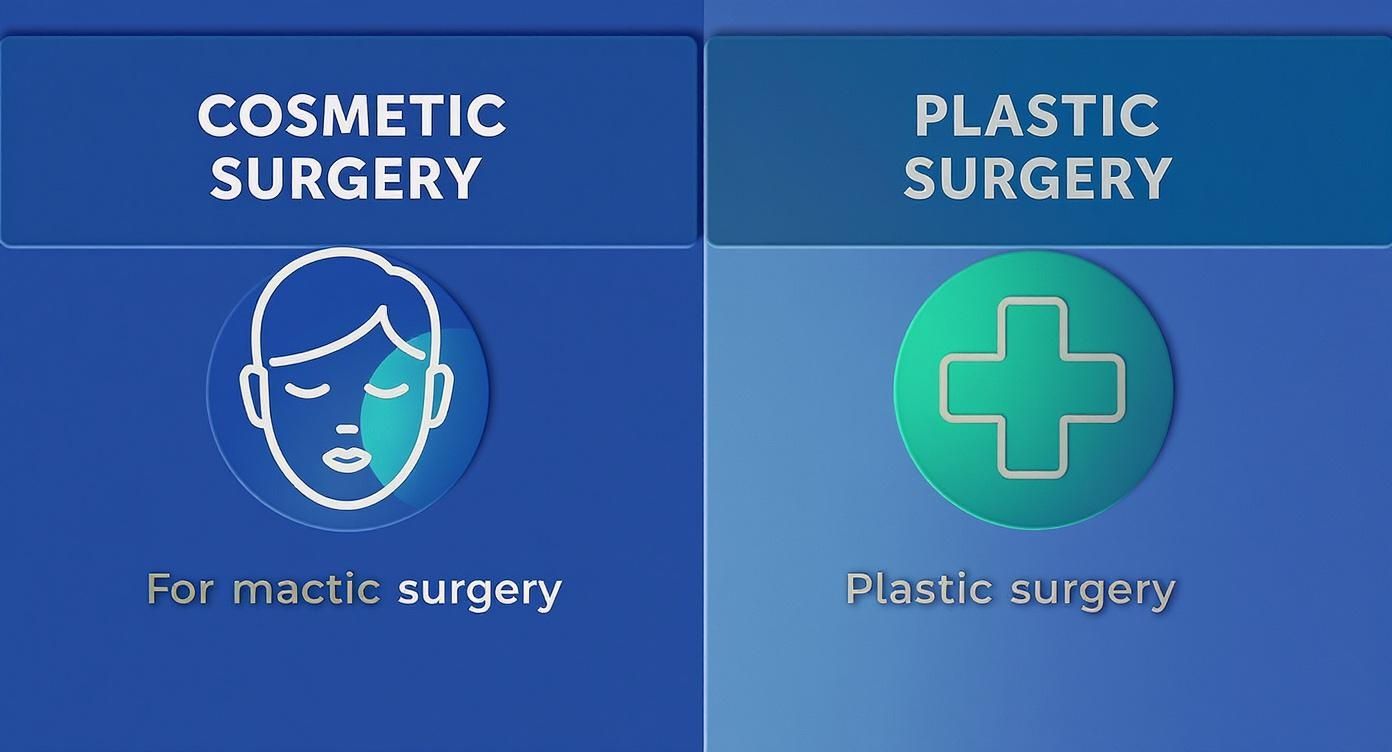
This infographic helps visualize that core focus—cosmetic surgery is centered on aesthetics, while plastic surgery is fundamentally about medical reconstruction.
The key takeaway is this: while both paths can lead to a beautiful outcome, only plastic surgery is formally recognized and structured to address medical and functional needs from the ground up.
Why Training and Board Certification Matter
Many people use the terms “cosmetic surgeon” and “plastic surgeon” interchangeably, but their training and certification can be worlds apart. This isn’t just about titles on a business card—it’s the single most critical factor for your safety and the quality of your results.
The key difference comes down to the rigor and scope of their training. A doctor performing cosmetic procedures might come from any medical background and may have only taken a weekend course on a single technique. In the eyes of the law, any licensed physician can call themselves a cosmetic surgeon, no matter their original specialty.
In stark contrast, a surgeon certified by the American Board of Plastic Surgery (ABPS) has endured a demanding, multi-year residency program. This is the gold standard for a reason. Their training covers the entire spectrum of plastic surgery, from complex reconstructive cases to the full range of aesthetic enhancements.
The Gold Standard: ABPS Certification
Becoming a board-certified plastic surgeon is an exceptionally difficult path. It’s a highly structured journey designed to forge true experts with a profound understanding of anatomy, surgical artistry, and patient safety.
A surgeon holding ABPS certification has completed:
- A minimum of six to eight years of surgical training after graduating from medical school.
- An integrated residency that covers both reconstructive and cosmetic surgery, building a comprehensive and adaptable skill set.
- A series of rigorous written and oral exams to prove their expertise and commitment to ethical practice.
This exhaustive process ensures they can not only execute your procedure flawlessly but also manage any unexpected complication that might arise. Their deep foundation in reconstructive surgery gives them an unparalleled ability to restore both form and function—a skill that’s invaluable even in purely aesthetic procedures.
The “Cosmetic Surgeon” Dilemma
Here’s the problem: “cosmetic surgeon” is not an officially recognized specialty by the American Board of Medical Specialties (ABMS). This creates a huge gray area for patients. A doctor could be board-certified in a field completely unrelated to surgery, like internal medicine or dermatology, yet still market themselves as a “cosmetic surgeon.”
While they might be skilled in specific non-invasive treatments, they simply don’t have the comprehensive surgical foundation of an ABPS-certified plastic surgeon. This training gap can become a serious safety issue when things don’t go as planned.
This is exactly why you have to verify credentials. To put yourself in the safest possible hands, you need to look past slick marketing and confirm your surgeon’s board certification. Our guide on how to find a board-certified plastic surgeon walks you through the exact steps to verify credentials and ask the right questions during your consultation.
Why It Matters For Your Procedure
Think about a complex procedure like a facelift or a “mommy makeover.” An ABPS-certified plastic surgeon’s training has prepared them to navigate the intricate layers of tissue, blood vessels, and nerves with surgical precision. Their reconstructive background means they are fundamentally problem-solvers, equipped to handle unique anatomical challenges and ensure a result that is both beautiful and safe.
On the other hand, a practitioner with limited training might be proficient at one specific technique but may lack the depth to adapt to your body or manage a complication effectively. Choosing an ABPS-certified plastic surgeon isn’t just about getting a good aesthetic outcome—it’s about minimizing risk and putting your health first.
Comparing Procedures Goals and Motivations

While training and certification define the surgeon, it’s the patient’s core motivation that defines the procedure. The true difference between cosmetic and plastic surgery crystallizes when we look at the “why” behind the operation.
Is the goal to enhance an already healthy part of the body, or is it to restore function and normalcy to a structure affected by injury, disease, or a congenital condition? This fundamental question shapes the entire surgical journey, from the first consultation to how “success” is ultimately measured.
Cosmetic Surgery: A Focus on Aesthetic Enhancement
Cosmetic surgery is driven entirely by a desire for aesthetic improvement. These procedures are elective, meaning they are not medically necessary but are chosen by the patient to improve their appearance, symmetry, or proportions. The patient starts with a normal, healthy body part and seeks to refine it.
Think about these common cosmetic procedures:
- Breast Augmentation: A patient seeks this procedure to increase breast size or improve shape for purely aesthetic reasons. The goal is to create a more balanced or proportionate silhouette according to her personal preferences.
- Rhinoplasty (Nose Reshaping): Often called a “nose job,” this procedure is performed to alter the size or shape of the nose to achieve better facial harmony. While it can sometimes correct a deviated septum, the primary driver is typically cosmetic.
- Liposuction: This procedure removes stubborn fat deposits from areas like the abdomen, thighs, or arms to create a more contoured appearance. It’s a body-shaping tool, not a solution for weight loss.
In each case, the patient is healthy, and the objective is to elevate their appearance based on aesthetic ideals. The economic landscape reflects this elective nature. The global cosmetic surgery market was valued at approximately $86 billion in 2025, with projections showing significant growth fueled by patient demand for these types of procedures.
Plastic Surgery: A Mission of Restoration and Reconstruction
In sharp contrast, plastic surgery—in its reconstructive sense—is driven by medical necessity. Its mission is to repair, restore, and reconstruct parts of the body that have been damaged or are abnormal. The goal is not just aesthetic improvement but the restoration of normal function and form.
The core principle of reconstructive plastic surgery is to help a patient feel and function “whole” again after a life-altering event. The aesthetic outcome is crucial, but it serves the primary purpose of reconstruction.
Here are a few powerful examples of reconstructive plastic surgery:
- Breast Reconstruction after Mastectomy: Following breast cancer surgery, a plastic surgeon can reconstruct the breast to restore a sense of normalcy for the patient. This procedure is a vital part of the healing process and is covered by insurance as a medical necessity.
- Burn Repair Surgery: Severe burns can cause disfigurement and debilitating scar contractures that limit movement. Plastic surgeons perform complex procedures, including skin grafts, to restore function and improve the appearance of the affected skin.
- Cleft Lip and Palate Repair: This surgery is performed on infants born with a separation in their lip or the roof of their mouth. The procedure is essential for enabling normal speech, eating, and breathing, profoundly impacting the child’s quality of life.
These examples show how reconstructive surgery addresses functional deficits and physical abnormalities. The procedures are life-changing, going far beyond simple aesthetic tweaks to rebuild a patient’s physical and emotional well-being. This focus on functional restoration is why these procedures are typically covered by health insurance.
While both specialties require immense skill, the underlying purpose separates them completely. This distinction is also explored in other related fields, as seen in this look into the world of aesthetic dermatology.
Understanding Costs and Insurance Coverage
One of the most practical—and significant—differences between cosmetic and plastic surgery boils down to who pays the bill. The financial side of things creates a clear dividing line, and it all hinges on a single question: is the procedure medically necessary? This distinction is what determines whether you’ll be paying entirely out-of-pocket or if your health insurance will step in.
With cosmetic surgery, the financial path is straightforward. Because these procedures are elective—meaning you’re choosing to have them to enhance your appearance, not to fix a medical problem—they are almost never covered by insurance. This means the patient is responsible for 100% of the cost.
Breaking Down Cosmetic Surgery Costs
When you get a price quote for a cosmetic procedure, it’s not just one lump sum. It’s a combination of several critical services that make up the total fee. Understanding this breakdown shows you exactly what you’re paying for.
A typical quote will include:
- Surgeon’s Fee: This is the largest part of the bill, covering the surgeon’s time, specialized skill, and years of expertise.
- Anesthesia Fee: This charge covers the anesthesiologist’s services and the anesthetic agents needed to keep you safe and comfortable.
- Facility Fee: This pays for using the accredited surgical suite, which includes the nursing staff, high-tech equipment, and all necessary supplies.
It’s also smart to budget for related expenses that aren’t usually in the initial quote, like pre-operative lab work, post-op compression garments, and any prescription medications. Since these procedures are entirely elective, many practices offer financing plans through third-party lenders to help patients manage these significant costs.
When Insurance Covers Reconstructive Surgery
Reconstructive plastic surgery, on the other hand, works within a completely different financial framework. Its entire purpose is to correct a functional problem or physical abnormality caused by trauma, disease, or a congenital issue. Because of this, it is considered medically necessary. As a result, these procedures are very often covered by health insurance plans.
A perfect example is breast reconstruction after a mastectomy. This isn’t viewed as an aesthetic choice but as a crucial part of a patient’s recovery from breast cancer. In fact, the Women’s Health and Cancer Rights Act of 1998 is a federal law that requires most group insurance plans covering mastectomies to also cover reconstructive surgery.
To get your procedure covered, your surgeon’s office will submit a detailed claim with all the necessary documentation—medical records, diagnostic codes, and a formal letter of medical necessity. This letter is critical, as it explains exactly why the surgery is essential for restoring your health or normal function. While coverage is common, you should still expect to be responsible for deductibles, co-pays, and co-insurance, just like with any other medical treatment.
The global demand for these surgeries reflects these financial realities. Cosmetic procedures are most popular in countries with higher disposable incomes, like the United States, which performed over 6.1 million cosmetic procedures. The global ratio of cosmetic to reconstructive procedures is estimated to be around 3:1, with elective surgeries dominating in wealthier nations where patients can afford them. You can find more insights on the global plastic surgery statistics on madisonps.com.
Ultimately, sorting out the financial aspect of surgery is a huge part of the decision-making process. The stark difference in insurance coverage is one of the most powerful, real-world examples of the fundamental gap between cosmetic and plastic surgery.
How to Choose the Right Surgeon for Your Needs
Choosing your surgeon is, without a doubt, the single most critical decision you’ll make in this entire process. It’s a choice that directly shapes your safety, your satisfaction, and the final reflection you see in the mirror.
The gap between a properly trained plastic surgeon and someone simply marketing “cosmetic” services can be immense. Getting this right requires moving beyond a quick online search and adopting a structured approach to vetting a surgeon’s qualifications, hands-on experience, and even their artistic sensibilities. This is about finding a true partner—a skilled expert whose vision for your outcome aligns perfectly with your own.
Verify Board Certification The Right Way
First things first: board certification is non-negotiable. But you need to know that not all “board certifications” carry the same weight. For any procedure touching the worlds of cosmetic and plastic surgery, the undisputed gold standard is certification by the American Board of Plastic Surgery (ABPS).
The ABPS is the only board recognized by the American Board of Medical Specialties to certify surgeons in the complete field of plastic and reconstructive surgery. Be wary of official-sounding boards that are less rigorous. An ABPS certification means the surgeon has completed at least six to eight years of dedicated surgical training, passed demanding written and oral exams, and commits to the highest ethical standards. You can and should verify any surgeon’s ABPS status online.
Evaluate Their Specific Experience
Once you’ve confirmed ABPS certification, it’s time to drill down into their specific experience with the procedure you want. While a board-certified plastic surgeon has broad training, most develop a deep focus in certain areas over their careers—becoming known for facial work, breast surgery, or complex body contouring.
You’re not looking for a surgeon who performs your procedure occasionally; you want one who does it all the time. During your consultation, ask direct questions:
- How many of these specific procedures did you perform last year?
- Do you consider facial surgery, breast work, or body procedures your primary specialty?
- Can I see your portfolio of before-and-after photos, specifically of patients with a body type or facial anatomy similar to mine?
That last point is crucial. A great portfolio isn’t just about showing off a few “home run” results. It’s about demonstrating consistent, beautiful outcomes for a wide range of patients who look like you. This proves the surgeon can tailor their technique to unique anatomies—the true mark of an expert.
The goal is to find a surgeon whose work consistently reflects the outcome you envision for yourself. A vast portfolio of high-quality results in your specific procedure is one of the strongest indicators of skill and experience.
Align on Aesthetic Philosophy
Surgery is as much an art as it is a science. Every surgeon develops a unique aesthetic eye that shapes their results. Some are celebrated for creating dramatic, transformative changes, while others have built their reputation on subtle, incredibly natural-looking enhancements.
Neither approach is right or wrong—but one is right for you.
Your consultation is the time to have a frank conversation about your goals. Bring inspiration photos that show the kind of look you’re hoping for. This is your chance to see if your vision clicks with the surgeon’s artistic style. A great surgeon listens carefully, gives you honest feedback about what’s realistic for your anatomy, and works with you to create a surgical plan. If you feel like they aren’t hearing you, or their style just doesn’t resonate, that’s your cue to keep looking.
When you’re meeting with potential surgeons, it’s easy to get overwhelmed. Having a checklist of essential questions ensures you gather the critical information needed to make a confident choice.
Surgeon Consultation Checklist
Use this table as a quick reference during your consultations to ensure you cover all the essential points.
| Category | Essential Question to Ask |
|---|---|
| Board Certification | Are you certified by the American Board of Plastic Surgery (ABPS)? |
| Specialized Experience | What percentage of your practice is dedicated to the procedure I am interested in? |
| Portfolio Review | Can I see photos of your work on patients with similar starting points and goals? |
| Aesthetic Alignment | How would you describe your aesthetic philosophy, and how does it apply to my goals? |
| Safety and Facility | Is the surgical facility accredited, and what safety protocols are in place? |
Making the right decision takes time and thorough research, but it’s an investment in your health, safety, and happiness. By following this framework, you can confidently find a highly qualified surgeon who can help you achieve your goals. For a curated list of top-tier, board-certified specialists, networks like Haute MD offer a vetted place to begin your search.
Frequently Asked Questions

As you explore your options, it’s natural to have questions. Getting clear, direct answers is the key to making a decision you can feel confident and secure about. Here are some of the most common questions that come up when distinguishing between cosmetic and plastic surgery.
Can a Plastic Surgeon Perform Cosmetic Surgery?
Yes, absolutely. A board-certified plastic surgeon isn’t just qualified to perform cosmetic surgery—they are among the most qualified physicians to do so. This is a critical point that often gets misunderstood.
Think of it this way: the specialty of plastic surgery is incredibly broad. A surgeon’s residency is a multi-year deep dive into the full spectrum of procedures, covering both complex reconstructive work (like microsurgery for burn victims) and the entire range of aesthetic operations (like breast augmentations and facelifts).
This dual training creates a powerful advantage. The principles learned in reconstruction—an intricate knowledge of anatomy, precise tissue handling, and restoring natural form—provide an unparalleled foundation for achieving safe, beautiful results in cosmetic surgery.
That said, many surgeons choose to specialize within their field. Some dedicate their careers to reconstructive challenges, while others focus entirely on aesthetics. That’s why, during your consultation, you should always ask about a surgeon’s specific experience with the procedure you’re considering.
Is a Tummy Tuck Cosmetic or Plastic Surgery?
A tummy tuck, or abdominoplasty, is a perfect example of how a single procedure can fall into either category, depending entirely on the reason it’s being done. For the vast majority of patients, a tummy tuck is a purely cosmetic procedure.
The goal is to improve the abdomen’s appearance by removing loose skin and fat while tightening the underlying muscles, often after pregnancy or significant weight loss. When aesthetics are the sole motivation, it’s cosmetic surgery, and insurance won’t cover it.
However, it can become reconstructive plastic surgery under specific medical circumstances. For example, if massive weight loss leaves a large panniculus (an “apron” of overhanging skin) that causes chronic rashes, ulcers, or infections that don’t respond to treatment, removing it is considered medically necessary.
Likewise, if the procedure is done to repair a ventral hernia at the same time, it serves a functional purpose. In these cases, the aesthetic improvement is a secondary benefit, and your surgeon will need to provide extensive documentation to your insurance company to prove medical necessity.
How Do I Verify a Surgeon Is Board-Certified?
Verifying a surgeon’s board certification is the single most important step you can take to protect your health. It’s also surprisingly easy, as long as you know where to look.
The gold standard is certification by the American Board of Plastic Surgery (ABPS). This is the only board recognized by the American Board of Medical Specialties (ABMS) that certifies surgeons in the complete field of plastic surgery, from head to toe.
Here’s the most reliable way to check:
- Go to the official ABPS website and find their surgeon verification tool.
- Enter the surgeon’s name.
- The search results will instantly confirm if they are currently ABPS board-certified.
Be wary of official-sounding but less rigorous certifications. Some organizations use names that sound similar to the ABPS but lack the same exhaustive training and examination requirements. Going directly to the ABPS website is your guarantee.
Membership in respected professional organizations like the American Society of Plastic Surgeons (ASPS) also requires ABPS certification, adding another layer of confidence that you’re in the hands of a highly trained expert.
Are the Risks Different for Each Type of Surgery?
The fundamental risks—infection, bleeding, reactions to anesthesia, scarring—are present in any operation, whether it’s cosmetic or reconstructive. Those are universal.
Where the risk profile changes dramatically is in the risk-benefit analysis. This calculation is completely different depending on the purpose of the surgery.
With reconstructive surgery, the goal is correcting a significant physical abnormality. For a patient who needs breast reconstruction after a mastectomy or a child needing a cleft lip repair, the benefits of restoring function and normalcy are life-altering. Those immense benefits often justify accepting a higher level of surgical risk.
With elective cosmetic surgery, the equation flips. The procedure isn’t medically necessary and is performed on an otherwise healthy part of the body. Therefore, the tolerance for risk should be extremely low. The primary benefit is aesthetic, which means your surgeon’s top priority must be minimizing every possible risk. A board-certified plastic surgeon will insist on a thorough health evaluation to ensure you are an excellent candidate, putting your well-being above all else.
Finding a surgeon who upholds the highest standards of safety, ethics, and skill is non-negotiable. The Haute MD network provides a trusted, curated resource connecting patients with the nation’s most respected and rigorously vetted board-certified specialists. Find your expert at https://www.hauteliving.com/hautemd.