


When you’re looking for a qualified plastic surgeon, your first and most important step is to verify their credentials. This isn’t just a formality; it’s the bedrock of a safe and successful outcome. The place to start is with the American Board of Plastic Surgery (ABPS). This check ensures your surgeon has completed years of dedicated, specialized training in both cosmetic and reconstructive surgery.
It’s a crucial distinction, because the term “cosmetic surgeon” isn’t legally protected. Any licensed doctor can technically call themselves one, but that title says nothing about their specific surgical training.
Why Board Certification Is Your First Checkpoint
As you start your search, you’ll be bombarded with different titles and credentials. It can get confusing fast. But here’s the bottom line: only one certification guarantees a surgeon has met the absolute highest standards for training, safety, and ethics specifically in plastic surgery of the entire face and body.
This is why making sure your surgeon is board-certified by the ABPS is a non-negotiable first step. It cuts through all the noise and marketing language.
The path to becoming a board-certified plastic surgeon is incredibly demanding. It’s a marathon, not a sprint, and it goes far beyond just finishing medical school.
The Rigorous Path to Certification
To earn that coveted ABPS certification, a surgeon has to prove their dedication and skill over many years. This includes:
- Completing a minimum of six to eight years of intensive, hands-on surgical training after graduating from medical school.
- Passing a series of comprehensive written and oral examinations that cover every conceivable aspect of plastic and reconstructive surgery.
- Committing to continuous education and regular recertification to stay on top of the latest techniques, technologies, and safety protocols.
This grueling process ensures a surgeon has proven expertise across a massive range of procedures, from something like a breast augmentation to the most complex facial reconstructions. They aren’t just tested on their textbook knowledge; they’re evaluated on their ethical judgment and ability to handle real-world surgical challenges.
Choosing a surgeon without ABPS certification is a bit like hiring an architect who never passed their licensing exam. They might know a few things, but they haven’t met the official, peer-reviewed standard of excellence the profession demands.
Now, let’s break down exactly what sets a board-certified plastic surgeon apart from someone who simply markets themselves as a “cosmetic surgeon.” The difference in training and oversight is staggering.
Here’s a clear comparison to help you understand the gap:
Board-Certified Plastic Surgeon vs. Cosmetic Surgeon
| Credential Aspect | Board-Certified Plastic Surgeon (ABPS) | Cosmetic Surgeon (General) |
|---|---|---|
| Surgical Training | Minimum 6-8 years of dedicated residency in plastic & reconstructive surgery. | No specific surgical residency required. Can be a general physician, dermatologist, or OB-GYN with weekend courses. |
| Governing Board | Certified by the American Board of Plastic Surgery (ABPS), recognized by the American Board of Medical Specialties (ABMS). | May be certified by boards not recognized by the ABMS, with widely varying standards. |
| Scope of Practice | Trained in the full spectrum of cosmetic and reconstructive procedures for the entire face, body, and limbs. | Training is often limited to a narrow set of non-invasive or minimally invasive procedures. No comprehensive surgical training. |
| Hospital Privileges | Can obtain privileges to perform complex surgeries in accredited hospitals. | May not have hospital privileges for the cosmetic procedures they perform in their office. |
| Safety & Ethics | Adheres to a strict code of ethics and must pass exams on patient safety. | Oversight and ethical standards can vary significantly, with less stringent requirements. |
| Recertification | Required to undergo continuous medical education and periodic re-examination to maintain certification. | Requirements for ongoing education and recertification are often less rigorous or non-existent. |
The takeaway is simple: the “Board-Certified Plastic Surgeon” title is earned through a decade of validated, specialized surgical training. “Cosmetic surgeon” is a marketing term.
Fortunately, the United States has a highly regulated and skilled workforce, making it a global leader in plastic surgery. As of 2024, there are about 7,752 board-certified plastic surgeons practicing in the U.S. This represents the largest concentration of these highly qualified experts in the world.
You can find more fascinating global plastic surgery statistics on MadisonPS.com. This credential matters because while any licensed doctor can legally perform a cosmetic procedure, only an ABPS-certified surgeon has the dedicated training to do it with the highest possible level of skill and safety.
How to Confidently Verify a Surgeon’s Credentials Online
When it comes to your health and appearance, you simply can’t take a surgeon’s marketing materials at face value. It’s on you to become your own detective and use official online tools to verify every single claim. Thankfully, the key organizations have made this process incredibly straightforward, giving you direct access to the information that truly matters.
Your first and most critical stop is the American Board of Plastic Surgery (ABPS) website. Think of this as the gold standard for verification in the United States. Their “Check a Surgeon” tool is a simple search bar where you type in a surgeon’s name and instantly see if they are currently board-certified. It’s a clear pass/fail test—their name is either in the database, or it isn’t.
This entire verification process should happen before you ever set foot in a consultation room.
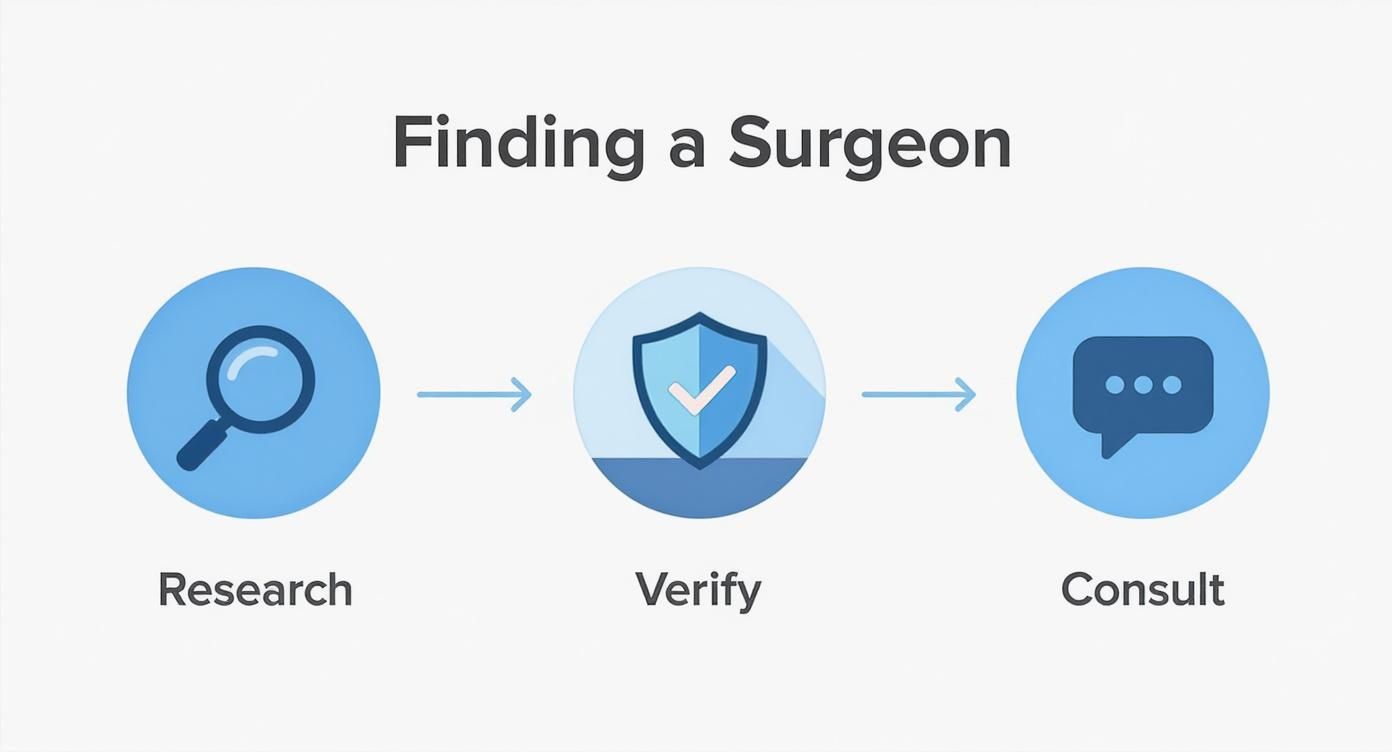
As you can see, verification isn’t a passive assumption; it’s an essential, active step in your research.
Beyond the Initial Search
Once you’ve confirmed their ABPS certification, your detective work isn’t quite done. The next step is to check for any disciplinary actions. Every state has its own medical board that licenses and regulates physicians. A quick search for “[Your State] medical board lookup” will take you straight to a database where you can check the status of a surgeon’s license and, more importantly, see if any complaints or disciplinary actions have been filed against them.
Remember, a clean record is the baseline expectation. While a very minor issue might be explainable, multiple or serious actions are a massive red flag. Cross that surgeon off your list immediately.
You can also add another layer of confirmation by cross-referencing their credentials on The American Society of Plastic Surgeons (ASPS) website. Since ASPS membership requires ABPS certification, finding a surgeon on their “Find a Surgeon” tool provides extra peace of mind. It also shows they are committed to a strict code of ethics and ongoing education.
A surgeon’s professional standing and digital footprint are things they invest in heavily. To get a better sense of how this works from their perspective, you can explore these insights on online reputation management for doctors.
Using these tools takes only a few minutes, but it provides the unshakeable confidence you need to move forward to the next step of your journey.
Decoding Before-and-After Photos Like an Expert
Checking a surgeon’s credentials is the first essential step, but their before-and-after gallery is where you truly see their artistry. Think of a portfolio as more than just a collection of wins; it’s a visual resume that showcases a surgeon’s aesthetic style, consistency, and technical skill. Learning to analyze these photos with a critical eye is one of the most important parts of this entire process.
Don’t just get wowed by the “best” results featured on their homepage. You need to go deeper. Dive into the complete gallery for the specific procedure you’re thinking about. A surgeon with real-world experience will have a substantial library of photos, not just a select few.
This volume isn’t just for show—it proves they’ve handled a wide range of cases and gives you a much clearer picture of their typical results across different body types and starting points.
Look for Patients Like You
Your main goal here is to find examples of patients who started out with a similar anatomy to yours. If you’re considering a rhinoplasty and have a prominent dorsal hump, look for other patients with that specific issue. If you’re interested in a breast lift, search for examples of patients who had a similar degree of sagging.
This is the only way to visualize a realistic potential outcome for your own body. A surgeon who consistently delivers beautiful results for patients with your exact anatomy is very likely a great match for what you want to achieve.
A great portfolio isn’t about shocking, over-the-top transformations. It’s about consistently natural-looking results that are beautifully proportional to each patient’s individual frame.
Analyze the Finer Details
Once you’ve found some relevant examples, it’s time to play detective. Look past the main transformation and start scrutinizing the small details that signal high-quality, meticulous work.
- Lighting and Angles: Are the photos consistent? A professional surgeon will use standardized lighting, backgrounds, and camera angles to give you an honest, direct comparison. Be suspicious of galleries where the “after” shots use flattering soft lighting or different poses that might be hiding imperfections.
- Scar Quality: For any procedure involving incisions, zoom in and examine the scars. Are they hidden discreetly in natural body creases? Do they look like fine, flat lines that have healed well in the “after” photos? This is a direct reflection of the surgeon’s suturing technique and care.
- Symmetry and Proportions: Look for balance. The result shouldn’t just be “better,” it should be harmonious with the patient’s entire body. The goal is to avoid an artificial or “overdone” look that screams plastic surgery.
This kind of detailed analysis is critical for any aesthetic procedure. The same principles apply whether you’re reviewing a surgeon’s work or learning how to find a good dermatologist for a skin concern. Authentic, well-documented results are the mark of a true expert. Finding a board-certified plastic surgeon is about finding someone whose artistic vision aligns with yours, and their gallery is the best evidence you’re going to get.
The Critical Questions to Ask During Your Consultation

You’ve done the background checks, reviewed the before-and-after photos, and narrowed down your list. Now comes the most important part of the journey: the consultation. This meeting isn’t just about getting a price quote. It’s your chance to interview a potential surgeon, understand their philosophy, and see if you feel a genuine connection.
Walk in prepared. This is your time to ask specific, insightful questions that go far beyond what you can find on their website.
Your first line of questioning should be direct and focused on their experience with the exact procedure you’re considering. While a board-certified plastic surgeon is trained in a wide range of procedures, many develop a deep expertise or a true passion for certain surgeries. You want to make sure their focus aligns with your goals.
Beyond the Basics of Experience
Don’t just ask, “How many have you done?” It’s a common question, but it doesn’t tell the whole story.
A far more revealing question is, “How frequently do you perform this specific procedure?” A surgeon who performs several breast augmentations a week has a completely different level of current, hands-on skill than one who does a few per year. That continuous experience is what hones their craft.
Then, dig into the details of their technique. For example, if you’re thinking about a facelift, ask if they prefer a deep plane or SMAS technique for someone with your facial structure. More importantly, ask them why. Their answer will instantly reveal their depth of knowledge and whether they create a truly customized surgical plan or apply a one-size-fits-all approach.
Your consultation is a two-way interview. You are evaluating their expertise and communication style just as much as they are assessing your candidacy for surgery. Never hesitate to ask for clarification or express your concerns.
Discussing Safety and Complications
This is a big one. A confident, highly experienced surgeon will never shy away from a conversation about risks and potential complications. In fact, they should bring it up themselves. Their willingness to discuss the “what-ifs” is a massive indicator of their transparency and unwavering commitment to patient safety.
If they brush off these questions or downplay the risks, that’s a major red flag.
Be ready to ask these critical questions about safety protocols:
- What is your plan if a complication happens during or after surgery? You’re looking for a clear, detailed, and reassuring response that shows they have a well-established protocol.
- Where will my surgery take place? The answer must be an accredited hospital or a state-licensed, accredited ambulatory surgical center. These facilities are equipped with advanced life support capabilities.
- Who is in charge of the anesthesia? Make sure it is administered by a board-certified anesthesiologist or a certified registered nurse anesthetist (CRNA). This is non-negotiable.
Asking these tough questions will give you the complete picture you need. It ensures you’re not just choosing a qualified surgeon, but the right surgeon for you—one you can trust completely.
The Risks in a Booming—and Borderless—Market
The demand for aesthetic procedures isn’t just growing; it’s exploding. This incredible surge has created a global marketplace filled with world-class experts but also, unfortunately, opportunistic and unqualified individuals looking to cash in.
Suddenly, your vetting process isn’t just important—it’s everything.
This boom is most obvious in the rise of “medical tourism,” where patients fly abroad chasing the promise of lower-cost procedures. While some people have good experiences, the risks are very real and often completely misunderstood. Medical regulations, safety standards, and your legal rights can vary wildly from one country to another. A certification that sounds official overseas may hold none of the weight or rigorous standards of an ABPS certification here at home.
When you choose a surgeon in a less-regulated environment, you often lose the safety net of accountability. If something goes wrong, your legal options may be extremely limited, and finding a U.S. surgeon willing to perform complex revision surgery can be difficult and costly.
The numbers tell a staggering story. The global cosmetic surgery market saw nearly 38 million aesthetic procedures performed in 2024. That’s a stunning 42.5% increase in just four years, a testament to the incredible demand driving this industry. You can dig into the full ISAPS global survey report to see the trend for yourself.
This is exactly why your search for a board-certified plastic surgeon is so critical. It’s the single most effective way to protect yourself and ensure you’re in the hands of a true expert.
Common Questions About Finding a Plastic Surgeon
Trying to make sense of a plastic surgeon’s credentials can feel like learning a new language. But once you understand a few key terms, the whole picture becomes much clearer. Getting this final step right is critical to finding a board-certified plastic surgeon you can feel completely safe with.
A lot of patients ask about the difference between a surgeon being “board-certified” and being a member of a group like The American Society of Plastic Surgeons (ASPS). Here’s the simplest way to think about it: board certification from the American Board of Plastic Surgery (ABPS) is the foundational requirement. It’s the non-negotiable proof of years of dedicated training and rigorous examination in plastic surgery.
ASPS membership is an extra layer of validation. They only accept members who are already certified by the ABPS, so it’s a good signal, but the ABPS certification is what truly matters.
Key Distinctions and Red Flags
So, can a doctor certified in another field perform cosmetic surgery? The short answer is yes, but this is a major area of concern. A dermatologist might be board-certified in their specialty, but that training is focused on the skin. It doesn’t compare to an ABPS-certified plastic surgeon, who has completed years of residency training dedicated exclusively to the cosmetic and reconstructive surgery of the entire face and body.
It’s just as important to know what to walk away from. Keep an eye out for these red flags during your consultations:
- A heavy emphasis on discounts and special offers rather than patient safety.
- Hesitation to show you a wide variety of before-and-after photos for your specific procedure.
- Any kind of high-pressure sales tactics designed to make you book on the spot.
- Vague answers when you ask about their hospital privileges—a crucial safety standard.
A trustworthy surgeon prioritizes transparent communication and patient education above all else. Their primary goal is to ensure you are fully informed and confident, not just to book a procedure.
Recognizing these signals will help you sidestep unqualified or unethical practitioners. For more strategies on identifying top-tier doctors, take a look at these expert ways to find top-rated physicians near you. In the end, a well-informed patient is always the safest.