



Finding the right doctor isn’t just about a single search; it’s a process. You need to build a solid list of potential candidates before you start digging into their credentials, patient reviews, and overall philosophy of care. The best approach is layered, starting with sources you already know and trust before expanding outward.
Starting Your Search for the Right Doctor
It’s easy to feel overwhelmed by the sheer number of options out there. The key is to break it down into manageable steps. First, you’ll gather names from reliable sources. Then, you’ll make sure they fit your practical needs, like being covered by your insurance. This initial legwork builds a high-quality list so you’re not wasting time vetting doctors who are a non-starter from the beginning.
Start with the people whose opinions you value most. Reach out to friends, family, and colleagues for their personal recommendations. But don’t just ask who they see; ask why.
Get specific. What’s their doctor’s communication style like? Is the office staff responsive and easy to deal with? A genuine, firsthand account gives you the kind of nuance you’ll never find in an online profile.
Leverage Your Professional Network
Here’s a resource most people completely overlook: other healthcare professionals you already trust. Your dentist, physical therapist, or even a specialist you see for another issue can be a goldmine for referrals.
They have an insider’s view of the local medical community. They know which physicians have stellar reputations among their peers, and that’s an incredibly powerful endorsement.
Use Your Insurance Provider’s Directory
This next step is non-negotiable. Log into your insurance provider’s website and use their directory. Going to an out-of-network doctor can lead to staggering, unexpected bills, so confirming coverage is critical.
Most insurer portals let you filter your search, which is incredibly helpful for narrowing the field. You can typically sort by:
- Specialty (e.g., internal medicine, dermatology, cardiology)
- Location or zip code
- Hospital affiliation
- Gender
Use these filters to create a preliminary list of in-network doctors who are conveniently located. This list becomes the foundation of your search, ensuring every candidate you consider is financially practical from the get-go.
A doctor can have the most impressive credentials in the world, but if they aren’t in your insurance network, you could be on the hook for significant medical bills. Always verify in-network status twice: once with the insurance company and again with the doctor’s office before scheduling anything.
Broaden Your Options with Online Databases
With a baseline list from your personal network and insurance directory, it’s time to expand your options with high-quality online resources. This is where you can move beyond just “in-network” to “top-tier.”
Curated medical networks are especially valuable here. For instance, you can use specialized platforms to find a doctor who has already been vetted for their expertise, credentials, and patient care standards. This adds a layer of quality control to your search.
Additionally, check the physician directories on the websites of major hospital systems in your area. This helps you find doctors affiliated with top-rated medical centers, which is often a good indicator of quality. Combining these approaches gives you a comprehensive, well-rounded group of potential doctors to investigate further.
Verifying a Doctor’s Credentials and Expertise
Once you have a shortlist of promising doctors, the real work begins. This is where you move from gathering names to doing your homework. Think of it as a background check for your health—a crucial step to ensure a physician has not just a degree, but a proven track record of excellence in their field.
Your investigation should start with one of the most important qualifications a doctor can have: board certification. This isn’t just a piece of paper; it’s proof that a physician has gone above and beyond basic medical licensing to demonstrate mastery in their specific area of medicine.
Confirm Board Certification and Training
Board certification is voluntary, but it’s widely considered the gold standard. It means a doctor has successfully completed an accredited residency program and passed a rigorous exam given by a specialty board, like the American Board of Medical Specialties (ABMS). Frankly, it should be a non-negotiable benchmark in your search.
You can verify a doctor’s status directly on the ABMS’s official website or through your state’s medical board. While you’re there, take a look at their complete training history:
- Medical School: Where did they earn their medical degree? Reputation can matter.
- Residency Training: This is where doctors specialize after medical school. Look for well-regarded programs.
- Fellowships: Did they pursue additional, highly specialized training after residency? A fellowship in a niche area signals a much deeper level of expertise.
This initial check helps build a clear picture of their foundational knowledge and commitment to their specialty. For instance, if you’re looking for a top-tier aesthetic expert, understanding their fellowship training can make all the difference. We dive deeper into this in our guide on how to find a good dermatologist the right way.
Investigate Malpractice Claims and Disciplinary Actions
No doctor is perfect, but a clean professional record is a strong indicator of quality and safety. Every state has a medical board that licenses physicians and investigates complaints. These websites are public resources where you can look up any doctor licensed in that state.
You can typically find information on:
- Disciplinary actions taken against the doctor.
- Current license status (active, inactive, or revoked).
- Any malpractice claims or settlements.
It’s important to approach this information with the right context. Not all claims are equal, and some specialties inherently carry more risk than others.
A recent study published in Nature provides valuable perspective, showing that the annual risk of facing a malpractice claim varies dramatically by specialty. This data helps contextualize what a claim might mean for a doctor in a high-risk field versus a low-risk one.
Annual Malpractice Claim Risk by Medical Specialty
| Specialty | Annual Risk of Claim (%) | Average Time Between Claims |
|---|---|---|
| Neurosurgery | 22.0% | 4.5 years |
| Thoracic-Cardiovascular Surgery | 21.6% | 4.6 years |
| General Surgery | 16.6% | 6.0 years |
| Obstetrics/Gynecology | 12.2% | 8.2 years |
| Orthopedic Surgery | 11.7% | 8.5 years |
| Urology | 8.3% | 12.0 years |
| Anesthesiology | 2.5% | 40.0 years |
| Internal Medicine | 2.2% | 45.5 years |
| Dermatology | 2.0% | 50.0 years |
| Pediatrics | 0.9% | 111.1 years |
As you can see, surgeons face a significantly higher inherent risk. A single claim against a neurosurgeon (with an annual risk of 22.0%) might carry different weight than one against a pediatrician (with a risk of just 0.9%).
Having a malpractice claim doesn’t automatically disqualify a doctor. Consider the frequency, severity, and nature of the claims. The goal is transparency—you deserve to know a doctor’s complete history to make a fully informed decision.
This infographic breaks down the primary avenues people use to start their doctor search, from personal networks to insurance directories and online tools.
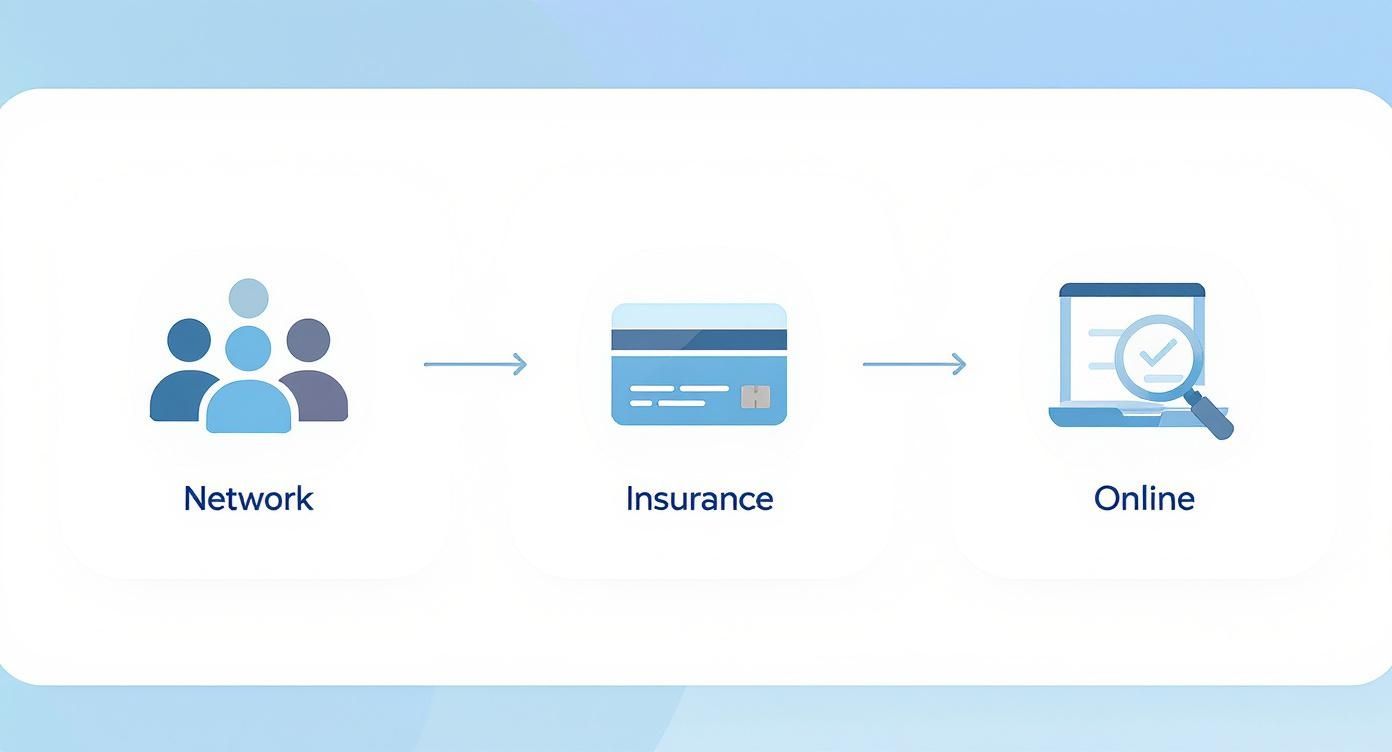
The visualization highlights how a multi-channel approach—combining trusted referrals with practical insurance checks and broader online searches—creates the most robust foundation for finding a top doctor.
Looking Beyond Credentials with Patient Reviews

A doctor’s board certification tells you they have the technical skills, but it says nothing about what it feels like to be in their care. That’s where patient reviews come in. They offer a ground-level look at the entire experience, from the moment you walk into the waiting room until the end of your appointment.
Think of reviews on platforms like Healthgrades, Vitals, and Zocdoc as a crucial layer of social proof. They illuminate the “soft skills” that are impossible to list on a resume but are absolutely vital for a trusting doctor-patient relationship.
Reading Between the Lines of Patient Feedback
The trick to using patient reviews effectively is to ignore the outliers. A single five-star rave or a one-star rant is usually driven by extreme emotion and rarely reflects the typical experience. Your real goal is to spot the consistent patterns across dozens of comments.
Look for the themes that pop up again and again. Do multiple people mention feeling rushed? Or do several praise the doctor’s knack for explaining complex issues in simple, understandable terms? These repeated observations are the most reliable indicators of what you can expect.
As you sift through the comments, keep an eye out for specifics on a few key areas:
- Communication and Bedside Manner: Zero in on comments describing how the doctor listens, answers questions, and shows empathy. Phrases like “took the time to really listen” or “made sure I understood all my options” are huge green flags.
- Office Environment and Staff: Don’t underestimate feedback about the front desk team, nurses, and office managers. A friendly, organized, and responsive staff can completely change your overall experience for the better.
- Wait Times and Punctuality: Are chronic long waits a common complaint? This could signal an overbooked or disorganized practice. Consistent comments about punctuality suggest an office that truly respects its patients’ time.
A doctor’s clinical expertise is paramount, but the quality of your care is also shaped by how you’re treated as a person. Reviews that highlight a doctor’s compassion, patience, and clear communication are often the most telling signs of a truly exceptional physician.
Building a Complete Picture
Imagine each review as a single pixel. By itself, it doesn’t show you much. But when you step back and look at hundreds of them together, a clear picture starts to emerge.
For example, you might discover a surgeon with impeccable credentials who consistently gets feedback about an abrupt bedside manner and a chaotic office. On the other hand, you might find a family physician with fewer prestigious accolades but glowing reviews praising their attentive listening and the warmth of their staff.
Ultimately, digging into patient reviews is a critical step in your research. It closes the gap between a doctor’s professional qualifications and the real-world, human experience of being their patient. This balanced perspective is essential when learning how to find the best doctors—those who aren’t just clinically skilled, but also a great personal fit for you.
Making Your First Appointment Count

That first consultation is your best—and sometimes only—chance to determine if a doctor is the right partner for your health. This isn’t just a medical exam; it’s an interview. And you’re the one doing the hiring.
If you walk in prepared with thoughtful questions and a sharp eye for detail, you can turn a routine visit into the final, decisive step of your search. This is where you get to see the crucial “soft skills” that no online profile or five-star review can ever fully capture.
Pay close attention to how the doctor engages with you. Do they make eye contact? Do they listen without cutting you off? A physician’s ability to connect and make you feel heard is just as vital as their clinical expertise.
Questions to Steer the Conversation
Having a list of questions ready isn’t about being difficult; it’s about being an engaged, informed patient. The best doctors I know actually welcome this. It shows you’re invested. Your goal is to get a feel for their approach to medicine and how they see the doctor-patient relationship.
Think about framing your questions around these key areas:
- Treatment Philosophy: “When it comes to [your specific condition], what’s your general approach? Are you more conservative, or do you lean toward more aggressive treatment plans?”
- Patient Collaboration: “How do you involve your patients in making decisions about their own care? What’s your process for making sure I understand all my options?”
- Communication & Access: “If I have a follow-up question after our visit, what’s the best way to get in touch? Who on your team handles patient messages, and what’s a realistic response time?”
This line of inquiry tells you a lot about their collaborative spirit. It’s also a practical way to assess their office’s commitment to clear, timely communication—which is absolutely critical. In fact, one study revealed that diagnostic errors were the top reason for malpractice claims, accounting for 31.8% of all paid claims.
Taking Stock of the Clinic Environment
Your evaluation begins the second you walk through the door, long before you meet the doctor. The clinic’s atmosphere and the staff’s professionalism speak volumes about the practice’s values.
Notice the front desk experience. Are the staff members welcoming and organized, or do they seem stressed and dismissive? A well-run office is often the sign of a physician who prioritizes efficiency and a positive patient experience. Even the cleanliness of the waiting area and exam rooms offers important clues.
A doctor’s office should inspire confidence, not anxiety. If the environment feels chaotic or the staff is unprofessional, consider it a major red flag. It often reflects the quality of care you can expect to receive.
Ultimately, the right choice comes down to a blend of professional credentials and personal comfort. You should leave that first appointment feeling respected, understood, and confident in the doctor’s ability to manage your health.
For those seeking an even more personalized and accessible healthcare experience, it might be worth exploring different models of care. You can learn more by reading about the top benefits of concierge medicine to see if that approach aligns better with your needs.
Understanding the Real Risk Profile of a Medical Specialist
When you’re vetting a specialist, especially in a high-stakes field like cardiac surgery or neurosurgery, you have to look at their record with a bit more nuance. Not all medical specialties carry the same level of inherent risk, and that context is everything when you’re trying to fairly interpret a doctor’s professional history.
Let’s be real: a malpractice claim doesn’t automatically mean a doctor is careless. Often, it just reflects the insane complexity of the care they provide.
Think about it. A neurosurgeon is working on the most delicate, intricate system in the human body. The margin for error is razor-thin and the potential for severe complications is always present, even with perfect execution. A family doctor, while absolutely essential, is typically managing conditions that carry a lower risk of a catastrophic outcome on any given day. This difference in risk shows up directly in the malpractice data.
High-Stakes Fields vs. Lower-Risk Practices
It’s a statistical fact that doctors in certain specialties are simply more likely to face a lawsuit at some point in their careers. This isn’t necessarily a reflection of skill; it’s tied to the invasive, high-acuity nature of their work.
A landmark study in the New England Journal of Medicine laid this out in stark terms. It found that neurosurgeons had the highest annual claim rate at 19.1%, with thoracic-cardiovascular surgeons right behind them at 18.9%.
On the other end of the spectrum, family medicine physicians had a claim rate of just 5.2% per year. Psychiatrists had the lowest of all, at 2.6%. You can dig into the specialty-specific risk findings here.
This data provides a critical framework for your research. Finding a single malpractice claim against a top cardiac surgeon over a 25-year career means something entirely different than finding one against a pediatrician. The surgeon’s field is inherently fraught with risk, and complications can happen even when the care provided is world-class.
How to Use This Information in Your Search
So, when you uncover a malpractice claim in your research, don’t just write the doctor off. Instead, let it be a trigger to dig deeper and ask the right questions.
Here’s how to think about it:
- Look for patterns, not just incidents. Is this a single, isolated event over a long and distinguished career? Or do you see a pattern of repeated claims for the same type of issue? One is a data point; the other is a red flag.
- Consider the severity. While the specific details are often private, state medical board websites can sometimes provide context about the nature of the claim and the outcome.
- Factor in the specialty’s baseline risk. Always keep the statistics in mind. A claim against an OB/GYN or a general surgeon is statistically far more probable than one against a dermatologist.
Your goal isn’t to find a surgeon with a “perfect,” blemish-free record—in many high-risk fields, that person might not exist. The real objective is to find a highly skilled specialist whose history, when viewed through the realistic lens of their specialty, shows a clear commitment to excellent outcomes.
This informed perspective is a huge part of learning how to find the best doctors. It allows you to weigh a doctor’s expertise, their field’s inherent risk, and their professional history intelligently, so you can choose a specialist with complete confidence.
Common Questions About Choosing a Doctor
Even with the best game plan, searching for a new doctor brings up some tough questions. It’s easy to get bogged down in the details or feel uncertain about what really matters. Let’s cut through the noise and tackle the most common concerns that pop up during this critical process.
Think of this as turning that uncertainty into informed action. Getting clear, practical answers will give you the confidence to move forward and make a choice that truly fits your health needs and personal style.
What Is the Most Important Factor?
While credentials like board certification are the absolute baseline—a non-negotiable—the single most important factor often boils down to the quality of the doctor-patient relationship. Technical skill is essential, of course, but a strong partnership is what drives better health outcomes over the long haul.
You need a physician who listens without interrupting, explains complex topics in a way you can understand, and genuinely values your input. During that initial consultation, pay close attention to how the interaction feels. Do you feel comfortable enough to ask what might seem like a silly question? Do you feel heard, or are you being rushed out the door? Trust your gut on this one.
How Much Should I Trust Online Reviews?
Online patient reviews can be a goldmine of information, but they’re just one piece of a much bigger puzzle. The trick is to read them with a critical eye, looking for consistent themes rather than getting swayed by a single rave review or a scathing takedown.
Look for the patterns. If dozens of people mention a doctor’s incredible communication skills or a warm, efficient office staff, that’s a pretty reliable insight. But remember, it’s incredibly difficult for a patient to accurately judge a doctor’s clinical skill. You have to balance these subjective reviews with your own research into their credentials and, most importantly, your in-person impression.
Patient feedback offers a window into the “human” side of a practice—things like bedside manner, typical wait times, and how the staff interacts with patients. Use it to build a picture of the patient experience, but always verify professional qualifications through official sources like state medical boards.
Is It Okay to Switch Doctors?
Yes, it is 100% okay to switch doctors if you’re not happy with your care. Your health is your single most important asset, and you have every right to a healthcare provider who meets your needs and makes you feel comfortable and respected.
If you consistently leave appointments feeling dismissed, unheard, or rushed, that’s your cue. It’s time to find someone new. Before you make the change, just be sure to contact the office and formally request a complete copy of your medical records. This ensures a seamless transition and helps your new physician get up to speed on your health history right away.
Finding an elite, vetted physician shouldn’t be left to chance. At Haute MD, we connect discerning patients with the nation’s leading medical specialists, from board-certified dermatologists to top-tier surgeons, all in one trusted network. Discover top doctors in your area on Haute MD.