


At its heart, concierge medicine is about three things: incredible access to your doctor, deeply personalized care, and a relentless focus on your long-term wellness. It flips the script on traditional healthcare, moving away from high-volume, reactive treatment and toward a real partnership between you and your physician. The result is almost always better health.
What Is Concierge Medicine Really

Imagine your primary care doctor as a true partner—someone who knows your health history inside and out, not just a name on a chart they glance at for ten minutes. This is the fundamental promise of concierge medicine. It’s a model built to dismantle the biggest frustrations of the old system: the long waits, the rushed appointments, and the feeling that you’re just another number.
Instead of juggling thousands of patients, a concierge doctor keeps their practice small, often just a few hundred people. This is made possible by a membership fee, which allows the physician to focus on delivering a higher standard of care rather than just churning through appointments.
The core idea is simple: by slashing the number of patients, doctors can dedicate meaningful time and energy to each individual. This turns the annual physical from a quick, superficial check-up into a deep, strategic planning session for your health.
This model directly tackles a huge problem in modern healthcare. The average primary care visit is now down to about 18 minutes, which is barely enough time to say hello, let alone have a meaningful conversation or map out a preventative strategy. Concierge medicine puts quality time back at the center of the relationship.
A VIP Pass to Your Health
Think of the membership fee as having your doctor on retainer. It’s an investment in their dedicated attention, unlocking a level of service that’s simply not possible in a conventional practice. Patients get direct access to their physician—often a personal cell phone number or email—for those urgent questions that pop up after hours.
But this isn’t just about convenience; it’s about building a proactive, forward-looking healthcare partnership. Key features almost always include:
- Same-day or next-day appointments that actually work with your schedule.
- Unhurried, longer visits where you can have in-depth conversations.
- A powerful focus on preventative care and personalized wellness plans.
- Direct communication with your doctor, skipping the administrative runaround.
The appeal is obvious, and the market is booming. Valued at $21.77 billion in 2025, the concierge medicine space is projected to nearly double by 2034. This growth isn’t just a trend; it’s driven by patients demanding a more responsive and effective healthcare experience. For many, it’s not a luxury—it’s a necessary move toward better health. You can learn more about finding the right concierge internal medicine doctors in our detailed guide.
How Deeper Doctor-Patient Relationships Drive Better Care
In the traditional healthcare system, the clock is the enemy. When a primary care doctor is responsible for thousands of patients, complex health discussions get squeezed into mere minutes. That rushed, checklist-driven environment makes it nearly impossible to build the trust needed for truly effective care.
This is where concierge medicine changes the entire game. By intentionally shrinking their patient panel to just a few hundred people, concierge physicians reclaim the most valuable resource in medicine: time. An appointment is no longer a frantic ten-minute sprint through a list of symptoms.
Instead, it becomes a thoughtful, unhurried conversation. A standard visit might last 45 minutes or even an hour, creating the space for a genuine partnership to finally take root.
From Symptoms to Solutions
That extra time fundamentally changes the nature of a medical visit. Instead of just reacting to today’s problem, the focus can shift to the bigger picture. The doctor has the bandwidth to move beyond surface-level questions and really dig into the interconnected factors driving your health.
This deeper dive allows for a more complete understanding of you as a person, not just a set of vitals. The conversation can naturally evolve to cover:
- Lifestyle Factors: A detailed discussion about your diet, exercise habits, and daily routines.
- Stress and Mental Well-being: Exploring how work pressures or personal challenges might be showing up as physical symptoms.
- Long-Term Health Goals: Collaborating on a strategic wellness plan designed to help you thrive for years, not just get through the week.
It’s all about connecting the dots between your life and your health—something that’s nearly impossible in a high-volume practice. A concierge doctor can spot a subtle pattern or a potential risk factor that might otherwise go unnoticed, creating a truly proactive wellness strategy. This is a core reason why many people look into an executive health practice for a personal physician.
The shift is from simply treating a disease to caring for the whole person. This builds a foundation of trust that transforms your entire healthcare experience, making you an active collaborator in your own well-being.
The Measurable Impact of a Stronger Partnership
This enhanced relationship isn’t just a “nice-to-have” feature; it delivers tangible results. When you feel genuinely heard and cared for, you’re far more likely to stick with a treatment plan and take an active role in your own health. The data backs this up, loud and clear.
One of the most compelling statistics to emerge from concierge medicine is the dramatically higher patient satisfaction. Surveys show that around 90% of patients in concierge practices are satisfied with their care—a stark contrast to just 67% in traditional settings.
Even more telling, nearly 97% of concierge patients felt their physicians took a personal interest in their health. This level of trust fosters an environment where you feel comfortable sharing sensitive information, which leads directly to more accurate diagnoses and effective treatments. It empowers the physician to act not just as a medical expert, but as a trusted advisor and fierce advocate for your health.
Getting Care When and How You Need It
One of the biggest frustrations with modern healthcare isn’t the medicine itself—it’s the friction. It’s the phone trees, the scheduling black holes, and the agonizing wait for an appointment when you’re worried about something right now. A sudden health concern can feel like a logistical nightmare before you even see a doctor.
This is one of the first and most profound problems concierge medicine solves. It completely dismantles those barriers. Instead of being told the next available appointment is in three weeks, patients get same-day or next-day appointments. This isn’t a special favor; it’s just how the system works.
For busy professionals, parents juggling family health, or anyone managing a chronic condition, this shift is massive. It turns healthcare from an obstacle you have to plan your life around into a responsive service that fits seamlessly into your schedule.
Unlocking Direct and Unfiltered Access
Beyond just getting an appointment quickly, the very nature of communication changes. The usual gatekeepers—receptionists, nurses, automated systems—are largely taken out of the picture. Most concierge memberships give you your doctor’s direct cell phone number or a private email address.
Think about what that means. You have a question about a new medication on a Saturday morning. Or you’re experiencing a strange new symptom late at night. Instead of rushing to an urgent care clinic or stewing with anxiety until Monday, you can reach out directly to the one person who knows your entire health history. This kind of 24/7 access delivers incredible peace of mind.
This infographic does a great job of showing how this improved access is the foundation for better care overall, building on time, trust, and a focus on wellness.
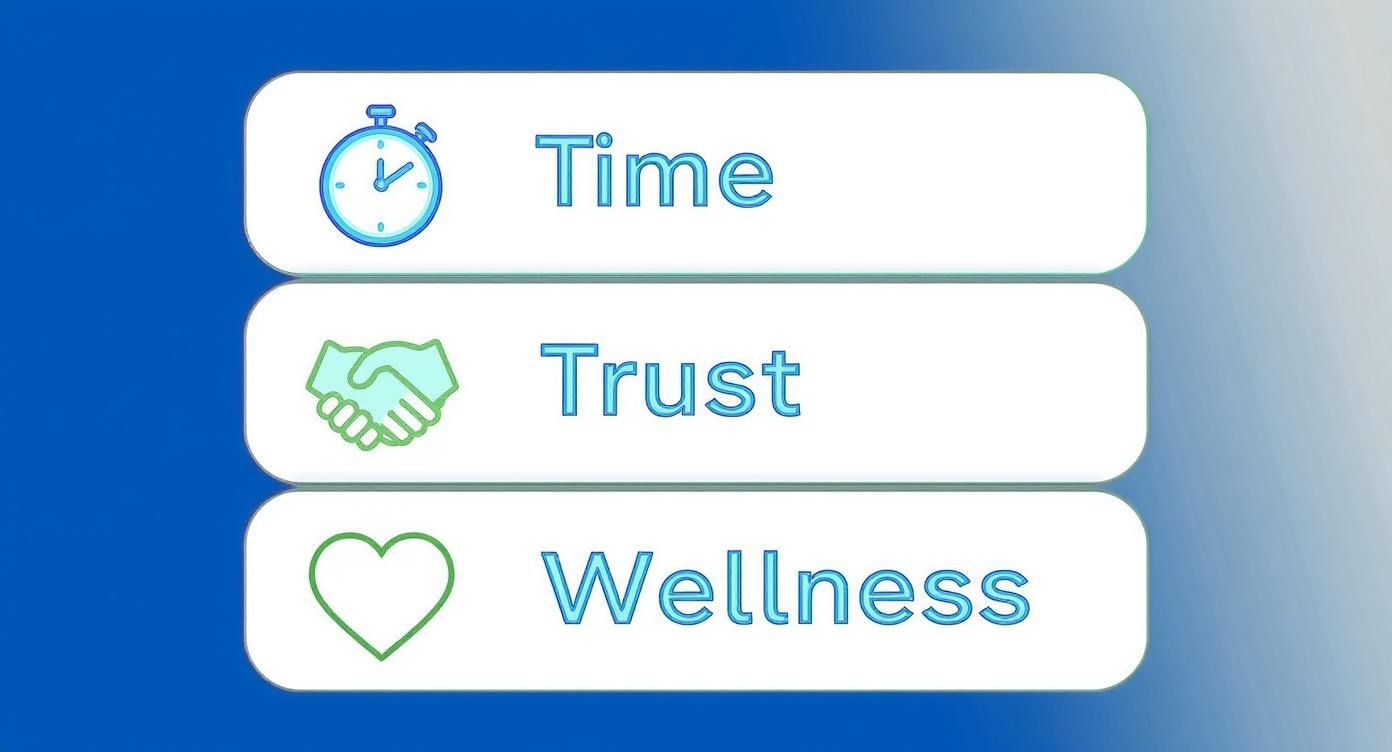
As you can see, when you actually have enough time with your physician, a deeper trust naturally develops. That trust, in turn, allows for a much greater focus on proactive, preventive wellness instead of just reactive sick care.
This direct line isn’t just for emergencies, either. It’s for the small questions that can prevent big problems down the road. It fosters a continuous, collaborative approach to your health that extends far beyond the four walls of the clinic.
The ability to text or call your doctor directly eliminates guesswork and anxiety. It replaces uncertainty with clear, timely guidance from a trusted medical professional, empowering you to make informed decisions about your health in real time.
This responsive relationship ensures small concerns get addressed before they have a chance to escalate. It’s a cornerstone of the exceptional service that defines the benefits of concierge medicine.
Comparing Accessibility Models
The difference in patient access between concierge and traditional healthcare isn’t just a minor tweak—it represents a completely different philosophy. One model is built for volume, prioritizing efficiency for the system. The other is built for the individual, prioritizing responsiveness and convenience for the patient.
Let’s put them side-by-side to see just how stark the contrast really is.
Concierge Medicine Vs Traditional Healthcare Access
This table breaks down the practical differences you’ll experience when trying to get care in each model.
| Feature | Concierge Medicine | Traditional Healthcare |
|---|---|---|
| Appointment Wait Times | Typically same-day or next-day appointments are the standard. | Weeks or even months for a routine visit; long waits for acute issues. |
| Communication Channels | Direct access via cell phone, text, or private email to the physician. | Communication is filtered through receptionists, portals, and nursing staff. |
| After-Hours Support | 24/7 direct access to your personal doctor for urgent concerns. | Often requires a trip to an urgent care clinic or the emergency room. |
| Time with Doctor | Longer, unhurried appointments, often lasting 30-60 minutes or more. | Short visits, often averaging less than 20 minutes, with limited time for questions. |
Ultimately, this level of access is about more than just convenience. It’s about effectiveness. When care is timely and easy to get, patients are far more likely to seek it out early, follow through on treatment plans, and stay in control of their health.
Shifting from Reactive Treatment to Proactive Wellness
Let’s be honest: traditional primary care often feels like a fire department. You only call them when something is already burning. You get sick, you scramble for an appointment, and you walk out with a prescription to douse the immediate flames. It’s a reactive cycle that does very little to prevent the next fire from starting.
Concierge medicine flips this entire model on its head. It’s one of the most powerful changes the service offers. The goal is no longer just putting out fires; it’s about fireproofing your health. It’s a strategic shift from playing defense to going on offense for your long-term wellness.
With longer, unhurried appointments, your doctor finally has the breathing room to look beyond today’s sore throat or nagging cough. They have the mental bandwidth to connect the dots, spot emerging risks, and build a forward-looking health plan that’s actually designed for you, not a generic patient profile.
Investing in Prevention, Not Just Treatment
Think of the membership fee not as a cost, but as an investment in your future self. By paying for your doctor’s dedicated time and expertise upfront, you unlock a suite of proactive tools designed to keep you healthy, not just patch you up after you’re broken.
This proactive approach typically includes:
- Comprehensive Annual Physicals: Forget the rushed 15-minute check-up. We’re talking deep-dive sessions that can last an hour or more, including advanced diagnostics and meaningful conversations about your lifestyle, nutrition, and genetic predispositions.
- Advanced Screenings: Armed with knowledge of your personal and family history, your doctor can order cutting-edge screenings for cardiac health, cancer risk, and metabolic function—catching potential problems at their absolute earliest and most treatable stages.
- Personalized Wellness Coaching: Your physician becomes a true partner in your health. They help you set—and actually achieve—goals for fitness, stress management, and diet. This isn’t a one-off suggestion; it’s continuous guidance that helps create lasting change.
The entire model is built to identify and neutralize risk factors long before they have a chance to become full-blown medical crises.
A Real-World Scenario in Action
Imagine a 50-year-old executive. He feels great, but during a long, conversational annual physical, he mentions his father had a heart attack at 60. In a packed, traditional clinic, that might earn a quick note in the chart and a “watch your diet.” That’s it.
In a concierge practice, that single comment triggers a proactive strategy.
The doctor has the time to dig deeper. How are your stress levels? What are your sleep patterns really like? What did you eat yesterday? Based on that conversation, the physician might order an advanced lipid panel and a coronary calcium scan—tests that are almost never part of a standard physical.
The core value here is moving from population-based guidelines to personalized, pre-emptive care. It’s about using the deep knowledge of a patient’s life and history to stay one step ahead of potential health crises.
What if those tests reveal early plaque buildup in his arteries? Now, the doctor can immediately create a highly targeted plan involving specific nutritional changes, a new exercise regimen, and perhaps medication to manage cholesterol. This simple intervention, born from a real conversation, could very well prevent a life-altering—and incredibly expensive—cardiac event a few years down the road.
This is what proactive wellness actually looks like. It’s about using the power of a strong doctor-patient relationship to see the smoke before there’s a fire, potentially sidestepping costly specialist visits, ER trips, and hospital stays altogether. It transforms healthcare from a chaotic series of emergencies into a well-managed, strategic plan for a long and healthy life.
Better Health Outcomes and Smarter Chronic Illness Management

Ultimately, any healthcare model has to answer one simple question: does it keep you healthier? While the immediate access and personalized attention of concierge medicine are huge draws, the most powerful benefit is seen in tangible, measurable improvements to patient health. This is especially true for anyone managing a chronic condition.
For patients navigating illnesses like diabetes, heart disease, or hypertension, the traditional healthcare system can feel like a lonely, disjointed journey. It’s often a frustrating cycle of brief, infrequent appointments that leave little room for real collaboration or meaningful adjustments. You’re mostly on your own between visits.
Concierge medicine flips that script. It replaces a reactive model with a continuous, supportive partnership. When your doctor is always accessible and knows your case inside and out, managing a chronic illness becomes a team effort instead of a solitary struggle. That consistent oversight makes all the difference.
A Proactive Stance on Chronic Conditions
Imagine having a dedicated health ally who helps you track blood sugar levels daily, fine-tunes medications in real-time based on your feedback, and provides coaching on lifestyle changes. That’s the day-to-day reality in a concierge practice. Your physician becomes the central hub, coordinating everything to ensure nothing falls through the cracks.
This constant communication loop allows for incredibly rapid intervention. Small issues—a slight uptick in blood pressure, a reaction to a new medication—can be addressed immediately with a quick phone call or text. This is how you stop minor concerns from escalating into major medical events that land you in urgent care or the hospital.
This hands-on approach is uniquely effective for managing complex, long-term conditions in several key ways:
- Early Warning Detection: Because your doctor knows your personal health baseline so well, they are far more likely to spot the subtle changes that could signal a worsening condition.
- Medication Optimization: The physician works closely with you to ensure medications are both effective and well-tolerated, making adjustments as needed without waiting weeks for the next appointment.
- Real-World Lifestyle Support: Your doctor helps you integrate healthier habits into your actual daily life, providing the accountability and guidance needed to make lasting changes.
The entire model is designed to keep you stable, healthy, and—most importantly—out of the hospital.
The goal shifts from just treating the symptoms of a chronic illness to actively managing the condition in a way that truly enhances your quality of life. It’s about building a robust, proactive defense system for your long-term health.
The Proof Is in the Data
This intensive, personalized management style doesn’t just feel better; it delivers objectively superior results. The data is clear: when patients have better access to primary care, they use expensive and stressful emergency services far less often.
Research consistently shows that individuals in concierge care experience fewer hospital admissions and ER visits, largely due to the proactive management of conditions like diabetes and hypertension. In fact, one notable analysis showed an incredible 61.3% reduction in hospitalizations for concierge patients compared to those in traditional care. You can find more insights on why patients are choosing concierge medicine and the outcomes they experience.
These numbers paint a clear picture. The consistent, preventative care at the heart of the concierge model is incredibly effective at preventing health crises before they happen. By investing in this higher level of primary care, patients aren’t just buying convenience—they’re making a powerful investment in their long-term well-being.
Understanding the Cost and Value
Let’s talk about the bottom line. The first question most people have about concierge medicine is about the cost, and it’s a fair one. The model runs on a membership fee, usually paid once a year or every quarter. This fee is what buys you out of the conventional system and into a world of exceptional access and truly personal care.
It’s critical to understand that this membership fee complements, not replaces, your health insurance. Think of it this way: your membership covers the premium primary care experience—the unhurried appointments, 24/7 access to your doctor, and the deep-dive wellness planning. Your health insurance is still there for the big-ticket items like specialist visits, hospital stays, surgeries, and prescriptions.
This two-part structure is what frees your concierge doctor from the hamster wheel of insurance-based billing. They can focus completely on your health, not on patient volume.
Calculating the True Value Proposition
While there’s an upfront investment, one of the biggest—and often overlooked—benefits of concierge medicine is its potential for long-term savings. That initial fee can frequently be offset by a sharp drop in other out-of-pocket medical costs. When you have a physician whose entire job is to keep you healthy, the financial equation starts to look very different.
The real value shines through when you add up the costs you start to avoid:
- Fewer Urgent Care and ER Visits: A quick text or call to your doctor can often handle issues that would have sent you straight to a pricey urgent care clinic or the emergency room.
- Better Chronic Disease Management: Having a doctor continuously and proactively managing conditions like diabetes or hypertension can prevent the devastating—and expensive—complications and hospitalizations that can happen down the road.
- Reduced Need for Specialists: With more time to get to the root of a problem, your primary doctor can often manage issues that, in a rushed 10-minute appointment, would have resulted in an immediate (and costly) referral to a specialist.
For a clearer picture of how this model stacks up against the conventional system, you can explore detailed comparisons of concierge medicine vs traditional healthcare.
An Investment in Peace of Mind and Productivity
Beyond the hard numbers, the value of concierge medicine is also measured in currencies that are often priceless: time and peace of mind. For busy executives, entrepreneurs, or anyone juggling a demanding schedule, being able to get a same-day appointment without blowing up an entire workday is incredibly valuable.
Just think about the lost productivity from spending hours in a waiting room or blocking off a half-day for a simple check-up. Concierge medicine gives you that time back.
The real return on investment isn’t just financial. It’s the confidence that comes from knowing you have a dedicated medical expert on your side, ready to act as your advocate and guide you through any health challenge.
Ultimately, the choice comes down to your priorities. If you’re managing a complex health condition, navigating a demanding career, or simply place a high premium on proactive wellness and immediate medical access, the investment often delivers a value that far outweighs its price tag. It’s a strategic decision to put your long-term health first.
Frequently Asked Questions
Switching to a new model of healthcare naturally brings up a few questions. Let’s clear up some of the most common ones about how concierge medicine works in the real world.
Do I Still Need Health Insurance?
Yes, absolutely. This is one of the biggest points of confusion. Think of your concierge membership not as a replacement for insurance, but as a powerful complement to it.
Your membership fee is for the elite primary care experience itself—the unhurried appointments, 24/7 direct access to your doctor’s cell, and deep-dive wellness planning that the traditional system just can’t offer.
Your health insurance is still the backbone for everything else. It’s what you’ll use for:
- Seeing specialists like cardiologists or orthopedists
- Any hospital stays or surgical procedures
- Covering your prescription medications
- Advanced imaging, such as MRIs and CT scans
So, the membership buys you unparalleled service and access from your primary doctor, while your insurance plan remains the essential safety net for significant medical events.
What Does the Annual Fee Typically Cover?
That annual or quarterly fee is your key to the entire concierge model. While the specifics can vary a bit from one practice to another, it almost always unlocks a core set of premium services you won’t find in a standard clinic.
This fee typically covers unlimited, unhurried office visits, incredibly thorough annual physicals that go miles beyond the basics, and the ability to call, text, or email your physician directly.
In essence, the fee buys you out of the high-volume, impersonal system. It pays for your doctor’s most valuable assets: their time and their undivided attention, making you the priority whenever you need care.
This structure frees your physician to focus on proactive wellness and prevention, rather than chasing insurance billing codes. Ultimately, that fee is an investment in a true partnership for your long-term health.
Finding the right physician is the most critical step in your health journey. On Haute MD, you can discover and connect with a network of the nation’s top, board-certified concierge doctors and other elite specialists. Explore the network and find your trusted medical partner today.