
Haute Living Los Angeles Jan/Feb 2012
Tesla is Charged Up and On the Move
by Jessica Davis

Tesla_Blog

After an eight-month search Tesla has announced they will be relocating from San Carlos to nearby Palo Alto, CA. The driving force of the move was to find a facility suited for assembling powertrains. The site chosen is located in Stanford Research Park and formerly housed Hewlett-Packard and Agilent Technologies. With 369,000 square feet on 23 acres of land Tesla has not only found a new facility to manufacture the powertrains, but also a new home for R&D and corporate headquarters.

The powertrain (what others might call a battery) is Tesla’s new system that increases torque and improves range for the electric vehicles (EV).  With increased performance from the motor and inverter the Tesla Roadster can expect 30 percent more torque and an extra 10 miles of travel per charge.

With the auto industry in desperate times, it may seem unusual that Tesla can afford to make such advancements.  However, thanks to $465 million in federal loans, Tesla is able to avoid the pain other auto manufacturers are feeling.  That’s the advantage of being an EV company.  The United States Department of Energy administered the Advanced Technology Vehicle Manufacturing Loan Program, which provides loans to manufacturers in the U.S. to expand or establish facilities that will be used to research and produce EVs.  Tesla plans on using $100 million in the development and operation of the new Palo Alto facility, and the remaining $365 million for a future Model S assembly plant.

The lease terms of the new location are unavailable, but Tesla has announced that they are looking to obtain a second facility, hopefully in Southern California, for the Model S plant.

Via SF Gate

Aug 21, 2009 3:47 PM
Creating their own economy
by Stephanie Wilson

It’s easy to feel down in today’s world. The economic circumstances that are plaguing the country are widespread, affecting virtually every industry, and it seems that no one is immune…with one notable exception. In 2008, Internet shopping phenomenon Market America saw its profits increase by a whopping 20 percent, a figure that is on track to be topped in 2009. At Market America, there is no recession.

This can be attributed to both a sound business model and the unmatched dedication and sheer positivity of its leaders, CEO JR Ridinger and his beautiful wife Loren, who serves as the company’s senior vice president. The couple works tirelessly every day to better not only their lives, but also the lives of anyone who is involved in Market America. They do this through the implementation of technological advances and strategic partnerships, along with heartfelt advice and wisdom that they pass down to those who inquire about how to make Market America work for them during what is the biggest economic conundrum of our lifetimes.

Market America provides people with a way to supplement their income by a few hundred dollars a month, or build an empire that will allow them to live a life of which most can only dream. The key to the company’s unwavering success is rooted in the business model. Market America’s motto is “Built on Product. Powered by People.” Using One-to-One marketing techniques, Market America is the UnFranchise business. It was founded by JR and Loren (with the help of Loren’s brother, Marc Ashley) in 1992 out of a 1,200-square-foot house in Greensboro, North Carolina. From the very beginning, the three of them knew they were onto something big, and it didn’t take long for others to believe in JR’s vision. In the last 17 years, Market America has exploded into an international conglomerate that has generated more than $3 billion in sales thus far with no end in site. It is projected to exceed $1 billion in sales over the next year or two with $10 billion projected in five to 10 years.

In the typical corporate business model, those dollars would line the pockets of those at the top of the chain, but Market America works differently, which is surely what inspired others to believe in the model. “There is an old saying that I love,” JR drawls in his pleasant southern accent. “In order to be successful, you have to identify a trend, or a paradigm shift—something hot—and position yourself to lead the parade rather than jump in on the tail end of the parade.” Market America is at the forefront of Internet commerce, revolutionizing the way people shop. Shopping trends have shifted over the course of the last century; from door-to-door sales to catalogs to shopping malls, the way people secure their goods has always been evolving. Market America is ahead of the next revolution. “Things are changing,” says JR. “Everything is moving onto the Internet. Of course, our mission is to change the way people shop through an addictive shopping experience….What we are doing is cool, it’s relevant, it’s interesting.”

Think of Market America as a hybrid between QVC and Amazon. Brands like Isotonix nutritionals, Motives cosmetics, and Cellular Laboratories skincare are a few examples of the exclusive items available through the company’s high-tech Internet portal, which is transparent to the individual web portals of its UnFranchise owners. Market America’s Internet portal offers the most cutting-edge, high-quality products of virtually every fashion, from nutrition and health and beauty to home and garden and telecommunications. As the UnFranchise, Market America functions using the idea of “One-to-One” marketing, meaning that those who invest the $129 to become an UnFranchise owner have the opportunity to generate untold income through anyone who purchases through them or decides to become an UnFranchise owner themselves. “We call it the UnFranchise because it has all of the advantages of a franchise, but not the disadvantages,” explains JR from the Greensboro headquarters. “In a franchise, you have an average cost of $147,000, and you are really paying for the right and privilege to use the brand’s name, and paying the company five to 10 percent of your sales each month. We do the reverse; we pay our UnFranchise owners on what they develop.”

What’s more, Market America provides the tools to make these developments, giving its UnFranchise owners a guide to success. Because the better its UnFranchise owners do, the better everyone does. “In the traditional model, generally to climb a ladder of success you have to bring other people down,” explains Loren. “It’s a competitive cycle. But in Market America, the more you help people, the more successful you are—it’s mutual success. And I don’t know another business model in the world that operates like that. The more you help other people succeed and make money in Market America, the more money you make.

And people are responding in droves. Whether it is a long-time UnFranchise owner who recently stepped up sales and earned a new income level or a first time convert, in response to the recession, Market America has seen an unprecedented increase in interest regarding its business model over the past year. People are in need of a Plan B, and Market America provides just that.

Market America has been able to harness the power of the Internet for its UnFranchise owners, and given thousands of people the ability to take control of their own destiny. They are able to generate certain income in an uncertain time. Loren Ridinger is passionate about how Market America can help people navigate. “One of the reasons I think we have been so successful in this recession is that a lot of people joined Market America to help supplement their income, to make extra money. Then they realize that when they put in just a little bit more time and effort, they end up making more money than their full time job, just working part time with Market America. And we have some amazing success stories.”

Take, for example, Norm Roth. As a schoolteacher, Roth turned to Market America to help make ends meet. Before he knew it, not only did he supplement all of his income, he has made around an extra $50,000 a month for the last eight years. “Now he is a school teacher because he enjoys being a school teacher, not because he has to be,” Loren exclaims. Then there are the Whiteds, who got involved in Market America when they had no other options; young, pregnant, and on welfare, the couple used the company’s plan to turn their lives around. They now bring in about $35,000 a month, every month, which has given Stacey Whited the opportunity to pursue her dream of being a recording artist. Julie Scholl began with Market America when she was 21 and working as a waitress at Pizza Hut; today, her income averages $60,000 a month.

For those interested in getting involved now, don’t let the recession stop you. Market America provides the tools necessary to help everyone succeed. The proven 90-day Fast Track program will have you earning residual income within three months, and profits from retail sales are made instantly.

Loren and JR both stress that to make Market America work for you, you have to be willing to work. While UnFranchise owners only have to invest $129, the advice Loren always gives is to work as if your life depends on it. “You have to treat Market America like you invested a million dollars of your own money, because then you will treat it like it’s the business that it is, and it will pay you back 10 times that. It’s a multi-million dollar business potential for anyone who wants that opportunity, regardless of their education, their income level, or their financial position. Age, sex, and social status have nothing to do with it—everyone has the same opportunity.”

And the company is constantly working to expand those opportunities. The ultimate goal is to have the Market America portal be the center of someone’s web experience, with links to every site frequented included right on the home page. This is being achieved through a number of strategic partnerships that constantly improve the Market America experience.

At the annual World Conference in Miami in 2008, Loren and Marc introduced the “high tech, high touch” partnership with Google that expanded the site’s search engine capabilities exponentially, offering real-time comparisons of the millions of products offered. The idea was to provide customers with the ability to search for exclusive Market America products, as well as those from more than 3,000 partner stores.

This year, Market America teamed with Microsoft to finish the job that Google started and was not able to finish. During the 2009 conference, JR announced the details of Microsoft Fast, which allows a search of more than 35 million products through MarketAmerica.com, with a goal of putting 50 million products at their customers’ fingertips within the coming months. The smart software gives consumers the ability to comparison shop based on price, size, color, and more. It is the next evolution in Internet shopping.

With this software, consumers will not have to visit multiple sites to find everything they need, making MarketAmerica.com the ultimate URL. To help achieve this, industry experts have been brought into the Market America family to help reach the next level. Ashfaq Rahman, the legendary application engineer and social network developer from Microsoft, is building MA Connect, a social networking application that will integrate the current social network with Facebook and Twitter, allowing UnFranchise owners and customers to merchandise across these platforms. The development includes a “recommend” feature similar to that of Netflix. Silvy Matthews, formerly Amazon’s chief mobile application engineer, is creating a mobile platform that will combine the portal, MAChatterbox.com social connect, and MA Connect for easy use on smart phones. With further developments such as an “EZ cart” that allows for simple checkouts on a number of sites, and the MAMyWorld.com platform, with digital music, entertainment, games, and more, JR hopes to give Amazon a run for its money when it all goes live within the next six months. To lead this ambitious technology advancement, Market America has hired a seasoned Internet professional as its new chief technology officer, Michael Brady, formerly the CTO of LendingTree.com.

It is through these tools and developments that Market America is creating its own economy, one that is not affected by the current recession. The company provides goods and services that people need to buy, regardless of market situations. While not everyone will be upgrading their vehicle this year, in light of the recession, people are making purchases on MarketAmerica.com for items that they need as well as products that make them feel better.

The recession has also given UnFranchise owners a reason to expand their business; in an uncertain time, income from Market America can provide a cushion and therefore peace of mind, and people around the country are jumping on board.

It caught the attention of Loren and JR’s close circle of friends, which includes the likes of Jennifer Lopez and Marc Anthony, Alejandro Sanz, Alicia Keys and Swizz Beatz, Eva Longoria, and Shakira and Antonio De la Rua, all of whom have come to the events and have been very supportive once they learn more about what Market America does for its members. In 2006, Jennifer Lopez stopped by the Greensboro convention, and was struck by the packed arena. “It is very rare for performers to even get to sing in front of 25,000 people,” explains Loren. “When Jennifer and Marc came in, she said, ‘I am singing the national anthem!’ I had to say, ‘No babe, we have a young girl who has been practicing for two weeks to sing the anthem.’ We couldn’t take it away from the girl!” It speaks to the level of excitement that people of every stature have about the company; upon learning about the positive impact it has, everyone wants to be involved.

Loren explains that, even knowing she has made a difference in the lives of thousands doesn’t satisfy her. “It’s an overwhelming feeling to wake up in the morning and know that so many people in Market America rely on you. At the same time, it’s very humbling and empowering because we want to do more.” She constantly strives to help others, even going so far as writing the blog “MyFashionCents.com,” where she teaches people how to recreate designer looks for less. It just so happened that at the 2009 Miami conference, she was presenting the blog to the audience using as an example a post about one of Eva Longoria’s pricey outfits, which she recreated for $150. The star herself was in the audience that day, and jumped on stage. She declared that she wished she had taken Loren’s fashion advice before paying thousands for the frocks.

Eva is equally enthralled with making a difference. In November, she will partner with Market America on the “Rally for Kids with Cancer Scavenger Cup” in Miami. The event, which will be sponsored in part by Haute Living, will give the children affected by the disease an opportunity to pair up with a celebrity for a race around the city in search of token objects. Market America brands Motives and Cellular Laboratories will provide exclusive skincare and cosmetics for all of the celebrities.

The combination of these technological advances, incredible partnerships, and the drive of the UnFranchise owners to succeed, when partnered with JR and Loren’s unmatched passion for making the world a better place by giving others the tools to fulfill their dreams and shape their destiny is the reason that Market America is beating the odds. Those lucky enough to be involved with Market America have the opportunity to reject the recession as well.

Aug 20, 2009 9:29 AM
Where are they now?
by Stephanie Wilson

Haute Living first launched as a small local publication dedicated to the happenings of Miami’s real estate industry. The first issue was less than 80 pages pages and featured one of the area’s most impressive properties on the cover. It only took a few months before the publication progressed from a trade magazine to a trusted source about the region’s luxury lifestyle, and the content progressed as well. By our fifth issue, Summer 2005, we had landed one of the biggest names in the entire luxury world—Donald Trump—and ever since then, the publication has been on fire.

We have expanded into four markets—first New York in 2007, followed by Los Angeles in 2008, and San Francisco earlier this year. Our welcoming in each of those regions has been overwhelming, but we never forgot our roots. So we would like to take this special opportunity to reflect not only on our past, but on those who made the magazine stand out amongst the other local publications that have risen and fallen during our tenure as Miami’s premier luxury lifestyle magazine. It is our way of saying thanks to those who made Haute Living what it is today. Here is an update on a select number of our cover features who continue to make an impact on our region today.Vol1No6TrumpCover: Donald Trump
Issue: Summer 2005

When Haute Living had the opportunity to feature Donald Trump, it allowed us to break our mold of featuring the most impressive properties on the cover to featuring the most impressive man behind such properties. It was before Trump launched The Apprentice, so we beat the media blitz that followed his first utterance of “You’re fired.” At the time, Trump was making a mark on South Florida with his condo projects in Sunny Isles and his real estate holdings in Palm Beach, which included the impressive Mar-a-Lago estate. Since 2005, his impact on the region has done nothing but grow exponentially. The Trump name is ubiquitous throughout South Florida, from the Trump Grande and Trump Towers in Sunny Isles to Trump International Golf Club in West Palm Beach, with the Trump International Hotel & Tower coming soon to Ft. Lauderdale. It actually was Michael and Gil Dezer, Trump’s partners on a number of development projects, who introduced him to the idea of branding the towers with the Trump name, and Trump Towers now exist in cities around the globe.SepOct05_PerezHitchcoxCover: Philippe Starck
Issue: September/October 2005

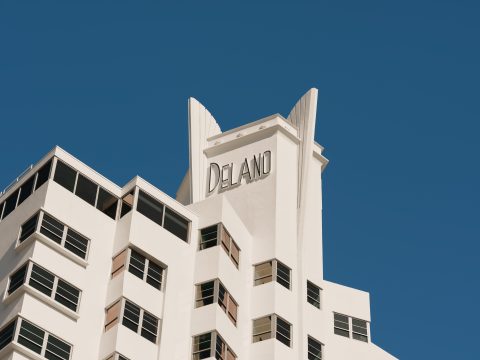
Philippe Starck can be credited with creating a particular code for Miami cool. As the designer of Ian Schrager’s Delano property, he kicked off the movement that led away from large hotel designs to boutique dreamscapes, one that has been copied the world over. He has been hailed (even by Haute Living) as the world’s leading designer of luxury restaurant, hotel, and real estate properties. Luckily for Miamians, we have an abundance of his great works dotting our shorelines. He is responsible for the designs of the Delano, Icon South Beach, and the new Icon Brickell, which opened this year. The property is being heralded as his greatest work yet, as it creates another worldly experience from the moment one enters the property by passing through the enormous sculpture garden of 100 twenty-two-foot-high columns inspired by the Maoi structures of Easter Island.

His tour in Miami will not end there. He has signed on as the exclusive design partner for SBE, entrepreneur Sam Nazarian’s entertainment and hospitality group. SBE is in the midst of transforming the former Ritz Plaza on South Beach into an SLS, using the highly successful Hollywood locale as a model.Mar-Apr07_ItalianCVCover: Giuseppi Cipriani
Issue: November/December 2005 and March/April 2007

From Italy to New York, the Cipriani name has long been synonymous with the good life. Since Haute Living strives to bring our readers information about the good life, we first featured Giuseppe Cipriani in 2005, when he announced the Cipriani Residences at 55 Wall Street. Two years later, he decided to bring his unique brand of hospitality south by launching the Cipriani Ocean Resort and Club Residences, a joint venture with developer Ugo Colombo’s CMC Group. The photo shoot of these two moguls took place at the Saxony hotel on Miami Beach, the future home of the resort/condominium condo. Spending a day with the two friends was an uplifting experience, as they were so inspired by the project at hand, ready to bring a taste of old-world glamour and charm back to the city. The project received its final financing in September of 2008, and CMC Group was ready to get started on construction. The company had just finished putting the final touches on the EPIC Hotel & Residences in Brickell, which opened at the end of last year to rave reviews. As for Cipriani Ocean Resort and Club Residences, interior demolition on the Saxony is underway, and the new tower is expected to break ground shortly. The current projections have the property opening summer 2010, bringing a taste of la dolce vita to the sands of South Beach.May-June06_SchragerCoverCover: Ian Schrager
Issue: May/June 2006

Just like Philippe Starck, Schrager can be credited with helping to kick off South Beach’s heyday as a luxury destination, a trend that is still running strong. His Delano Hotel has long been the go-to destination for the haute jet set, and in New York, he is known for his luxury properties such as 40 Bond and 50 Gramercy Park. But here in Miami, he is working on a new breed of luxury: affordable. While details on his new hotel project (designed by John Pawson) are scarce, we do know that it is slated to be on Miami Beach. In addition, he has partnered with the JW Marriott to create a new type of hotel that will combine the service that JW Marriott is known for with the boutique feel that Schrager has made his trademark. With as many as 100 properties in the works, Miami is likely going to be home to one of these unique hospitality havens.July-Aug06_DubaiCoverCover: Mohamed Ali Alabbar
Issue: July/August 2006

Haute Living Miami has dedicated two issues in the past five years to the burgeoning city-state of Dubai. A paradoxical world of wonder, Dubai captured our imagination from the get-go. From the man-made islands in the shape of the world to the incredible Burj Dubai, the world’s tallest structure, we were just in awe with every piece of news that came out of the desert. And to have the chairman of Emaar Properties, Mohamed Ali Alabbar, on the cover of one of our issues was such an honor. Emaar Properties is responsible for some of the region’s greatest residential developments, including Emirates Hills, Dubai Marina, The Meadows, The Greens, The Views, The Springs, Arabian Ranches, The Lakes, Emaar Towers, and the aforementioned Burj Dubai, an engineering feat that developers around the world will be scrambling to beat for decades. Beyond the development range, Alabbar is active in the betterment of Dubai as a whole through his plans to revolutionize and deliver much-needed health and education products worldwide. He puts these ideas to use through Emaar Healthcare Group and Emaar Education, which, when combined with the hospitality, hotels and resorts, malls, and commercial leasing divisions, will help the company reach Vision 2010, as Emaar strives to become one of the most valuable companies in the world by next year.Sep-Oct06_JadeCoverCover: Jade Jagger
Issue: September/October 2006

When we featured Jade Jagger, the beautiful daughter of crooner Mick, she was just cutting her teeth in the design world. Along with partner Tom Bartlett, a London-based architect, she had just launched “Jade Jagger for YOO,” the design division of the international über-development firm founded by Philippe Starck and real estate magnet John Hitchcox. At the time of the feature, Jagger’s first major YOO project, Jade, a 57-unit building in New York City, had just opened for sales. Mere weeks after the launch of Jade NYC, the project had created press coverage worth $2.3 million. The $90 million Manhattan condo tower features the famous daughter’s interior designs. Shortly after the sales office opened in New York, she headed south to Miami for the groundbreaking of the now-complete Icon Brickell, with designs courtesy of YOO by Philippe Starck. Jade Jagger for YOO is currently working on projects in Turkey, Morocco, and England. Last year, she partnered with Belvedere on the $250,000 Jagger Ice Dagger, which took a common ice pick and turned it into something truly beautiful and desirable. She also promotes Jezebel (her middle name and alter ego), a lifestyle venture that fuses music, fashion, and clothing through unique recordings and art. During Winter Music Conference 2009 in Miami, Jezebel hosted one of the most exclusive soirees in the city at the Mondrian South Beach. The gathering was modeled after Jagger’s legendary parties in Ibiza.Nov-Dec06_RosenCoverCover: Aby Rosen
Issue: November/December 2006

In “The Art of the Deal,” Haute Living’s cover feature on real estate tycoon and noted art collector Aby Rosen, we detailed how a close business relationship with Ian Schrager first brought Rosen to our fair city when the duo partnered on the Delano. We mentioned barely in passing his work on the development of the W South Beach, where he partnered with developer David Edelstein. At the time, the property was nothing more than a hole in the ground where a Holiday Inn had stood only a year prior. In an era of stalled projects and building delays, the W South Beach and The Residences at W South Beach recently opened as one of Miami Beach’s great success stories. Built from the ground up in a few short years, the W South Beach quietly opened its doors in June, yet quickly attracted a regular crowd of Miami A-listers and international jetsetters. The strikingly serene and modern property proudly displays pieces from Rosen’s personal art collection, including works by Andy Warhol, Kenny Scharf, Jean-Michel Basquiat, and George Condo.Jan-Feb07_ShaqCoverCover: Shaquille O’Neal
Issue: January/February 2007

Since appearing in Haute Living, the Heat’s biggest star turned in his Miami jersey to play for the Phoenix Suns followed by the Cleveland Cavaliers. When the basketball superstar left Miami, the city mourned; not only was he an inspiration to watch in the American Airlines Arena, he was incredibly involved in the community, even being named an honorary reserve police officer in Miami, a duty he took seriously. He memorably placed some misbehaving thugs under arrest one night on South Beach. His larger-than-life personality was a welcome addition to South Florida, and he didn’t shy away from the cameras and local establishments, as many celebrities in our midst so often do.

During his tenure in Miami, Shaq launched The O’Neal Group, which formalized the athlete’s long-standing love of real estate. The company partnered with MDM Development Group on Metropolitan Miami, a $1 billion mixed-use project on 9.3-acres of land in downtown Miami. The economic downturn has affected the development; originally scheduled to be complete in 2009, only Met One is up and running, while Met Two is currently under construction and Met Three has yet to break ground. Since Shaq left the Magic City, he has continued with his real estate acquisitions. The O’Neal Group has partnered with Boraie Development to form The Boraie O’Neal Urban Development Partnership, with a project underway in Newark.

Just this June, the last piece of Shaq’s Miami hold was sold. Even before being traded, Shaq put his Star Island mansion on the market, with an asking price of $35 million. The waterfront stunner features eight bedrooms, an indoor basketball court, gym, steam room, and sauna. The 2.5-acre grounds include a tennis court, six-car garage, dock, two-bedroom guesthouse, and pool displaying Shaq’s favorite Superman logo. Miami’s housing slump certainly had an affect on this trophy spread; four years after first going on the market, it reportedly sold for $16 million, which is $2.8 million less than Shaq paid for the property in 2004.May-June07(1)_FarkasCoverCover: Andrew Farkas
Issue: May/June 2007

The title of the cover article on the founder of Island Global Yachting says it all: Global Domination. At the time of the feature, IGY had just opened the world’s first five-star megayacht marina experience at Yacht Haven Grande in St. Thomas, USVI. The property combines white-glove service with state-of-the-art docking and a plethora of shore-side amenities, so that it more resembles a hospitality destination than a typical marina. In the two short years since the feature story, IGY has taken the successful formula it established at Yacht Haven Grande and applied it to 15 marinas from Montauk and New York, to Dubai and Croatia, with 10 locations in the Caribbean alone.May-June07(2)_SofferCoverCover: Don & Jeff Soffer
Issue: May/June 2007

The Soffers are an American real estate dynasty, with the holdings to prove it. At the time of our feature, the Soffers’ Turnberry Associates had a $5 billion portfolio that was expected to increase thanks to ventures in Las Vegas. Since taking control of the company’s residential sector, Turnberry has built more than 3,100 condo units in Sin City, the majority of which sold out before the market downturn.

Then, of course, there is the crowning achievement: Fontainebleau Miami Beach. Following a $500 million renovation, Jeff and his father unveiled the property in November to a crowd that included everyone who was anyone from Miami, Hollywood, and beyond. The Victoria Secret Fashion Show, filmed on property the night following the opening, introduced the hotel’s glossy new updates to a global audience when it aired less than a month later.

However, Jeff was unsuccessful in translating the Fontainebleau brand to the Vegas market. In June, he was forced to seek bankruptcy protection on the stalled $3 billion development on the Strip. Official reports say that the blunder will not have a negative affect on the family’s other holdings, and that the Miami Beach property is safe. Nakheel, a subsidiary of Dubai World, recently bought a 50 percent interest in the Fontainebleau Miami Beach resort for $375 million.July-Aug07_RatnerCoverCover: Brett Ratner
Issue: July/August 2007

For our three-year anniversary, we were honored to feature “Billion Dollar Director” Brett Ratner on the cover. The article detailed the Miami Beach native’s rise from a quasi-promoter at the Forge making $500 per week to one of the biggest box office draws in Hollywood. Ratner is behind films such as Rush Hour, X-Men: The Last Stand, and Red Dragon. When we profiled the director, his eight feature films had grossed more than a billion dollars worldwide. Since that time, he has released Rush Hour 3, which increased his billion-dollar ranking exponentially, and he is currently working on Playboy: The Life of Hugh Hefner. He also launched Rat Press, which is billed as “everything that film is not.” The works published by Rat Press go behind the scenes of the movie business, with interviews with actors and producers, as well as novels, photos, and artworks from the most prolific individuals in the industry. The latest publication is Scott Caan Photographs Vol. 1, featuring the photojournalism of the actor/writer/director. Between films, Ratner also keeps himself busy by directing commercials, such as the Risky Business play for Guitar Hero.

While now a Hollywood resident, Ratner’s impact on Miami Beach is still felt today. He played an active roll in the city’s transformation from geriatric haven to international haute spot, and the hometown boy is often back in the city hanging with his childhood friends Jeff Soffer and Shareef Malnik, who have also graced the cover of the magazine.Sep-Oct07_SheldonCoverCover: Sheldon Aldelson
Issue: September/October 2007

At the time of his cover feature in our Las Vegas-themed edition, casino magnate Sheldon Adelson was listed as No. 3 on Forbes’ list of the wealthiest Americans. What a difference two years and a global recession can make. Adelson’s fortune took some big hits in 2008, dwindling by $13 billion as shares in his Las Vegas Sands dropped 65 percent due to a lack of gamblers in Sin City and Macau. The son of a taxi driver was No. 15 on Forbes’ 2008 list, but in 2009 he took an even bigger hit. He lost a whopping $22 billion in 12 months, and shares dropped by 95 percent. His personal net worth is now estimated at $2 billion, not a bad figure for the 75-year-old college dropout. He remains positive that the market will turn around soon, and his empire will once again reign over the Strip. He has reason to be optimistic: his stalled casino project in Macau may soon be resuming construction.Nov-Dec07_KellerCoverFLCover: Samuel Keller
Issue: November/December 2007

Often regarded as one of the most influential people in the art world, Sam Keller is responsible for bringing Art Basel to the shores of Miami Beach. The Basel, Switzerland, native launched America’s most important art event in 2002, which brought a new level of sophistication to a city that previously was regarded as a tourist haven. Each December since, international art cognoscenti descend upon the city for a weekend full of glamour, panache, and sophistication. While 2007 was Keller’s last year as the director of Art Basel Miami Beach, the 2008 show did not lose any of its allure without him at the helm. While the economic climate may have impacted sales, the show was still an overwhelming success, and 2009 is expected to be as well. Art Basel Miami Beach allowed the city to grow up in the eyes of the cultured world, and other institutions have taken notice. Frank Gehry and Herzog & de Meuron are both involved in projects on the Beach that will further cement the city’s rightful place as a cultural haven rather than a Spring Break destination.Jan-Feb08_MalnikCover: Al & Shareef Malnik
Issue: January/February 2008

When Brett Ratner offered to take the cover photos of “Living Legend” Al Malnik and his son Shareef, we couldn’t have been more honored. A long-time family friend, Al often refers to Ratner as his 11th son, and he even helped get the billion-dollar director his start in his film career. Ratner, an accomplished photographer, headed to the Malnik estate in Palm Beach for a photo shoot that captured the compelling father-son dynamic of Al and Shareef. A legendary lawyer, entrepreneur, and restaurateur, Al is the mastermind behind culinary institution The Forge, which dominated the haute dining scene for decades as the place on Miami Beach. Shareef took over the restaurant in 1991, and the establishment continued its reign. Now, Shareef is taking this proven formula and expanding on a global scale. While the Miami location is closed in July for multimillion-dollar renovations, hungry patrons looking for The Forge’s inimitable steaks can satisfy their cravings at The Forge Dubai, located in the Ottoman Palace Hotel, and there are also talks about a Forge Las Vegas. The Malniks are also actively involved in the betterment of the community, working with the Make-A-Wish Foundation.

Al recently made headlines when false rumors about the paternity of Michael Jackson’s youngest son Blanket started flying. Al is the boy’s godfather, and some were questioning if he was the actual father. Al went to two media sources to refute these claims: The Today Show and Haute Living. He opened up to our publication for the cover story of the Los Angeles edition (the article also appears in this issue), sharing personal family photos and details about intimate moments with the star, and we were happy to be able to provide a worthy outlet for his memories.Mar-Apr_SHARP_FLCover: Issy Sharp
Issue: March/April 2008

Isadore “Issy” Sharp began building a name for himself and a brand for luxury lovers in the early 1960s. Today he is the CEO and founder of more than 80 international locations of Four Seasons hotels, an accomplishment that earned him a spot on one of our early covers in 2008. For several consecutive years, the Four Seasons was voted the best company to work for, and customers can’t seem to get enough of the bespoke service and luxury offerings that the five-star hotel brand brings. Since the recent change in global economic conditions, Sharp has stated that his bottom line is suffering just like everyone else’s in 2009. And though his locations in the Middle East are faring better than the North American and European branches, he is still making current business decisions based on a conservative approach. But a modest strategic plan doesn’t mean that the brand is cutting back on the white-glove, world-class standards upon which it has built its unblemished reputation. As Sharp recently explained, right now is a time when the management skills of his staff will be tested. It is a time to determine how to survive without compromising the guest experience. And that, in a nutshell, is the winning philosophy that has earned him an unprecedented number of accolades and a RevPAR (revenue per available room) rate that traditionally has been approximately 25 percent higher than his competitors. He credits such an impressive statistic to the value that the Four Seasons brand offers, and his formula for achievement has proven so successful that he recently authored a book about it, Four Seasons, The Story of a Business Philosophy.AugSep08SultanCVCover: Sultan bin Sulayem
Issue: August/September 2008

Named a “Global Leader of Tomorrow” by the World Economic Forum and one of the top five most influential Arabs in the world, Sultan bin Sulayem proved the ideal cover personality for our Fall issue in 2008. He is the chairman of Dubai World, the parent company of some of the fastest growing global businesses, including Nakheel, the real estate powerhouse behind the Palm Islands. The development project was born in 1997 because of the vision of Sheikh Mohammed bin Rashid al Maktoum, Ruler of Dubai and Prime Minister of the greater United Arab Emirates, who wanted to increase Dubai’s tourism industry. Under bin Sulayem’s leadership, Dubai World oversees interests in more than 80 companies, and has recently staked quite a few claims on the African continent. It is reported that he applied for permits to dock the floating luxury hotel, Queen Elizabeth 2, in Cape Town, while he has also supposedly inked deals for two luxury hotels in Ethiopia. But his American interests are prevalent as well. Stating the need to see opportunity in times of financial turmoil, Nakheel bought 50 percent of the Fontainebleau in Miami Beach for $375 million.CV-HELIO_80021919Cover: Helio castroneves
Issue: June/July 2009

When Roy and Lea Black approached Haute Living about Helio Castroneves appearing on the cover of our June/July 2009 edition, we jumped at the opportunity. A Miami local, Helio is a fixture throughout the city when he is not off taking flags in the biggest racing events around the globe. The Formula 1 racer had just had two amazing victories: first, in his tax evasion trial, during which he was represented by Roy Black and team, followed by win at the Indy 500 just a few weeks later. The Blacks and Helio bonded over the course of his trial, and the personal relationship allowed Helio to open up to Lea about his roller coaster ride of emotion following the trial.
Aug 20, 2009 9:27 AM
Ahoy, Oculus!
by Natasha Dorsainvil

When the Oculus finally makes the grand leap from animated concept to cruise above the world’s most premier cerulean seas, shore-side eyes will join company with those who have already ogled and ahhed at the ship’s progressive renderings.

It’s the boat’s unique design that piqued people’s interest and has been causing a stir amongst megayacht and design enthusiasts alike. The concept comes courtesy of Harvard-trained architect E. Kevin Schöpfer, who founded the Boston-based Ahearn | Schöpfer and Associates more than 30 years ago. The firm’s projects run the gamut from the traditional European-style Hotel Commonwealth in Boston, Massachusetts, to the out-of-this-world International UFO Museum & Research Center in Roswell, New Mexico. Oculus represents Schöpfer’s first foray into the water world. “I started looking at [yachts] from the interior design point of view and I thought it was the right extension of high-end residential,” Schöpfer says. “The more I looked at them, the more I realized I liked the outside as well.”

With Oculus, Schöpfer used his experience in architecture and interior design to carve out an untouched U.S. market, which he hopes will seduce yachters in search of boat profiles that break through more than just water. When he first decided to embark upon the yacht scene, Schöpfer didn’t want his place in the trade to be etched by the conventional lines and angles associated with long established yacht designs. “I saw that traditional yachts weren’t progressing a lot,” he explains. “I saw that there was a niche where someone could explore something a little more robust.” He sought to make waves in a completely different way.

Schöpfer brought the Oculus to life by way of a fortuitous meeting with digital animators Tangram 3DS. The animation firm was looking to tread into the yacht market right around the time Schöpfer launched Schöpfer Yachts, in 2008. Fish and squid were the inspiration for their first collaboration. More like an enormous whale because of its size, Oculus’ stunning design plans are the inaugural fruit of their partnership.

With speeds that can top at 25 knots, the 250-foot ship will boast a super super yacht composition that brings to mind a variety of sea life. Schöpfer’s most obvious innovation is the ship’s reverse configuration that upends the front of the vessel. The bow resembles the smooth forehead of a dolphin at the moment it breaks the surface of water. At the stern, the ship cradles one of its three expansive decks between the toothless upper and lower lips of an open-mouthed barracuda and finishes off the look with the help of swooping circular windows for eyes. Oculus’ hull features elongated and curved window carvings that are reminiscent of the markings on an orca. Set at a low profile, the Oculus allows for side recreational areas that utilize retractable panels to keep rough waters in the ocean. This exterior feature also makes accessing docked sea sport vehicles less of a hassle. Schöpfer’s website describes the Oculus’ unique and innovative bodywork an “elegant expression of symmetry and structure.”

With regard to the nonlinear innovations outside, Schöpfer’s designs provide an airy and light-filled setting for the conveniences and surfaces that yachters expect in a ship’s interior. “There’s sometimes a big disconnect between the outside of yachts and the inside—and that’s not a bad thing,” Schöpfer explains. “Many people want a very traditional inside, and that’s fine. I feel that [design] should all flow together. In this case, I said let’s combine it all and do both the architecture and interior.”

Aboard, the long-range yacht will accommodate up to 12 guests within sleek and luxurious settings. Taking a page from the vast ocean, 12-foot ceilings will appear endless above guests in the first level’s main salon. Also on that level will be a cylindrical, double-height dining room, central stairway, and an elevator tube.

On the Oculus’ second level, plans call for a sprawling dedicated owner’s suite with well-appointed living and sleeping quarters. Four freestanding columns will serve dual purposes as structural dividers for the fluid space and ideal locations for bath and storage areas. Bridging the second and third levels is the separate owner’s stairway between the third level’s aft private salon, deck, and water feature. Other third floor highlights are a pilothouse, separate captain’s quarters, and a complementing deck and water feature at the opposite end of the ship.

Although Oculus is still in its concept stage, Schöpfer has teamed up with naval architects Sparkman & Stephens to build the ambitious creation. “What I always try to do in my business is get the best people around me. In my research, I found that everybody thought they were the best. So I approached [Sparkman & Stephens] after Oculus was far enough along so that they could get a sense of it, and they agreed to join forces,” Schöpfer comments.

While Schöpfer offers a pretty impressive idea of what the ship’s overall structure will resemble, he’s careful to leave room for his affluent clients’ discerning preferences. “Because there is no particular client here,” Schöpfer says about the Oculus design process, “we’re sort of inventing it as we go along [to see] what the ideal environment could be both inside and out.” There have been serious inquiries from like-minded individuals.

A self-described restless thinker, Schöpfer’s inventive design abilities show no signs of ebbing. He has already unveiled his second unique aquatic venture under his Schöpfer Yachts brand. Much larger than its older sister Oculus, Infinitas spans 300-feet and is a dramatic personification of the infinity symbol.

Aug 19, 2009 3:56 PM
Ready for Takeoff
by HauteLiving

By Monique Stringfellow

The Bombardier Learjet 40 XR puts light jets into a whole new category of performance.

E7F0001

The Bombardier Learjet 40 XR is the most technologically advanced light jet on the market today. It is faster than any other aircraft in its category and its takeoff is shorter as well. At a soaring altitude of 51,000 feet, it supersedes commercial crafts and rockets past the competition. What does that mean for you? It means you get the shortest, safest, most comfortable trip possible. And so, with the introduction of this model in the Learjet series, one small step for Bombardier equals a giant step for light jet travel.

The Learjet 40 XR, introduced nine months after the revolutionary Learjet 40, offers increased take-off weight, faster cruise speeds, and better time-to-climb rates as compared to the Learjet 40, advances that come as the result of upgraded engines. The Learjet 40 and the 40 XR have a shorter fuselage than their predecessor, the Learjet 45.

Despite its lighter weight and smaller size, the Learjet 40 XR still retains a considerable carriage capacity, holding up to seven passengers and two crewmembers. It is spacious in terms of its ability to hold cargo as well; the 50 cubic feet of external baggage space offers storage for up to 500 pounds of regular or oversized luggage while the internal space measurements total 15 cubic feet.

This seemingly paradoxically large interior is another factor that makes the Learjet 40 XR a standout in its class. The cabin is about 20 percent larger than today’s light business jet. It is also the tallest in its class, reflecting the aircraft’s premium status. With superior style and functionality throughout, it has every amenity to maximize passenger comfort and productivity, incorporating the facilities and space that we associate with larger craft into the body of a smaller plane.

The cabin area is available in a number of layouts to suit the specific needs of a sophisticated traveller. Just as with cars, homes, toys, and wardrobes, personalization can transform the generic into something that exudes class. Bombardier Learjet aircraft can be outfitted to meet owner preferences, with a full selection of interior, exterior, equipment, and avionics options. There is something for everyone, whether one’s tastes are conservative or trendy, or their technology needs are basic or highly specialized.

Another important feature of the Learjet 40 XR—particularly in this day and age, where cost- and fuel-efficiency are weighing heavily on almost everyone’s mind—is the relative affordability. The 40 XR is incredibly economical due to its fuel-saving capabilities. It is truly a business jet for the times. The small size is key, as it is a full two feet shorter than the Learjet 45, which means it accommodates two less passengers and carries 100 fewer gallons of fuel. Despite its reduced stature, the internal workings are nearly identical between the 40 and the 45. The two share the same engines, avionics, wings, cockpits, and fuselage cross-sections, but the reduction in size and weight accounts for a $2.4 million difference in the price tag.

What’s more, the Bombardier Learjet 40 XR is a high performance jet. It has specifications that ensure maximum flight capabilities even in extreme heat. The XR aircraft features a 600-pound increase in maximum takeoff weight, increased fuel capacity, and a pair of high performance Honeywell TFE731-20-BR engines that improve time to climb and deliver better high-speed cruise. Under hot and high conditions, the Learjet 40 XR can fly up to 1,000 nautical miles farther than the Learjet 40.

Business travellers appreciate that this fuel- and cost-efficient increased performance comes with almost no sacrifice of comfort or interior spaciousness. It still feels like every bit the luxury aircraft, a well-appointed home in the sky for frequent flyers that demand the best.

Aug 19, 2009 2:26 PM
The Wonderful World of Chow
by Tatijana Shoan

With the mere mention of the name Mr. Chow, one immediately thinks of the famed restaurants that are revered not for just the food but for the experience, the scene, and the trendy, celebrity-infused crowd that dines there. Michael Chow’s restaurants are more than high-end eateries; they are institutions that become ingrained in the culture of the city they inhabit.

This can be attributed to the fact that Mr. Chows have always been in the right place at the right time. The London location opened its doors in 1968 and is still going strong. The Beverly Hills hotspot launched in 1974 and continues to serve an eclectic mix of A-list celebrities, art-world stars, and international jetsetters. Mr. Chow in Midtown in New York opened in 1979, and famously served the faction who put Studio 54 in the history books. Tribeca’s outpost opened in 2005 and quickly became the restaurant of choice for New York’s stock market mavens, and a Las Vegas eatery is in the works, scheduled to open in 2010. Copycats consistently pop up hoping to take over Mr. Chow’s reign, but none can boast such a legacy or innate understanding of what captivates the cultured diner. In decades to come, what will be remembered of Mr. Chow restaurants is that they prospered in the toughest, fastest, and trendiest cities in the world. With no signs of slowing down, Mr. Chow is about to unveil a new location in our own backyard at the W South Beach, which has foodies salivating in anticipation of the pending August opening.

Restaurateur Michael Chow successfully created a culinary dynasty that sprouted in China and planted its roots in the new world. A master of design and architecture and a predictor of trends, he single-handedly revolutionized the way the West sees and eats Chinese cuisine.

The birth of Mr. Chow restaurants came from Michael’s desire to reconnect with his heritage. He was sent away from his home in China to an English boarding school at the age of 12, never to see his parents again due to the ravages of the Cultural Revolution. “I had a desire to link the past, which is my culture, and establish a structure base because I lost everything and wanted to regain it,” he explains. “I experienced racism in the West, so the only way to reduce that is by cultural defending. Mr. Chow restaurants are a bridge between East and West. They gained a reputation of respect and refinement. [The restaurants] show how sophisticated Chinese food is, and thereby [the sophistication of] the culture as well.”

Michael gained the respect he deserves by serving authentic, high-quality Chinese food with silver cutlery and a price tag to match. He opted out of using chopsticks “because people would come to the restaurant and play with them. The food is too good to be played with.” The American public’s reference to Chinese cuisine is through low-end, inexpensive dishes that are high in salt and sugar. If one is adventurous enough, they might take a trip to their local Chinatown where the food is typically Cantonese- and Sichuan-based—heavy in sauces and quite greasy. On the flip side, Mr. Chow serves Beijing cuisine, considered more sophisticated with roots in aristocracy. (Beijing is where the emperor lived, and typical dishes avoid heavy seasoning.) Beijing cuisine isn’t commonplace in America simply because it’s hard to come by authentic Beijing chefs. Training begins at an early age and is approached as an art. Skilled teachers not only pass down techniques, but a 1,000-year-old culture. Form and foundation are very important, as are the schools where chefs train. Because of this instruction and dedication to ancient culinary customs, Mr. Chow’s new Miami location will easily be one of the best new Chinese restaurants in America. Nick Du, a leading master in Beijing cuisine, along with 10 additional chefs from China versed in other regional cuisines, have been flown into the city to create a menu using both tradition and progression. A must-have will be the rice cake with clam and spinach sauce, a mixture of Shanghai and Beijing cuisine.

The design of the establishment is something to be celebrated as much as the food. A student of architecture, Michael has designed every one of his restaurants. His signature good taste is now legendary and dates back to the year 1965 when he designed his first project, a hair salon in London that Twiggy later took over. Upon seeing the design, hairstylist guru Vidal Sassoon praised Michael for having vision ahead of his time. The illustrious French designer Hubert de Givenchy said the Mr. Chow restaurant on 57th Street in Manhattan is designed as beautifully as a jewel box, and Giorgio Armani called Michael Chow a “genius” and hired him to design his boutiques in Beverly Hills and Las Vegas. Michael designed Armani’s Rodeo Drive store back in 1987, and to this day it still feels fresh and modern, an extraordinary feat for a design born in a decade of neon colors and bubblegum pop rock. Celebrated artists like Andy Warhol, Keith Haring, David Hockney, Francesco Clemente, and Jean-Michael Basquiat have all immortalized Michael on canvas, and Warhol and Basquiat famously worked off their restaurant tabs by painting Michael, a preferred payment that enabled him to keep the patronage eclectic.

For the last 20 years, Michael has shared his success with the strikingly elegant woman he made his wife, Eva. “Eva is extraordinarily talented,” boasts Michael. “She is an incredible chef, great at flower arranging and giving parties. As far as I’m concerned, I’m not bad, but she is much better.”

As a young girl in Korea, Eva trained with masters of Chinese watercolor. Their influence has carried her through life; she looks at form and design, and expresses her own individuality with the skilled eye of a designer. She left Korea at the age of 17, eventually landing in New York and becoming a prominent figure in the fashion scene. Her line was sold internationally and carried by such exclusive shops as Barneys New York, Saks Fifth Avenue, and Bergdorf Goodman. Eva left the fashion industry upon giving birth to her daughter Asia, but she continues to design her own jewelry—masterfully detailed Art Deco creations she molds and casts using the highest quality gems and pearls. These days her creativity and trained eye are put to excellent use as she works side-by-side with Michael to conceive and design their restaurants. The business is known for being relentlessly competitive, but “we like it,” she says. “Obviously we have some days where we look at each other and say, ‘Why are we doing this?’ but that doesn’t last too long. I love to entertain, and Michael loves to promote China and Chinese culture. The greatness of Chinese food is his motivation and passion, and I think he feels very rewarded when he sees his restaurants and his diners eating and happy. Those are magical moments. In restaurants there is a similarity to performers who get their high on stage in the sense that you get so much satisfaction from the reaction of your clients.”

Opening a restaurant in Miami was something Michael and Eva have been debating for 15 years, so when they were approached by the team behind the new W South Beach, the couple knew this was the right moment. “My husband and I aren’t the type of people who aggressively pursue something,” says Eva, “especially when it comes to opening a restaurant. The Miami location has been long coming, and we waited very patiently and turned down a lot of opportunities. We are glad we waited and are happy to be doing this with the W.”

In so many trendy new restaurants, owners save money on design by using inexpensive and easy-to-find materials that can be masked by the use of low light. The opposite is true of Mr. Chow establishments where quality, craftsmanship, and art reign supreme. Michael and Eva’s approach to creating their restaurants is organic and an extension of their lifestyle, where global education is communicated through color, comfort, and artistic vision. The Miami restaurant, located on the ground floor of the W South Beach, is nearly 160 feet long. Gold leaf Swarovski chandeliers run the length of the room, acting as ornate halos of light. The walls and floors are adorned with French limestone, and tables and chairs have dark brown and black lacquered accents. Known for their patronage of the arts, the couple’s personal extensive collection is displayed in all of their locations; in Miami, a majority of walls are windows, so the view serves as the artwork. However, they will be hanging a piece by Denise De La Rue, an emerging Mexican artist, as well as a series of Sir Peter Blake portraits, an eminent British pop artist Michael has known since his teens.

The cuisine is of the same caliber that has come to be expected of the Mr. Chow name. “I think there is a very fine line with being consistent and always moving forward,” says Eva. “The most important thing for us in our restaurants is that the food and service stay consistent, yet never boring. Our staff is our family and many of them have been with us for more than 25 years. They also have relationships with our clients, and therefore our clients feel special when they dine with us. This makes our service and food consistent, yet we always stay up-to-date with the advances being made in Chinese cuisine. For the first time in Chinese history, regional foods are merging, creating new flavors and spices. This is a very exciting time for people who like Chinese cuisine,” explains Eva. “For the first time in the evolution of Mr. Chow you will find new dishes with heavy spices; it’s very off the grill, so to speak.”

In the Chows’ home in Bel Air (yes, Michael designed that too), dominating his-and-her fireplaces blaze on opposite sides of the indoor courtyard, flanked by a Julian Schnabel portrait of Eva in her Vivienne Westwood wedding gown, and a Jean-Michel Basquiat portrait of Michael painted in the ’80s. The couple has been painted and photographed by the world’s leading artists, an honor bestowed on very few. They were recently featured in L’Uomo Vogue’s Icon Issue as one of the most beloved couples in the world. Their allure goes beyond design and lives in a realm that merges continents and gives us a cultured view of what happens when East meets West.

Their hospitable nature transcends into their home. Together the couple hosts parties based on the theater mantra: Don’t bore the audience. To receive an invite to one of these gatherings is to be inducted into Hollywood high society. For each of these alluring evenings, Eva has special tablecloths made and uses antique silver and china collected during her travels around the globe. She handpicks flowers so the blooms time perfectly with the soirees. As passionate about philanthropy as she is hospitality, Eva serves as a trustee of Los Angeles County Museum of Art and the couple is active in several charities.

Whether fully immersed in their philanthropic endeavors, in hosting elegant evenings in their home, or welcoming their loyal patrons into a new dining venue, it is clear that no matter what the venture, it will be a fervent extension of the Chows themselves, and a warm welcome into a culture and lifestyle they are proud to share.

Mr. Chow Miami opens for W Hotel guests this August and will begin taking outside reservations in September.

Aug 19, 2009 1:51 PM
The Winning Strategy
by Christina Bohnstengel

It was a cold day in February—Valentine’s Day to be exact—and the town of Phoenix, Arizona, was descended upon by a bevy of legends in their own time, including NBA stars, film industry magnates, Grammy award-winners, and Fortune 500 CEOs. It was the NBA’s 58th annual All-Star Weekend. And while for basketball fans, it was a weekend chock-full of fun-filled contests centered around the hoops, for marketing-driven entrepreneurs, 2009’s holiday for lovers served as the ideal platform for promotions and brand attention.

Noah Tepperberg, CEO and cofounder of Strategic Group, was such a tycoon at the helm of the PR events for the All-Star Weekend. For the third year in a row Strategic Group teamed up with Jay-Z and LeBron James for the “Two Kings Dinner and After Party,” and—the most important part—presented by Sprite Green.

Jay-Z, the “King of Entertainment” (as well as part owner of the New Jersey Nets), along with LeBron, the “King of Sports,” cohost the Two Kings event each year, inviting the who’s who in business, entertainment, and sports to a private power dinner, which, this year, was held at The Phoenician in Scottsdale. Following the exclusive feast, the after-party began, and 500 more power players, including Beyonce, Grant Hill, Shaquille O’Neal, Kobe Bryant, Jesse Jackson, John Legend, and Spike Lee, flooded the ballroom for the DJ beats, dancing, and drinks. This year, the nonalcoholic beverages came in the form of Sprite Green, the corporate sponsor who enlisted the help of the famous former club kid from New York City. Today, at 33 years old, Tepperberg’s reputation has evolved from that of mere party promoter into one that is revered throughout the nation as a mastermind of strategic planning. For this particular project, the carbonated company hired Tepperberg’s Strategic Group to help launch the new Sprite Green advertising campaign.

But it’s not all about marketing; philanthropy plays a part in the Two Kings event weekend as well. Earlier in the day, Sprite Green and the two kings stopped by the Mesa Arts Academy in Mesa, Arizona, to donate 150 musical instruments (including a signed piano) to the struggling school.
“They [Jay-Z and Lebron James] don’t hire us directly to do the event,” says Tepperberg. “Instead, what we do is, between their relationships and our relationships, we put together a corporate partnership. We found the venue, and we put together the deal between the brand, the hosts, and the venue. We coordinated the charity component, the dinner, and the party, we handled the guest list, and handled the PR for what turned out to be another fantastic event.”

And while the success of the entire weekend cannot be fully credited to the great Noah Tepperberg, the fact that the title of the event, “Sprite Green presents the 3rd Annual Jay-Z and Lebron James Two Kings Dinner and After Party” garnered more than 80 different print, web, and television mentions can certainly be ascribed to his business savvy. Calculations by Tepperberg’s Strategic Group indicate that those 80 mentions earned more than 1.4 million media impressions in a circulation pool of more than 1.1 million.
Tepperberg is not the only mogul mind running the show at Strategic Group. It is a multifaceted operation that he founded seven years ago with his longtime business partner and high school friend, Jason Strauss. The legend of the dynamic duo in New York City club lore is well documented as they have been in the business now for more than 15 years. The partners began as high school party promoters in the early 1990s, hosting some of the most decadent parties of the decade. The progression from adolescent club host to legitimate club owner did not take long, and two years after Tepperberg’s graduation from the University of Miami in 1997, he linked up with Strauss for their first venture as proprietors; their new baby was Conscience Point in the Hamptons, which they held onto for three years. (They sold the seasonal social hot spot after the summer of 2001, coincidentally the same summer that PR princess Lizzie Grubman notoriously backed her father’s Mercedes SUV into a crowd waiting at Conscience Point’s red ropes, screaming expletives at the doorman, and driving off into the night, leaving 16 injured victims in her wake.)

Shortly thereafter Tepperberg and Strauss opted out of club land and took their inherent event planning expertise to the next level with the creation of Strategic Group in 2002. “When we first started we were just an event firm. Then it grew to an events and consumer promotions firm doing projects for a lot of liquor brands,” explains Tepperberg. “We didn’t open the doors with a set business plan. We’re entrepreneurs, so it’s like we saw an opportunity and started a company to fill a gap in the marketplace.” The gap they filled offers clients a multi-tiered, one-stop shop for all aspects of brand identification, public relations, advertising, and event planning. In 2004, they brought in Seth Rodsky, the CAA marketing guru with his own legendary reputation, to enhance the marketing services of the firm. According to Tepperberg, the book definition of Strategic Group today is a full service marketing, promotion, and special events company that builds brand experiences for consumers and influencers through nightlife, entertainment, and lifestyle programs. “For example, when a company like Yahoo! wants to do an event, rather than hiring a company to do the creative, one to do the production, another to do the PR, one to bring the crowd, and another to bring the talent, they can just hire us. We have all of those divisions in house. It’s a no-brainer actually, and it makes it very seamless for our clients,” says Tepperberg.

The seamlessness for the clients is enhanced by the fact that Strategic Group operates six of their own venues on both the East and West Coasts. “Frequently, we’ll do these events at our own venues. So the management of the venues and the event companies are all in sync, as opposed to having all of these outside vendors coming in, which can make it not as organic for the client,” he says. “Obviously we do events and programs all throughout the country, not just at our own locales, but having our own venues also gives us an incredible amount of access, which is really unparalleled by any other firm in the industry. That is a key point of differentiation for us, and we are able to leverage that for our clients. It ultimately drives results, and we create really powerful experiences because of that.”

Marquee, their oldest club baby that opened in New York City in 2003, is certainly one of their most celebrated venues, with A-list celebrities waltzing through the notoriously guarded velvet ropes on a weekly basis. The fact that Marquee is in its sixth year of life and is just as frequented and written about today as it was in its infancy is a remarkable feat. “It takes a lot of work to keep it fresh and as popular as it was when it first opened,” Tepperberg explains. “The truth is that we have a phenomenal team there. It is beyond just Jason and I. It has truly become like the Cheers of nightclubs, and we fully expect to live out the length of our lease. We’re six years down and nine to go. But actually, if we only make it 10 total, then I’ll be happy, considering that three years is about the average lifespan for a nightclub.”

After Marquee, several other club children came into being under the Strategic Group umbrella, including Dune, a beach-chic nightclub in the Hamptons and their newest bundle of joy, the two-month old Avenue in New York, which they are billing as a gastrolounge. “Avenue is our jewel box,” says Tepperberg, making sure to emphasize that this venue is not a nightclub. “It’s a small, ultra exclusive lounge with a beautiful and sophisticated clientele.” The menu, which he describes as comfort food, includes tuna tartar, salad rolls, popcorn shrimp, and as Tepperberg described, a fantastic pretzel dog. “We’ve got an incredible chef. The food is served in small dinner boxes, so it’s not like going to a plated dinner at a sit-down, tablecloth restaurant. It’s more casual and the food is served until 4 a.m., so in addition to the early cocktail crowd, we also get a late-night munchie crowd.” The owners of Tao New York, Marc Packer and Rich Wolf, also brought them in to help oversee the operations at Tao and Tao Beach in Las Vegas, as well as Lavo, an Italian restaurant and Mediterranean-themed bathhouse nightclub in The Palazzo Resort-Hotel-Casino in Las Vegas.

Additionally, for the past five years, Strategic Group has been in charge of the operations for the Bridgehampton Polo Club, making for a very busy summer in 2009. “Strategic Group has a long term agreement with Peter Brandt and Neil Hirsch to run the matches; handle the production of the event, the VIP tent, the guest list, the PR, the talent management; and all of the sponsor procurement,” he says. “This year we have had record turnout with more than 3,000 people over two weekends. It’s THE social event of the summer out in the Hamptons and luckily there’s six weeks of it, so we have a big web to catch a lot of the great people who come through the Hamptons.”

There are many new projects on the drawing boards for Tepperberg, Strauss, and Rodsky at Strategic Group, but like the well-trained marketing whiz that he is, Tepperberg is careful not to prematurely mention them. It stands to reason that with Strategic Group’s many creative layers and leaders, we will be hearing and reading about them again soon.

Aug 19, 2009 1:43 PM
Rah-Rah Rahr

It’s a beautiful day at the beginning of a long holiday weekend in July, and Stewart Rahr is sporting his signature yellow glasses. He calls them his “Rah Rah Ray-Bans.” They are his trademark, and he is known for convincing other bigwigs to don the shades for photo ops, including President Bill Clinton, who wore a pair during a golf outing with the pharmaceutical magnate in early July, when the duo played a round with Arnold Palmer and Donald Trump. They make for the perfect accessory for Haute Living’s cover photo shoot; the Rah-Rah Ray-Bans are bright, in your face, and help define the man behind them, who declares that he lives a type of “Rah-Rah” lifestyle. This unique brand of attitude and panache is one others aspire to. Rahr is the self-declared King of All Fun, and the shades serve as his crown.

Rahr is one of the wealthiest men on the planet, and he certainly doesn’t shy away from the spotlight. He earned his money the hard way, from long, grueling days of intense, non-stop work (combined with an inherent business sense), and he uses his fortune not only to fund his good life, but to make the dreams of others come true as well.

The cover shoot is taking place at Rahr’s Wainscott, East Hampton, home, which was featured in glossies and newspapers across the nation when Rahr purchased it in 2005. At the time, it was the most expensive real estate transaction in New York State’s history, with a closing price of $45 million. Rahr paid cash. The 25-acre property sits on Georgica Pond, known to be one of the most exclusive enclaves in an utterly exclusive town, and his neighbors include the likes of Steven Spielberg and Ron Perelman. What’s more, Rahr wasn’t even in the market for a property when he came across Burnt Point, but all it took was one look for him to make an offer on the estate. “I wasn’t looking to buy the home,” Rahr explains, “but my friend Howard Lorber [from Prudential Douglas Elliman] had the exclusive on the property. He had been telling me about it for six months, but I never wanted to look at it; I had a home five miles away in Sagaponack.” Upon seeing the 18,000-square-foot home and the sprawling grounds, which include a private, 2,000-foot beach with dock and boathouse, tennis court, and greenhouse, Rahr was smitten. He famously purchased the property, furnishings and all, and it became his family’s sanctuary on weekends from May through early September.

Burnt Point is a place he goes to relax, to unwind from the rigors of his everyday life. “On the pond, it’s peaceful,” he quips. “It’s everything I need, because I am always multitasking, doing so many different things at the same time. When I wake up here in the morning, and just have breakfast on the terrace and see the swans and the other beautiful birds, it stimulates me in a calming way. It’s good for me.”

It’s a needed sanctuary considering that the rest of his life is known for being a whirlwind of social and business obligations that often lands him on the society pages. He runs with quite the crew, hitting the links with the likes of Donald Trump, Justin Timberlake, Phil Mickelson, and George Lopez, and cruising the society circuit with his wife Carol. His brash personality and biting wit are as much of a trademark as the yellow Ray-Bans, and there is no room for doubt this over-the-top character is a direct result of his Queens roots.

Rahr’s childhood in the outer borough was solidly comfortable; his father Joseph ran a small company in Brooklyn called Kinray Pharmacy, but the younger Rahr had little intention of going into the family business. It wasn’t until he was in law school at NYU that he was called to action; Joseph was losing his partner in Kinray Pharmacy and was forced to consider closing the business because of behemoth competitors and brutal market conditions. At the time, the company had only five employees and did less than a million a year in sales. It was the Stewart to the rescue; he grew up watching his father navigate the industry and knew what was needed to make the company thrive: hard work and a winning personality. “People tell me I was a good salesman,” he recalls, a trait that is still apparent. He hit the streets, and Kinray evolved from a local pharmacy into a drug wholesaler, as Rahr bet big on the increase in the price of pharmaceuticals. It was a wager that paid off. In the subsequent decades, he worked tirelessly for 20 hours a day, seven days a week, growing Kinray into the world’s largest privately held distributor of pharmaceutical, generic, health and beauty, and home healthcare products, with an annual revenue around $5 billion. His father has since passed, and Rahr is the company’s sole owner.

This allowed him to amass a personal fortune around $2 billion with a ranking as No. 227 on the Forbes 400 in 2009. It’s an impressive number that has afforded him the lifestyle that others can only dream of, and one he certainly takes advantage of. In addition to Burnt Point in the Hamptons and his two apartments in NYC, Rahr’s holdings include a space on the 30th floor of Trump Park Avenue and an impressive art collection made up of masters like Renoir and Picasso. But while these worldly possessions may be the hard-earned result of his business acumen, he cites Winston Churchill for his ultimate inspiration: “We make a living by what we get, we make a life by what we give.”

Rahr is one of our country’s most active philanthropists, serving as a benefactor for the Robin Hood Foundation, The Columbia University Medical Center, The Shriners Childrens Hospital, The NYU Medical Center, The Parkinson’s Foundation, The Israeli Defense Force, The Alzheimer’s Association, The Christopher Reeves Coalition, The Leukemia and Lymphoma Society, The Breast Cancer Society, The Skin Cancer Foundation, The Rainforest Foundation, P.A.L. (he donated $1 million just last month), and countless others. “Life is dependent upon how you feel and how you interact,” he explains. “Giving back is important to me, because there are no luggage racks on top of a hearse.”

But the cause closest to his heart is the Make-A-Wish foundation, and he has granted one wish per month for the past six years, with no end in site. His generosity has earned him a top spot as Make-A-Wish’s largest donor in history (he donated $1 million in 2007 alone), and he sits on the board of the foundation. “I love helping the children get away from their everyday torments and troubles, and helping the family, by giving them something to look forward to, making their dreams come true. It takes away from their pain. They think about the experience of, say, going to Disney World, or going to Europe, or seeing their favorite singer, and it stops their spinning world from spinning for a long time, and I think that is very rewarding.”

With his latest venture, even more people will have the opportunity to benefit from Rahr’s giving, feel-good nature. His name will be rolling on the silver screen in the credits of the upcoming Shannon’s Rainbow as “executive producer.” The film stars Darryl Hannah, Lou Gossett Jr., Charles Durning, Eric Roberts, and Claire Forlani—some big names for his first feature film (he says there will be more in the future). He plans to premiere the flick at the Hamptons Film Festival in October, hosting the after party at Burnt Point. “It’s a terrific family story about a horse and the attachment between mother and daughter,” he explains. “It’s a nice Disney, feel-good movie. That appeals to me. I like to feel good.”

It’s a touching change from some others in a high net worth bracket who may not be known for their generosity. Rahr is building an endearing legacy, one that is no doubt matched by that of his Rah-Rah personality. The “King of All Fun” empire is also branching out into the music business and hospitality and restaurant industries, and he is a partner in Southern Hospitality, which was cofounded by Justin Timberlake, so that even more people can experience his signature brand of style. Stewart Rahr has earned the right and the means to live his life to the absolute fullest, and people are taking note the world over. It won’t be long now before the term “Rah-Rah” becomes synonymous with “The Good Life.”

Aug 19, 2009 12:28 PM
Related Posts
On Saturday August 6, billionaire Stewart Rahr united power players like Bill Clinton and Donald Trump for his annual party, the hottest and most sought-after invite on the East Coast.
by Ashley Joy Parker and Rachel Morgan, Aug 26, 2011 9:34 AM
 
On Thursday evening, Ambassador Paolo Zampolli held an extravagant birthday party at Provocateur NYC. The party was thrown by Paolo's wife, Amanda Ungaro Zampolli.
by Paolo Zampolli, Mar 15, 2011 2:59 PM
 
Yesterday, Natasha Silver invited a bunch of us to Russell Simmons’ Valentine’s Day Rush Philanthropic Arts Foundation charity luncheon at the Plaza Hotel. The foundations is dedicated to supporing arts education in New York public schools. Mayor Bloomberg spoke, and Christine Mack, Flo Fulto...
by Dori Cooperman, Feb 15, 2011 8:13 AM
 
HAUTE 100: NEW YORK
by Rachel Morgan, Rachel Willis, Marie Condry, Alexandra Delgado, Amanda Lang, Nov 3, 2011 12:03 AM


CURATORS
 
TOP 5
 
San Francisco Jan/Feb 2012
 
HAUTE 100
Grammy-nominated songwriter Denise Rich has put her 12,000 square foot apartment on the market for $...
 
HAUTE SECRETS
Wendy Williams is a former 20 plus year radio veteran and now is the host of the successful daytime ...

You need to install or upgrade Flash Player to view this content, install or upgrade by clicking here.

Haute Videos: Eva Longoria Video
© HAUTE MEDIA GROUP 2011