
A Course in Design from Perry Dye

By Christopher Garland
Perry Dye, one of the most prominent golf course designers in the U.S., shares his insight on the creation of the source of so much heartache and pleasure.
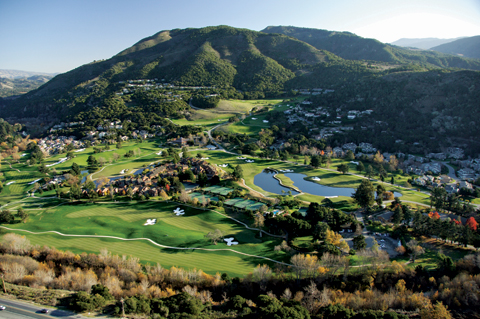
[highlight_text] “I never want golf holes to seem contrived. I use the natural elements of the land to create the ebb and flow of a golf course.” [/highlight_text]
The great Bobby Jones, one of the golfing world’s all-time legends, best summed up the omnipresent challenge of golf with one succinct statement:
“Golf is assuredly a mystifying game. It would seem that if a person has hit a golf ball correctly a thousand times, he should be able to duplicate the performance at will. But this is certainly not the case.”
A simple truth, yes, but it matters more when Bobby Jones says it.
Jones, the founding father of the Augusta National Golf Club, home of the Masters Tournament and the U.S course with arguably the greatest sense of history and tradition, didn’t limit himself to only becoming the greatest player of his generation. After his retirement, Jones was one of the first golfers to transition from his career on the greens to a career in designing them. He was instrumental in attracting Dr. Alister Mackenzie, a Scotsman who is one of the world’s most influential course architects, to serve as the head designer of Augusta National.
While Jones’ oft-repeated pronouncement about the difficulty of golf deals directly with the golfer’s ability to “correctly” connect the club head with that maddeningly small white ball, he could have talked about the other major factor: the shape and overall environment of the golf course itself. This, in reality, might be the ultimate obstacle in golf. Not the striking of the ball, but the movement of the ball across a particular space. With the bunkers and fairways, greens and trees, it is the spectacle of this human-crafted nature that fills the eye and delights-or, when things are going bad, haunts-the golfer’s imagination.
The creation of the golf course, the transformation of “unused” space into an area for the activity that Winston Churchill, borrowing liberally from Mark Twain, said was “the best way to ruin a good walk,” is a combination of heavy-duty landscaping, an ability to work in the subtleties that make a course unique, and, maybe more than anything else, a deep love for, and knowledge of, the game of golf.
In an attempt to unravel some of the mysteries of golf course design, Haute Living had the opportunity to speak with Perry O’Neal Dye, one of America’s top course architects, about the process of creating a golf course. Dye’s experience as a course designer is unique in the sense that it is truly a family business, stretching back almost 100 years. Today, the Dye family name is attached to the design of more than 200 golf courses around the world.
In 1922, Perry Dye’s grandfather started the family tradition by designing and constructing a nine-hole course in Urbana, Ohio. However, it was Perry’s father, Paul “Pete” Dye, who would later go on to design courses around the country, including those pictured in this article, and pursue a successful playing career (he finished ahead of both Jack Nicklaus and Arnold Palmer in the 1957 U.S. Open and was inducted into the World Golf Hall of Fame in 2008), and who gave his son a start in the business when Perry was only 12 years old.
This tutelage continued through Dye’s college years, where he was involved in the development of The Country Club of Colorado in Colorado Springs and the Oak Tree Golf Club in Edmond, Oklahoma. From there, Dye and his father have designed numerous courses together, including the Firethorn Golf Club in Lincoln, Nebraska, the Red Mountain Ranch Club in Mesa, Arizona, and the Fuego Maya at La Reunion outside of Antigua, Guatemala. (The last is the course that Dye is most proud of, for a number of reasons including the fact “the property is in the midst of four volcanoes, two of which are active.”)
Dye credits his family and their shared love of golf as two of the primary guiding principles in his career. “My design philosophy is a direct result of my experience,” Dye says. “A major part of that comes from my mother, who taught me about designing golf courses that are playable for women.” This education continues today, due to his family’s continuing love affair with the game. “With a wife and two daughters who are players, I see how important making golf accessible and fun for women has been to our industry.”
Aside from his design philosophy, Dye prides himself on a direct involvement with the growth of a course from an idea on paper to playable holes on grass. When asked what is the first step in designing a golf course, Dye attests that the only way to start is literally from the ground up.
“For me, I need to really get in touch with the ground I am building on. I never want golf holes to seem contrived. I use the natural elements of the land to create the ebb and flow of a golf course,” Dye says. “After I see how the holes will fit into the landscape, I go back and create a preliminary design base map.”
Although the base map is the basic vision for the overarching course design, this does not mean that it is a static plan. This, Dye argues, is what makes it necessary to possess a different mindset for golf course architecture than any other kind of landscape or building design. “My maps are more guides than they are exact maps,” says Dye. “This is a major difference between course design and other forms of architecture. We can dictate where the holes go, but as things start to take shape, they often change.”
Dye works from the position of a golfer and refutes the idea that golf course design is a largely theoretical proposition, despite the philosophy that underlines all of his designs. “Great inspiration always comes in the field,” he says. “Not in front of a computer.”
The other element of course architecture that Dye stresses is the individual touch. Like when one enters a building designed by Zaha Hadid or Frank Gehry, Dye has a desire to spread the Dye course style. “I want every golfer who steps on one of my courses to instantly know who designed it, and to have a memorable experience,” Dye says. “Whether you play well or terribly, you always remember a Dye design.”
Related Articles
Major Food Group Is Taking Over the Former Tribeca Grill Space — Here’s What to Know
Major Food Group confirms plans to open a new Rich Torrisi-led American tavern and steakhouse at the former Tribeca Grill address, in 2027.
Nordstrom & adidas Launch Nationwide FIFA World Cup 2026 Retail Experience Across U.S. Host Cities
Nordstrom and adidas launch a nationwide FIFA World Cup 2026 retail experience across New York, Seattle, Miami, and more.
Celebrity Trainer Shuichi Take Launches V40, an Elite Fitness Coaching Platform for High-Performing Men
Celebrity trainer Shuichi Take launches V40, a personalized fitness coaching program designed for busy, high-performing men.

LoveShackFancy Leads Buckhead Village’s Big Year: Inside Atlanta’s Big Retail Boom
LoveShackFancy has opened its first Georgia store at Buckhead Village, a 2,100-square-foot space designed to look like a historic French townhouse—powder-pink and cream walls, intricate moldings, pale oak floors, brass rails, and fresh roses. Founded by Rebecca Hessel Cohen in 2013, the New York label built its following on a romantic, vintage-inspired look heavy on […]
Piccolo MORINI Returns to SoHo with Handmade Pasta, Signature Cocktails, and a Reinvented Legacy
Piccolo MORINI returns to SoHo with handcrafted pasta, martinis, and a vibrant new take on the iconic MORINI legacy.
Business Owner Strategy Summit: Helping Owners Unlock Value and Maximize Their Exit
BOSS Summit Miami brought business owners together to learn exit planning, tax strategies, wealth preservation, and M&A.
Latest Stories
Trending Articles


Related Articles
Major Food Group Is Taking Over the Former Tribeca Grill Space — Here’s What to Know
Major Food Group confirms plans to open a new Rich Torrisi-led American tavern and steakhouse at the former Tribeca Grill address, in 2027.
Nordstrom & adidas Launch Nationwide FIFA World Cup 2026 Retail Experience Across U.S. Host Cities
Nordstrom and adidas launch a nationwide FIFA World Cup 2026 retail experience across New York, Seattle, Miami, and more.
Celebrity Trainer Shuichi Take Launches V40, an Elite Fitness Coaching Platform for High-Performing Men
Celebrity trainer Shuichi Take launches V40, a personalized fitness coaching program designed for busy, high-performing men.
LoveShackFancy Leads Buckhead Village’s Big Year: Inside Atlanta’s Big Retail Boom
LoveShackFancy has opened its first Georgia store at Buckhead Village, a 2,100-square-foot space designed to look like a historic French townhouse—powder-pink and cream walls, intricate moldings, pale oak floors, brass rails, and fresh roses. Founded by Rebecca Hessel Cohen in 2013, the New York label built its following on a romantic, vintage-inspired look heavy on […]
Piccolo MORINI Returns to SoHo with Handmade Pasta, Signature Cocktails, and a Reinvented Legacy
Piccolo MORINI returns to SoHo with handcrafted pasta, martinis, and a vibrant new take on the iconic MORINI legacy.
Business Owner Strategy Summit: Helping Owners Unlock Value and Maximize Their Exit
BOSS Summit Miami brought business owners together to learn exit planning, tax strategies, wealth preservation, and M&A.
Subscribe to Haute Living
Receive Our Magazine Directly at Your Doorstep
Embark on a journey of luxury and elegance with Haute Living magazine. Subscribe now and have every issue conveniently delivered to your home. Experience the pinnacle of lifestyle, culture, and sophistication through our pages.


Haute Black Membership
Your Gateway to Extraordinary Experiences
Join Haute Black and unlock access to the world's most prestigious luxury events